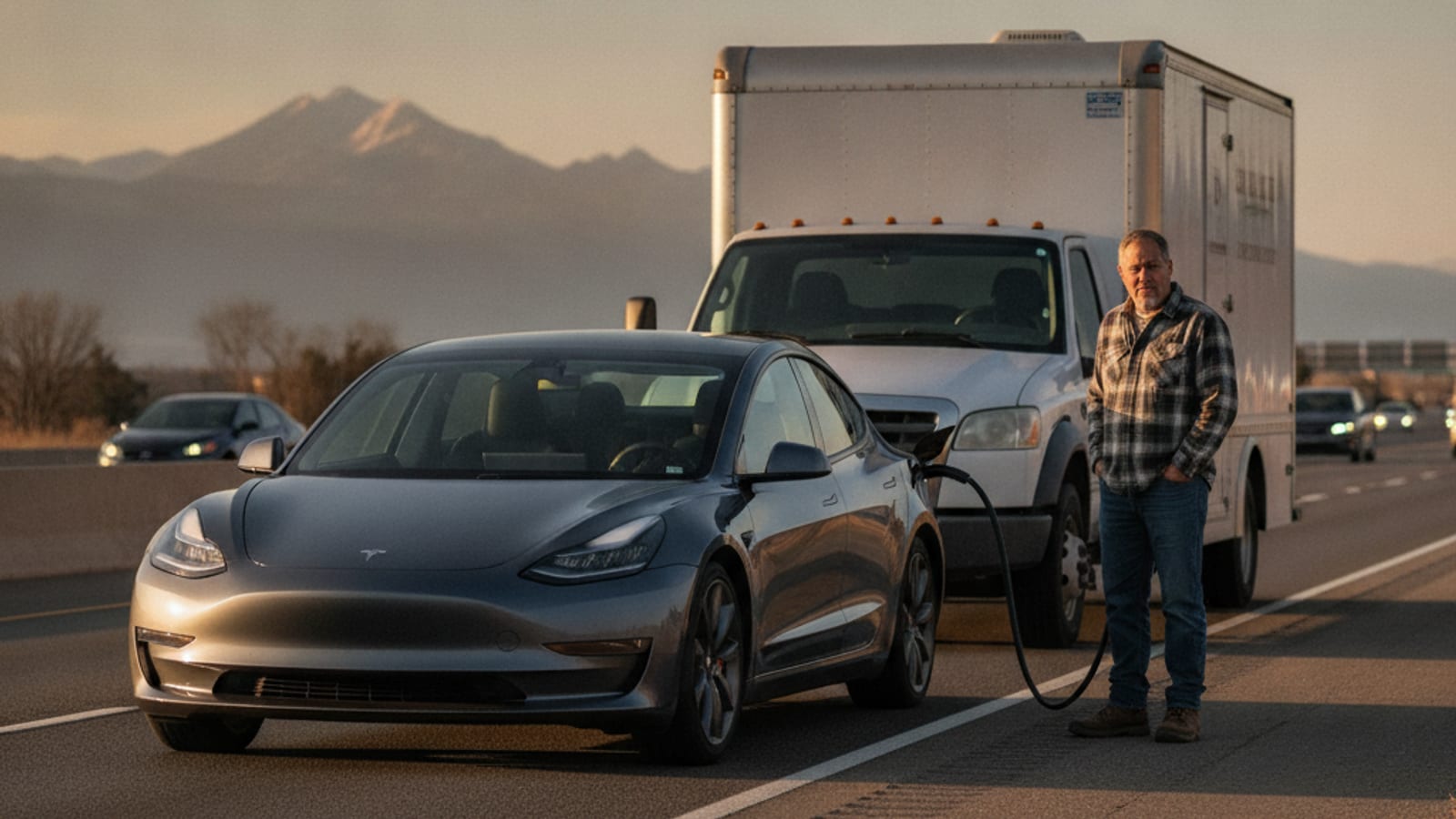
A mobile EV charger truck is a van or pickup with rolling battery storage and a 240-volt Level 2 source. The kit is power storage, an inverter, and a long charge lead with a connector that fits your car. Charge Pro DEN is a referral line for stranded drivers in the Denver metro. We do not own trucks. The operators we refer bring Level 2 to your bumper on a shoulder, in a lot, or in your driveway. They quote you before any cable goes in, and you pay them directly for the work they do. Call (720) 738-6950 when you want that match.
A mobile EV charger truck is not a tow
A tow truck moves the car. A mobile EV charger truck brings power to the car. The point of the visit is to add range in place so you drive away under your own power, not to load the vehicle onto a flatbed. For the broader outcome question, read mobile EV charging versus tow. For an empty pack that has to drive now, use out-of-charge recovery.
The trade is straightforward. A flatbed moves the car to a stall you do not yet occupy. A mobile charge adds range where the car sits, and you finish the trip yourself. Neither result is promised in advance. The operator confirms what they brought and what the car will accept before the cable goes in.
What the kit actually is
A typical mobile EV charger truck carries three things.
First, battery storage. Pack size varies by operator. The energy on board is the energy that becomes range in your car.
Second, an inverter and a 240-volt output. That is Level 2 AC power, the same kind of power a home wall connector or a public Level 2 stall delivers. The truck is a rolling 240-volt source.
Third, a charge lead with the right connector for your car. The operators we refer carry a native NACS plug for Teslas. Other EVs use a CCS adapter or a J1772 adapter. Connector fit is confirmed on the call, before anyone rolls.
You will see phrases like “DC fast charging truck” in marketing. Charge Pro DEN does not publish that as the standard kit. Level 2 AC is the proven rolling source for the operators we refer. It is what adds the range that gets you to a stall under your own power.
What a session looks like in the Denver metro
A driver in Denver, Lakewood, or Boulder runs the pack low on a cold morning. The car still drives but the gauge says 5 miles. The driver pulls into a parking lot or onto a shoulder and calls for help. The operator confirms equipment, price, and timing on the call. They roll to the car, set up behind the bumper, and run the charge lead to the port.
Once the cable is in, charging starts. Charging time is the time the cable is connected, not the time until arrival. A typical rescue session adds 10 to 20 miles of range in 15 to 30 minutes of charging. That is the donor brand figure for Level 2 on a shoulder, and it is the figure the operators we refer work to. Your car, your pack temperature, and the operator’s hardware all shape the real number. The clock starts when the cable goes in, not before.
For a driver stuck at the bottom of Evergreen after dark on SH-74, that 10 to 20 miles is the difference between a slow creep home and a safe turnaround back to the metro. For a Denver apartment dweller who street-parked through a freeze, that range is a drive to the next open stall. For a Longmont commuter who miscounted the last charge on the Diagonal, that range is a safe pull into the driveway.
Who brings the kit
The operators we refer are independent local businesses. They own their trucks. They carry their own insurance. They quote the visit before any cable goes in. They bill the driver directly. Charge Pro DEN does not employ them, train them, or publish their hours. We match you with one who can take the call.
This matters in the Denver metro because the corridors are spread out. A driver stuck on I-70 near Idaho Springs, at the bottom of a US-285 climb, or on the shoulder of E-470 east of Aurora needs a different operator than someone in Centennial or Westminster. The match is local. The quote is local. The arrival window is local.
What the kit is not
It is not a tow truck. If the car cannot roll, the right tool is a flatbed, not a charge lead. A bent suspension, a flat tire, or a damaged pack housing is a tow question. Operators we refer will tell you when the job is a tow and not a charge.
It is not a DC fast charger. Level 2 AC adds range in tens of minutes. DC fast charging adds range in tens of minutes at much higher power. Most mobile trucks in the metro roll Level 2 hardware because it is the proven rolling solution for the pack voltages and connectors on the road today. If you specifically need DC fast charging on a shoulder, ask the operator what they carry. Charge Pro DEN does not publish DC fast as a default mobile kit.
It is not a club membership. Charge Pro DEN is a referral line, not a roadside program. There is no annual fee, no covered services list, and no dispatch promise. You call when you need help. The operator quotes. You pay them for the visit.
What you do before the truck rolls
If you still have phone battery and a few minutes, work through this list.
First, turn your hazards on. CRS 42-4-230 requires hazard lights on a disabled vehicle. Stay visible to traffic. Stay in the car if that is the safer choice.
Second, get to the shoulder. CRS 42-4-1202 says you may not stop on the paved main-traveled part of a highway. The exception is a vehicle so disabled it cannot be moved off. If you can roll to the outside shoulder, do it.
Third, confirm your connector. Tesla uses NACS. Most non-Tesla EVs use CCS, with some older or Japanese models on J1772. The operator needs the right adapter. Tell them your make, model, and year on the call.
Fourth, do not assume any other program will bring a charge. CDOT Safety Patrol does not publish an EV charging service on its menu. AAA roadside for Colorado was not confirmed by this page to bring an on-site EV charge. Tesla roadside and other OEM programs run their own coverage rules. None of these is a guaranteed Level 2 visit.
For the breakdown-versus-12-volt call, read Tesla looks dead, empty pack or 12-volt. The split matters because a charge truck is the right tool for an empty pack, and a 12-volt jump is the right tool for a dead 12-volt. Some operators we refer can do both. Confirm what the job is when you call.
Cold weather and the Denver metro
Cold shrinks the usable range in every EV on the road. Recurrent Auto studied more than 30,000 U.S. EVs in winter. At 32 degrees, EVs kept about 78 percent of max range. At 20 degrees, that drops to about 70 percent. AAA published a separate figure of about 39 percent loss at 20 degrees. The exact numbers depend on the car, the heat pump, and how the driver uses the cabin heater, but the direction is the same: cold eats margin.
That matters on a mobile EV charger truck visit because the pack the operator is charging is already cold. Cold packs accept charge more slowly than warm ones. A cold-soak rescue session adds real range, but it adds it more slowly than the same session in July. Plan for the longer end of the time window in winter.
Cold also kills the 12-volt battery. A car that sat through a Denver freeze may look completely dead when the traction pack still has 40 percent. The 12-volt runs the computers, the contactors, and the door locks. When it dies, the whole car looks finished. Operators we refer jump 12-volts on site. They can replace one on site when the job calls for it. Confirm the symptom on the call so they bring the right kit.
For the metro cold-weather split, read Tesla 12-volt warning signs before you get stuck and Rivian R1T or R1S won’t start in the cold.
Mountain corridor, airport lot, or city street
The Denver metro has three different stranding patterns, and the kit matters in all three.
In the city and the inner ring, the typical call is a cold-morning no-charge in a lot or on a street. Over half of Denver’s housing predates 1980, and that pattern repeats in Wheat Ridge, Edgewater, and Englewood. A driver without a home plug runs out of margin faster than the trip meter predicted. A mobile charge adds the range to reach the next open stall.
In the foothills and on the I-70 Mountain Corridor, the typical call is a climb that ate the margin. A driver who left the metro with a comfortable buffer can watch it vanish between Golden and Idaho Springs, or up SH-74 toward Evergreen. Idaho Springs is the last confirmed Tesla Supercharger before I-70 climbs to the Eisenhower-Johnson Memorial Tunnel. Georgetown in between shows no Supercharger in the current inventory. A mobile Level 2 boost at the bottom of the canyon can save the day.
At the airport and on the eastern plains, the typical call is a week in a lot. An EV left at DEN for a week in January returns to a car that will not wake, usually a dead 12-volt, not an empty pack. A jump solves that, and a charge truck with 12-volt capability handles both symptoms on the same visit.
For the long-haul I-70 piece, read EV roadside assistance in Georgetown for a Model Y. For the city-side commute question, read mobile EV charging near me in the Denver metro.
A mobile EV charger truck versus a personal portable charger
Some EV owners carry a small portable charger in the trunk. Those are typically Level 1, 120-volt devices that add a few miles of range per hour. They are meant for overnight trickle charging at a cabin or a relative’s house, not for emergency rescue on a shoulder.
A mobile EV charger truck carries commercial-grade Level 2 hardware and significant battery storage. The power is much higher. The session adds real range in a real window. A personal portable charger is a top-off tool. A mobile charger truck is an emergency rescue tool.
For the Level 1 versus Level 2 question through a Denver winter, read is a Level 1 charger enough through a Denver winter.
When the right answer is still a tow
A charge truck does not straighten bent metal. If the car cannot roll under its own power, the right answer is a tow to a shop or to a stall you can wait on. A failed 12-volt can sometimes mask a deeper pack problem. A physical collision is a tow question. Confirm with the operator on the call when the job is a tow and not a charge.
Colorado’s towing rules still apply. CRS 42-4-1803 sets the abandoned-vehicle standard on officer discretion, not on a fixed clock. The Colorado Public Utilities Commission regulates towing carriers. Exact tow fee figures are not part of this page.
How to call
If your EV is dead on a shoulder or stuck in a lot in the Denver metro, call (720) 738-6950. Tell us the make, model, and year. Tell us where you are. We match you with an independent operator who carries the right connector for your car. The operator quotes you before they start. You pay them for the visit. Charge Pro DEN does not set the price. We do not promise an arrival window. We connect you with a local operator who does the work.
The kit is a 240-volt Level 2 source with a NACS, CCS, or J1772 lead. The session adds enough range to drive to the next stall under your own power. That is what a mobile EV charger truck is, and that is what the operators we refer bring.
Frequently asked questions
What does a mobile EV charger truck actually bring?
A mobile EV charger truck brings battery storage, a 240-volt Level 2 inverter, and a charge lead. The lead has a NACS plug for Teslas or a CCS or J1772 adapter for other EVs. The operators we refer carry Level 2 AC as the standard kit. Connector fit is confirmed on the call before the truck rolls.
How many miles does a mobile EV charger truck add?
A typical session adds 10 to 20 miles of range in 15 to 30 minutes of charging, once the cable is in. Cold packs and cold weather slow the rate. The operator confirms what the actual session looks like on the call. The clock starts when charging starts, not before.
Can a mobile EV charger truck charge a Tesla?
Yes. The operators we refer bring a native NACS lead for Teslas. Tesla uses the NACS connector in North America. The session adds range the same way it does for any other EV on Level 2 AC. For the broader question of what is and is not covered, read Tesla roadside, CDOT patrol, or a local boost.
Can a mobile EV charger truck help a non-Tesla EV?
Yes. Most non-Tesla EVs in the Denver metro use the CCS connector. Some older or Japanese-market models still use J1772. The operators we refer carry CCS or J1772 adapters. Confirm your connector on the call. For non-Tesla coverage across the metro, read non-Tesla EV rescue in the Denver metro.
Is a mobile EV charger truck the same as a tow truck?
No. A tow truck moves the car. A mobile EV charger truck brings power to the car. If the vehicle cannot roll, the right tool is a tow. If the traction pack is empty and the car still drives, the right tool is a mobile charge. Operators we refer will tell you on the call which job yours is.