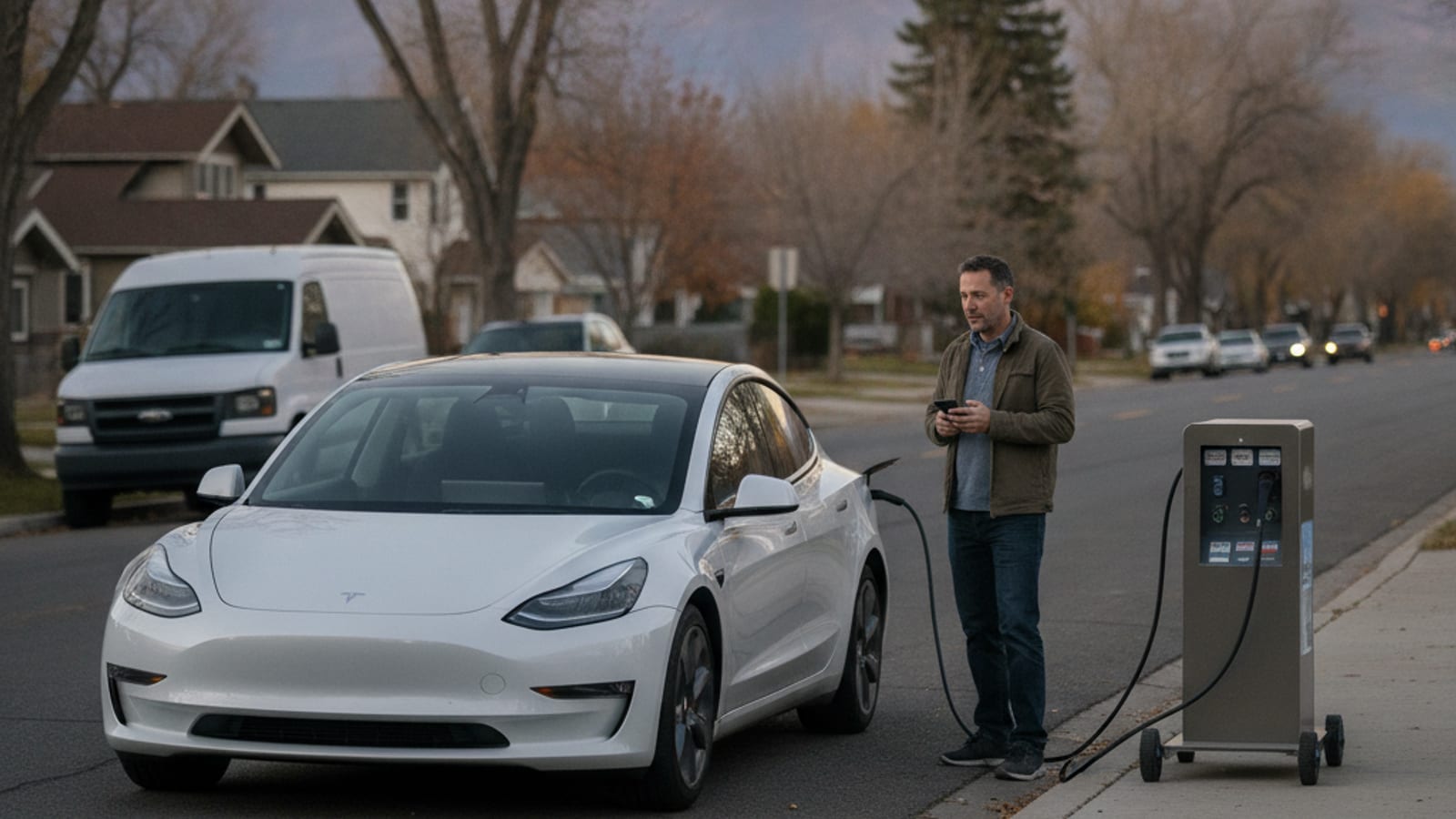
Mobile EV charging near me in the Denver metro means a referral line, not a fleet of trucks we own. Charge Pro DEN is a match service for stranded drivers. When you call (720) 738-6950, we connect you with an independent local operator who brings a 240-volt Level 2 source to your car. The operator quotes you before any cable goes in. You pay them directly for the work they do. We set no price, and we do not promise an arrival time. That is the whole deal.
What “mobile EV charging” actually is
Most drivers search “mobile EV charging near me” because they ran out of charge somewhere they did not plan to. The empty pack on a shoulder, in a parking garage, at a trailhead, or in a long-dwell airport lot is the recurring call. A mobile operator answers it by bringing a portable 240-volt Level 2 source to the car and adding real range while you wait in or near the vehicle. That is a different service from a tow truck, a different service from a roadside jump, and a different service from the OEM’s own roadside program.
Charging time depends on your state of charge, your pack size, your onboard charger, the equipment the operator is rolling, and how much power the outlet or battery source can deliver. The range added is real and usable, enough to get you to a public stall or to your own charger. It is not a full charge. Treat it as a rescue boost that ends the stranding, not as a replacement for a home or workplace charger.
If the car is in a travel lane or another dangerous place, call 911 first. Stay visible. Hazards on. Do not stand in the lane. Wait for a shoulder, a lot, or a parking structure before you call for a mobile charge.
How a referral works in plain terms
Charge Pro DEN is a referral line. We do not own trucks, and we do not employ technicians. We do not set prices. We do not quote an arrival window. What we do is match a stranded driver in the Denver metro with an independent operator who can reach the car and put real range back into the pack.
The flow is short. You call (720) 738-6950. We confirm where you are, what you drive, and what happened. We pass the job to an operator in our network. The operator calls you back. The operator confirms equipment, access, price, and timing with you directly. The operator shows up, plugs in, and adds range. You pay the operator. We are not on the truck and we are not on the invoice. We are the match.
This shape matters because it sets clear expectations. No member fee. No subscription. No “we will be there in N minutes” promise from us. The operator owns the equipment, the schedule, and the price. The operator is the party doing the work. We are the phone line that gets you to one.
What the operator brings to your car
The kit on a mobile EV truck is a portable 240-volt Level 2 source with the adapters the metro actually needs. Tesla drivers get a native NACS plug on the lead. Other EVs use a CCS adapter or a J1772 adapter, depending on the car. A skilled operator also carries a 12-volt jump pack, basic PPE, and a way to talk through port problems before anyone reaches for a winch.
Typical charging time adds roughly 10 to 20 miles of range in about 15 to 30 minutes of charging. The clock starts when charging starts, not when the truck leaves. The range added is real, and it depends on your car accepting what the operator is offering. Some cars taper charging at very low states of charge. Some packs reject a charge if the 12-volt is too low to handshake. Talk to the operator about what your car will accept before you sign off on the job.
Mobile EV charging is the umbrella service. If the pack is already at zero and the traction system will not wake, the operator’s first step is often the 12-volt, then the pack. Out-of-charge recovery is the narrow service for the empty-pack scenario.
What a mobile operator cannot fix
A mobile Level 2 charge is not a fix for every reason an EV is stuck. It will not straighten bent suspension. It will not replace a tire. It will not pull a car out of a ditch. It will not bring a pack back from a hardware failure inside the traction system. If the car cannot roll under its own power, the job is a tow, and the operator will tell you that.
It also will not wake a car with a dead 12-volt battery, which is the most common Denver metro no-start in winter. The traction pack can sit at 60 percent and the car still looks dead if the 12-volt is gone. The 12-volt runs the computers, the contactors, and the door locks. Without it the car will not handshake with the charger. A mobile operator carries a 12-volt jump pack and can put a fresh 12-volt on a car on the shoulder or in a lot. That is a separate task, and it is usually billed as such. Read Can roadside jump an EV 12-volt for the full split between the two systems.
A frozen charge port is another call that looks like charging but is actually a latch. Operators handle stuck ports for most major EV brands, including Tesla, before anyone reaches for a tow. If the operator confirms the port will not release, the answer is a flatbed, not a longer charge session.
Where Denver geography changes the answer
The Denver metro is a high plain at roughly 5,280 feet that tilts up on its west edge into the Front Range. That tilt is the whole story for an EV driver. From Denver the plains run east to Aurora, Watkins, and Bennett, where services thin toward Kansas. From Golden west, US-6 climbs into Clear Creek Canyon toward Idaho Springs, which is the last Tesla Supercharger before I-70 climbs to the Eisenhower-Johnson Memorial Tunnel. Georgetown, sitting in between on the climb, shows no Supercharger in the current inventory. A driver who reaches Idaho Springs low, in winter, with a heater running, faces the biggest range question on the whole site.
Recurrent Auto studied more than 30,000 U.S. EVs in winter. At 32 degrees, EVs kept roughly 78 percent of max range. At 20 degrees, retention dropped to about 70 percent. AAA’s 2026 dynamometer study put loss at about 39 percent at 20 degrees. Cold is why a morning buffer vanishes on I-70 west of Golden, on US-285 up to Aspen Park, and on SH-74 up to Evergreen. It is not a reason to guess the next charger.
The good counterpart on the descent: regenerative braking returns a real share of what the climb spent. A Lucid Air GT used about 3 percent of its battery over a 77-mile descent from Loveland Pass. A Hyundai Ioniq 5 used about 10 percent over a 75-mile descent from the same area. Drivers often dial regen down on icy descents for traction, so the exact number varies with conditions. The point stands: a climb that looks grim on the meter often ends with more range in the pack than the math predicted.
What CDOT Safety Patrol will and will not do
CDOT Safety Patrol is free on listed Front Range metro and regional freeways. The published coverage includes segments of I-25 South, I-70 East from Wadsworth to Airport Boulevard, portions of US-6, C-470, and I-225, and the I-70 Mountain Corridor from Morrison to Vail. The published Front Range metro weekday windows are 6:00 to 9:30 a.m. and 2:30 to 7:00 p.m. Weekend hours run 10:00 a.m. to 7:00 p.m.
The published menu is tires, jump-starts, emergency fuel, minor mechanical help, debris removal, and incident support. The Safety Patrol page and CDOT’s breakdown page do not mention electric vehicles. That silence in state guidance is the answer to a real question: the free state patrol can wake a dark 12-volt, and it can put air in a tire. It does not bring a charge to the traction pack.
On E-470, the answer is *470. E-470 publishes free roadside assistance that covers flat tires, fluid top-offs, jump-starts, phone help, and debris removal. *CSP, which is *277, reaches Colorado State Patrol. E-470 does not publish an EV charging service.
When a tow is still the right tool
A roadside charge adds range. A tow moves the car. The two solve different problems, and the operator on the phone will tell you which one you actually need.
CRS 42-4-1202 covers a disabled vehicle on a highway. You may not stop on the paved main-traveled part of a highway, with the exception of a vehicle so disabled it is impossible to avoid stopping and to move it off the roadway. Hazards must be on under CRS 42-4-230. Read the statute as a permission to wait on the shoulder with hazards on when the car cannot move, not as a permission to wait in a travel lane.
If the car must reach a specific shop, a charge may delay the hook. If the car cannot roll, a charge will not help. If the pack is empty and the car is otherwise fine, a mobile EV charging referral is the faster path back to driving.
How to call from a Denver shoulder or lot
Put your hazards on and stay visible to traffic. Stay in the car if that is the safer choice. If you are on a listed CDOT Safety Patrol segment during posted hours, that free jump is for a dark 12-volt, not an empty pack. Skip the wait when the gauge was already at zero.
For an empty pack or a car that will not handshake, call (720) 738-6950. We serve the Denver metro from the plains to the foothills, including Lakewood, Centennial, Boulder, and the long-haul corridors up to Evergreen and out to Bennett. The operator we refer quotes you before any work starts. Treat the call as a referral number, not a promise.
For a longer coverage comparison, read Tesla, AAA, and a local mobile rescue. That post stays on who covers which script. This one stays on the referral flow and what shows up at the car.
Frequently asked questions
Does mobile EV charging work in Denver’s winter?
Yes. A 240-volt Level 2 source adds real range in the cold, though charging takes a little longer when the pack is cold-soaked. The bigger Denver metro winter pattern is a dead 12-volt battery, which a mobile operator can also jump or replace on site. Confirm your situation on the phone before the truck rolls.
What plug does the operator bring?
Tesla drivers get a native NACS plug on the lead. Other EVs use a CCS adapter or a J1772 adapter, depending on the car. The operator confirms the connector on the call before the truck leaves, so you do not need to translate the spec yourself.
Is this the same as a tow?
No. A mobile charge adds range in place so the car can drive under its own power to a charger. A tow moves the car on a flatbed to a shop, a charger, or a home. An empty pack usually needs a charge, not a tow. A car that will not roll usually needs a tow, not a charge.
Can I just call AAA instead?
AAA may still jump a 12-volt for you, and many empty-pack calls still move as flatbed tows. This page could not confirm a published AAA Colorado policy for on-site EV charging. The operators we refer bring Level 2 to the car, quote you before any cable goes in, and bill you directly.
Will the operator come to the airport lot?
Yes, in most cases. A car left for a week in a cold DEN lot often comes back with a dead 12-volt, not an empty pack. The operator can jump the 12-volt on site so the car wakes, then add range to the pack if you need it. The lot rules vary, so the operator will confirm access with you on the call.