CDOT Safety Patrol will jump a 12-volt battery on the freeway segments it covers. It won’t fill your EV’s traction pack. If you’re asking can you jump start an EV, start with which battery failed. A jump helps a dead 12-volt. It doesn’t refill an empty pack.
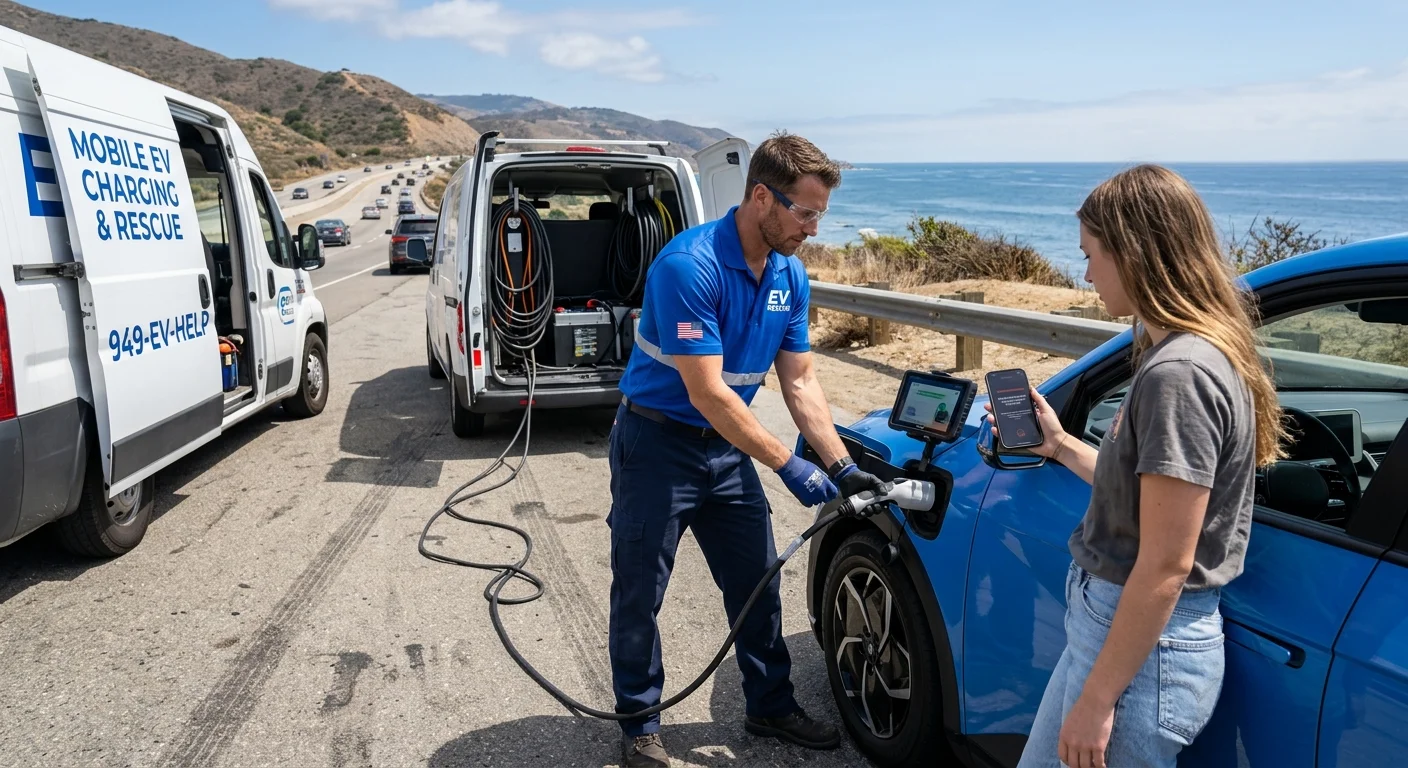
CDOT patrol jumps a 12-volt. It doesn’t charge the pack
CDOT’s Safety Patrol is free on covered metro freeways. Published Front Range hours are 6:00 to 9:30 a.m. weekdays. Afternoon coverage is 2:30 to 7:00 p.m. those same weekdays. Weekends run 10:00 a.m. to 7:00 p.m. The Mountain Corridor from Morrison to Vail has a separate window. That’s 6:00 a.m. to 7:00 p.m. Friday through Sunday. Crews also roll during significant weather on that corridor.
Covered metro stretches include I-25 South from 120th Avenue to Arapahoe Road. They include I-70 East from Wadsworth to Airport Boulevard. Portions of US-6, C-470, and I-225 are listed too.
They list jump-starts, flat tires, emergency fuel, and minor mechanical help. Debris removal and incident support are on that list as well. CDOT’s Safety Patrol page doesn’t mention electric vehicles. Its “my car broke down” page doesn’t either. Neither page names EV charging or a pack refill. That silence was still true on September 18, 2026.
A patrol truck on I-25 through Thornton or Northglenn may still stop. It can jump the 12-volt if that’s what failed. It can’t put driving miles back into the pack. That’s a real hole in the state’s published guidance. COtrip.org and the 511 line post I-70 closures and traction-law status.
Two batteries sit in every EV
Every modern EV carries a traction pack and a low-voltage battery. The 12-volt runs computers, locks, lights, and the contactors that wake the pack. A jump talks only to the 12-volt. It doesn’t pour miles into the pack.
Tesla, Rivian, a Chevy Equinox EV, and a Hyundai Ioniq 5 share that split. The 12-volt chemistry can differ by year. Drivers say “dead” for both failures. That word doesn’t help the operator. Say whether the dash last showed driving range. Read each warning exactly as the screen wrote it. Say whether the displays light and the key is recognized. Say whether the car will enter drive.
If the pack was already at zero, a jump won’t save the trip. You need a charge in place, or a tow. If the pack still showed miles, start with the 12-volt. That’s the case when the car simply won’t wake.
Colorado has no separate statute for a disabled EV. CRS 42-4-1202 treats you like any other disabled vehicle on the shoulder. Stay off the paved travel lanes when you can. Use hazard lights under CRS 42-4-230. A class B traffic infraction is the published penalty for a violation. There’s no EV carve-out in that law.
Cold Front Range mornings hide which one died
Denver’s January normal low sits around 18 degrees. The January 2024 arctic blast dropped Denver from 47 to minus 19. That swing happened in about 48 hours. A car that sat through that often comes back with a sleeping 12-volt. The pack can still hold miles. The same pattern shows up after a week in a DEN parking garage. It shows up after a long dwell at the Denver Tech Center. It shows up after a Red Rocks show when the car sat in the lot. Silence isn’t proof the pack is empty.
Recurrent Auto’s winter study found about 78% of max range at 32 degrees. EVs keep about 70% at 20 degrees, on average. That’s range loss in the pack. It isn’t the same failure as a 12-volt that won’t close the contactors.
If a Tesla or any major EV won’t unlock after a cold sit, say so. If range hit zero on I-70 toward the airport, that’s an empty pack. Those two calls need different trucks.
Give the model, the message, and the mile marker
Before you call anyone, collect facts you can see. Don’t open battery covers. Don’t follow a jump diagram written for another car. Give the full make, model, and year. “Tesla” isn’t enough. A Model 3 lithium 12-volt isn’t the same job as older lead-acid. A CCS or J1772 car needs the right adapter for a charge.
Read every warning word for word. Say what happens when you press start. Name the road: I-25 South near Arapahoe Road, or I-70 East toward Airport Boulevard. C-470, I-225, and US-36 need the same precision. On the I-25 North and US-36 Express Lanes, CDOT built an 8-foot outside shoulder. Move to that right shoulder. Don’t sit in a travel lane.
Say if you’re behind a gate, in a garage, or on a freeway shoulder. Access decides whether a jump, a Level 2 charge, or a tow even fits. Peña Boulevard is city-maintained, and it’s the only road into DEN. It sits exposed across the plains. A silent car after a week in a DEN lot is often a 12-volt case. That isn’t automatically an empty pack.
For the procedure on your exact car, the owner’s manual is the authority. Our guide to jumping an EV 12-volt in the cold gives metro context. It doesn’t replace the pages written for your VIN.
A jump is the wrong ask for an empty pack
Ask for a jump only when the symptoms point at the 12-volt. An empty traction pack needs a different truck. CDOT Safety Patrol won’t bring a 240-volt source.
E-470 is its own road. Pull to the shoulder and dial *470 for the Authority’s free help. That list is jump-starts, flats, fluids, a phone, and debris. Dial *CSP (*277) for Colorado State Patrol. E-470 publishes no EV charge and no pack refill. A jump on E-470 is still a 12-volt jump.
If you smell smoke, see heat, or just hit something, say that first. Don’t call those details a battery diagnosis. They change whether anyone should connect cables. A low-clearance garage off Capitol Hill is a different job from an open shoulder.
If the pack is empty, the operator can bring 240-volt Level 2 to the car. Operators bring a native NACS plug for Teslas. They use a CCS or J1772 adapter for other brands. That typically adds 10 to 20 miles of range. That’s in 15 to 30 minutes of charging. That’s charging time, not a promise of when someone arrives. The operator quotes you before work starts and bills you directly.
Who wakes the car, and who puts miles back
Charge Pro DEN is a referral line. We match stranded EV drivers with independent local mobile rescue operators. We don’t hold a trade license. We set no prices, and we publish no hours.
You describe the car and the symptoms. We pass that to an operator who can review the job. That may be a 12-volt jump or an on-site 12-volt replacement. It may be a Level 2 charge or a tow. You’ll contract with that operator, not with us.
Read our note on which EV battery matters at the roadside. Use it when you aren’t sure which system failed. If the pack is empty, start with out-of-charge recovery or mobile EV charging. For a Tesla that won’t wake, Tesla 12-volt jump service is the 12-volt path. For a CCS or J1772 car, see non-Tesla EV rescue. Compare Tesla roadside, CDOT patrol, or a local boost for who does what.
Colorado State Patrol handles crashes, enforcement, and abandoned-vehicle calls under CRS 42-4-1803. Abandoned is an officer’s judgment, not a published hour count. Don’t wait on a rumor of a fixed clock.
Call when the car won’t ready and you need a mobile operator. Have the year, model, warning text, last range shown, and a precise location. If you’re on a covered CDOT segment during published hours, flag Safety Patrol. They can still jump a 12-volt. Don’t expect that truck to charge the pack. If the pack is empty, you need a different kind of help. The same is true off those segments, or outside those hours.
Call Charge Pro DEN at (720) 738-6950. We’ll connect you with a local EV rescue operator. Confirm the work and the quote with that operator before anything starts.