You came back to a silent EV after a cold sit. What matters is which EV battery type failed. That’s the small 12-volt, or the traction pack that stores your miles.
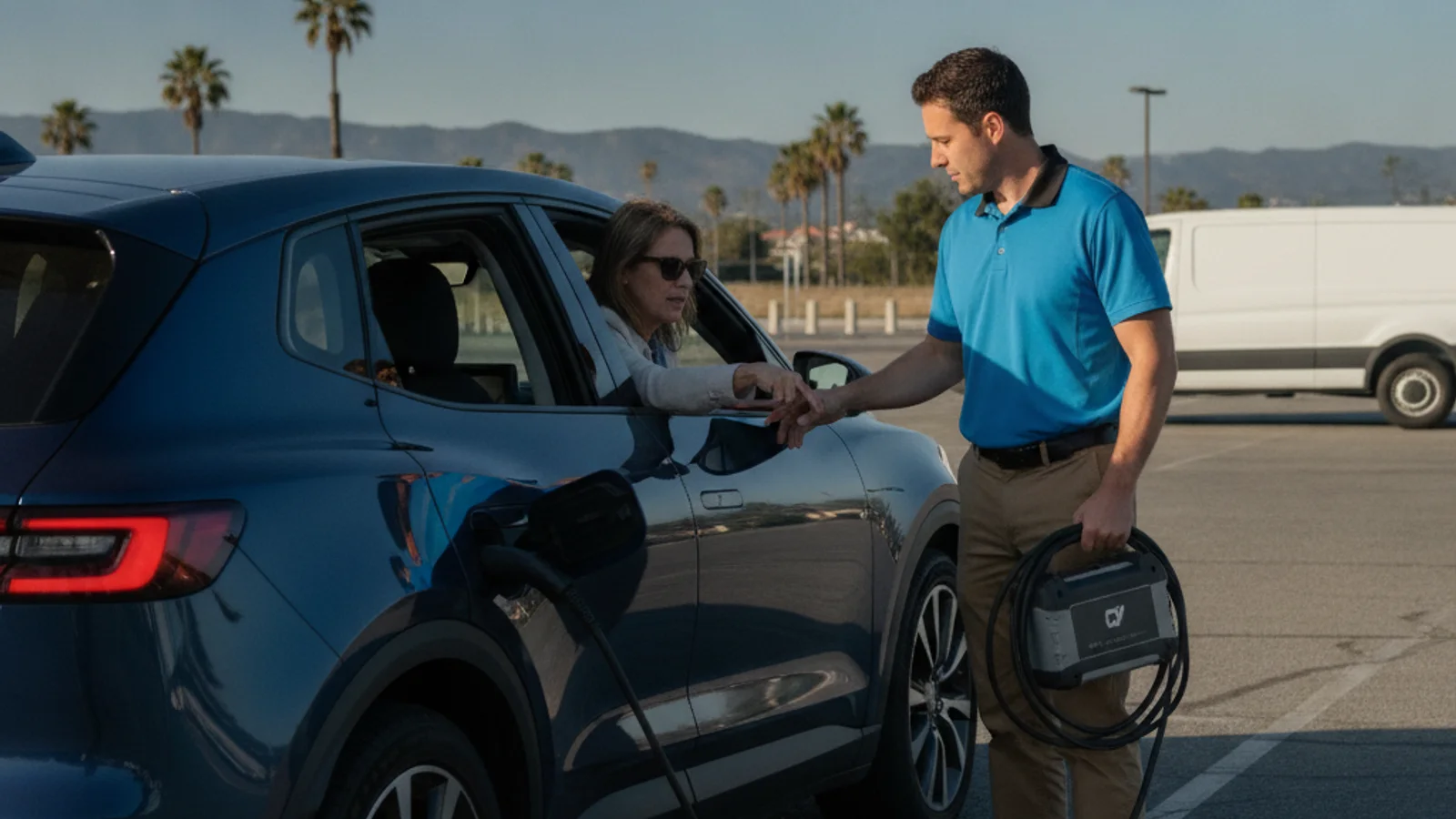
Two systems fail for different reasons
Every EV carries a traction pack and a 12-volt battery. They don’t fail the same way in Front Range cold. That split is the EV battery types question that actually helps.
The traction pack stores the miles you drive. You fill it at home or at a public stall. When it’s empty, the car may still unlock and light up. You just don’t have energy left to move.
The 12-volt battery runs a different job in the same car. It wakes the computers, locks, lights, and pack contactors. Without it, a full pack can sit unused underneath you. The car still looks completely dead from the curb.
A DEN lot sit isn’t the same as a curb sit
Denver International sits at the end of Peña Boulevard. That’s an 11-plus-mile city-maintained freeway across open plains. A car can sit in a DEN garage or shuttle lot for days.
Charging stall counts for DEN parking were not confirmed here. flydenver.com wouldn’t load a verified inventory for this page. NREL lists a Canopy off-site station with one DC fast port. That listing also shows nine Level 2 ports. Confirm airport charging on site if that option matters to you.
The 12-volt risk is the part we can confirm. A week in a cold DEN lot can leave the car silent. The traction pack may still hold miles when you return. The 12-volt is the system that often won’t wake.
A night on a city street is a different soak. Capitol Hill, the Denver Tech Center, and Park Meadows lots all see long sits. January’s normal low around here sits near 18 degrees. The January 2024 arctic blast was a harsher test. Denver dropped from 47 to minus 19 in about 48 hours.
In that cold, a 12-volt can fail with range still showing. An empty pack means you used the miles, then stopped. One is a wake-up failure, and the other is an energy failure.
Cold range loss is a pack problem
Range loss belongs to the traction pack, not the 12-volt. Recurrent Auto studied more than 30,000 US EVs in winter. Packs keep about 78% of max range at 32 degrees. They keep about 70% at 20 degrees on average. Heat-pump vehicles hold about 10 points more at 32 degrees.
AAA’s 2026 dynamometer study is the other published figure. It found about 39% range loss at 20 degrees. Don’t treat either study as your exact car. Those averages explain a shorter Front Range commute. They don’t explain a dark screen and dead handles. A range hit still leaves a car that unlocks. A dead 12-volt often leaves the cabin dark.
West-side elevation adds a pack cost of its own. Denver’s official mark is 5,280 feet at the Capitol steps. None of that range hit is a 12-volt diagnosis.
Cold parking is what kills the 12-volt
The 12-volt is a small battery with a large wake-up job. Cold slows its chemistry after a long sit. Background draws keep nibbling while you’re in the terminal. Then the contactors never close, and the pack never connects.
Tesla, Hyundai, Ford, and Rivian all carry this system. Jump points and approved steps still differ by model year. Don’t copy a clip filmed on another make.
Teslas still have a 12-volt, even with a huge pack. Our cold-weather Tesla 12-volt note covers that layout. CCS and J1772 cars show the same split.
If the app still talks to the car, say so. If handles won’t present and the cabin stays dark, say that too. Don’t assume the pack is empty because the car is quiet. The pack versus 12-volt read walks through those clues.
Read the dash before you call
Bring two facts when you call for help. Name the exact make, model, and model year. Quote the dashboard message word for word, not a summary.
A zero-mile readout points at the traction pack. A black screen or a 12-volt warning points at low voltage. Saying it just died tells an operator almost nothing. A DEN garage sit plus a dark screen tells them much more.
Note what still works before you hang up. Interior lights, the key fob, and the phone app ride the 12-volt. A live app and a car that won’t drive is a 12-volt clue. A car at true zero still often talks to the app.
Pack chemistry can wait until you’re home
Pack chemistry matters when you’re shopping, not tonight. An operator isn’t sorting cell chemistry from the shoulder. They’re sorting an empty pack versus a dead 12-volt.
Charge Pro DEN doesn’t publish pack-capacity figures for any model. We also don’t have verified cell-composition numbers on file. Those figures don’t belong in a roadside decision. Your current owner’s manual is the source for model-specific steps.
Charge, jump, or a ride
Once you know the system, three paths cover most calls.
A charge fits when the traction pack is actually empty. That’s a mobile EV charging call, not a 12-volt fix.
Operators we connect you with bring a 240V Level 2 source. A native NACS plug is typical for Tesla calls. CCS or J1772 adapters cover other major EV brands. That usually adds 10 to 20 miles in 15 to 30 minutes of charging. That’s charging time, and it isn’t an arrival promise.
A jump or on-site 12-volt swap fits a low-voltage fail. The maker has to allow that procedure for your year. Tesla 12-volt jump help is the Tesla version of that stop. Confirm the steps in the manual before anyone clips on.
A tow fits when the cause isn’t confirmed. It also fits when the spot isn’t safe to work. Guessing a charge onto a dead 12-volt wastes the stop. Guessing a jump onto an empty pack does the same.
What a CDOT truck can jump, and what it can’t charge
CDOT Safety Patrol is free on covered metro freeway segments. Published help includes jump-starts, flats, fuel, and debris removal. Coverage includes parts of I-25 South, I-70 East, US-6, C-470, and I-225.
Weekday hours run 6:00 to 9:30 am and 2:30 to 7:00 pm. Weekend hours run 10:00 am to 7:00 pm.
CDOT’s own pages mention nothing about EV charging. The free truck can jump a 12-volt battery. It doesn’t bring a charge to a stranded EV.
E-470’s *470 line is that toll road’s own roadside help. It doesn’t publish a charging service for stranded EVs. Peña Boulevard is a city freeway, not a state patrol default. Our Peña Boulevard out-of-charge note covers that corridor.
CRS 42-4-1202 is the disabled-vehicle shoulder rule in Colorado. Outside a business or residential district, you can’t stop on the paved travel lanes. A genuinely disabled car may sit on the shoulder with hazards on. Colorado doesn’t have a separate statute for a disabled EV.
On I-70 west, check COtrip.org or 511 for closures. Traction law activates by signage, not by a date we could verify.
HB22-1314 requires 24-hour written notice before most private-property tows. Exact tow fees were not confirmed in the sources for this page.
The utility map can wait
Home charging questions wait until the car moves. The metro spans Xcel Energy, CORE Electric Cooperative, and United Power. Longmont Power and Communications is the city’s own utility. CORE covers Castle Rock, Parker, and the south Douglas corridor. Thornton, Westminster, Arvada, and Broomfield split street by street. Confirm the utility by address when you’re home. Don’t assume Xcel from the city name on the sign.
When to call
Call when the EV won’t wake or won’t take a charge. Charge Pro DEN is a referral line for stranded EV drivers. We match stranded drivers with independent local operators. We don’t own trucks, and we don’t employ technicians. We don’t set prices, promise an arrival window, or publish hours. The matched operator quotes you before work starts. They bill you directly after you accept the quote.
Say the make, model year, and the exact warning. Say whether this was a DEN lot, a street sit, or a freeway shoulder. If you’re not sure which system failed, say that. An honest unknown beats a wrong diagnosis on the first call.
For the roadside decision itself, start with EV roadside assistance. Call (720) 738-6950 and we’ll connect you with a local operator.