A 240 volt EV charging station is home Level 2 on a dedicated circuit. It doesn’t rescue a car already sitting on a Denver street. It also doesn’t help on a metro shoulder. Older apartments near the Capitol often have street parking. Many stalls have no assigned 240-volt plug. A cold morning then becomes a mobility problem, not a remodel.
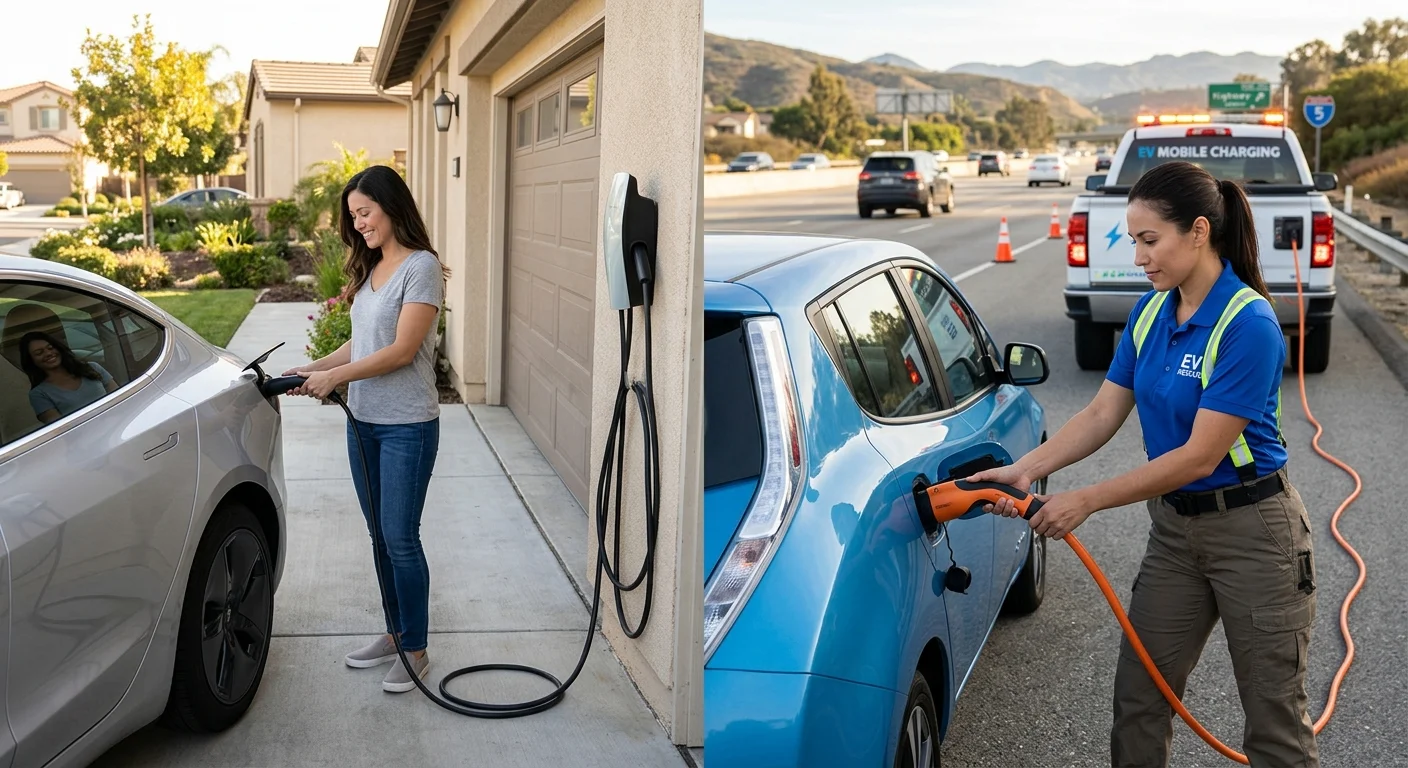
Home 240-volt charging is a building problem
The US Department of Energy treats residential Level 2 as 240-volt service. Voltage alone doesn’t set your charging speed. The car, the breaker, and the air temperature all change the result.
A home station assumes a stall you control and time on the clock. A licensed electrician sizes the circuit against the panel and the house load. Charge Pro DEN doesn’t do that inspection. We don’t pull permits or hang wall units. We connect stranded drivers with independent local mobile rescue operators.
Level 1 is a 120-volt outlet that trickles energy overnight. Through a Denver winter, that trickle is often tight. Is a Level 1 charger enough here covers that slower path. A 240 volt EV charging station is the usual home upgrade. It only works if the building lets you have one.
If you plugged in and still woke empty, stay on the house diagnosis first. Your EV was plugged in overnight and still woke empty walks that check. Rescue is for a car that can’t reach a usable source.
Cold mornings in older Denver housing
Denver’s official elevation is 5,280 feet at the west steps of the Colorado State Capitol. NWS Boulder climate normals put the January low around 18 degrees. In January 2024, Denver dropped from 47 to minus 19 in about 48 hours.
Recurrent Auto’s winter study covered more than 30,000 US EVs. At 32 degrees, cars kept about 78 percent of max range on average. At 20 degrees, the average was about 70 percent. January street miles won’t match a summer garage.
That’s why the 240-volt question bites in older apartments. Many buildings predate overnight EV charging as a design feature. You may have street parking, a shared lot, or an unpowered garage. You needed a 240 volt EV charging station on a dedicated stall. You had a curb instead.
A Highlands Ranch garage on CORE is a different 240-volt problem. So is a Castle Pines driveway, or a Golden house near Mines. Those sites can plan a wall unit with the right utility. A Capitol Hill curb can’t borrow that circuit. Your EV died on Capitol Hill with no driveway plug is that bind.
A no-start can still be the 12-volt battery. That small battery wakes the computers and the contactors. A week in a cold lot at Denver International can flatten it even when the pack still holds energy. A jump or an on-site 12-volt swap isn’t a pack fill.
A missing apartment circuit isn’t proof that public charging nearby disappeared. Named sites exist across the metro. The NREL inventory lists Tesla Superchargers at several Denver sites, plus Park Meadows in Lone Tree, Highlands Ranch, Castle Rock, and Idaho Springs. The morning problem is whether your car can reach one.
Colorado’s HOA charging-access statute is CRS 38-33.3-106.8. Read the current text and your association documents before you plan a wall unit. This page doesn’t claim what every HOA must approve. Denver’s permit steps for a home 240 volt EV charging station couldn’t be confirmed from the sources used here. Ask the city’s permitting office before anyone opens a panel.
The utility that serves your stall isn’t always Xcel
An Xcel-only plan fails a large share of this metro. Three utility regimes cover most addresses.
Xcel Energy, the Public Service Company of Colorado, serves Denver, Aurora, Lakewood, Golden, Wheat Ridge, Littleton, Englewood, Sheridan, Cherry Hills Village, and Greenwood Village. It also serves Boulder, Louisville, Superior, Lafayette, Idaho Springs, Georgetown, and Empire. Published program names include EV Accelerate At Home, EV Home Wiring Rebate, Optimize Your Charge, Charging Perks, the RE-TOU rate, the Residential EV Rebate, and the Public Charging Acceleration Network. Dollar rebate figures aren’t confirmed here. Check Xcel’s current EV pages before you count on a credit.
CORE Electric Cooperative owns the south-metro Douglas County corridor. That includes Centennial, Highlands Ranch, Lone Tree, Parker, Castle Rock, Castle Pines, Roxborough Park, The Pinery, and Stonegate. CORE’s own page says residential COREV Charge is at capacity and closed to new applications. Confirm the live status on core.coop. Don’t call Xcel from those towns.
United Power covers much of the north and northeast. Inside Thornton, Northglenn, Westminster, Arvada, Broomfield, and Erie, it splits streets with Xcel, so confirm the utility by address. United Power is Brighton’s electric provider, and it serves Commerce City as well. Published names include United EV, the EV Make-Ready Wiring Rebate, the EV Home Charge Panel Upgrade Rebate, and the RTD1 time-of-use rate.
Longmont Power and Communications is the City of Longmont’s utility. Charger rebate questions there go to the City, not Xcel.
Who bills a Tesla charge in the Denver metro maps that split for home charging. Panel upgrades for a home EV charger is the electrician path. Neither page is a roadside rescue.
Once the car is on the road, the wall unit can’t help
A 240 volt EV charging station doesn’t commute with you. If you’re on the I-25 shoulder, the house circuit is irrelevant. The same is true on C-470, I-225, and Peña Boulevard toward the airport. Peña Boulevard is city-maintained, and it’s the only road into Denver International. The car still follows the same disabled-vehicle rules as a gas sedan.
CRS 42-4-1202 is that shoulder statute. Outside a business or residential district, you may not stop on the paved main-traveled part of a highway. The exception is a vehicle so disabled it can’t be moved off the roadway, with hazard lights under CRS 42-4-230. There’s no Colorado EV carve-out.
CDOT Safety Patrol is free on covered segments. Those include I-25 South from 120th Ave to Arapahoe Rd, I-70 East from Wadsworth to Airport Blvd, and portions of US-6, C-470, and I-225. The published help list is flat tires, jump-starts, emergency fuel, minor mechanical help, debris, and incident support. CDOT’s Safety Patrol page and its breakdown page say nothing about EV charging. The state truck can jump a 12-volt. It doesn’t bring a 240-volt charge to an empty pack.
On E-470, pull to the shoulder and dial *470 for the authority’s assistance, or *CSP for State Patrol. Published help there is tires, fluids, jumps, phone help, and debris. It isn’t mobile EV charging.
For charging levels at a stranded car, use charging levels that actually help a stranded Denver EV. A mobile Level 2 source is 240-volt power brought to the vehicle. Operators typically use a native NACS plug, plus CCS or J1772 adapters for non-Tesla EVs. They typically add 10 to 20 miles of range in 15 to 30 minutes of charging. That window is charging time, not an arrival time.
Tell the operator the make, model, year, connector, remaining charge, any warning, and the exact pin. Say whether the car can shift or steer. The operator quotes before starting and bills you directly. Charge Pro DEN doesn’t set that price.
A boost in place, or a tow
A roadside 240-volt charge fits when the pack is empty and the car will accept power. You’re buying miles to a stall or back to a plug, not a full home session.
The car may refuse the charge, throw a fault, or sit with a live pack and a dead 12-volt. Adding energy doesn’t clear every message. Check the owner’s manual for the displayed warning. The matched operator decides whether a charge, a jump, or a tow is next.
The mobile EV charging page is the referral path. Charge Pro DEN matches you with licensed, independent local operators. We own no trucks, employ no technicians, and hold no trade license. The operator does the physical work and sets the terms. Rates vary by provider and by stop, and no countywide figure could be confirmed. Ask what equipment they’ll use, what miles they expect to add, and what you’ll pay before they start.
Smoke, fire, a crash, or a live travel lane is a 911 call first. Charging advice waits until you’re out of the hazard.
When to call for a roadside charge
Call when the EV can’t reach a usable charger and you need a local operator to assess a charge, a 12-volt jump, or a tow. A 240 volt EV charging station is the long-term answer for a dedicated stall. It won’t wake a car that sat through an 18-degree night on an unplugged Denver street.
Call Charge Pro DEN at (720) 738-6950 and we’ll connect you with a local EV rescue operator.