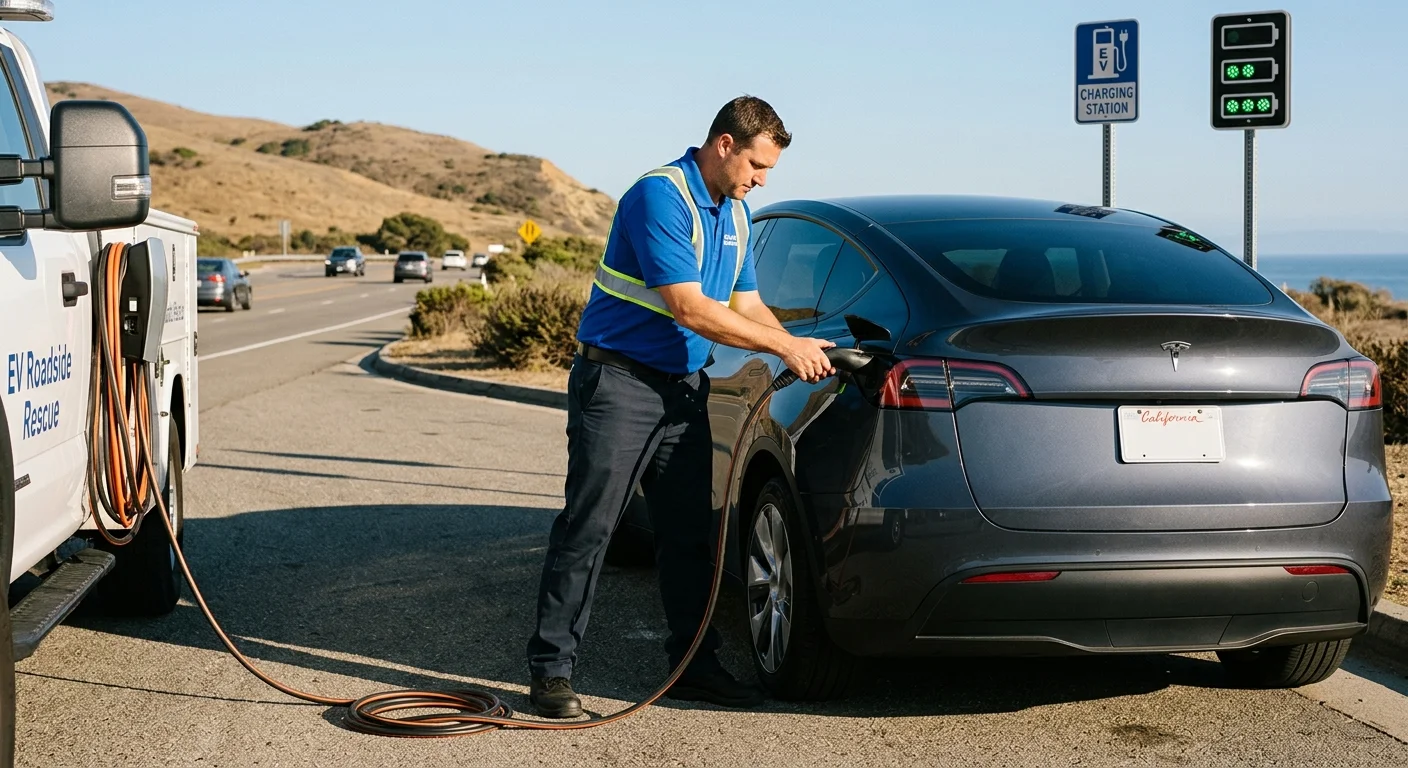
A stranded Denver EV needs 240-volt Level 2 at the bumper. A classroom chart of charging levels won’t move the car. Charge Pro DEN connects you with independent operators who bring that voltage. They typically add 10 to 20 miles of range while you charge. That session often runs 15 to 30 minutes of charging time. It isn’t a promise of when someone arrives.
Voltage, plugs, and speed aren’t the same thing
People talk about charging levels like they’re one spec. Voltage is what the source supplies. The plug is what fits the port. Speed is what the car accepts. Mix those up and you call the wrong help.
Level 1 is 120-volt AC from a regular household outlet. On a metro shoulder, that outlet usually isn’t waiting for you. Even when you find one, the session crawls. Check the manual and the circuit before you trust a random receptacle. Our winter write-up covers whether a Level 1 charger is enough in Denver.
Level 2 is 240-volt AC at a house. Many commercial buildings supply 208-volt AC instead. That’s the voltage a mobile rescue operator brings to you. Teslas take a native NACS plug. Other brands take a CCS or J1772 adapter. The point of the session is usable miles, not a full pack.
DC fast charging is the high-power cabinet most drivers mean by Supercharger, EVgo, or Electrify America. It feeds DC into the pack at a fixed site. If the car already sits at zero, the stall’s peak number is trivia.
Why roadside rescue is a Level 2 job
Mobile EV charging is 240 volts on wheels. The operator confirms the connector first, then quotes, then bills you directly. Charge Pro DEN doesn’t own the truck. We don’t employ the technician or sell you the kilowatt-hours. We match you with an independent local operator. The pros we connect you with are licensed and insured.
Ten to twenty miles is a typical add during that 15 to 30 minutes of charging. Cold packs, a deep discharge, and the car’s charge-acceptance rate all move the result. Ask the operator what their equipment is doing on your car.
If you’ve still got miles, roll to a Supercharger. Another DC fast stall can work too. If you’re already stopped, the stall can’t come to you. That’s when a roadside Level 2 charger is the level that actually helps.
Front Range cold is part of the charging-level story
Denver’s official elevation mark is 5,280 feet on the west steps of the State Capitol. January’s normal low sits around 18 degrees. In January 2024, Denver dropped from 47 to minus 19 in about 48 hours. A pack that was fine at noon can look different at dawn.
Recurrent Auto studied winter range across more than 30,000 U.S. EVs. On average, those cars kept about 78 percent of max range at 32 degrees. They kept about 70 percent at 20 degrees. AAA’s 2026 dynamometer study reported about 39 percent range loss at 20 degrees.
So a January Level 2 session isn’t a July session. The operator still brings 240 volts. The car may simply accept less while the cells are cold.
Climbing toward Evergreen, about 7,200 feet, spends energy on the grade. Idaho Springs sits at 7,526 feet. The Eisenhower-Johnson Memorial Tunnel’s west portal is 11,158 feet. Regen on the descent can return a large share of the climb. Drivers still ease regen on ice for traction. Regen is real, and it isn’t a roadside rescue.
Named DC fast sites, if you can still roll
Tesla Superchargers sit across the metro. An NREL pull on September 18, 2026 listed Denver sites with 6 to 16 stalls. Park Meadows in Lone Tree has 10. Centennial has 12. Highlands Ranch and Castle Rock each have 16. Lakewood has three sites and Boulder has two. Thornton, Northglenn, Westminster, Arvada, Brighton, Longmont, and Idaho Springs appear in that pull. Idaho Springs has 8 stalls. From the Denver side, that’s the last Supercharger before the Eisenhower-Johnson Memorial Tunnel. Silverthorne and Frisco are the first sites past it.
EVgo lists 24 Colorado sites in a complete pull. Electrify America adds more DC fast cabinets around the metro. Check the app before you commit. A queued stall doesn’t help a car that’s already sitting.
A dead 12-volt is not a charging-level problem
A silent car can still have miles in the traction pack. The 12-volt battery runs the computers, locks, and contactors. Leave an EV in a cold lot at Denver International for a week. That small battery is a common failure. Peña Boulevard is the only road in, an 11-plus-mile city-maintained freeway. Stall counts inside airport parking were not independently confirmed here. A dead 12-volt needs a jump or an on-site replacement, not a pack fill.
CDOT Safety Patrol will jump a 12-volt on covered freeway segments. Their pages, read September 18, 2026, mention nothing about charging a stranded EV.
Front Range metro hours are 6:00 to 9:30 a.m. and 2:30 to 7:00 p.m. weekdays. Weekends run 10:00 a.m. to 7:00 p.m. Coverage includes I-25 South from 120th Avenue to Arapahoe Road. It also includes I-70 East from Wadsworth to Airport Boulevard, plus portions of US-6, C-470, and I-225.
If the dash is dark, ask for a 12-volt jump before you assume you need miles. If the car is awake with an empty gauge, you need energy in the pack.
What E-470 and the state will not deliver
E-470 is the cashless eastern loop, run by the E-470 Public Highway Authority. A disabled driver pulls to the shoulder and dials *470. Their assistance covers flats, jump-starts, fluids, phone help, and debris. It doesn’t advertise a traction-pack charge.
There’s no Colorado statute that treats a disabled EV as a special class. CRS 42-4-1202 is the disabled-vehicle-on-the-shoulder rule. Outside a business or residential district, you may not stop on the paved travel lanes. The exception is a vehicle so disabled you couldn’t keep going. Keep hazards on, per CRS 42-4-230.
If you’re already sitting on I-25 with an empty pack, use the I-25 out-of-charge steps. Out-of-charge recovery is the referral path when charging in place is the job.
Match the plug before you argue about kilowatts
Charging level doesn’t pick the connector. J1772 is the older AC plug on many non-Tesla EVs. J3400, also called NACS, is Tesla’s native port. CCS adds DC contacts around an AC inlet. The operators we connect you with bring a native NACS plug. They carry CCS or J1772 adapters for non-Tesla EVs. Tell them the make, the model, and what you see on the port.
The 240 volts in your garage aren’t the 240 volts on the shoulder
Home Level 2 is still 240 volts. Xcel Energy covers Denver, Aurora, Lakewood, Golden, Wheat Ridge, Boulder, and the Clear Creek towns. CORE Electric Cooperative owns the south-metro Douglas corridor. That includes Centennial, Highlands Ranch, Lone Tree, Parker, Castle Rock, and Castle Pines. United Power serves Brighton and Commerce City. It splits streets with Xcel in Thornton, Northglenn, Westminster, Arvada, Broomfield, and Erie. Longmont Power and Communications is the City of Longmont’s municipal utility.
CORE’s residential COREV Charge program is at capacity. It’s closed to new applications, per CORE’s own page. Confirm the utility by address if you live in a split city. Don’t call Xcel from a CORE or United Power street. A garage charger doesn’t reach a car that’s already on C-470 or Peña. What a mobile EV charger brings is the 240-volt source that travels.
What to say so the operator can quote
Give the exact ramp, lot, or street. Say whether you’re on a freeway shoulder, in a garage, or in a driveway. Name the vehicle and read the dash out loud. Say whether the pack shows empty or the car simply won’t ready. If CDOT Safety Patrol is already there, say so. If you’re on E-470, say you already dialed *470. They quote before they start. You pay them, not Charge Pro DEN. We don’t set prices or warrant the work. We don’t publish hours or quote an arrival time.
Keep hazards on and stay out of the travel lane. If the car is a live hazard, call 911 or State Patrol. The port may not latch, or the car may refuse the session. Then the operator should say so, and a manufacturer’s tow beats a guess.
If the pack is empty, 240-volt Level 2 is the level that helps. If the 12-volt is the failure, say that on the call. We’ll connect you with an independent local operator who can talk through both.
Call (720) 738-6950 and we’ll connect you with a local EV rescue operator.