Your range just dropped to zero on I-25. CDOT Safety Patrol can jump a 12-volt and change a tire. The program’s own pages don’t mention EV charging. You need a different call for a dead pack. Start with the shoulder, then sort 12-volt versus empty.
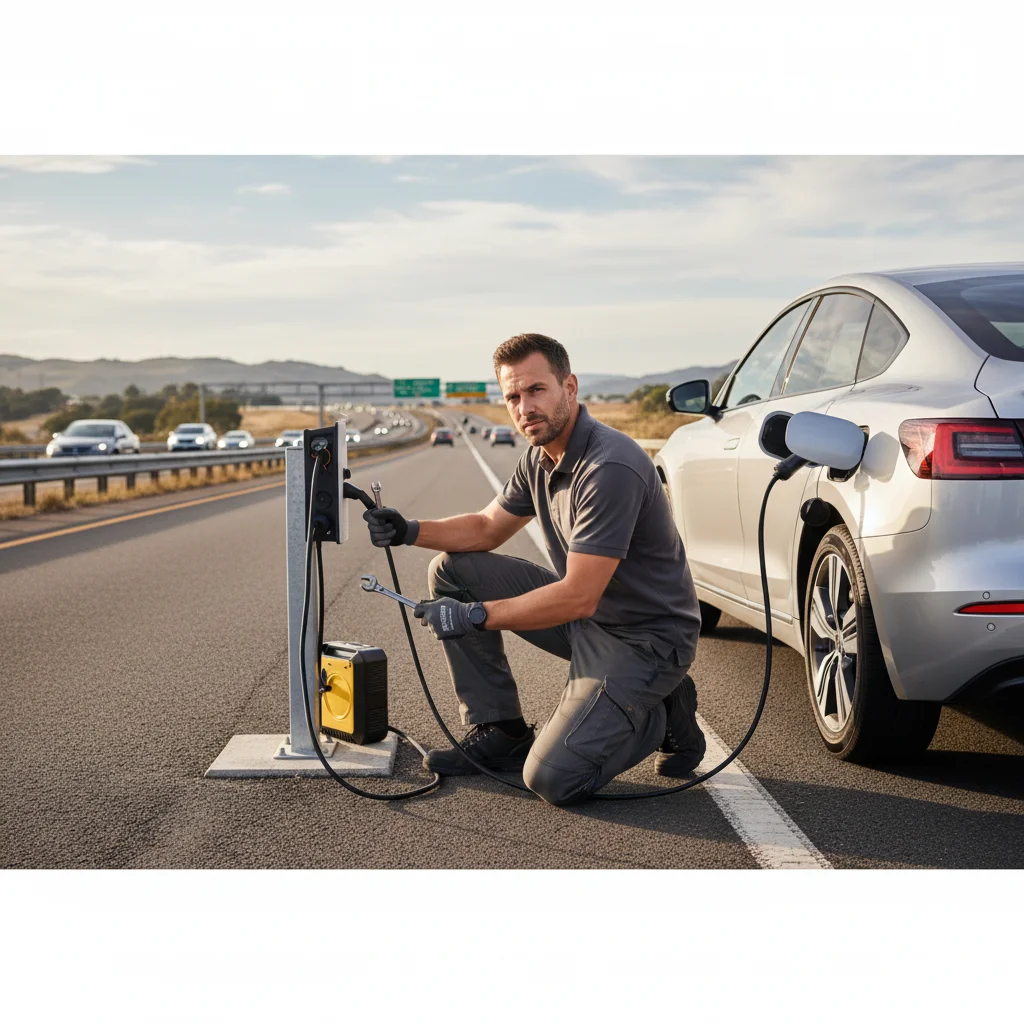
Get onto the right shoulder before you do anything else
Don’t sit in a travel lane hoping for a few more yards. Move right as soon as the car starts to sag. I-25 runs fast through the Tech Center and Castle Rock. A slow EV in a live lane is the hazard.
Colorado’s disabled-vehicle rule is CRS 42-4-1202. Outside a business or residential district, the rule is strict. You’re not allowed to stop on the paved main-traveled part of a highway. The exception is a vehicle so disabled it can’t be moved off the roadway. Hazard lights are required under CRS 42-4-230. If the pack is dead and the car won’t roll, the shoulder is lawful. Keep the hazards on.
Pull as far right as the pavement allows. Hug the barrier if that’s the only extra space. Turn hazards on before you fully stop. Drivers behind you need to see the speed drop.
Leave through the passenger door if you can. The driver’s door opens toward live traffic. Stay between the car and the barrier. Don’t stand in the gap beside the lane.
Don’t walk the shoulder toward an exit. Stay near the vehicle, behind the rear tire. Call 511 or check COtrip.org. Give direction of travel, the last exit, and a vehicle description. Colorado State Patrol handles enforcement and crash response. Logging the stop matters if someone clips the car.
CRS 42-4-1803 doesn’t put a clock on abandonment. An officer decides on reasonable grounds. That statute sets no 24-hour or 72-hour threshold. Move the car when you can, or get a charge so you can.
What Safety Patrol will do, and what it will not
CDOT Safety Patrol is the state’s free roadside program on covered metro freeway segments. On I-25 South, published coverage is 120th Avenue to Arapahoe Road. That run includes downtown Denver and the central spine. It doesn’t include the Douglas County climb.
Published Front Range hours are 6:00 to 9:30 a.m. and 2:30 to 7:00 p.m. on weekdays. Weekends are 10:00 a.m. to 7:00 p.m. If you’re outside those hours, don’t sit there expecting a patrol truck.
They list flat tires, jump-starts, emergency fuel, minor mechanical help, debris removal, and incident support. Their Safety Patrol page says nothing about electric vehicles. CDOT’s “my car broke down” page is silent on charging too. Both were read in September 2026. They can jump a 12-volt. They won’t bring a charge to a dead pack.
If the car won’t ready because the 12-volt is flat, a patrol jump may wake it. If the traction battery is empty, a jump does nothing. You still need energy in the pack. Read the Tesla roadside, CDOT patrol, or local boost comparison. Don’t assume a patrol truck can finish this.
South of Arapahoe Road, I-25 runs through Lone Tree, Castle Pines, and Castle Rock. That stretch is outside the published I-25 South patrol segment. Confirm current coverage on CDOT’s Safety Patrol page or through 511. Don’t assume a truck will roll up on Monument Hill.
North of 120th Avenue, the freeway keeps going through Thornton and Northglenn. The published I-25 South list ends at 120th. Confirm coverage there too. I-25 North Express Lanes were built with a minimum 8-foot outside shoulder. CDOT’s project FAQ says a driver who breaks down moves to the right, outside shoulder. Don’t stop in a toll lane.
I-25 is one spine with three different jobs
North metro, the central city, and Douglas County don’t drive the same road.
South of the Tech Center: home charging, then a hill
Highlands Ranch, Lone Tree, Castle Pines, and Castle Rock sit on CORE Electric Cooperative, not Xcel. Centennial is CORE too. Greenwood Village, next door at the Tech Center, is Xcel. Confirm the utility by address before you blame the car.
Housing on that south spine is new. Highlands Ranch is about 2 percent pre-1980. Lone Tree is under 1 percent. Castle Pines is about 3.7 percent. People charge at home. The stranded call here is the road, not a missing wall outlet.
Lone Tree adds a long-dwell story. Park Meadows is the region’s largest mall. Cars sit there for hours. Sky Ridge Medical Center holds cars all day. Then you merge onto I-25 with less buffer than the dash showed that morning. A Tesla Supercharger at Park Meadows has 10 stalls. Centennial has 12. Highlands Ranch has 16. Castle Rock has 16. Those sites help if you can still roll to them. They don’t help if you’re already on the shoulder.
Castle Pines sits on the ridge at about 6,300 feet, between Lone Tree and Castle Rock. The commute is north to the Denver Tech Center or south over the rise.
Castle Rock is the last metro city before I-25 climbs the Palmer Divide. Town elevation is about 6,200 feet. Monument Hill heads toward the 7,352-foot Divide summit at Monument. Winter storms hit this stretch hard between Denver and Colorado Springs. The March 2019 bomb cyclone closed I-25. Check COtrip before you commit south with a thin pack.
Going south, you spend energy on the climb. Regen on the far descent doesn’t help you until you’re already over the top. That’s the return trip, not the launch from Castle Rock. The Outlets at Castle Rock are a long dwell, then a southbound merge toward that hill.
CORE’s residential COREV Charge program is at capacity and closed to new applicants. COREV Connect is a separate enrollment for connecting an EV or charger to CORE’s platform. Confirm your address on CORE’s service-area page. Don’t call Xcel from Castle Rock.
For the climb itself, the Castle Rock I-25 rescue page is the local companion.
Through Denver and the Tech Center
The central stretch is stop-and-go around the interchanges, then a faster run past Greenwood Village. Arapahoe Road is the south edge of the published Safety Patrol I-25 segment. If you stall near that interchange, a patrol truck may still help. That’s for a 12-volt jump. It still won’t charge the pack.
Greenwood Village and the Denver Tech Center are long-dwell territory after work. A car that sat in a garage all day can look dead for two reasons. The 12-volt may have dropped. Or the pack may actually be empty. Those are different jobs. Sort them before you ask for a flatbed.
North toward Thornton and Northglenn
North of downtown, I-25 is the commute through Northglenn and Thornton. 120th Avenue is the north end of the published Safety Patrol I-25 South segment. Broomfield is its own city and county, with I-25 on the east side. United Power and Xcel split some north-metro streets. Confirm the utility by address. Don’t assume Xcel.
Superchargers exist in Thornton and Northglenn. They help if you can still drive. If you’re already on the shoulder, you need a charge brought to the car. Or you need a tow you then have to charge after.
I-25 North Express Lanes add courtesy-patrol presence, per CDOT’s project FAQ. That still isn’t an EV charge. Get to the outside shoulder. Then make the same 12-volt versus pack call.
The I-25 north metro shoulder guide covers that stretch in more detail.
Empty pack or a dead 12-volt
A lot of “out of charge” calls aren’t an empty pack. The 12-volt runs the computers, contactors, and door latches. In Front Range cold it can drop overnight. Denver’s January normal low sits around 18 degrees. The January 2024 arctic blast took Denver from 47 to minus 19 in about 48 hours. Recurrent Auto’s winter study found EVs keep about 78 percent of max range at 32 degrees. They keep about 70 percent at 20 degrees, on average. Heat-pump models held about 10 points more at 32.
If screens are dark and handles don’t work, start with the 12-volt. Safety Patrol can jump that on a covered segment, in published hours. A local operator can jump it or replace it on site. If the car is awake and the range says zero, that’s a pack problem. A jump won’t fill it.
Operators in the Charge Pro DEN network bring a 240-volt Level 2 source to the car. Native NACS for Tesla. CCS or J1772 adapters for other brands. Typical add is 10 to 20 miles of range in 15 to 30 minutes of charging. That’s charging time, not a promise of when someone arrives. Enough to leave the shoulder and reach a site you can actually use.
Mobile EV charging is that in-place boost. Out-of-charge recovery is the same idea when the gauge is already at zero.
If you still have a sliver of range, take the next exit and wait in a lot. A parking stall is safer than a live shoulder. Southbound at Castle Rock, look at the grade ahead before you try to stretch it. The Palmer Divide doesn’t give those miles back until you’re over the top.
Charge on the shoulder, or call a tow
A tow is the backup a lot of drivers picture first. On I-25, ask what you actually need.
Most EVs need a flatbed if they must be towed. Dolly tows can stress AWD hardware and regen systems. A flatbed takes you off the freeway. It doesn’t put energy in the pack. You still need a charge at the drop. Colorado has no statute that treats a disabled EV differently from any other disabled car. CRS 42-4-1202 still governs the stop.
The Colorado Towing Bill of Rights (HB22-1314) regulates nonconsensual tows. The Colorado Public Utilities Commission regulates towing carriers. Exact tow prices aren’t something this page can publish. They change by carrier and by mile. Confirm them with the company before the hook goes on.
A mobile charge leaves you with a car that can move. The operator quotes you before starting and bills you directly. Charge Pro DEN doesn’t set that price. We connect you with the independent operator. Charge in place or tow walks through that choice.
What to tell the operator from I-25
Charge Pro DEN is a referral line for the Denver metro. We don’t own trucks. We don’t employ technicians. We match you with independent local mobile rescue operators. The operator quotes before the work starts.
Have this ready:
- Northbound or southbound
- Last exit or a milepost
- Year, make, model, and color
- Whether the car is still awake
- Pack percent, if the screen still shows it
- Whether you think it’s a 12-volt or an empty pack
That lets the operator bring the right connector. Native NACS, plus CCS and J1772 adapters.
There’s no Colorado law that creates a special EV breakdown service. You’re under the same shoulder rules as a gas car. Emergency fuel on a Safety Patrol truck doesn’t help a pack.
If traction law is up, you’ll see it on highway signs and on COtrip. CDOT can require AWD or winter tires, or chains in a severe storm. Monument Hill is where that call gets real in winter. Don’t treat a low pack and a traction-law posting as two separate problems. They’re the same afternoon.
Frequently asked questions
Does CDOT Safety Patrol bring a charge to an EV on I-25?
No. The published program covers jumps, tires, emergency fuel, and similar help on listed segments. I-25 South is listed from 120th Avenue to Arapahoe Road. The pages don’t mention EV charging. A dead pack needs a mobile Level 2 boost, or a tow to a charger you can use.
What should I do first if my EV dies on I-25?
Get fully onto the right shoulder with hazards on. Exit the passenger side if you can. Stay with the car. Call 511. Then call for a mobile charge if the pack is empty. Call for a 12-volt jump if the car won’t wake.
Can a mobile rescue help a non-Tesla on I-25?
Yes. Operators in the network bring a NACS plug plus CCS and J1772 adapters. Tesla and every major EV brand are in scope. The operator confirms the connector when they quote the job.
If you’re already on the I-25 shoulder, call (720) 738-6950. We’ll connect you with a local operator. They can quote a charge or a 12-volt jump before any work starts.