Your EV ran out on I-25 in Castle Rock after a home charge. That’s EV roadside assistance in Castle Rock: a mobile boost or a 12-volt jump. The pack looked fine leaving Founders Parkway. Then the southbound grade toward Monument Hill spent it. EV roadside assistance in Castle Rock starts with charging the car where it sits. A tow is the backup, not the first move.
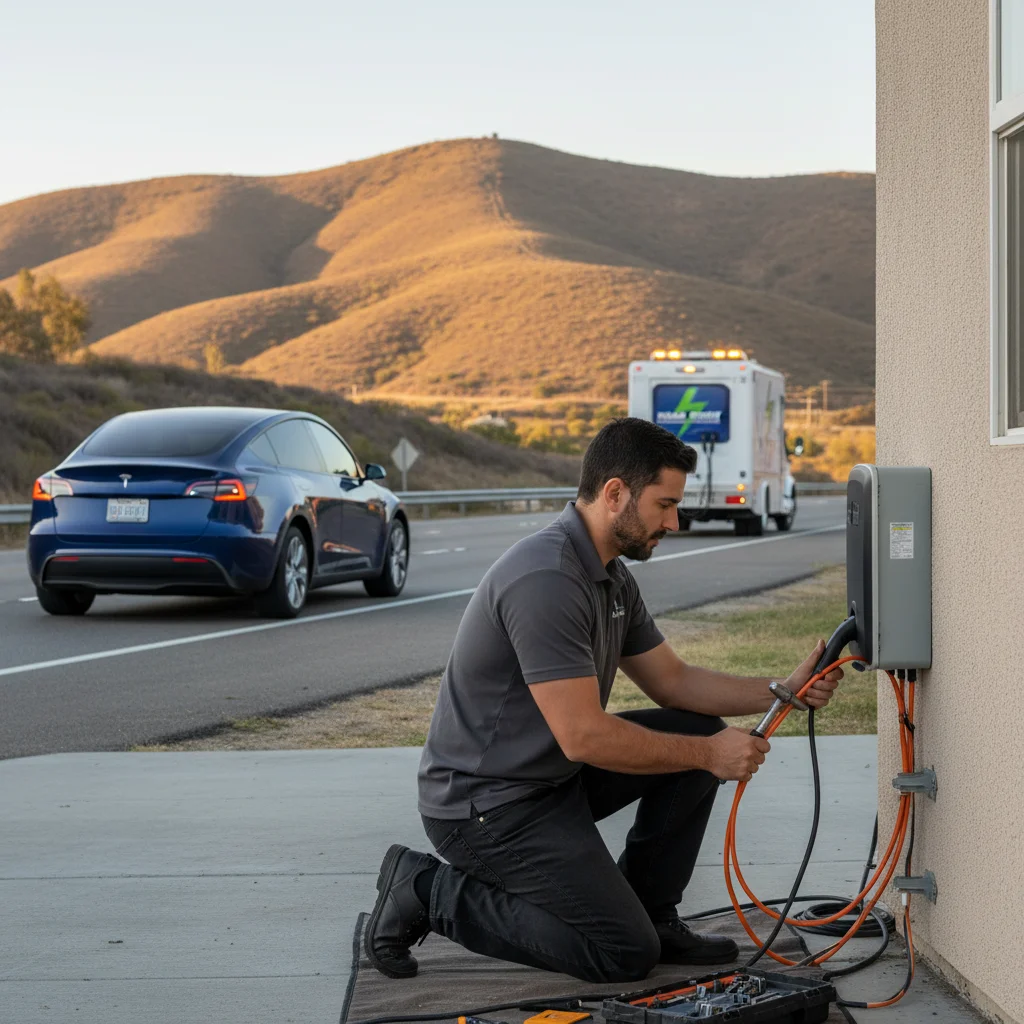
I-25 south is where Castle Rock range gets spent
Castle Rock is the last metro city on I-25 before the Palmer Divide climb. Town sits in Douglas County at about 6,200 feet. South of here, the interstate keeps rising toward Monument Hill. The Divide summit at Monument is 7,352 feet. Winter storms hit this stretch hardest between Denver and Colorado Springs, and closures are common. Check COtrip.org or 511 before you roll south in weather.
A gas car hides that climb, and an EV doesn’t. You’re hauling a heavy pack uphill in cold air. Cabin heat in January spends still more. Recurrent Auto’s winter study found EVs keep about 78% of max range at 32 degrees. At 20 degrees, the average is about 70%. Heat-pump cars hold about ten points more at 32.
The January 2024 arctic blast showed how Front Range air can turn. Denver went from 47 to minus 19 in about 48 hours. Castle Rock sits on the southern edge of that same pattern. Leave The Meadows or Founders Village with a thin buffer, and the grade can spend it.
CDOT can post a Passenger Vehicle Traction Law or a Chain Law by signage. COtrip carries that live status for you. Traction law means AWD, 4WD, or M+S winter tires with at least 3/16-inch tread. Two-wheel-drive needs chains or an approved traction device. Confirm the current rule on CDOT’s traction-law page. Don’t treat a remembered date as the law.
Coming back north, regen can return a large share of the climb. That’s a documented pattern, not a local promise. Drivers still ease regen off on ice for traction. Southbound toward Monument, you’re spending energy instead of banking it.
CORE territory, not an Xcel driveway
Castle Rock runs on CORE Electric Cooperative. So do Castle Pines, Parker, and The Pinery. Denver’s Xcel programs don’t apply on these meters. CORE’s COREV Charge program is at capacity and closed to new applications, per CORE’s own EV page. COREV Connect is still accepting enrollments on that site. Check core.coop before you plan around either program.
Housing here is mostly new. Only 7.2% of units were built before 1980. Driveways in Crystal Valley, Castlewood Ranch, Terrain, and Red Hawk often already have a plug. People still strand anyway. They charge at home, then take one more trip than the overnight top-off covered.
You get in late off Wilcox Street. The cable stays coiled in the garage. Morning looks fine for a school run or Philip S. Miller Park. Then an extra loop on Plum Creek Parkway leaves the lot estimate as a warning. That’s a neighborhood empty-pack call, not a mountain one.
Outlets lots, the fairgrounds, and the US-85 launch
The Outlets at Castle Rock are a long, cold sit. So is a day at the Douglas County Fairgrounds. Parking at the Rock Park while you look up at the namesake formation and the star is the same pattern. Accessory load can kill a 12-volt even when the traction pack still has miles. The car then won’t ready, unlock, or take a public plug. Operators in the network can jump or replace that 12-volt on site. They can also bring a 240-volt Level 2 source if the pack is empty.
US-85 feeds in from the northwest. E-470 is the other launch into this south-metro edge. Stall on E-470 and the authority’s own line is *470. They publish jumps, tires, fluids, and debris help. They don’t publish an EV pack charge. CDOT Safety Patrol is free on listed metro segments, including I-25 South from 120th Avenue to Arapahoe Road. Castle Rock sits south of that published I-25 window. Those patrol pages also don’t mention EV charging. A 12-volt jump may be in scope. A pack boost isn’t.
Castle Rock has a Tesla Supercharger with 16 stalls in the NREL inventory as of September 2026. If you can still drive there, that’s a real site to aim for. If you’re already on the shoulder, you need energy brought to the car. Don’t guess a mileage to a stall from a dead dash.
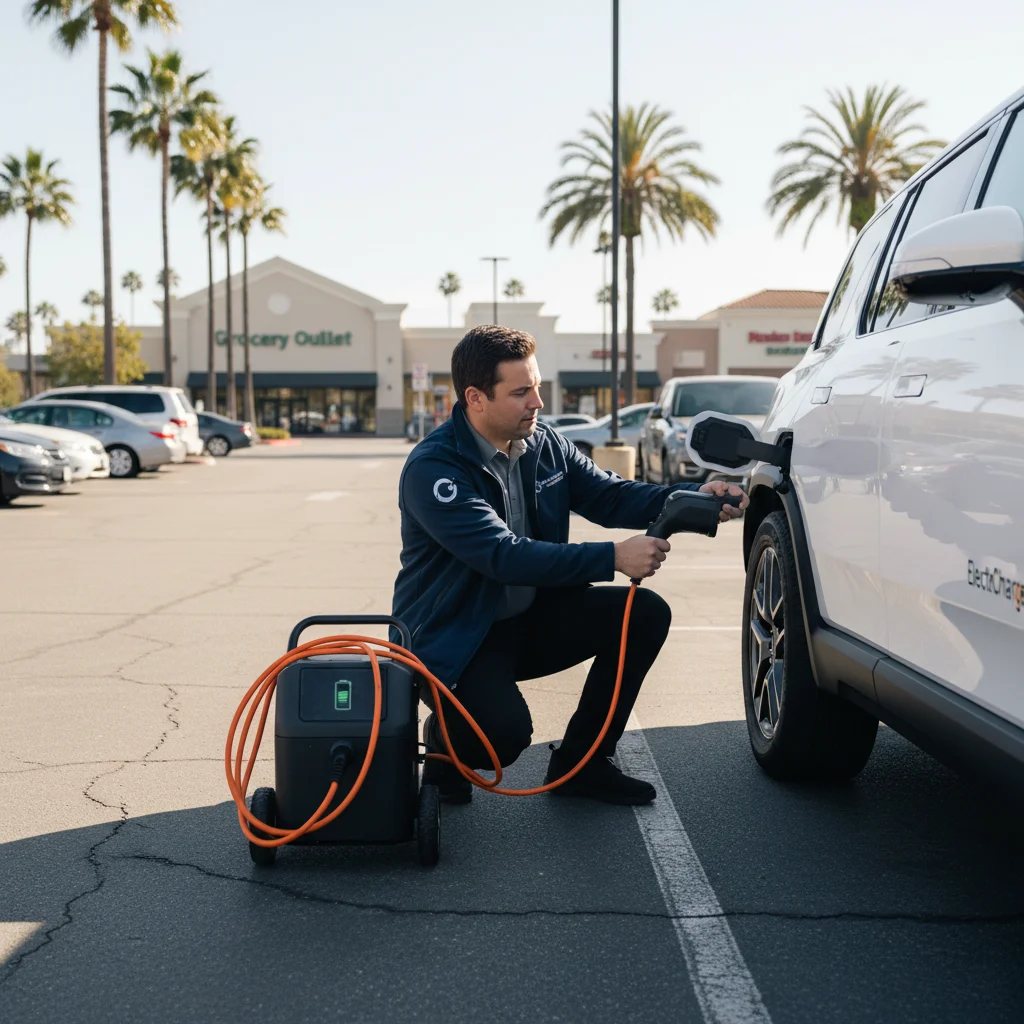
What the pros we connect you with actually bring
Charge Pro DEN is a referral line. We match stranded EV drivers with independent local mobile rescue operators. We don’t hold a trade license. We don’t own trucks or a yard. We don’t employ technicians. We don’t set prices or quote an arrival. The operator quotes you before starting and bills you directly. The pros we connect you with are licensed and insured.
They bring a 240-volt Level 2 source to the car. Teslas use a native NACS plug. CCS and J1772 cars use an adapter. Typical charging adds about 10 to 20 miles of range in 15 to 30 minutes of plug time. That’s charging time only, not a clock on when someone shows up.
They cover Tesla and every major EV brand. Dark screens and silent doors are often the 12-volt. A live car at 0% is an empty pack. Both are jobs for EV roadside assistance, not a body shop. For a pack that’s simply empty, mobile EV charging is the in-place boost.
Colorado has no EV-specific breakdown statute. CRS 42-4-1202 is the disabled-vehicle-on-the-shoulder rule. Outside a business or residential district, you can’t stop on the paved travel lanes unless the car truly can’t go on. Hazards must be on, per CRS 42-4-230. A violation is a class B traffic infraction. Abandoned-vehicle law under CRS 42-4-1803 to 1805 uses officer judgment. It doesn’t publish a sit-time clock. Get out of the live lanes.
If you’re already on I-25, use the same shoulder steps as any out-of-charge stop on I-25. Keep hazards on and stay out of traffic. Then pick charge in place or a tow. Most EVs need a flatbed if they have to ride. That’s a second wait at a stall after the hook. A Level 2 boost on the shoulder is meant to give you miles to reach a charger you can use.
Neighborhood dead packs versus the Monument Hill commit
The Meadows, Founders Village, Plum Creek, Crystal Valley, Castlewood Ranch, Terrain, and Red Hawk all sit on CORE. Neighbors are Castle Pines, Parker, and The Pinery, with Larkspur and Sedalia farther south. A dark driveway after a CORE outage isn’t the same as a car that died heading toward Monument. If the house is out, the wall plug is out too. A mobile charge to the car is the workaround until CORE restores the meter.
Garage wiring is a separate project. CORE’s rebate names don’t match Xcel’s EV Accelerate At Home list. If you’re still planning the plug, read the Douglas County home charger path. If you’re already stuck, skip the panel talk.
Tesla roadside, AAA, and most insurers will jump a 12-volt. They generally won’t bring a pack charge. Confirm your own card. Don’t assume a nationwide club carries a Level 2 truck.
What to do when the Castle Rock pack is done
On I-25 south of Founders Parkway, single-digit miles isn’t a Monument Hill buffer. If you can still move, take the right shoulder. Keep hazards on. Stay in the vehicle when traffic is moving hard.
In an Outlets stall, a car that won’t ready is often the 12-volt. Check that before you blame the pack. A pack with miles and a dead 12-volt still looks like a brick.
In ZIPs 80104, 80108, 80109, 80116, or 80134, a driveway that didn’t charge overnight can be a CORE outage, a tripped breaker, or a cable you never plugged in. A mobile Level 2 visit moves the car. It doesn’t repair the house.
Charge Pro DEN connects you with those operators. Call (720) 738-6950 when the car is the problem. Say you’re in Castle Rock, on I-25, at the Outlets, or in a named neighborhood. The operator quotes before they start. You pay that operator directly.