Yes, every Tesla has a 12-volt battery. A car that won’t wake at DEN is usually that battery. The traction pack can still hold plenty of range. The small battery just failed to boot the car.
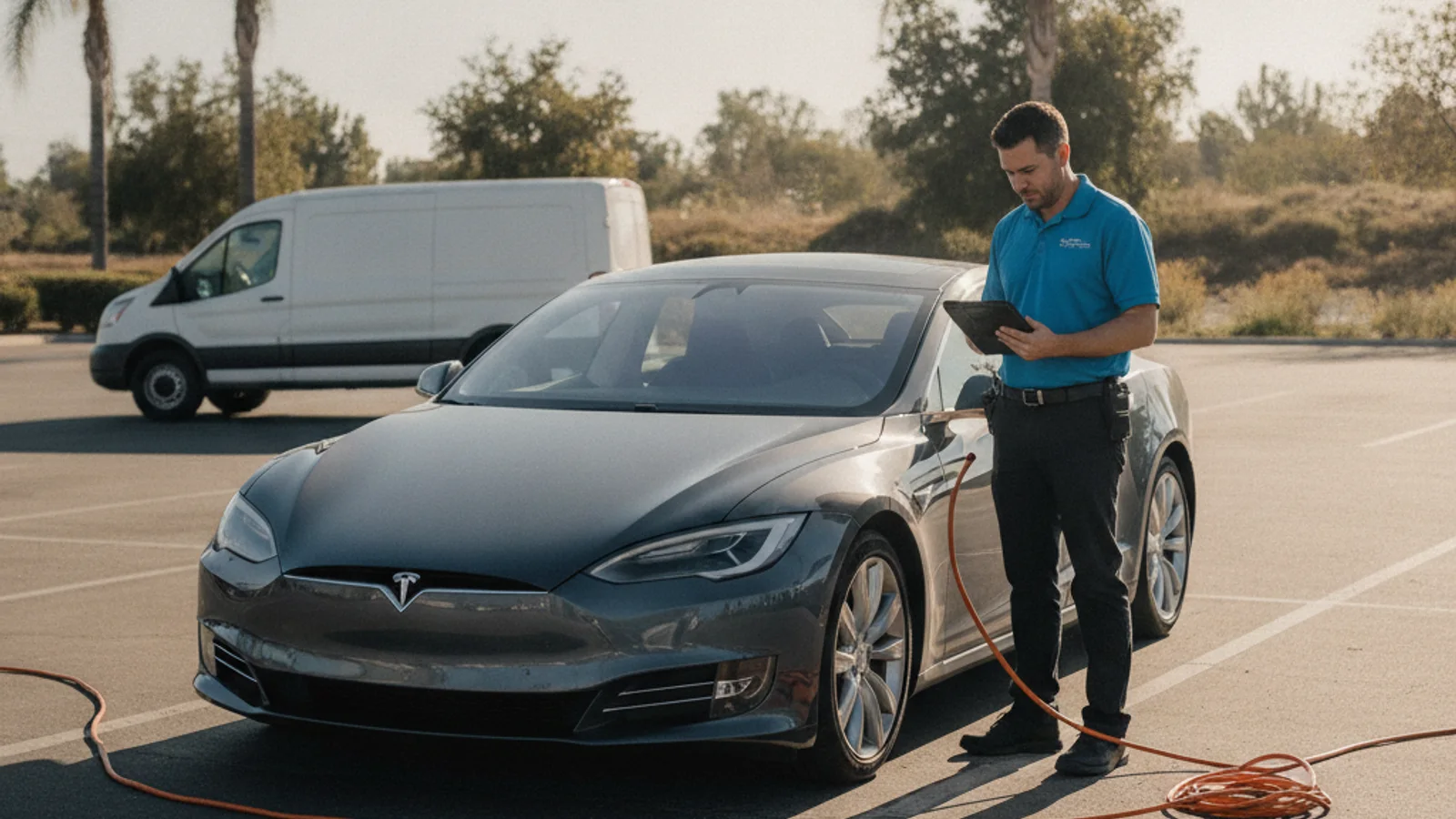
Two batteries sit in every Tesla
Tesla markets one battery. Owners still search this because the car has two. The large pack drives the motors and sets the window-sticker range. A much smaller 12-volt-class battery runs everything else. That includes the touchscreen, door handles, cameras, and the computer that wakes the car.
That second battery isn’t a Tesla quirk. Almost every production EV keeps a low-voltage battery beside the pack. Cabin electronics and safety modules are built for that voltage. They aren’t built to run on several hundred volts.
The traction pack sits behind contactors, which are large relays. Those contactors need low-voltage power to close. Until they close, the pack can’t feed the motors. A Tesla uses this small battery and a DC-DC converter.
While you drive or plug in, the converter tops the 12-volt off. Once the car sleeps, the 12-volt carries the background load. Sentry Mode and the mobile app still draw. That’s why a parked Tesla can go dark.
The U.S. Department of Energy covers this two-system design in its EV overview.
Why a cold DEN lot knocks it out
You parked at Denver International, flew out, and came back to silence. That’s the Front Range pattern this question actually lives in.
DEN sits at the end of Peña Boulevard. Peña is an 11-plus-mile city-maintained freeway from I-70. It isn’t a state highway or an interstate. It runs exposed across open plains. The March 2019 bomb cyclone closed Peña, I-70, and I-25. A Tesla that sat through weather like that can refuse to wake.
DEN parking includes the East and West garages by the terminal. It also includes the 61st and Peña lot. The Pikes Peak and Mount Elbert shuttle lots are in the mix. Leave a Tesla there for a week in January. You can return to a car that won’t unlock. That’s a jump or an on-site 12-volt replacement. It isn’t a dead traction pack.
Charging stall counts for DEN’s own facilities could not be confirmed from the airport’s site. One independently listed site is the Canopy off-site lot. That listing shows one DC fast port and nine Level 2 ports. Named stalls don’t keep the 12-volt alive through a week of freeze.
January’s normal low around Denver is about 18 degrees, per NWS Boulder. The official city elevation is 5,280 feet. That’s the 13th step on the west side of the State Capitol. In January 2024, Denver dropped from 47 degrees to minus 19 in about 48 hours. A Tesla that sat through it didn’t need an empty pack.
Range loss is a drive problem, not this no-start. Recurrent Auto studied winter range loss on more than 30,000 U.S. EVs. Packs kept about 78% of max range at 32 degrees. They kept about 70% at 20 degrees. AAA’s 2026 dynamometer work showed about 39% range loss at 20 degrees. Those figures describe driving in the freeze. They don’t explain a cabin that’s fully dark after the car sat.
Foothills overnight parking is colder still. Golden sits near 5,675 feet. Evergreen sits near 7,200 feet. Idaho Springs sits at 7,526 feet. A Model Y on a Morrison street near Red Rocks soaks harder.
A long sit at Park Meadows in Lone Tree does the same drain. So does a full day in a Denver Tech Center garage in Greenwood Village.
Dark and silent versus awake and empty
A dead 12-volt looks like a brick. The touchscreen stays black. Door handles don’t present. The Tesla app can’t reach the car. Drivers describe it as the car going to sleep and never waking up.
An empty traction pack looks different. The car still wakes. The screen still comes up. You see a range warning, not total silence. Tesla looks dead: empty pack or 12-volt walks that split in more detail.
If you’re sorting it in the lot right now, start there. Then read how to tell if your Tesla’s 12-volt is dead. Don’t treat a dark cabin as a reason to call a flatbed first.
If the dash is awake and the number is near zero, you need miles. That’s a charge, not a jump. Peña toward the airport is a common place for that second failure. Use the Peña Boulevard out-of-charge steps when the pack itself is empty.
Lead-acid and lithium aren’t interchangeable
Tesla has changed the 12-volt’s chemistry more than once. Those changes don’t share one cutoff year. Model S, Model 3, Model X, and Model Y each moved on their own timeline.
Some Teslas use a lead-acid low-voltage battery. Others use a lithium-based one. They aren’t serviced the same way. On some cars the battery sits where you can picture it. On others, reaching it means trim or underbody work. That isn’t a driveway job.
This page won’t freeze a model-year table. A stale chart sends you to the wrong part.
Current Tesla Model Y owner’s manuals describe a lithium-ion low-voltage battery. Jump posts are identified after the hood is open. The wires behind the tow-eye cover only unlatch the hood. Tesla says they cannot charge the low-voltage battery.
Confirm chemistry, location, and access in that year’s book for that VIN. The lithium 12-volt notes for newer Model 3 and Y stay on that chemistry. Don’t copy a Model Y video onto an older Model S.
Tesla’s published New Vehicle Limited Warranty covers the high-voltage battery and drive unit. Check the Tesla app Specs and Warranty screen for your VIN. The North America PDF Tesla publishes doesn’t cover Cybertruck in that same document.
What the free patrol will do, and what it won’t
Colorado has no EV-specific breakdown statute. CRS 42-4-1202 is the same disabled-vehicle rule as any car. Outside a business or residential district, you may not stop on the paved travel lanes. The exception is a vehicle so disabled you couldn’t avoid stopping. You also couldn’t move it off the roadway. Hazards must be on, per CRS 42-4-230. A violation is a class B traffic infraction.
Abandoned-vehicle rules sit in CRS 42-4-1803 to 1805. The statute sets no 24-hour or 72-hour clock. An officer uses reasonable grounds.
CDOT Safety Patrol is free on covered metro segments. Those include I-25 South from 120th Ave to Arapahoe Rd. They also cover I-70 East from Wadsworth to Airport Blvd. Portions of US-6, C-470, and I-225 are on the list. Front Range hours are 6:00 to 9:30 a.m. and 2:30 to 7:00 p.m. weekdays. Weekends run 10:00 a.m. to 7:00 p.m.
Patrol trucks will jump a 12-volt and change a tire. CDOT’s Safety Patrol page mentions nothing about charging an EV. A jump can wake a Tesla. It won’t add miles to the pack.
On E-470, pull to the shoulder and dial *470. That authority’s roadside help includes jump-starts, tires, fluids, and debris. Dial *CSP (*277) for State Patrol. E-470 doesn’t publish an EV charging service.
Tesla roadside is requested in the Tesla app. Tesla says out-of-range assistance may be available. It isn’t financially covered. That’s Tesla’s published policy, not a Charge Pro DEN promise. If the car is in a travel lane or another dangerous place, call 911.
What to confirm before anyone clips on
Tell the operator the exact model, year, and trim. That’s what sets chemistry and access. Your owner’s manual is the first reference. Tesla’s current service documentation supersedes any article, including this one.
Don’t follow a driveway video for a different year. A routine step on one Tesla can be the wrong move on another. If you aren’t sure which 12-volt you have, say so.
Charge Pro DEN is a referral line. We match stranded EV drivers with independent local operators. We don’t own trucks. We don’t employ technicians. We don’t set prices or promise an arrival time. The operator quotes you before starting and bills you directly.
The pros we connect you with jump or replace a dead 12-volt on site. They also bring a 240-volt Level 2 source to the car. Tesla uses a native NACS plug. Charging time is typically 15 to 30 minutes. That session adds about 10 to 20 miles of range. That’s charging time on the car, never an arrival window.
Start with Tesla 12-volt battery jump when the cabin is dark. Use Tesla roadside rescue when you aren’t sure which failure you have. Tesla 12-volt failure in Denver cold covers the weather side in more depth.
Home charging won’t wake a car that already went dark. Xcel Energy covers Denver, Aurora, and the Boulder County cities. CORE Electric Cooperative owns the Douglas County south corridor. United Power covers much of the north and northeast. It splits streets with Xcel in Thornton, Westminster, and Broomfield. None of those programs revive a 12-volt that died in a DEN lot.
Call Charge Pro DEN at (720) 738-6950 when the Tesla has gone dark. Describe whether the screen is black or the range number is near zero. We’ll connect you with a local operator who quotes before any work.