You park at DEN for a week, fly, and come back to a Tesla that won’t wake. The handles stay in. The app stays quiet. That’s tesla 12v battery failure in Front Range cold, not a ruined pack.
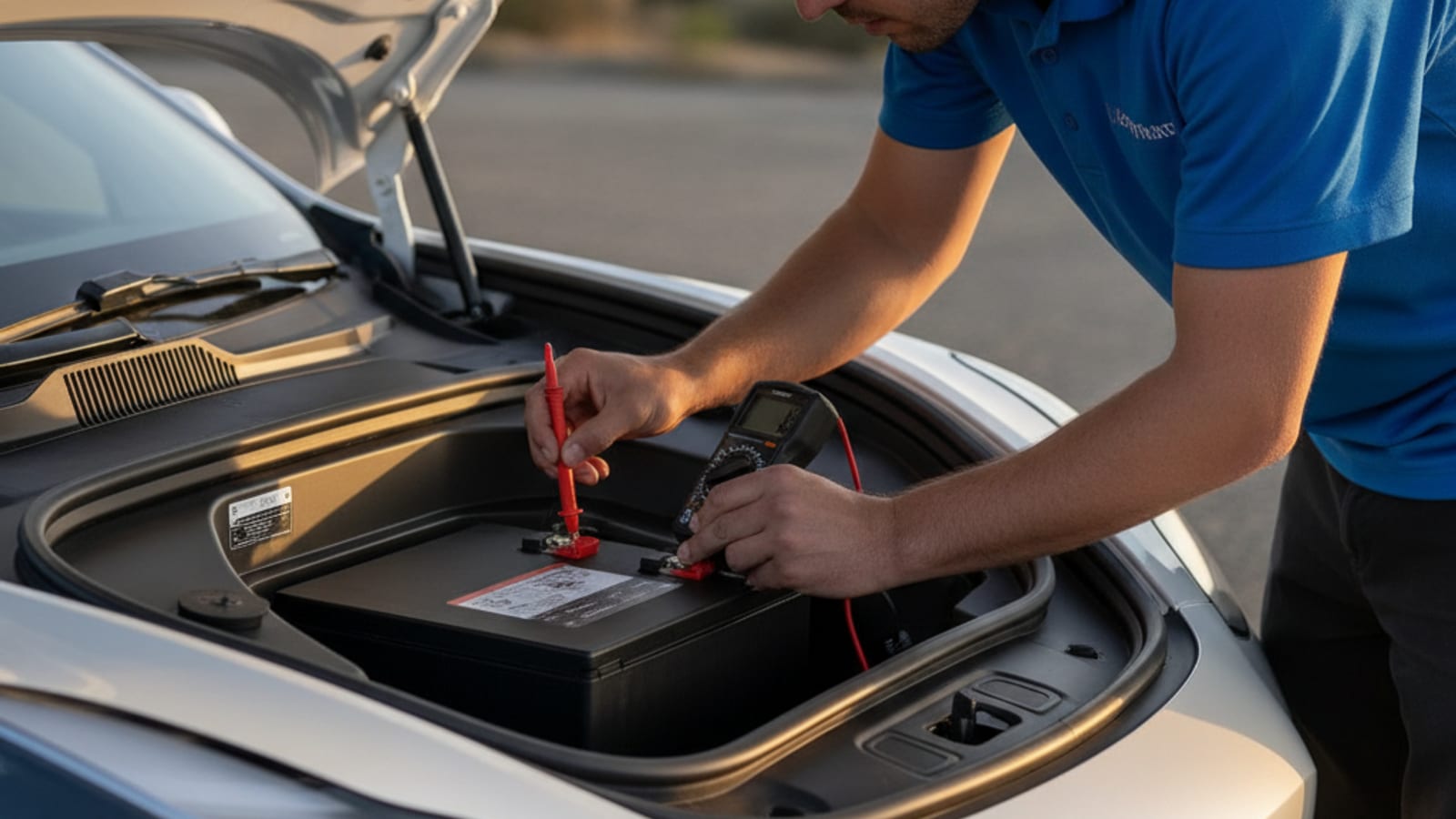
The traction battery can still hold a normal charge. The small 12-volt is what boots the car. When it’s flat, latches, screens, and the pack relay stay asleep. From the curb it looks like the whole vehicle died.
People call for a flatbed on that look alone. Start with the 12-volt posts instead. If the car wakes and the miles look normal, the pack wasn’t the failure.
Why a Denver sit knocks out the 12-volt
January’s normal low around Denver sits near 18 degrees. The all-time record is minus 29 on January 9, 1875. In January 2024, Denver fell from 47 to minus 19. That drop took about 48 hours. A lead-acid 12-volt loses punch in that kind of soak.
DEN is the clean example. Peña Boulevard is the only way in. It’s an 11-plus-mile city freeway, not an interstate, across open plains. You leave the car in the East or West garage. You might use a shuttle lot at 61st and Peña. Then you fly. You return, tap the handle, and get nothing.
The pack didn’t freeze empty. Cold does cut range once you drive. Recurrent studied more than 30,000 U.S. EVs in winter. Cars kept about 78% of max range at 32 degrees. They kept about 70% at 20 degrees. AAA’s 2026 study reported about 39% range loss at 20 degrees. A parked Tesla can still refuse to wake. That happens when the 12-volt is dead, even with a healthy pack.
You don’t need an airport week for the same failure. A long dwell at the Denver Tech Center in Greenwood Village does it. Hours later it won’t ready.
A Tesla can sit after a Red Rocks climb in Morrison. That asks a lot of a tired 12-volt.
What the 12-volt still does in a Tesla
There’s no starter motor. The 12-volt still runs the unglamorous systems. It powers door actuators, including Model S pop-out handles. It powers frunk and trunk latches. It feeds the screen and network modules. It closes the relay that lets the high-voltage pack drive the motors.
That last job is the trap. The pack can sit at 80%. The car still won’t move. That’s tesla 12v battery failure, not a pack replacement.
Older Model S and Model X cars used a lead-acid 12-volt. Early Model 3 builds did too. Later Model 3 and Model Y cars moved to lithium. Lithium holds a rest charge longer. It can still die after a long, cold sit. That happens if the car stayed awake. Neither chemistry is the traction pack.
When the 12-volt actually fails
A multi-day sit without a charge source is the usual story. While the car is awake, a DC-DC converter tops the 12-volt from the pack. Asleep in a lot, that isn’t a steady charger. A week in a cold DEN stall is a long nap.
Lead-acid units in the frunk also just age out. The Tesla app may have already shown a 12-volt low notice. If doors still work, treat that warning as a short fuse. Plan a jump and a replacement before the next cold snap. If the car is already dark, stop guessing about the pack.
Pack empty or 12-volt: the check that belongs first
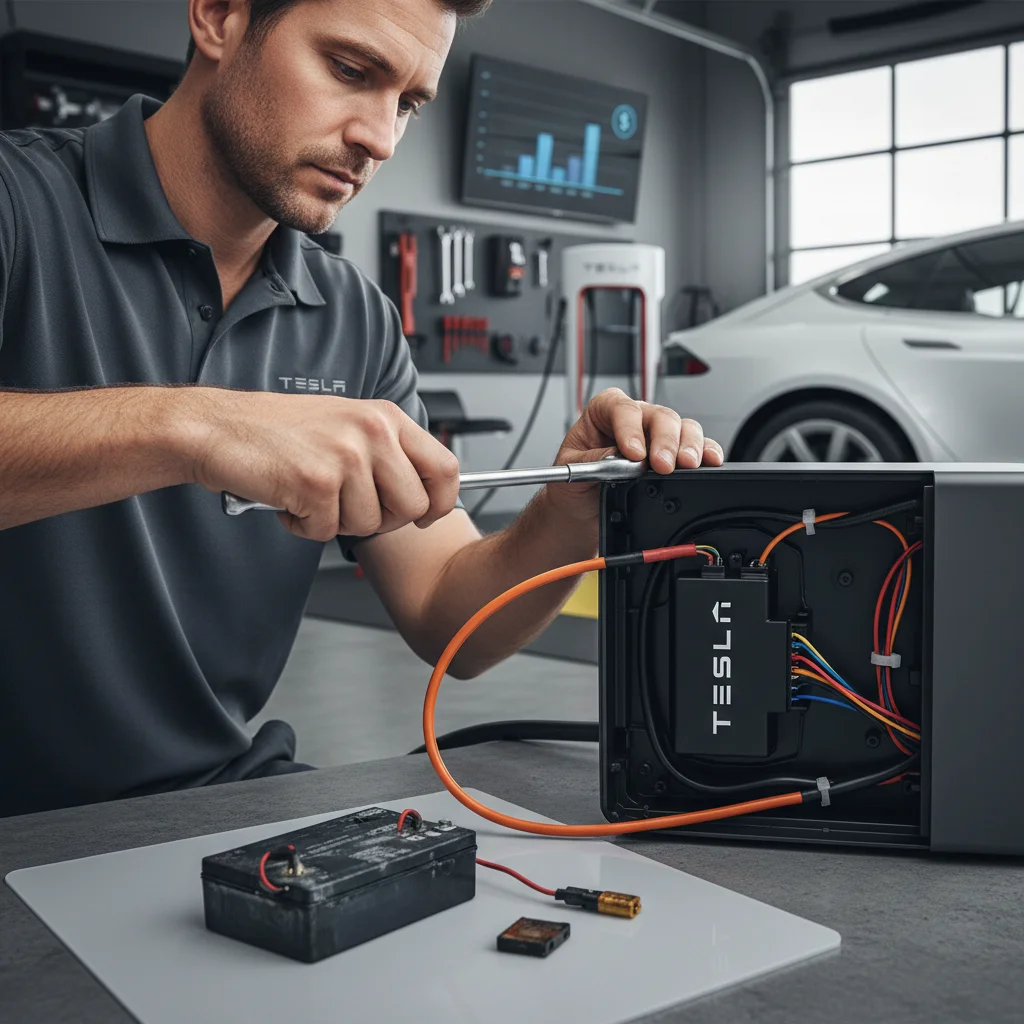
A fully dark Tesla is almost always the 12-volt. No screen. No handles. No app handshake. Pack trouble usually still lets the car power on. You see a range drop, a warning, or limp mode. You don’t get a silent brick.
Most Teslas have a 12-volt jump point up front. On Model 3 and Y it sits under the hood. On Model S and X it’s in the frunk near the firewall. Use a standard jump pack on those posts. Don’t use the charge port. Don’t try to feed another car’s traction pack from yours.
If the screens return and the pack percentage looks normal, you have the answer. The jump is a test, not a repair. Remove the jumper and the 12-volt can fail again. Next is a replacement, in the lot or at Tesla service. Charge Pro DEN doesn’t perform that work. The independent operators we connect you with jump a dead 12-volt on site. They quote before they start, and they bill you directly.
If the car wakes at a true zero, that’s a different job. A mobile Level 2 charge typically adds about 10 to 20 miles. That takes 15 to 30 minutes of charging time. That’s charger time, not an arrival window. Read how to tell if your Tesla’s 12-volt is dead and Tesla looks dead: empty pack or 12-volt.
Patrols will jump a 12-volt. They won’t charge the pack.
CDOT Safety Patrol is free on listed metro freeway segments, in published hours. Weekday hours run 6:00 to 9:30 a.m. They also run 2:30 to 7:00 p.m. Weekend hours run 10:00 a.m. to 7:00 p.m. I-70 East coverage runs from Wadsworth to Airport Boulevard.
Those CDOT pages mention nothing about charging an EV. A 12-volt jump is in the toolkit. A charge into the pack isn’t. E-470 works the same way. Pull to the shoulder and dial *470. They publish jump-starts. They don’t publish an EV charge. Colorado has no separate disabled-EV statute. CRS 42-4-1202 treats a Tesla on the shoulder like any disabled car. If the car couldn’t go farther, keep hazards on. Peña Boulevard is city-maintained. Don’t assume Safety Patrol covers that 11-mile run.
A wall connector can’t wake a dark Tesla
Xcel Energy covers Denver, Aurora, Lakewood, Boulder, and much of the core. CORE Electric Cooperative owns the south-metro Douglas corridor, not Xcel. A home plug only helps if the car can close its contactors. If the 12-volt is dead, the garage charger can’t start a session. Wake the 12-volt first. Then the pack can take a charge. Keep Do Teslas have a 12-volt battery, and why cold parking kills it and how to jump a Tesla 12-volt on Model 3, Y, S, and X on your phone.
A week at DEN is the hard version of that physics. One independently confirmed listing is Denver International Airport - Canopy. It has one DC fast port and nine Level 2 ports. They’re in the Canopy off-site lot. Stall counts for the East and West garages weren’t confirmed here. None of that matters if the 12-volt won’t close the relay.
If the car is already a brick
Stay with the car on a freeway shoulder. Hazards on. Don’t stand in a travel lane. On E-470, *470 is the published help line.
If you want a local operator, Charge Pro DEN is a referral line. We match stranded EV drivers with independent mobile rescue operators across the Denver metro. We own no trucks. The operator quotes you before work starts. They jump or replace a dead 12-volt on site. They can also bring a 240-volt Level 2 source. It uses a native NACS plug. CCS or J1772 adapters cover non-Tesla EVs if the pack is empty. See Tesla 12-volt dead: jump it or replace it on site, when an EV’s 12-volt dies, the car will not wake, and Tesla 12-volt jump help.
Call (720) 738-6950 when you want that match. It’s a referral, not a clock.
Frequently asked questions
How do I know this is tesla 12v battery failure, not the pack?
A silent car with no screen and no door response is the 12-volt pattern. Jump the front 12-volt posts. If it wakes with a normal pack percentage, the traction battery wasn’t the failure.
Can CDOT or E-470 fix a Tesla 12-volt on the road?
CDOT Safety Patrol and E-470’s *470 help both list jump-starts. Neither publishes an EV charge. A jump may wake the car. A dead 12-volt still needs a replacement after that.
Does a week at DEN always kill the 12-volt?
No. Plenty of cars sit and restart. Cold, age, idle electronics, and a long rest stack the odds. January’s 18-degree normal lows make a weak battery fail in the lot. Check the 12-volt before you order a flatbed.