A parked EV that won’t ready after a Front Range freeze is a 12-volt story. The traction pack can still show tens of miles. The small battery that wakes the computers didn’t survive the night. Jump that 12-volt with a dedicated pack. Don’t treat it like a gas-car cable jump.
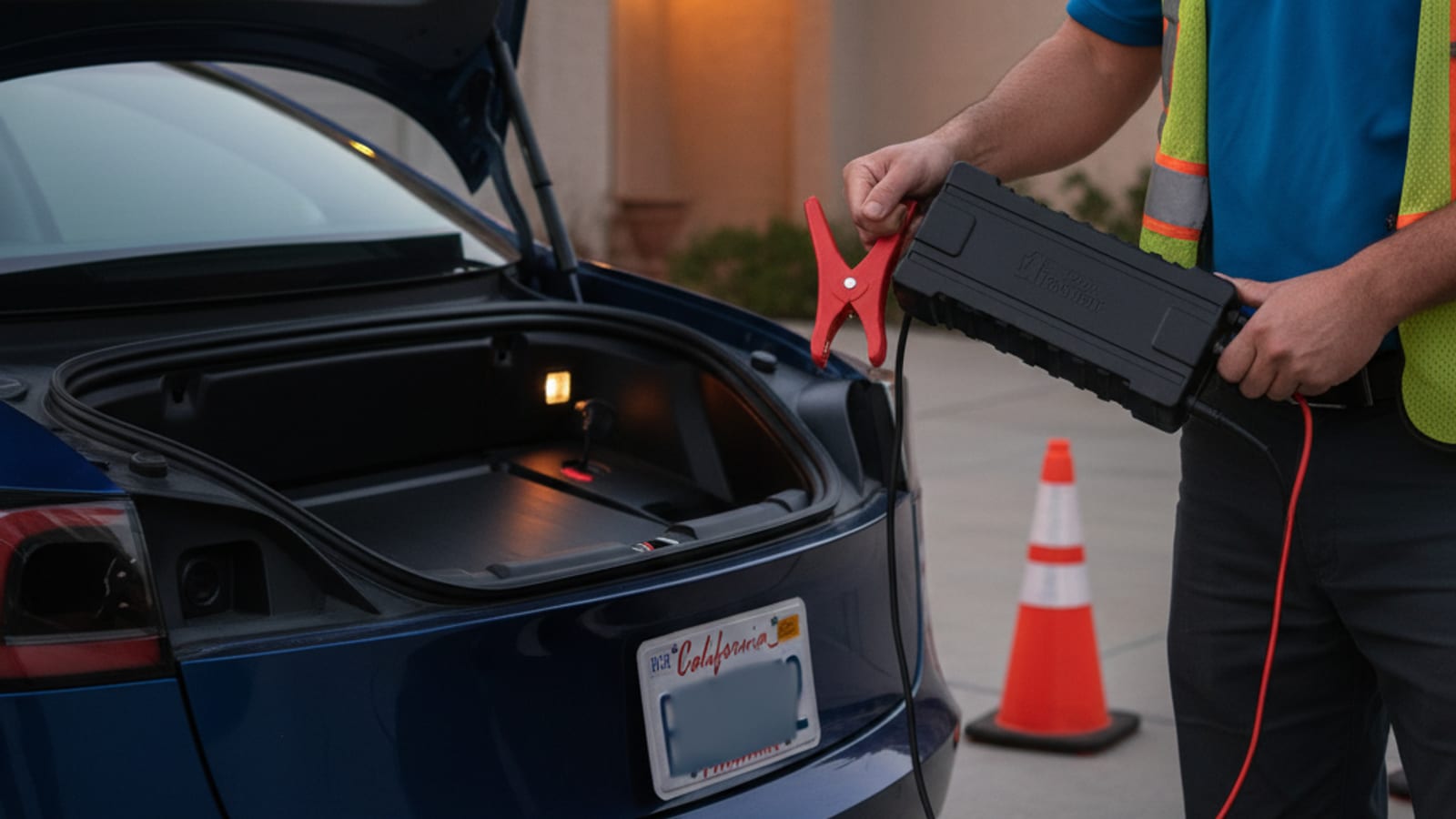
The 12-volt is what actually wakes the car
Every EV still carries a small 12-volt battery. It runs the locks, the screens, and the contactors for the traction pack. When that little battery is dead, nothing on the car wakes. A full pack sitting next to it doesn’t matter until those contactors close.
Denver’s January normal low sits around 18 degrees, per National Weather Service climate normals. In January 2024 the city fell from 47 to minus 19 in about two days. That kind of soak is hard on a parked 12-volt. It hits cars left at Denver International and at the Denver Tech Center. Open driveways from Aurora through Lakewood see the same overnight drop. The traction pack can still hold range. The 12-volt can’t keep the computers alive.
Elevation makes the same night uneven. Downtown sits at 5,280 feet. Evergreen sits around 7,200 feet. A Model Y that overnighted up the hill sat colder than one downtown. That’s local weather, not a random electrical fault.
For the split in plain terms, read which EV battery matters on the roadside. Tesla drivers can start with whether Teslas have a 12-volt in the cold.
A cold lot is a 12-volt problem first
Leave a car for a week in a cold DEN garage. The 12-volt is the system that quits. The same pattern shows up after a long sit at Park Meadows, or overnight near the Capitol. The pack didn’t hit zero. The low-voltage battery did.
CDOT Safety Patrol will jump a 12-volt on covered freeway segments. It won’t bring a charge to an empty traction pack. Coverage includes I-25 South from 120th Avenue to Arapahoe Road. It also covers I-70 East from Wadsworth to Airport Boulevard. Portions of US-6, C-470, and I-225 are in the same program. Weekday hours run 6:00 to 9:30 a.m. and 2:30 to 7:00 p.m. Weekend hours run 10:00 a.m. to 7:00 p.m. E-470’s roadside line, *470, also lists jump-starts, tire help, and debris removal. Neither program describes a mobile EV charge.
If you’re on a shoulder, keep the hazards on. CRS 42-4-1202 allows a truly disabled vehicle to sit there. Colorado doesn’t have a separate statute for a dead EV. The same disabled-vehicle rules apply.
Don’t jump it from a running gas car
A running gas car feeds the cables from its alternator, around 14 volts. Spikes on that feed travel into the dead side. Gas 12-volt systems tolerate that. EV 12-volt wiring doesn’t.
On an EV those cables sit upstream of a DC-DC converter. They also feed body modules and the battery management system. A spike or reversed leads can damage any of them. Tesla tells owners not to jump from another vehicle. A dedicated lithium pack is the tool makers want you to use.
Use a lithium jump pack, not jumper cables
A lithium jump pack is a portable battery with leads already attached. It puts out a controlled 12 volts at a moderate current. That’s enough to wake a dead 12-volt. It isn’t an alternator on booster cables.
Pick a pack with reverse-polarity protection. Several hundred peak amps is enough for an EV 12-volt. Store it in the frunk or cargo area. Charge it every few months so it isn’t flat when you need it.
The sequence that keeps the converter intact
The order is the same on a Tesla, a Rivian, a Ford, or a Hyundai.
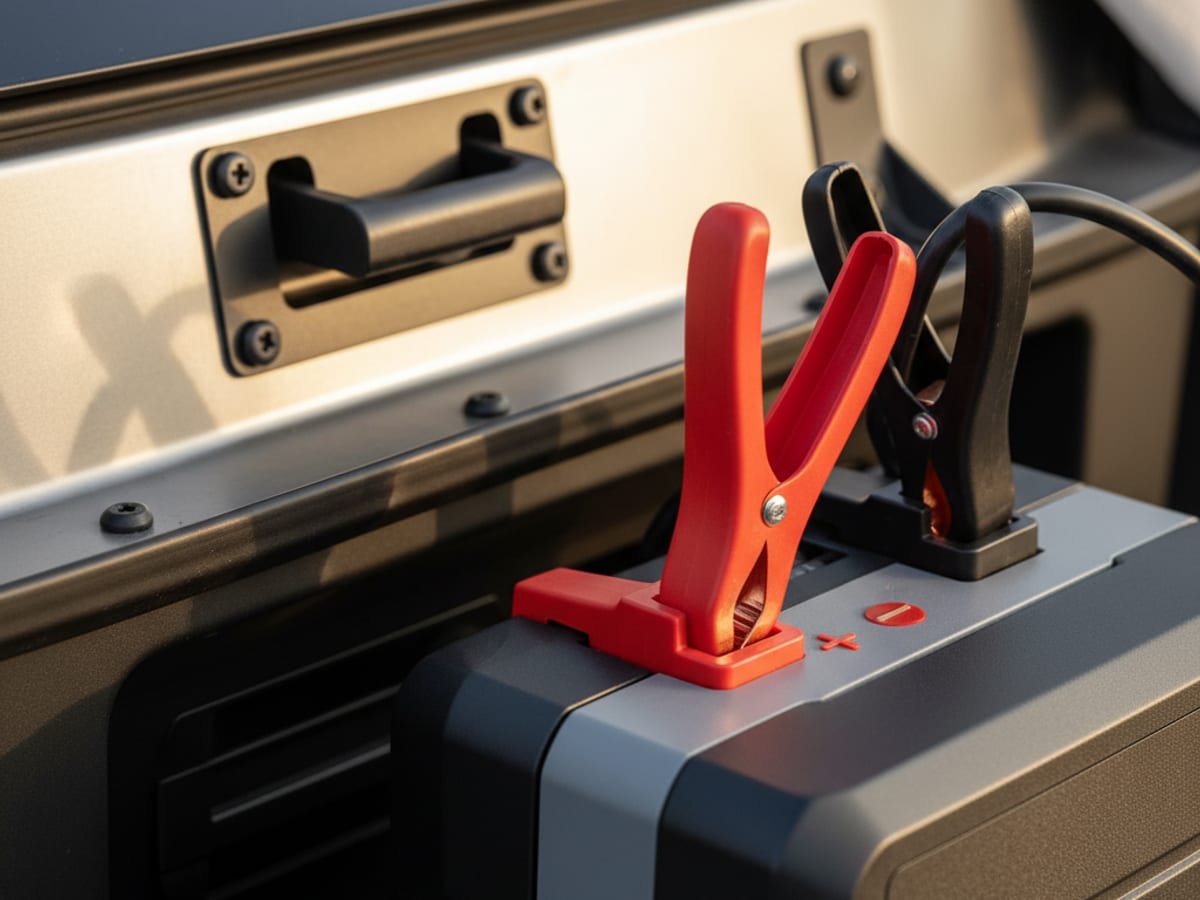
Make sure the jump pack itself shows charge. Find the marked 12-volt access for your model. Connect the red lead to the positive post first. Connect the black lead to the designated ground. If the car marks a ground stud, use that stud. Pause so the voltage can settle. Then try a door handle, the phone app, or the driver’s door.
Once the car wakes, leave the pack connected for a couple of minutes. That pause lets the traction pack’s DC-DC converter start supporting the 12-volt. Disconnect the black lead first, then the red.
Keep polarity honest: red to positive, black to the marked ground. Newer packs refuse a reversed hookup. Reversed leads are the fastest way to kill a converter.
Where the posts actually sit
Tesla Model 3 and Model Y
The tow-eye cover on the driver’s side of the front bumper pops off. Two pigtail leads sit behind it, one red, one black. Clip the pack there. After the frunk unlatches, you can reach the real 12-volt. More model notes are in how to jump a Tesla 12-volt.
Tesla Model S and Model X
On 2021 and newer cars, use the front-door manual releases. Inside, pull the frunk release under the carpet. Jump on the 12-volt terminals in the frunk. Pre-2021 S and X cars use the bumper tow-eye pigtails.
Rivian R1T and R1S
A dead 12-volt kills the fob’s power frunk button. There’s a manual pull cord behind the grille. A small cover over it takes a Phillips screwdriver. Once the frunk is open, the 12-volt sits under a passenger-side panel. Jump the positive post and the marked ground stud.
Ford F-150 Lightning and Mustang Mach-E
The Lightning’s mechanical frunk release is a pull loop under the front bumper. The 12-volt sits on the driver’s side with standard posts. The Mach-E hides the 12-volt in the rear. Labeled jump posts sit in the frunk. If the app won’t open the frunk, a manual cable sits behind a driver’s-side kickplate.
Hyundai Ioniq 5, Kia EV6 and EV9, Chevrolet Bolt
These models hide the 12-volt under the rear load floor. They also put jump terminals in the front bay. You’ll see a red positive post and a ground marked with a bolt. Jump from the front so you’re not digging through cargo in the freeze.
Polestar 2
The 12-volt lives in the frunk. If that lid stays shut, a manual release cable sits behind the driver-side headlight housing. Terminals inside are standard posts.
After the car wakes
Drive it or plug it in. Either one lets the DC-DC converter recharge the 12-volt. That’s how the car was designed to top it up. Sitting in park with the jump pack already disconnected isn’t a recharge plan.
If the 12-volt dies again within a day, plan on replacement. A jump is a wake-up, not a repair. Operators in the referral network can jump on site. When they have the matching battery, they can replace it there too. Warning signs before a full stall are in EV 12-volt replacement signs.
Watch for a 12-volt service message, slow waking, and screen resets. Watch for an app that keeps losing the car. Those show up in Boulder and Thornton the same as downtown. Replace the 12-volt before a Monday when the doors won’t unlatch.
What a patrol can do, and what it cannot
CDOT Safety Patrol can jump a 12-volt on those covered segments. It can’t add miles to an empty traction pack. CDOT’s own pages don’t mention EV charging. If only the 12-volt is dead, a patrol jump may wake the car. Then drive or plug in so the converter can hold it.
E-470 drivers pull to the shoulder and dial *470. That authority lists jump-starts. It doesn’t list a mobile Level 2 charge.
For a Tesla-specific jump, the operators we connect you with handle Tesla 12-volt battery jumps. Other brands go through non-Tesla EV rescue or EV roadside assistance.
When a jump pack isn’t in the car
You don’t have a pack, or the frunk won’t release. Or the traction pack is low too, and you need a jump plus a 240-volt top-off. That’s a referral call, not a guess on the shoulder.
Charge Pro DEN matches you with independent local operators. The operator quotes before starting and bills you directly. The brand doesn’t own trucks and doesn’t do the work. Operators jump or replace a dead 12-volt on site. They can bring a 240-volt Level 2 source that typically adds 10 to 20 miles. That’s 15 to 30 minutes of charging time, not an arrival time.
Call (720) 738-6950 when you need that match. Stay with the car, keep the hazards on, and don’t stand in a travel lane.