A Denver EV can sit with pack range left. It can still refuse to wake. If you’re looking up EV 12v battery replacement, start with the small battery. A cold night is usually when it fails. It runs the computers, the latches, and the contactors that connect the traction pack. When it sags, the car looks dead. The operators Charge Pro DEN refers can jump that 12-volt on site. They can replace it there if a jump won’t hold.
The 12-volt is what actually wakes the car
The traction pack moves the wheels. The 12-volt battery does something else. It boots the computers. It presents the door handles. It closes the contactors so high-voltage current can flow. Think of it as the key that turns the rest of the car on. There’s no engine to crank. Without a healthy 12-volt, nothing else starts.
That’s why a car with range still showing can sit dark. The screens stay blank. The charge port may not release. The app may show the car as offline. People assume the pack is empty. Often it isn’t. Read Which EV battery matters when you’re stranded in the cold for that mix-up.
Newer Teslas moved from AGM 12-volts to a small lithium unit. Rivian, Ford, Hyundai, and BMW still use a 12-volt. So do Audi, Kia, and most other EVs. The chemistry changes. The job doesn’t. If that circuit can’t hold voltage, the car won’t ready.
Front Range cold is hard on that small battery
Denver sits at 5,280 feet, marked on the west steps of the State Capitol. January’s normal low sits around 18 degrees. That’s already a strain on a 12-volt left outside. Then a real snap arrives. In January 2024, Denver dropped from 47 degrees to minus 19 in about 48 hours. A battery that felt fine Tuesday can fail Thursday morning.
Elevation makes the same night colder as you climb. Golden sits near 5,675 feet. Evergreen is around 7,200. Idaho Springs is 7,526. A car that slept on a Capitol Hill block saw one overnight low. A car that slept above Morrison saw another. The foothills soak is longer and colder.
Airport parking is hard on that 12-volt. Peña Boulevard is the only road into Denver International. It’s city-maintained, not an interstate, and it runs exposed across open plains. Cars sit in the East and West garages for a week. You come back. The pack still has range. The 12-volt sat unused in the cold and now the car won’t wake. That’s a jump or an on-site replacement, not an empty traction pack.
The same pattern shows up after a long dwell at the Denver Tech Center. It shows up after a Park Meadows shopping day in Lone Tree. It shows up on street parking in Glendale or Edgewater. The car never got a garage trickle. Short hops in Thornton, Northglenn, and Federal Heights are hard on it too. The DC-DC converter never gets much time to refill the 12-volt.
Recurrent Auto’s winter study is about traction-pack range, not this small battery. Cabin preconditioning, computers, and always-on modules still draw on the 12-volt while the car sleeps. The pack can look healthy. The small battery is already spent.
Signs the 12-volt is fading, not the pack
Catch it before the car goes fully dark. The early tells are boring, and that’s the point. They show up days or weeks before a no-start.
Dash messages come first on many Teslas. A 12-volt replacement notice or a low-voltage warning isn’t a suggestion. Read Tesla 12-volt warning signs before you get stuck for those Tesla-specific alerts. Other brands phrase it as a service warning or a replace-battery notice. A BMW i4 replace-battery message after a cold soak is often this same 12-volt.
The screen is the next tell. It boots slowly. It freezes. It goes black and comes back. Interior lights dip when a door opens. Headlights look weak. Windows crawl. None of that’s a pack-range problem.
Locks and handles fail next. The fob works on the second try. Handles don’t present. The charge port won’t open from the app. You’re already close to a no-wake. Once the car won’t ready when you press the brake, the 12-volt is done. It can no longer close the contactors. That’s the roadside version of the same failure.
Age is a clue, not a diagnosis. Many 12-volt units last a few years. Cold, short trips, and long sits shorten that. A unit that’s already showing slow screens in Lakewood or Aurora is worth testing. Don’t wait for a blank dash on I-25.
A public stall won’t wake a car that won’t boot
This is where mornings disappear. Drivers aim for a Supercharger because the car “must be empty.” Tesla Superchargers are dense across the metro. Denver has several sites. So do Park Meadows in Lone Tree, Highlands Ranch, Lakewood, Boulder, and Castle Rock. Idaho Springs has eight Supercharger stalls on I-70 west of Denver.
None of that helps if the 12-volt won’t let the car accept a plug. The port stays shut. The car won’t authenticate. You sit at a working stall with a car that still looks dead. A mobile Level 2 charge is the right call for a truly empty pack. Operators bring a 240-volt source and a native NACS plug. They carry CCS or J1772 adapters for non-Tesla EVs. They typically add 10 to 20 miles of range. That’s in 15 to 30 minutes of charging time. That’s charging time, not an arrival time. A dead 12-volt needs a jump or a replacement first. Mixing those two jobs is how a simple failure turns into a tow.
The car sat plugged in at home and still woke dark. Start with the 12-volt. Xcel Energy covers much of the core metro and Boulder County cities. CORE Electric Cooperative serves the south Douglas corridor, including Highlands Ranch, Lone Tree, Parker, Castle Rock, and Castle Pines. United Power covers much of the north and northeast. It splits streets with Xcel in Thornton, Westminster, Arvada, Broomfield, Northglenn, and Erie. Longmont has its own city utility. A charger that ran overnight can still leave a dark car. That’s often the 12-volt, not the wrong utility.
Jump first, replace it if the jump won’t hold
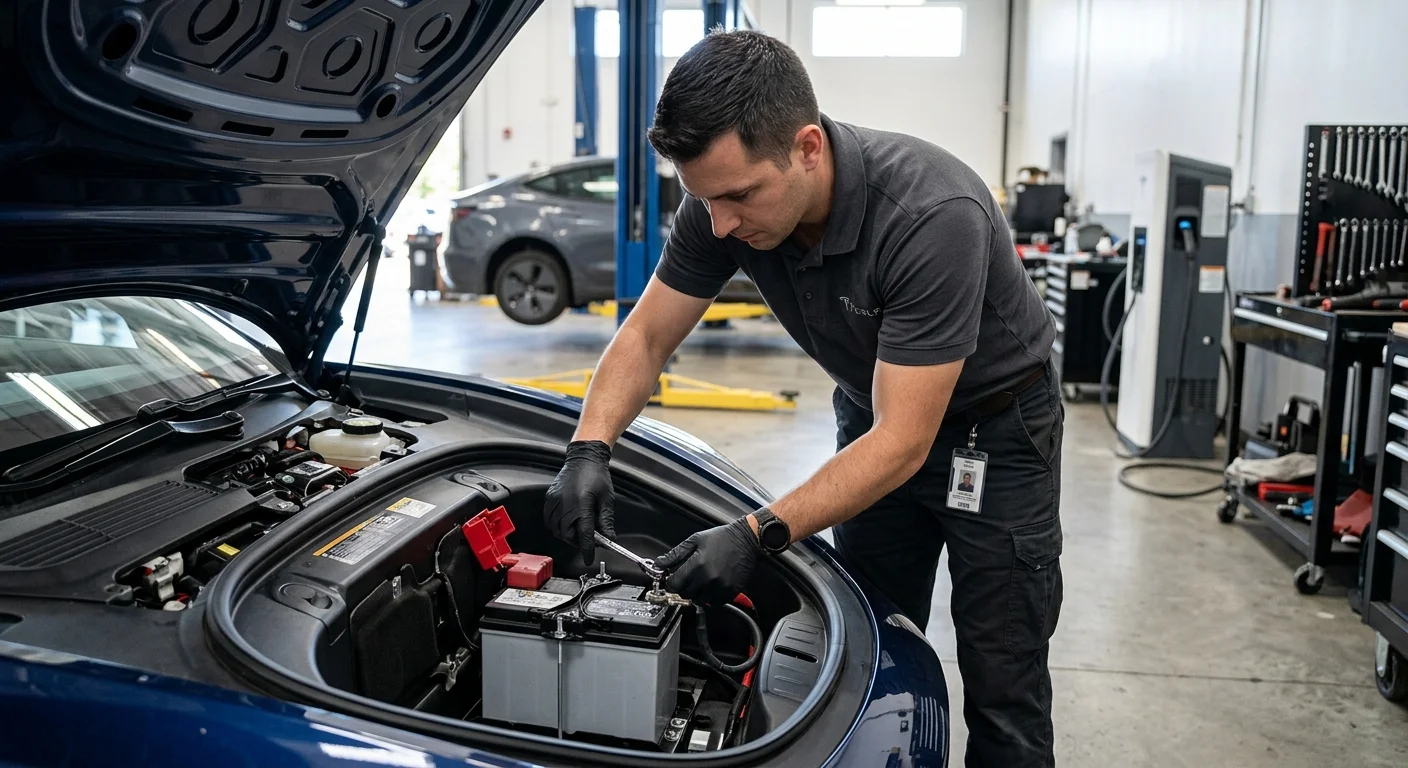
A jump brings the computers back. On many Teslas, Rivians, and other EVs, the jump points are hidden. They sit behind a small cover in the front bumper or frunk. Use those points. Don’t clip onto high-voltage hardware. Read How to jump an EV 12-volt without frying the pack for the safety version.
Once the 12-volt has enough voltage, the car can ready. The traction pack can then refill the 12-volt through the DC-DC converter. That’s why a jump sometimes “fixes” the morning. It’s also why the same car dies again after dinner. The underlying battery still can’t hold a charge. Read EV 12-volt dies again after a jump if it fails a second time.
Replacement is the durable fix. The operators in this referral network can jump on site. They can also replace a dead 12-volt on site when the unit won’t hold. That covers Tesla and the other major EV brands. You get a quote before work starts. The operator bills you directly. Charge Pro DEN doesn’t set that price, and it doesn’t own the truck.
A published parts-and-labor figure for this metro couldn’t be confirmed. That includes Tesla, Rivian, and Mach-E 12-volt work. Dealers, independent shops, and mobile operators each quote their own number. Confirm the current quote before you pay. Newer lithium 12-volts and older AGM units aren’t the same part. Your model year decides which one you need. The owner’s manual, not a blog, is the source for the exact part. Read Tesla 12-volt dead: jump it or replace it on site for the Tesla-specific fork.
What the free patrol will and won’t do
CDOT Safety Patrol is the state’s free roadside program on covered freeway segments. It handles flat tires, jump-starts, emergency fuel, minor mechanical help, debris, and incident support. Metro coverage includes stretches of I-25 South from 120th Avenue to Arapahoe Road. It also covers I-70 East from Wadsworth to Airport Boulevard. Portions of US-6, C-470, and I-225 are in the published list too. The I-70 Mountain Corridor is covered from Morrison toward Vail.
Published hours are limited. Front Range metro patrols run 6:00 to 9:30 a.m. and 2:30 to 7:00 p.m. on weekdays. Weekend hours are 10:00 a.m. to 7:00 p.m. Mountain Corridor hours are 6:00 a.m. to 7:00 p.m. Friday through Sunday. They also run during significant weather. Outside those windows, the free truck isn’t the plan.
The Safety Patrol pages say nothing about electric vehicles or bringing a charge. Their published list includes jump-starts. It doesn’t mention EV-specific jump points, a pack charge, or an on-site 12-volt replacement. If the jump doesn’t hold, you still need a replacement.
E-470’s own assistance is similar. The eastern loop is an all-electronic toll road run by the E-470 Public Highway Authority. A disabled driver pulls to the shoulder and dials *470. E-470’s help includes jump-starts. You can also dial *CSP for State Patrol. That’s another jump, not a battery swap, and not a charge.
If you’re on the paved shoulder, keep hazards on. CRS 42-4-1202 covers a disabled vehicle on the shoulder outside a business or residential district. You may sit there if the car truly couldn’t be moved. Keep hazards on, per 42-4-230. Colorado doesn’t have a separate statute for a disabled EV. The same disabled-vehicle rules apply. Abandoned-vehicle law under CRS 42-4-1803 doesn’t run on a fixed clock. An officer decides on reasonable grounds. Don’t assume you have a set number of hours.
COtrip.org and the 511 line cover I-70 closures and traction-law status. Traction law activates by signage and COtrip. A 12-volt failure in a storm still leaves you on the shoulder. The same rules apply as any other car.
Leave the swap off a live lane if you can
Some owners can change a 12-volt in a driveway. Brand procedures differ. Tesla Model 3 and Model Y units often sit under frunk trim. A Mach-E may sit in the frunk or under a rear seat. An Ioniq 5 is often up near the windshield. Many cars want a service mode before you disconnect anything. The owner’s manual is the procedure. This page isn’t.
A live shoulder on I-25, US-36, or I-70 is a poor place to pull trim. Clips, hold-down clamps, and a heavy battery don’t belong next to traffic. If the car is dark, you may not have interior light or a working liftgate. If you’re locked out, you can’t reach the battery at all. Read When an EV’s 12-volt dies, the car will not wake for the lockout case.
Call for help instead of improvising in a travel lane. The Tesla 12-volt jump is the Tesla version of that request. For other brands, the same referral can send an operator. That operator works CCS and J1772 cars as well. They jump first. They replace on site if the battery won’t hold. They don’t treat a jump as a repair.
A tow is the last option, not the first. If the 12-volt can be jumped or replaced where the car sits, you skip the tow. That’s the point of an on-site replacement.
Who to call, and what to say
Tell the person on the phone the car won’t ready. Say the screens are dark. Add that the pack still showed range the last time it was awake. That language steers the call toward a 12-volt, not an empty-pack charge. If you already tried a jump and it died again, say that. If you’re on a covered CDOT segment during patrol hours, you can try Safety Patrol. Ask for a jump. If you need a replacement in a lot or a driveway, call a local operator. That’s also the closer fit outside patrol hours.
Charge Pro DEN is a referral line. It matches you with independent mobile rescue operators across the Denver metro. It doesn’t perform the work. It doesn’t run a fleet. The operators it connects you with are licensed and insured. The operator quotes you before starting and bills you directly. Call (720) 738-6950 when you want that match. Say where you are, what the car is doing, and whether a jump already failed. That’s enough to start.