You jumped the car last night and it woke. This morning the screens sit dark again after the freeze. Below freezing, a weak 12-volt can die overnight after a jump. That second blackout’s the signal, not a fluke. Treat it as new information, not a botched first boost.
Why a jump can vanish overnight here
Denver’s January normal low sits around 18 degrees. That’s cold enough to shrink a weak 12-volt’s remaining capacity. The January 2024 arctic blast swung Denver from 47 to minus 19 inside 48 hours. A battery that held after a jump can empty itself again while it sits. It’s the 12-volt system, not the traction pack.
At 5,280 feet the overnight soak’s still cold metal and a small battery. Always-on modules and door locks keep drawing from that 12-volt. The pack can still hold plenty of miles. The low-voltage battery’s what wakes the computers up. When it sags again, the car looks fully dead.
A week in a cold DEN parking lot can do the same thing. You come back from a trip and the screens won’t light. That’s often a 12-volt that sat too long in the freeze.
Name the battery that actually failed
Don’t call it a dead battery and stop there. That phrase doesn’t tell anyone which system quit. Copy the exact words from the dash, center screen, app, or key-fob alert. Look for 12V, low voltage, propulsion, charging, or main battery. Leave those words as they are on the screen. Don’t translate those alerts into your own diagnosis.
Then write down what still works on the car. Note whether the doors unlock like they usually do. Note whether any dash light comes on at all. Note whether the phone app still connects to the vehicle. Those details describe the failure without assigning a cause.
Your owner’s manual should set the terms for this model year. Don’t follow steps written for a different EV. If the screen mentioned low-voltage power, sort pack versus 12-volt first. Which EV battery matters when you’re stranded in the cold can frame that question. It doesn’t replace your model’s own current instructions.
Give the actual pin, not a metro-wide label. Street, garage level, gate code, lot name, or freeway direction all change access. A car on an I-25 shoulder’s a different handoff than a Lakewood driveway.
The first jump didn’t finish the job
Power coming back once only proves the car responded to that boost. If it dies again, treat the second failure as fresh evidence. Write a short timeline while you still remember it.
- What you were doing before the first blackout
- The exact warning text sitting on the screen
- Who performed the first jump, if you know
- Which connection posts or written procedure they used
- What functions came back after that first jump
- Whether you drove, charged, or left it parked
- What happened right before it died again
Don’t fill the holes in that timeline with a theory. Don’t call it a bad battery or a wiring fault without a qualified look.
Timing’s still useful as an observation, not a diagnosis. Note whether it failed before you moved or after you parked. If someone else did the first jump, ask what gear they used. Don’t try to recreate that procedure yourself at the car.
A replacement isn’t the automatic next step either. EV 12-volt replacement: signs Denver drivers shouldn’t ignore covers questions to ask before a swap. Your model year, warning history, and current behavior should drive that talk.
Keep the warnings, don’t wipe them
Start with make, model, year, and the exact spot. Then capture the warning text and any symbols. Photograph the full dash and center screen when you can. Don’t crop the photo down to one line. If messages cycle, write them in the order they appeared. Note which ones showed up before the jump and which came after.
Tell them the screen stayed dark if that’s what you saw. Tell them the doors unlocked but the car wouldn’t shift. Report only what you saw, not what you think failed. Don’t clear warnings or mash buttons to make a cleaner screen. A screenshot from the app helps when the dash has already gone dark. If you don’t know a first-jump detail, say it couldn’t be confirmed.
On a freeway shoulder, give the route, direction, nearest exit, and a visible marker. CRS 42-4-1202 covers a disabled vehicle on the shoulder with hazards on. That’s outside a business or residential district, when you couldn’t move it further. There’s no separate Colorado statute for a disabled EV. Those same disabled-vehicle rules apply to an EV too.
CDOT’s Safety Patrol will jump a 12-volt on covered metro freeway segments. Those segments include parts of I-25 South, I-70 East, US-6, C-470, and I-225. Published weekday hours are 6:00-9:30 a.m. and 2:30-7:00 p.m. Weekend hours are 10:00 a.m. to 7:00 p.m. Their pages say nothing about bringing a charge to an EV. On E-470, *470 is the authority’s own roadside line for jumps and similar help. Neither program’s a mobile Level 2 charge to the car.
Don’t make a second jump the default
Check the official procedure for this make, model, and year first. Ask whether the person helping has that procedure and supports this vehicle. This page doesn’t give repeat-jump steps for every EV. Connection points, access, warnings, and allowed equipment vary by model. Generic advice can miss the car in front of you.
Skip another attempt if the owner docs say to stop. Don’t turn the next try into trial and error. If you can’t confirm the procedure, stop and call for qualified help. That can be a matched operator or the maker’s support line. Tell them power already came back once and failed again. Hand over the timeline, photos, and notes from the earlier jump. Ask whether they handle this exact model before anyone starts.
The 12-volt’s the jump target, not the traction pack. See How to jump an EV 12-volt without frying the pack for that distinction. Tesla drivers can read Tesla 12-volt dead: jump it or replace it on site. Those pieces still don’t replace your model’s current instructions.
If you see smoke, damage, or another immediate hazard, stop. Call emergency services if that hazard is present. Don’t ask a bystander to improvise around the car.
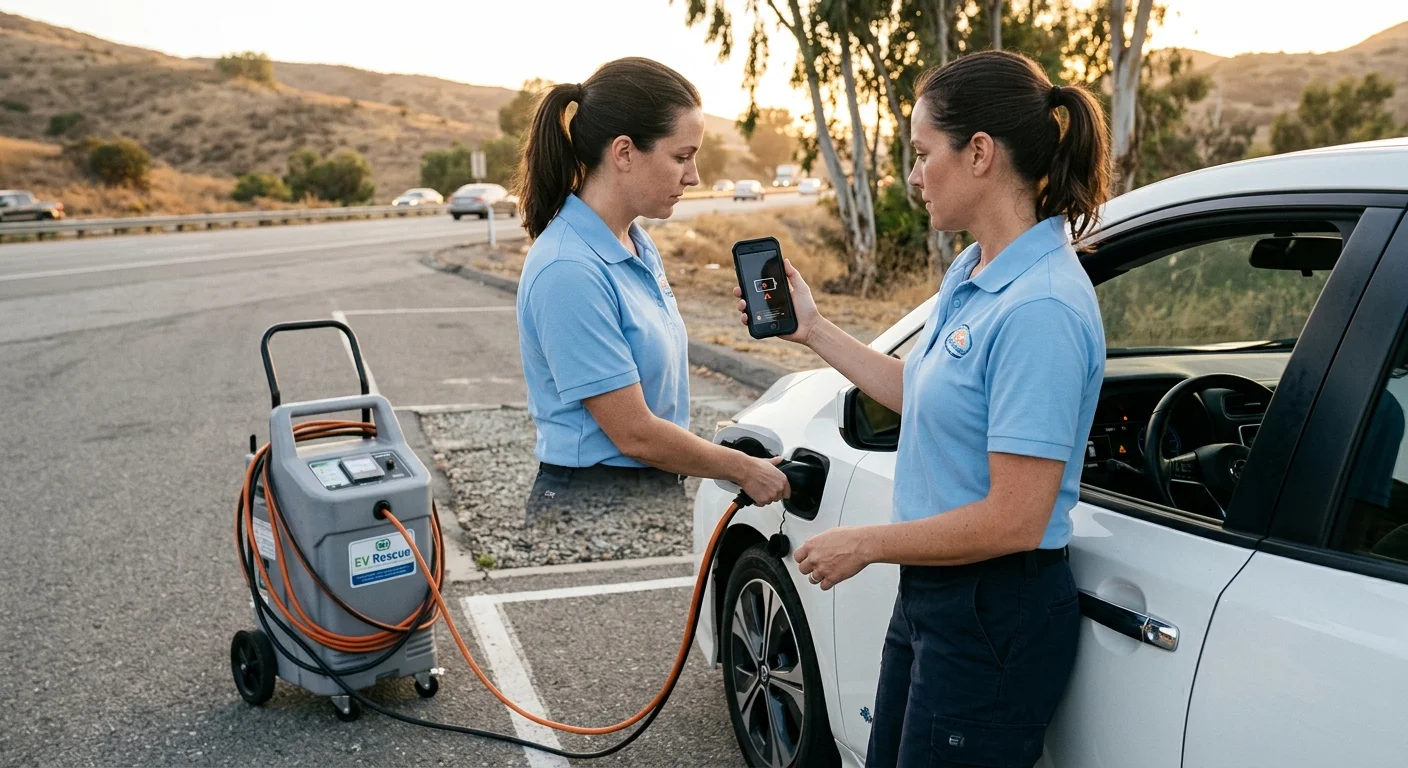
The operators we connect you with can jump or replace a dead 12-volt on site. They also bring a 240-volt Level 2 source when the pack itself is empty. Typical charging time adds about 10 to 20 miles in 15 to 30 minutes. That’s charging time on the car, not an arrival time. The matched operator quotes you before starting and bills you directly.
Pick roadside help or a service center
Choose from what you need at this spot right now. Roadside help fits when the car won’t unlock or won’t wake. Ask whether the operator supports your model and the help you’re requesting. A Tesla 12-volt jump is one path when that’s the failure. Broader EV roadside assistance covers the handoff when you’re not sure which battery failed. Drivers in other brands can start with non-Tesla EV rescue.
A service center fits when you need diagnosis or a repair. Tell the advisor it died again after a jump. Send the same timeline and photos you already made. An operator can handle the location problem first. Confirm that plan with the operator before any work starts. If a tow comes up, follow the manufacturer’s current towing instructions for your model.
Don’t pick based only on the range number you last saw. Report that figure as one observation next to the warnings and behavior. Let the operator or advisor decide what it means.
Say whether you’re in a private garage, public lot, gated complex, or parking structure. Say whether you’re on a route like I-70, Peña Boulevard, or C-470. Peña’s city-maintained, not an interstate, and it’s the only road into DEN. A week-long sit in a cold airport lot’s a classic 12-volt repeat-death. Don’t move the car in a way that fights the official procedure.
The U.S. Department of Energy’s electric vehicle overview is general background. It can’t diagnose this post-jump failure on your car.
Before you approve work, ask who will do it and what they’re proposing. You’ll contract with the independent professional and pay them directly. Charge Pro DEN’s a referral line, not a shop. We don’t own trucks, employ techs, or set prices.
If it still won’t wake
If the 12-volt fails again and the car stays dark, start with mobile rescue. Share the model, year, exact warnings, location, and what followed the first jump. Call (720) 738-6950 and we’ll connect you with a local EV rescue operator. The pros we connect you with are licensed and insured. They’ll quote you before they start the work.