The best roadside assistance for a Tesla still depends on what failed. A dead 12-volt, a flat, and an empty pack are different jobs. CDOT’s free Safety Patrol will jump a 12-volt on covered metro freeways. It will change a tire too. It won’t charge the pack. Colorado has no EV breakdown law. Tesla roadside, AAA, and a local mobile rescue still cover different holes.
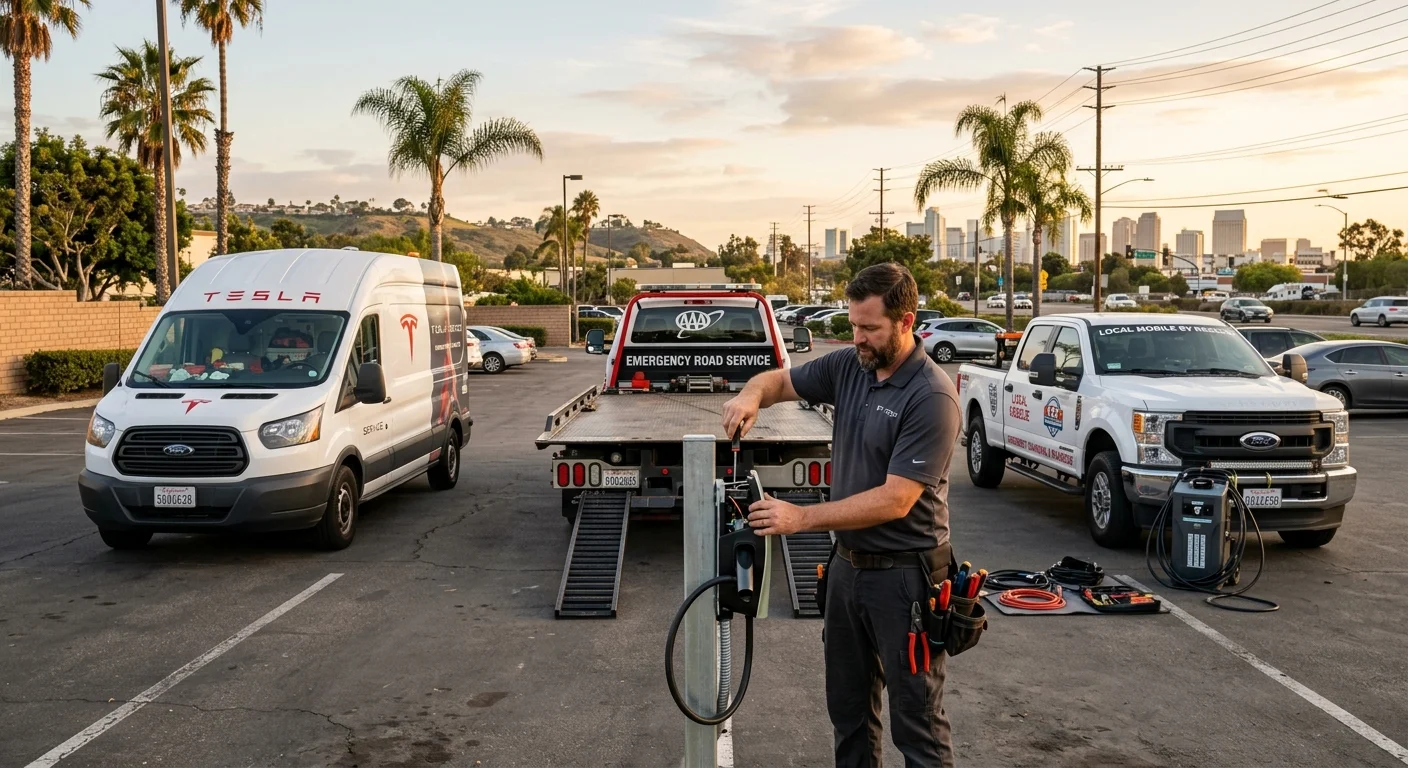
CDOT Safety Patrol is free. It still isn’t an EV charger
CDOT Safety Patrol is run by the Division of Maintenance and Operations. Help is free on listed metro freeway segments. Coverage includes I-25 South from 120th Avenue to Arapahoe Road. It includes I-70 East from Wadsworth to Airport Boulevard. Portions of US-6, C-470, and I-225 are on the list. The I-70 Mountain Corridor is covered from Morrison to Vail.
The published menu is ordinary roadside work. That means flat tires, jump-starts, emergency fuel, and minor mechanical help. It also means debris removal and incident support. CDOT’s Safety Patrol page, read on September 18, 2026, doesn’t mention electric vehicles. The agency’s breakdown page is silent on EV charging too. There’s no charging-specific service on either page.
A Tesla with a dead 12-volt can look fully dead. Patrol can often jump that small battery. A Tesla at zero on the traction pack is a different car. Patrol doesn’t bring 240-volt power to the charge port. Flag them for a tire or a 12-volt jump during published hours. A pack charge isn’t in the program.
Weekday Front Range hours are 6:00 to 9:30 am. Afternoon coverage is 2:30 to 7:00 pm. Weekends run 10:00 am to 7:00 pm. Mountain Corridor hours are 6:00 am to 7:00 pm Friday through Sunday. It also runs during significant weather. Outside those windows, the free truck isn’t the plan. For the after-hours fork, read Tesla roadside, CDOT patrol, or a local boost.
COtrip.org and the 511 line are CDOT’s live boards. Use them for I-70 closures. They also post traction-law and chain-law status. Those rules activate by highway signage and COtrip. They don’t activate on a date you memorize.
Colorado law treats a stalled Tesla like any other car
A stalled Tesla follows the same shoulder rules as a gas car. CRS 42-4-1202 is the disabled-vehicle statute. Outside a business or residential district, you may not stop on the paved main-traveled way. The exception is a vehicle so disabled it can’t leave the roadway. Hazards must be on under CRS 42-4-230. A violation is a class B traffic infraction.
You may sit on the shoulder if the car truly couldn’t go farther. Keep the hazards on. The statute doesn’t give you a charge, a tow, or a patrol truck.
Abandoned-vehicle rules sit in CRS 42-4-1803 to 1805. An officer decides on reasonable grounds. The statute sets no fixed hour threshold. Don’t assume you have a day before a tow. Colorado State Patrol handles enforcement, crash response, and dispatch. It also holds abandoned-vehicle removal authority under that statute.
No Colorado statute addresses a disabled EV. None addresses mobile or roadside EV charging. The EV-specific statutes on the books are HOA charging-access rights and charging-space parking enforcement. Neither is a breakdown law. That absence was confirmed on September 18, 2026.
Check the 12-volt before you blame the pack
A Tesla has two electrical systems. The big pack moves the car. The small 12-volt battery wakes screens, locks, and contactors. Cold hits the small one first. Denver’s January normal low sits around 18 degrees. The all-time record is minus 29. In January 2024, Denver fell from 47 to minus 19 in two days. A car that sat through that night may not be empty. It may not even unlock.
The same 12-volt stall shows up after a long sit at Denver International. Peña Boulevard is the only road in. It’s an 11-plus-mile city-maintained freeway across open plains. A dark car there is often a jump, not an empty pack.
If the car is dark and silent, treat it as a 12-volt problem first. Tesla roadside, CDOT patrol, and a local operator can all jump that battery. An empty pack needs energy at the charge port. That’s a different call. See Do Teslas have a 12-volt battery, and why cold parking kills it.
Range also shrinks in this climate. Recurrent Auto found EVs keep about 78 percent of range at 32 degrees. They keep about 70 percent at 20 degrees, on average. AAA’s 2026 dynamometer study reported about 39 percent range loss at 20 degrees. Heat-pump cars held about 10 points more at 32 degrees in the Recurrent data. Tesla doesn’t publish a Denver-specific range figure we could verify.
Elevation adds load on the climb. Denver sits at 5,280 feet. Idaho Springs sits at 7,526 feet. The Eisenhower-Johnson Memorial Tunnel west portal is 11,158 feet. Regen on the descent recovers a large share of the climb. Drivers still often cut regen on ice for traction. That mix is why empty-pack calls happen here.
Tesla roadside knows the car. It isn’t a bumper charger
Tesla publishes roadside terms in the app and on its own site. Confirm yours by VIN. Coverage windows, paid extensions, and contractor dispatch change. This page won’t invent a year count or a mileage cap.
Factory roadside is built for familiar Tesla work. That usually means a 12-volt jump, a tire, a lockout, and a tow. The line knows Tesla diagnostics. They dispatch Tesla-approved contractors. Those contractors aren’t Tesla employees with a Supercharger on the truck. See What Tesla roadside will and will not cover.
An empty traction pack is where owners get surprised. Tesla roadside isn’t a promise of 240-volt power at the bumper. The usual factory path for a zeroed pack is a tow to a charger. Superchargers sit across the metro, including Park Meadows in Lone Tree and Castle Rock. Idaho Springs is the last Supercharger before the tunnel from the Denver side. That site has 8 stalls. A tow into a queue still leaves you sitting.
Tesla roadside remains the right first call for a warranty diagnostic. Use it for a tire Tesla will own, or a tow Tesla will authorize. Skip it if you need miles added where the car already sits. See Tesla roadside policy in 2026, in plain terms.
Club plans like AAA: ask about a charge before you need one
Club roadside is still a tow-and-jump network first. AAA is the name most owners already carry. Membership tiers, towing miles, and EV extras vary by club and by year. This page can’t quote a 2026 add-on as if it were uniform. It isn’t.
Ask your club two questions before you stall. Will they jump a 12-volt on a Tesla. Will they send a charger to the car. Or will they only send a flatbed to a Supercharger. A long tow to a service center can still be the right club job. It’s a blunt tool for a pack that only needs 10 to 20 miles. See When your EV dies, does AAA bring a charge or only a tow.
Local mobile rescue in this metro is built to charge and jump. It isn’t a statewide heavy-tow network. If the car must ride a long way, use the club miles you bought.
E-470, express lanes, and the mountain corridor
E-470 is the eastern-metro loop. It’s all-electronic and cashless. The E-470 Public Highway Authority publishes its own free roadside assistance. A disabled driver pulls to the shoulder and dials *470. That truck handles flat tires, fluid top-offs, jump-starts, phone help, and debris removal. You can also dial *CSP (*277) for State Patrol. E-470 doesn’t publish an EV-specific charge. There’s no EV toll discount on E-470.
The I-25 North and US-36 Express Lanes were built with a minimum 8-foot outside shoulder. If you stall in those lanes, move to the right, outside shoulder. A claim of no shoulder isn’t accurate on those two corridors. Courtesy patrol presence is part of that design. It still isn’t a mobile EV charger.
The I-70 Mountain Express Lane runs roughly 12 miles. It sits between the Veterans Memorial Tunnels near Idaho Springs and Empire Junction. Westbound has used dynamic tolling since November 25, 2024. Toll amounts change and weren’t confirmed as a single figure. Get hazards on and pick the right phone. Northwest Parkway roadside hours weren’t confirmed from a page we could read.
What a local mobile rescue still does
Charge Pro DEN is a referral line. It matches stranded EV drivers with independent local operators. It doesn’t own trucks. It doesn’t employ technicians. It doesn’t set the price. The operator quotes you before starting and bills you directly.
The operators we connect you with bring a 240-volt Level 2 source. Teslas take a native NACS plug. Other EVs use a CCS or J1772 adapter. Typical charging time adds 10 to 20 miles of range in 15 to 30 minutes. That’s charging time, not an arrival promise. They also jump or replace a dead 12-volt on site. They handle Tesla and every major EV brand.
That’s the job Tesla roadside and CDOT still skip. It’s energy into the pack where the car already sits. A club plan may or may not buy that job for you. If the pack is empty on a shoulder, start with a charge at the car. A first-resort flatbed is the backup, not the default. Details live on Tesla roadside rescue. See Stranded with no charge on I-25: what to do next.
Limits are real. A local operator isn’t a mountain recovery fleet. A long mechanical tow is still a Tesla or club job. Shoulder law still applies. You still need hazards on. The quote is the operator’s, not a published rate on this site.
Save the numbers before you stall
Save Tesla roadside in the app, not only in a screenshot. Save your club number if you pay for one. Save *470 if you use E-470. Save 511 for CDOT. Call Tesla for a tire, a lockout, or a tow they’ll authorize. Call Safety Patrol or *470 for a jump or a tire on their roads. Call a local operator when the pack needs energy where the car sits. For a local charge or 12-volt rescue in the Denver metro, call (720) 738-6950. The operator quotes before any work starts. You’re buying a charge or a jump from an independent pro. This line doesn’t roll a truck.