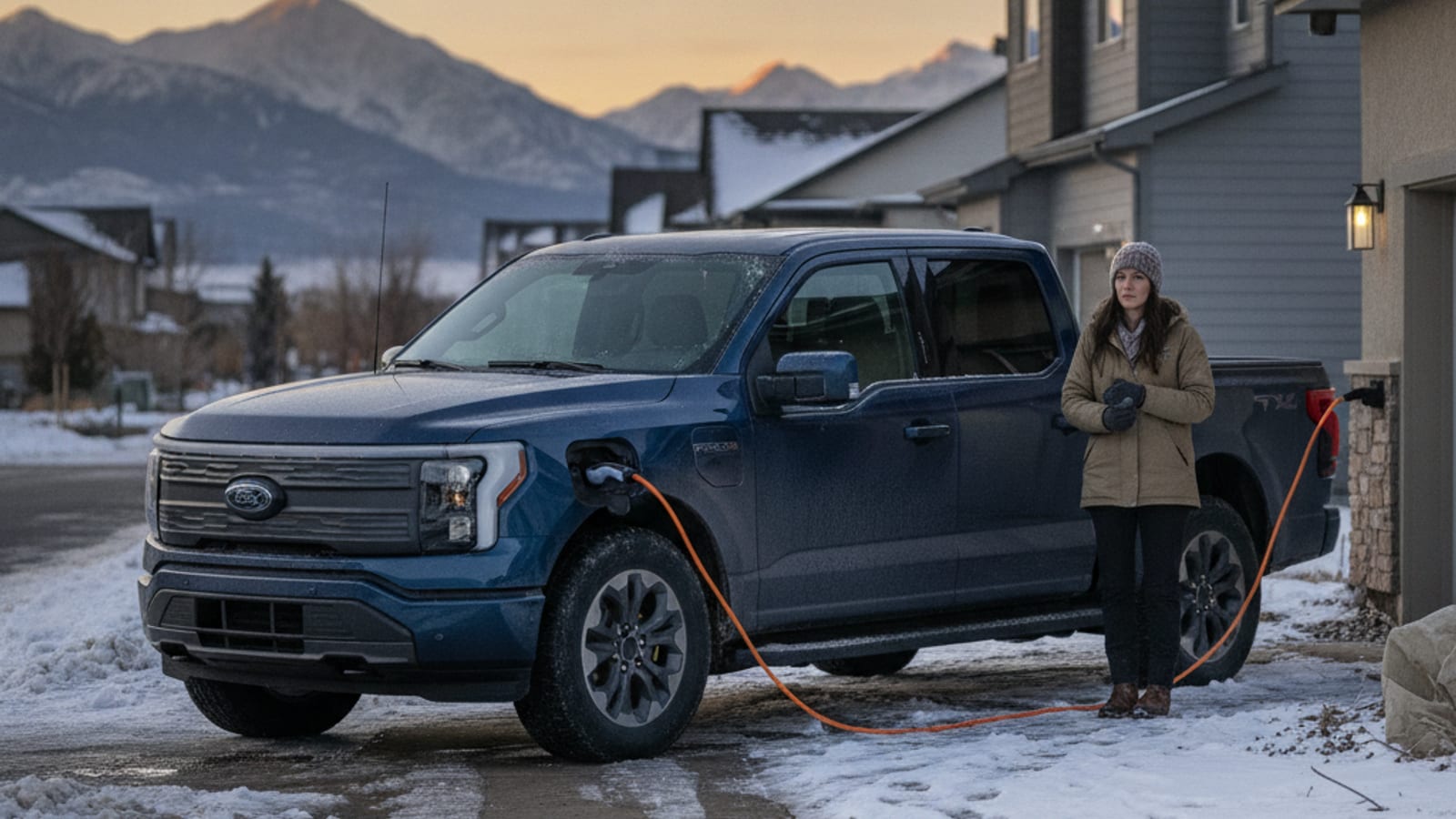
A Level 1 charger is the 120-volt cord that ships with most new EVs. It plugs into a standard household outlet. In a Denver January, it usually is not enough. The cold eats more range overnight than 120 volts can put back in. If your car wakes up below the buffer you expected, call (720) 738-6950 and the operators we refer can bring a 240-volt Level 2 boost to your driveway, garage, or a covered lot.
What Level 1 actually is
Level 1 charging is 120-volt alternating current from a normal household outlet. Power output sits around 1.9 kilowatts. Connector on most American EVs is the SAE J1772 plug, with NACS (J3400) on newer Teslas. Charging speed is roughly 5 miles of range per hour of charging. That number comes from a car sitting still in mild weather with the heater off. Real-world numbers swing with state of charge, battery size, the car’s onboard charger capacity, the cord’s gauge, and how cold the pack is when you plug in.
The 120-volt circuit is what every garage and most outdoor outlets already have. It costs nothing to install. The trade is time. A 60 kWh battery, sitting empty, needs many overnight sessions on Level 1 to come back to full.
What the Denver cold does to that math
Denver’s January normal low sits near 18 degrees. The all-time record cold for the city is minus 29. January 2024 swung Denver from 47 to minus 19 in about 48 hours. That kind of cold does two things at once.
It cuts the range the pack can deliver. Recurrent Auto studied more than 30,000 U.S. EVs in winter. At 32 degrees, EVs kept about 78 percent of max range. At 20 degrees, that fell to about 70 percent. Best model in the study kept 88 percent. Worst kept 69 percent. AAA’s 2026 dynamometer work found about a 39 percent range loss at 20 degrees. The cold cuts what your dashboard says you have.
It also makes the car work while it sits. Below about 15 degrees, the battery management system wakes up to run thermal management. That is the “phantom drain” drivers describe when their car loses charge sitting in the driveway overnight. The pack is protecting itself. The energy for that protection comes out of the same battery you are trying to refill from a 120-volt cord.
Put those two effects together and the math turns. You lose 20 to 30 percent of available range to cold, then the car spends some of what is left keeping the pack alive overnight. A 120-volt cord at 1.9 kW cannot outrun that draw on a Denver January night.
What a Level 1 cord can and cannot do here
It works fine for a short, predictable commute on a Level 2-ready car with a garage that stays above freezing. The plug comes with the car. You top off between drives. You never see an empty pack.
It fails when you layer any of these on top:
- A long commute that uses most of the pack before you get home
- Street parking with no outlet at all
- An attached garage that drops near or below freezing overnight
- A weekly ski run that adds mountain miles on top of a cold-soak weeknight
- A car without a heat pump, which costs more energy to warm the cabin
Most Denver EV drivers fall into at least one of those buckets for some part of the year. That is when a Level 1 cord stops being enough.
The Capitol Hill pattern and the foothills climb
More than half of Denver’s housing predates 1980. A large share of renters and older-home owners in Capitol Hill, Baker, Five Points, and Wash Park live entirely on public charging or street-parking Level 1 cords. Cold morning, frost on the windshield, the dashboard a few miles lower than the night before. That is the urban Denver call.
The foothills tell the other story. From Golden up to Evergreen, the climb gains well over 1,000 feet. The I-70 Mountain Corridor climbs to the Eisenhower-Johnson Memorial Tunnel at 11,158 feet. Idaho Springs, at 7,526 feet, is the last Tesla Supercharger before the tunnel from this side. Georgetown, sitting between, shows no Supercharger in the current inventory. Cold plus grade plus heater plus a long climb eats a margin that looked fine on the plain.
A Level 1 cord at home does not refill what a mountain day took out. Drivers who commute down to Denver and climb back up in the dark learn this fast.
Phantom drain and the cold-soak week
A week in a cold DEN parking lot can kill the 12-volt battery. The 12-volt is a separate system from the traction pack. It runs the computers, contactors, and door locks. When it dies, the car looks finished. The traction pack may still hold plenty of energy. Operators we refer can jump a 12-volt on site, and replace one on site when that is the job. The split matters because the fix is different.
For the wider choice on a dead car in a cold lot, read Can roadside jump an EV 12-volt. That post walks the 12-volt versus empty pack call.
When you need a Level 2 boost instead
A 240-volt Level 2 source adds about 10 to 20 miles of range in 15 to 30 minutes of charging. That is enough to clear the last mile home, reach a Supercharger, or get off a shoulder and back to a known stall. Charge Pro DEN is a referral line. We do not own trucks. We do not employ technicians. The operator quotes you before any cable goes in. You pay them directly for the work they do.
Call (720) 738-6950 when you want that match. Treat it as a referral number, not a rolling promise. For the broader empty-pack case, see out-of-charge recovery. For the charge-in-place versus tow choice, read mobile EV charging.
What Level 1 looks like at the end of a Denver week
A driver who relies on a 120-volt cord through a Denver winter spends the cold months one or two cycles behind. They plug in at 30 percent. They wake up at 50. They drive to work and arrive at 20. They plug in again. They do not have margin for an extra errand, a hospital run, or a friend who needs a jump-start. That is the lived experience the spec sheets do not describe.
The fix is not always a Level 2 home charger. Many Denver homes and rentals cannot host one. The fix in the moment is a mobile boost from an independent operator who quotes first.
Where a Level 1 cord still earns its place
Level 1 has real uses. It is a great top-off cord between drives on a warm day. It is a perfect travel backup for a plug-in hybrid that mostly uses gas. It is the right tool when your daily miles are well below the pack size and your parking spot stays above freezing. It is also the cord that gets you home once after a missed charge, while you sort a real solution.
It is the wrong tool to lean on for a Denver winter commute, a foothills climb, or a cold-soak week at the airport. Those situations need a Level 2 plan, and they need a fallback for the day the plan falls through.
How to plan for the cold week
Start with your real weekly miles, not your best week. Add the cold haircut (about 20 to 30 percent on a typical Denver January). Add a buffer for cabin heat, which alone can pull 5 to 10 miles out of a commute. If the math still leaves you inside the pack’s daily Level 1 refill, you are fine. If it leaves you under, you need a Level 2 home charger, a workplace charger, or a plan to call for a mobile boost before the pack drops below your safe floor.
For Tesla drivers, Tesla roadside, AAA, and a local mobile rescue compares the three paths and what each will and will not bring to your car. For non-Tesla drivers using CCS or J1772, non-Tesla EV rescue in the Denver metro is the path that finds an operator with the right adapter.
What we do and do not do
Charge Pro DEN is a referral line. We match stranded EV drivers with independent local operators. We do not set prices. We do not promise arrival times. We do not publish hours. We do not perform the work ourselves. The operator you reach through us quotes before they start and bills you directly for the job. We do not hold a license, and we do not name a single operator as “ours.”
The operators we refer handle Tesla and every major EV brand. A stuck charge port is a latch problem, not a tow problem. An empty pack is a Level 2 problem, not a flatbed problem. A dead 12-volt is a jump problem, not a tow problem. Knowing the split keeps the call the right size.
Colorado rules that matter on a cold shoulder
CRS 42-4-1202 lets you sit on the shoulder with hazards on if the vehicle could not be moved further. CRS 42-4-230 requires those hazard lights. Colorado is a one-party-consent recording state under CRS 18-9-303, so you may record a call with the operator without telling them, though disclosing is good practice. There is no Colorado statute that treats a disabled EV as a special class.
CDOT Safety Patrol covers listed metro freeway segments and the I-70 Mountain Corridor. It will jump a 12-volt and change a tire on those listed segments. It will not charge a traction pack. For a Level 2 boost on a covered segment, the operator is the path.
A short checklist for a Level 1 winter
- Know your real daily miles in cold, not your best-week miles.
- Keep the pack above about 20 percent overnight when a freeze is in the forecast.
- Plug in as soon as you park. The cord pulls more when the pack is warm.
- Pre-condition the cabin while the car is still plugged in, so the heater does not eat the morning’s range.
- Save (720) 738-6950 in your phone as the boost number, not just in your head.
If the morning pack is lower than the night before, and you cannot wait the hours a 120-volt cord needs to refill, that is the moment to call.
Frequently asked questions
Is a Level 1 charger enough for a Denver winter?
For most daily drivers it is not. Cold cuts available range by 20 to 30 percent, and phantom drain from thermal management eats more overnight. A 120-volt cord at 1.9 kW cannot outrun that draw on a typical Denver January night.
How long does Level 1 take to charge an EV?
About 5 miles of range per hour of charging in mild weather. Cold slows it further, and the car may use energy to keep the pack warm while it sits. A full charge from empty can take many overnight sessions.
Can I leave my EV plugged in all winter on Level 1?
You can leave it plugged in. The car manages its own charging. Level 1 will refill what a short, mild day used. It will not refill what a cold week, a mountain climb, or a long commute took out.
Should I install a Level 2 charger at home in Denver?
That depends on your housing and your miles. Many older Denver homes and rentals cannot host a Level 2 outlet easily. The fallback for those drivers is a mobile boost from an independent operator when the Level 1 cord falls behind.
Who do I call if my Level 1 charger cannot keep up?
Call (720) 738-6950. Charge Pro DEN matches you with an independent local operator who brings a 240-volt Level 2 source. The operator quotes before they start. You pay them directly.