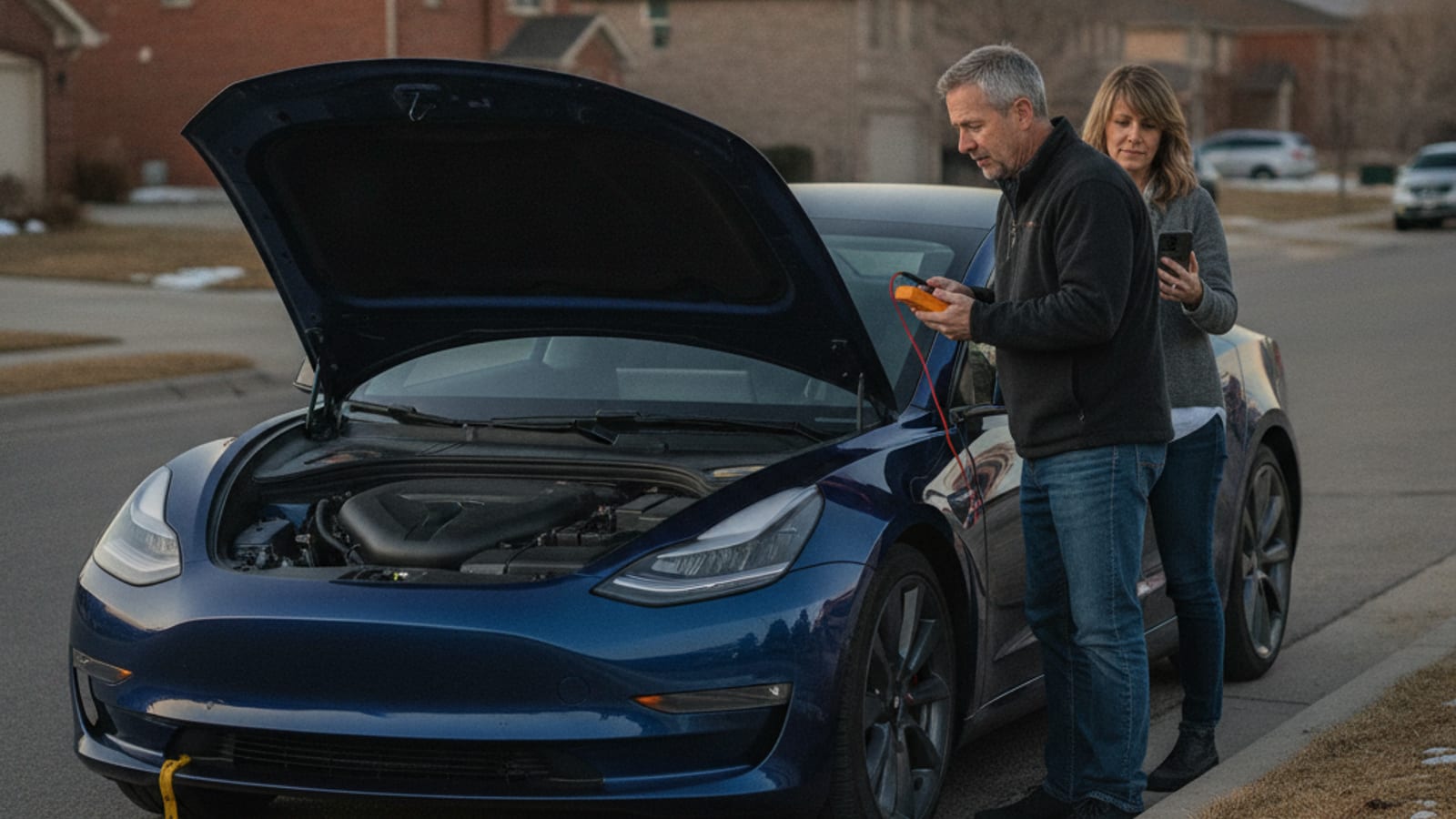
Tesla 12V battery failure symptoms almost always show up a few days before the car will not wake. The traction pack can still hold plenty of range, and the car still drives fine, but little signs start showing up. Phantom drain after a Denver freeze is the most common early warning. If you catch it before the car goes fully dark, you can jump or replace the 12-volt on your own schedule. If you do not, you wake up one morning to handles that will not come out and a touchscreen that will not light up. If that is happening now, call (720) 738-6950. Charge Pro DEN is a referral line. We match you with an independent local operator. The operator quotes you before any cable goes in and bills you directly for the work.
Phantom drain is the first sign on a Denver night
Denver sits at 5,280 feet on the high plains. January normal lows run around 18 degrees. The all-time record is minus 29 on January 9, 1875. In January 2024, Denver went from 47 to minus 19 in about 48 hours. Sub-freezing nights pull more from a parked Tesla than drivers expect. Two things stack on each other. Cold cuts a 12-volt’s available capacity, and the car’s thermal management wakes during a long soak to keep the traction pack warm. That draw is what people call phantom drain.
You see it the morning after a cold night. The state of charge dropped three, five, or ten percent sitting still. That is the thermal management pulling on the 12-volt to run the coolant heater. On older Model S and Model X with a lead-acid 12-volt, phantom drain shows up around 15 to 20 degrees. On a newer lithium 12-volt in late 2021 and forward Model 3 and Model Y, it still shows up, just at lower temperatures. If you plug the car in at night and wake up to a pack that did not gain what it should have, treat it as a 12-volt early warning.
Recurrent Auto studied more than 30,000 U.S. EVs in winter. At 32 degrees, EVs kept about 78 percent of max range. At 20 degrees, about 70 percent. The range loss is one thing. The phantom drain is another. The two together are why a Denver morning at 12 percent pack can feel like a cliff edge.
Slow handles and dim lights are the second sign
Before the car refuses to wake at all, the 12-volt usually shows its weakness in smaller ways. Pay attention to these and you can catch a dying 12-volt early.
- The door handles take longer to present. On Model S, the handles motor out. On Model 3 and Model Y, they push out when you approach with the phone. A 12-volt that is fading will make that motor sluggish. The handle may rock part-way and stop. It may sit flush and only respond after a second or third try.
- The headlights flicker or look dim. Stand in front of the car at night and look at the lamps. If the DRL or low-beam pulses when the car wakes, the 12-volt cannot hold steady voltage. The same can show up when you open the trunk or frunk and the light comes on weakly.
- The touchscreen lags. A Tesla boots the screen off the 12-volt. When the battery is marginal, the screen may take longer to wake. It may freeze on the Tesla logo. It may load and then go black, then come back. None of these are random. They trace to low voltage at the computer modules.
- The chimes sound wrong. The walk-away chime, the seatbelt chime, the open-door chime, all of these come from the 12-volt. If they sound quieter than usual, or sound when they should not, the 12-volt is sagging under load.
- The phone-as-key keeps disconnecting. If the Tesla app keeps losing connection to the car overnight, or the phone-as-key keeps needing a re-pair, the 12-volt is failing to keep the network module alive.
Each of these on its own can be a glitch. Together, or repeating over several cold mornings, they point at a 12-volt that is on its way out.
What the car itself tells you
Tesla pushes 12-volt warnings to the touchscreen and the app when the system sees a low-voltage fault. Some of these only show up after the car has been awake for a minute or two. If you ignore a warning, you may not see it again until the next drive.
Common messages that flag a 12-volt problem on a Tesla:
- “12V battery needs service.” This is the most direct one. Schedule the car in. The sooner the better, because the next cold night may finish the battery.
- “Vehicle may not restart.” A serious warning. The car is telling you it cannot promise the next wake-up. Drive straight to a service center or get a mobile 12V replacement.
- “Low voltage. Pull over safely.” This one can come up while driving. The DC-DC converter is having trouble charging the 12-volt from the pack. The traction pack still drives the car, but the accessories may start cutting off. Get off the road before you lose lights and signals.
- Battery icon with a red exclamation mark on the dash cluster (Model S and X). A clear warning that the 12-volt is below its safe threshold.
- A “service 12V battery” message after a software update. Updates wake the 12-volt and stress it. A marginal 12-volt sometimes only shows its age after an update.
If you see any of these, do not park the car overnight and hope. A 12-volt that has shown a warning once will show it again, and the gap between warning and stall gets shorter each cold night.
The lithium 12-volt still fails the same way
The newer lithium-ion 12-volt in late 2021 and forward Model 3 and Model Y is more resilient than a lead-acid unit. It holds a charge longer when parked. It can sit through a Denver weekend in a cold garage and still wake up. That buys time, not immunity.
Two patterns still kill a lithium 12-volt here.
The first is a long cold soak without a charger. Leave the car at the airport for a week in January. The traction pack still holds its charge because it is much larger, but the lithium 12-volt sags under the constant thermal management draw. By the time you fly home, the 12-volt is below the boot threshold.
The second is a stuck accessory. A phone left plugged into a USB port, a cabin overheat protection that keeps running, a dashcam sentry mode left on. Each one pulls a little current. Over days in the cold, that little adds up. The lithium 12-volt will protect itself by shutting down. When that happens, the car looks completely dead until the 12-volt recovers enough voltage to wake the network modules.
For the difference between lead-acid and lithium 12-volts in a Tesla, read Do Teslas have a 12V battery in cold.
Where the 12-volt hides and why that matters
The traction pack is the big battery under the floor. The 12-volt is a small separate battery that boots everything. Knowing where it sits tells you what a jump involves.
On Model 3 and Model Y built before late 2021, the lead-acid 12-volt sits under the frunk cowl. You open the hood and lift a red plastic cover to reach the positive post. The negative post is a chassis ground nearby.
On Model 3 and Model Y built from late 2021 forward, the lithium 12-volt is in the same general area. Tesla uses hood-mounted jump terminals accessed through small access panels on the driver and passenger sides of the frunk. You unlatch the hood without opening it fully.
On Model S and Model X, the 12-volt sits in the front trunk area. The Plaid and refreshed Model S moved to a lithium unit. Use your VIN and year, then the owner’s manual, to find the exact posts. Never improvise on the high-voltage orange cabling.
For the full layout, read Where a Model 3 hides the 12-volt and the pack.
What a Denver winter does to a marginal 12-volt
The Denver metro stacks three factors on top of each other.
Cold cuts available capacity. A 12-volt at 20 degrees delivers less current than the same 12-volt at 70 degrees. The boot sequence needs a short burst of high current. A cold, marginal 12-volt cannot deliver that burst even if it shows a normal voltage at rest.
Sub-freezing nights stack across a week. A single cold night is survivable. A week of cold nights in a row pulls the 12-volt lower each morning. The thermal management wakes more often as the pack itself cools. Drivers see phantom drain grow from two percent overnight to six percent overnight to ten percent overnight.
A long dwell in a cold lot finishes it. The Denver International airport, a Park Meadows garage in Lone Tree, a Tech Center structure in Greenwood Village, the Federal Center lot in Lakewood, a Red Rocks amphitheatre lot in Morrison. A parked car in any of these in January will not move. The traction pack survives. The 12-volt does not.
The CDOT Safety Patrol covers portions of I-25 South, I-70 East, US-6, C-470, I-225, and the I-70 Mountain Corridor Morrison to Vail. Front Range patrol hours are 6:00 to 9:30 a.m. and 2:30 to 7:00 p.m. weekdays, with 10:00 a.m. to 7:00 p.m. weekends. Mountain Corridor hours run 6:00 a.m. to 7:00 p.m. Friday through Sunday, plus significant weather days. If you can drive to a covered segment on a covered hour, the patrol will jump a 12-volt. They will not bring a Level 2 source for the pack. For the call order, read Tesla roadside, CDOT patrol, or a local boost.
What to do when the signs start
A warning you can act on is a good warning. A warning you ignore is a tow in the making.
Drive the car. The DC-DC converter charges the 12-volt from the pack while the car is awake. Twenty minutes of driving on the highway can bring a sagging 12-volt back above its threshold.
Plug the car in. A plugged-in Tesla runs thermal management from grid power, not from the 12-volt. That removes the largest cold-night draw. If you have a home Level 2, leave it plugged in overnight. If you only have a Level 1 at home, plug in anyway. The charger keeps the network modules awake without pulling on the 12-volt.
Schedule service. A “12V battery needs service” message will not clear on its own. The battery is aging. Replace it before the next cold snap, on your schedule. The independent operators we refer can come to your driveway or lot, quote you, and swap the 12-volt on site.
If the car will not wake today, do not keep trying the touchscreen. Each press wakes the network module and pulls from a 12-volt that cannot deliver. Open the Tesla app and request roadside. If your car is on the Tesla RSA plan, the app dispatches. If it is not, or you need a faster path, call (720) 738-6950.
For the diagnostic walk-through, read How to tell if your Tesla’s 12-volt is dead.
Why the operators we refer jump on site
A flatbed to a service center can take a day or more in the Denver metro, especially in winter when a single storm backs up every shop in the metro. A local operator with a 12V jump pack can reach you faster and start the car where it sits. That gets you to a charger under your own power.
Operators we refer do the same job CDOT Safety Patrol does on a covered segment, plus the things CDOT will not do. They jump a 12-volt on a private lot, in a residential garage, on a city street, at a shopping center, or in an airport lot. They carry a replacement 12-volt for the models they know. They quote before work starts and bill you directly. There is no membership and no dispatch fee added by the brand. You pay the operator for the work they do.
If the car needs a tow instead, the operator can coordinate that with a flatbed partner. A tow is the right call when the car cannot roll, when the suspension is bent, or when a Level 2 charge is the only fix and you do not want to wait for a mobile unit. For the choice, read Mobile charge or tow: which a stranded Denver EV actually needs.
If the signs have already turned into a stall
A Tesla that will not wake is the end state of the signs above. The handles stay in. The screen stays black. The phone-as-key disconnects. The car looks finished.
That is the moment to stop guessing about the traction pack. The pack may be fine. The 12-volt is the failure. A jump from a portable pack or another vehicle through the dedicated 12-volt posts will usually wake the car. The screen comes up. The dash lights come on. The pack relay closes. The car drives.
If you do not have a portable pack and you are not comfortable jumping a Tesla, call (720) 738-6950. Tell the operator where the car is parked and what model you drive. The operator will quote a 12V jump or an on-site 12V replacement. Use the call as a referral line, not a promise of arrival time. The operator sets the timing and bills you directly. For the broader coverage picture, read Tesla roadside: what is included and what is not.
Frequently asked questions
What are the first Tesla 12V battery failure symptoms after a cold night?
The first symptoms are phantom drain on the traction pack, slow or sluggish door handles, dim or flickering headlights, a touchscreen that takes longer to wake, and a phone-as-key that keeps disconnecting overnight. Each of these on its own can look like a glitch. Repeating over several cold mornings means the 12-volt is failing.
Can a Tesla 12V die without the pack going empty?
Yes. The 12-volt and the traction pack are two separate batteries. The traction pack drives the motors. The 12-volt boots the computers, latches, and relays. A cold-soak 12-volt can die while the pack still holds plenty of range. The car will not wake, will not unlock, and will not shift. From the curb it looks finished, but the pack is fine.
Does the lithium 12V in newer Teslas still fail in Denver cold?
Yes. The lithium 12-volt is more resilient than lead-acid, but it can still sag below the boot threshold during a long cold soak or a stuck accessory draw. A week at the airport in January can kill it. The warning signs look the same as on a lead-acid unit.
What should I do if I see a 12V battery warning on the touchscreen?
Drive the car for twenty minutes to let the DC-DC converter top the 12-volt, plug the car in overnight so thermal management runs from grid power, and schedule a 12V replacement before the next cold snap. The warning will not clear on its own and the gap between warning and stall gets shorter each cold night.
Who jumps a Tesla 12V in the Denver metro?
CDOT Safety Patrol jumps a 12V on listed Front Range freeway segments during published hours. Tesla RSA dispatches a contractor through the Tesla app. Independent operators we refer through (720) 738-6950 jump or replace a 12V on site on a private lot, a residential street, an airport lot, or anywhere a service truck can park. The operator quotes before work starts.