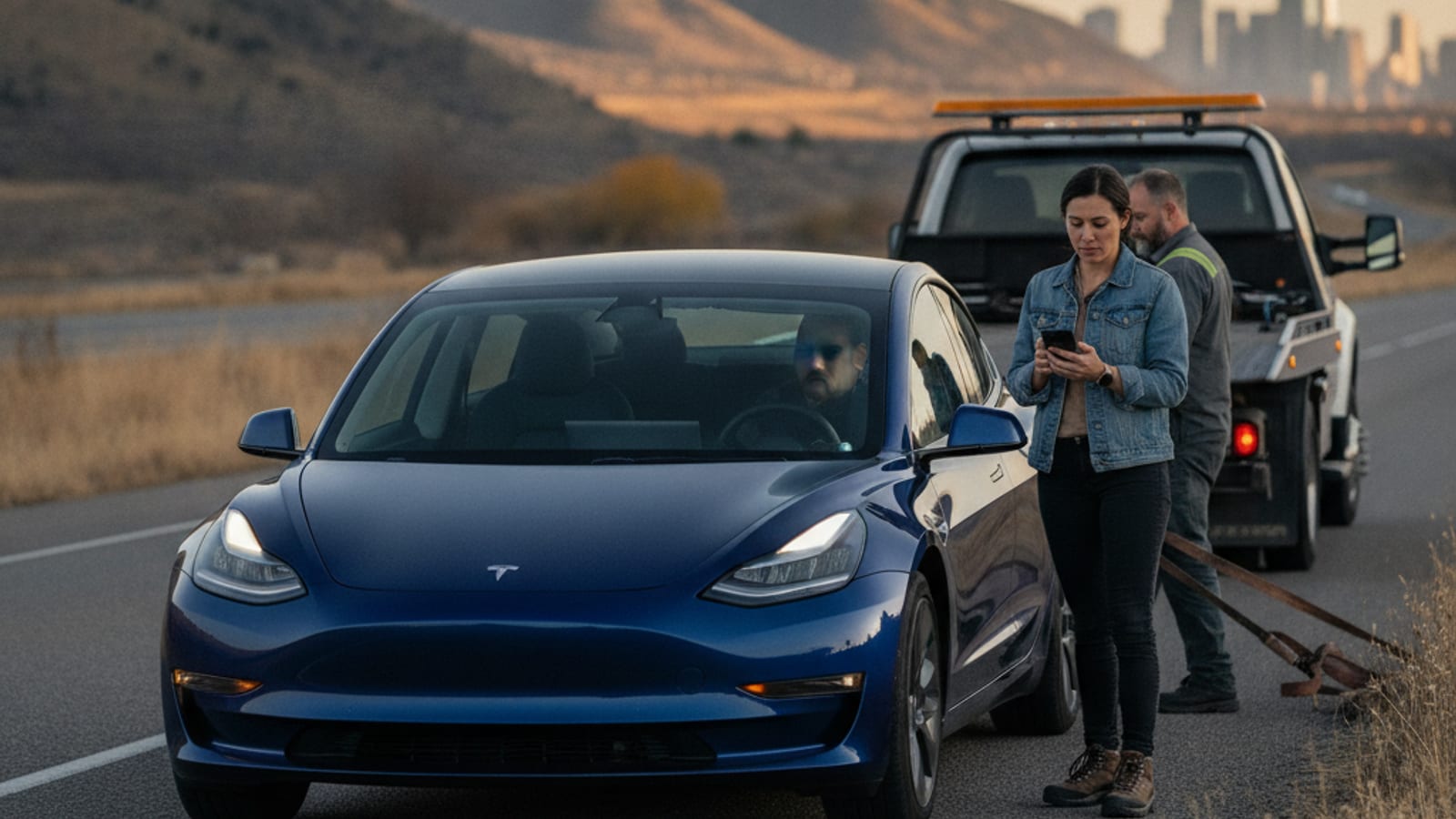
Tesla roadside assistance free vs paid is the question every stranded Tesla driver wants answered at the bumper. The short version: Tesla’s app path covers a short list of jobs at no extra charge to most owners. A 240-volt Level 2 charge in place is not on that list. That gap is the one that catches Denver metro drivers on I-70 west of Golden, on the I-25 South climb toward Castle Rock, and in a long airport-lot dwell at DEN. This post walks through what the program includes, what it skips, and what that means when you are sitting on a shoulder at 6 percent.
The whole program runs through the Tesla app
Tesla’s roadside path is a feature of the Tesla app. You don’t dial a published Colorado hotline. You open the app on the phone paired with your VIN, request help, and a third party contractor responds in most cases. Tesla does not promise a Tesla employee shows up at the car. Tesla also does not promise a 240-volt charger rolls out for an empty pack.
The Tesla app is the source of truth. Open it on your VIN before you trust a forum answer, a social post, or a sibling’s account from another state. The app on your VIN is what sets the response window and the list of jobs the program offers. The list has been quiet on charging for years, and this page won’t invent a new menu to fill the gap.
Charge Pro DEN is a separate path. We are a referral line for stranded drivers. We do not own trucks, and we don’t employ technicians. We match you with an independent local operator. That operator quotes you before any cable goes in. They bill you directly. Both paths can stay open at the same time.
What is included
Tesla’s roadside path covers a short list of jobs on most modern Teslas. Read what your VIN shows in the app, because the order and the wording can vary. As a general read of the published program in 2026, the included jobs are:
Jump-starts for a dead 12-volt battery. A Tesla that shows a dark dash after a cold soak or a long sit is usually a 12-volt problem, not an empty traction pack. The app path on most modern Teslas dispatches a contractor for that jump. The contractor carries booster gear for the 12-volt system. A successful jump lets the driver wake the car, see the actual pack percentage, and drive away under their own power.
Lockouts when the 12-volt is too dead to release the doors, the trunk, or the charge port through the touchscreen. The contractor carries a low-voltage source or a manual release method for the specific model and year.
Flat tire help for some VINs and some models. Coverage depends on the model, the year, and the tire policy in force for that VIN. Not every Tesla app path offers a flat tire dispatch. Read the app before you commit to waiting.
Towing for a car that cannot roll under its own power. The destination depends on the dispatch. A tow toward a Supercharger gets you to a stall. A tow toward a service center puts the car in line for diagnosis. The driver chooses the destination when the app offers the choice.
None of those four is a Level 2 charge. The Level 2 charge in place is the gap.
What is not included
Tesla roadside does not roll a 240-volt source to a stranded driver on a Front Range shoulder. The program does not promise a Supercharger at your location. The program does not promise a charge truck at your location. If the traction pack was at zero when you stopped, the Tesla app is most likely going to offer a flatbed, and the only way to drive away under your own power is a third option the app does not dispatch.
A few specific items fall outside the included list. Drivers who hit one of these on a Denver metro shoulder often expect the program to handle them. It doesn’t.
- A Level 2 charge at the car’s location, whether the pack is at zero or just too low to reach the next charger.
- A 12-volt battery replacement on the shoulder when the 12-volt will not hold a charge after the jump.
- Out-of-charge service in any form that adds range without a tow.
- Service for vehicles disabled by collision damage, fire, or flood. Those cars go to a service center or a body shop.
The out-of-charge gap is the one that catches Denver metro drivers most often. A Model Y that climbs US-6 out of Golden toward Idaho Springs and watches the pack drop on the grade. A Model 3 that sits in a Capitol Hill garage for a week in January and wakes at zero. A Cybertruck that misjudges the I-70 Mountain Corridor climb past Idaho Springs. A Model S that runs the pack down on a summer I-25 commute past Castle Rock. None of those scenarios get a Level 2 charge through the Tesla app. They get a flatbed to a stall or a service center, and the driver waits on the stall at the other end.
The 12-volt replacement is the second gap. A 12-volt that will not hold a charge after a successful jump is a battery problem, not a jump problem. The app may offer a tow to a service center for the replacement. The app does not roll a tech with a 12-volt battery to your shoulder for a swap on the spot. That is the difference between a included job and a job the program skips.
This is the practical answer to the free vs paid question. Tesla’s published roadside path on most modern Teslas does not list per-job dollar figures. Owners who pay nothing extra for a covered dispatch are reading the app, not a menu. The actual cost of a service Tesla does not include (a Level 2 mobile charge in place) is not a Tesla line item. It is a separate invoice from whoever does the work. Tesla’s app dispatches third party contractors in most cases. Those contractors are not Tesla employees. They run their own trucks, set their own schedules, and carry their own gear. Tesla routes the dispatch and, for included jobs, pays the contractor. For jobs the program does not include, the contractor can still arrive and bill the driver directly. Confirm what is on the invoice before work starts.
CRS 42-4-1202 lets a disabled car sit on the shoulder if it could not be moved further. Hazard lights must be on under CRS 42-4-230. That keeps the driver legal while they sort the next step. The next step is what this page is here to walk through.
The free state program has the same gap
CDOT Safety Patrol is the state’s free roadside program on covered metro freeway segments. It is run by CDOT’s Division of Maintenance and Operations. The published menu is tires, jumps, fuel, debris removal, and minor mechanical help. The Safety Patrol page and CDOT’s own breakdown page say nothing about electric vehicles or EV charging. That is silence in state guidance, not a guess. The free truck will wake a 12-volt battery. It will not bring a 240-volt source to your traction pack.
Denver-metro Safety Patrol coverage includes I-25 South from 120th Ave to Arapahoe Rd, I-70 East from Wadsworth to Airport Blvd, and portions of US-6, C-470, and I-225. The I-70 Mountain Corridor is covered from Morrison to Vail. Posted hours: Front Range metro 6:00 to 9:30 a.m. and 2:30 to 7:00 p.m. weekdays, plus 10:00 a.m. to 7:00 p.m. weekends. Mountain Corridor hours run 6:00 a.m. to 7:00 p.m. Friday-Sunday and during significant weather.
If the gauge was at zero before you pulled over, skip the patrol call. If the car went dark after a freeze, a jump may finish it. The free state program has the same gap as the Tesla app: it does not bring a charge.
E-470 has its own list, and the same rule
E-470 is the eastern metro loop, a cashless toll road. Pull to the shoulder and dial *470 for E-470’s own roadside assistance. The published list is flat tires, fluid top-offs, jump-starts, phone help, and debris removal. Dial *CSP, which is *277, for Colorado State Patrol. E-470 does not publish an EV charging service. A jump is fine for a 12-volt problem. It is the wrong call for a pack that was already at zero when you pulled over.
The same rule applies on E-470 as on a CDOT-covered segment and on the Tesla app. The free path jumps the 12-volt. The gap is the charge.
A local mobile charge is a third option
Charge Pro DEN is a referral line for stranded drivers. We don’t own trucks, and we don’t employ technicians. We don’t set prices for the visit. We match you with an independent local operator. That operator quotes you before any cable goes in. They bill you directly for the work they do.
The kit is a 240-volt Level 2 source. Tesla drivers get a native NACS plug on the lead. Other EVs use a CCS or J1772 adapter. Typical charging time adds about 10 to 20 miles. That add happens in 15 to 30 minutes of charging. The clock starts when charging starts, not before. It’s not an arrival time, and we don’t promise one.
Those miles let you drive under your own power. You’re not waiting on a public stall from a flatbed. For an empty pack, use mobile EV charging. For Tesla specifically, see Tesla roadside rescue. For the dispatch side of the same option, see mobile Tesla charging near me in the Denver metro.
Operators we refer handle Tesla and every major EV brand. A stuck charge port is a latch problem, not a tow problem. Ask the operator about the port before anyone hooks a winch.
Empty pack versus a dead 12-volt
January’s normal low around Denver sits near 18 degrees. A long sit in a cold DEN lot can kill the 12-volt. The traction pack may still hold plenty of energy. The 12-volt runs computers, contactors, and door locks. When it dies, the whole car looks finished.
Recurrent Auto studied more than 30,000 U.S. EVs in winter. At 32 degrees, EVs kept about 78 percent of max range. At 20 degrees, about 70 percent. Cold is why a morning buffer can vanish on I-70 west of Golden.
Tesla’s app path, CDOT patrol, and many club trucks will try a jump. A jump helps when the car is dark and locked. It doesn’t refill a pack sitting at zero. If the dash showed low range first, treat it as an empty pack. If the car sat dark through a freeze, start with the 12-volt. Tesla battery dead: empty pack or 12-volt walks that split in more detail.
How to choose from a Front Range shoulder
Start with the dash. A dark dash with a pack that still showed range is a 12-volt problem. A pack at zero is a traction problem. The two need different trucks.
If you hold a Tesla, open the Tesla app on your VIN and read what the program covers for your car. The app is the program. Take what the app offers if it fits the problem. If the app offers a flatbed and you are comfortable waiting on a Supercharger at the destination, take it. If the app offers a jump and your dash was dark after a cold night, that is the right job for the contractor.
If you are on I-25 South, I-70 East, US-6, C-470, or I-225 during posted hours, CDOT Safety Patrol will jump the 12-volt. The published number is on the Safety Patrol page. Skip the call if the pack was at zero.
If you are on E-470, dial *470 for E-470’s own roadside list. Same rule: jump only, not a charge. Dial *CSP, which is *277, for State Patrol.
If the pack was empty and you want range in place, or if you are off the listed segments and outside the posted hours, call (720) 738-6950. Charge Pro DEN serves the Denver metro from the plains to the foothills. We match you with an independent local operator. The operator quotes you before they start work. Treat it as a referral number, not a rolling promise.
For a longer coverage comparison that walks Tesla, AAA, and a local mobile rescue side by side, read Tesla roadside coverage. For the AAA side specifically, see AAA or mobile charge when your EV dies.
Frequently asked questions
Is Tesla roadside assistance free?
For the published list of jobs on the Tesla app path (jump-starts, lockouts, flat tire help on some VINs, tows for a car that cannot roll), most owners pay no extra charge. The cost is in the app’s included set, not in a published menu. Jobs that fall outside that included set are billed separately by whoever does the work.
What does Tesla roadside cost?
The Tesla app does not publish per-job dollar figures for the included list. The app offers the dispatch and Tesla covers the cost on included jobs. Jobs that fall outside the included list (a Level 2 mobile charge, a 12-volt replacement on the shoulder) are billed separately by the contractor or operator that does the work. Confirm what is on the invoice before work starts.
Does Tesla roadside cover a charge for an empty pack?
No. Tesla’s program handles jump-starts, lockouts, flat tire help on some VINs, and tows. An empty pack usually gets a flatbed to a Supercharger or a service center. A 240-volt Level 2 charge in place is not an included job, and Tesla does not dispatch it. A local mobile operator is the third option that brings Level 2 to the car.
What if my Tesla app says it will send a flatbed?
A flatbed is the most common dispatch for an empty pack. The destination depends on the path. A tow toward a Supercharger gets you to a stall. A tow toward a service center puts the car in line for diagnosis. If you would rather drive away under your own power with 10 to 20 miles added in place, call (720) 738-6950. We match you with an independent local operator who quotes before any cable goes in.
Can I use both the Tesla app and a local operator?
Yes. Tesla roadside is a separate program run through the app. A local mobile operator is a referral match from Charge Pro DEN, and they quote before they start. There is no membership with Charge Pro DEN, and using one path does not lock out the other. Open the Tesla app on your VIN and read the path it offers. If the path does not match the problem you are in, the local operator is the right call.
Does Tesla roadside cost the same as a local operator?
No. They are different transactions. Tesla’s included jobs cost nothing extra to most owners. A local operator’s charge in place is a separate invoice from the operator that does the work. A flatbed to a stall through the Tesla app moves the car to a stall where you wait on the stall’s own charging cost. A Level 2 in place through a local operator adds range where the car sits, billed by the operator. Read what your VIN offers in the app, and read what the local operator quotes before work starts.