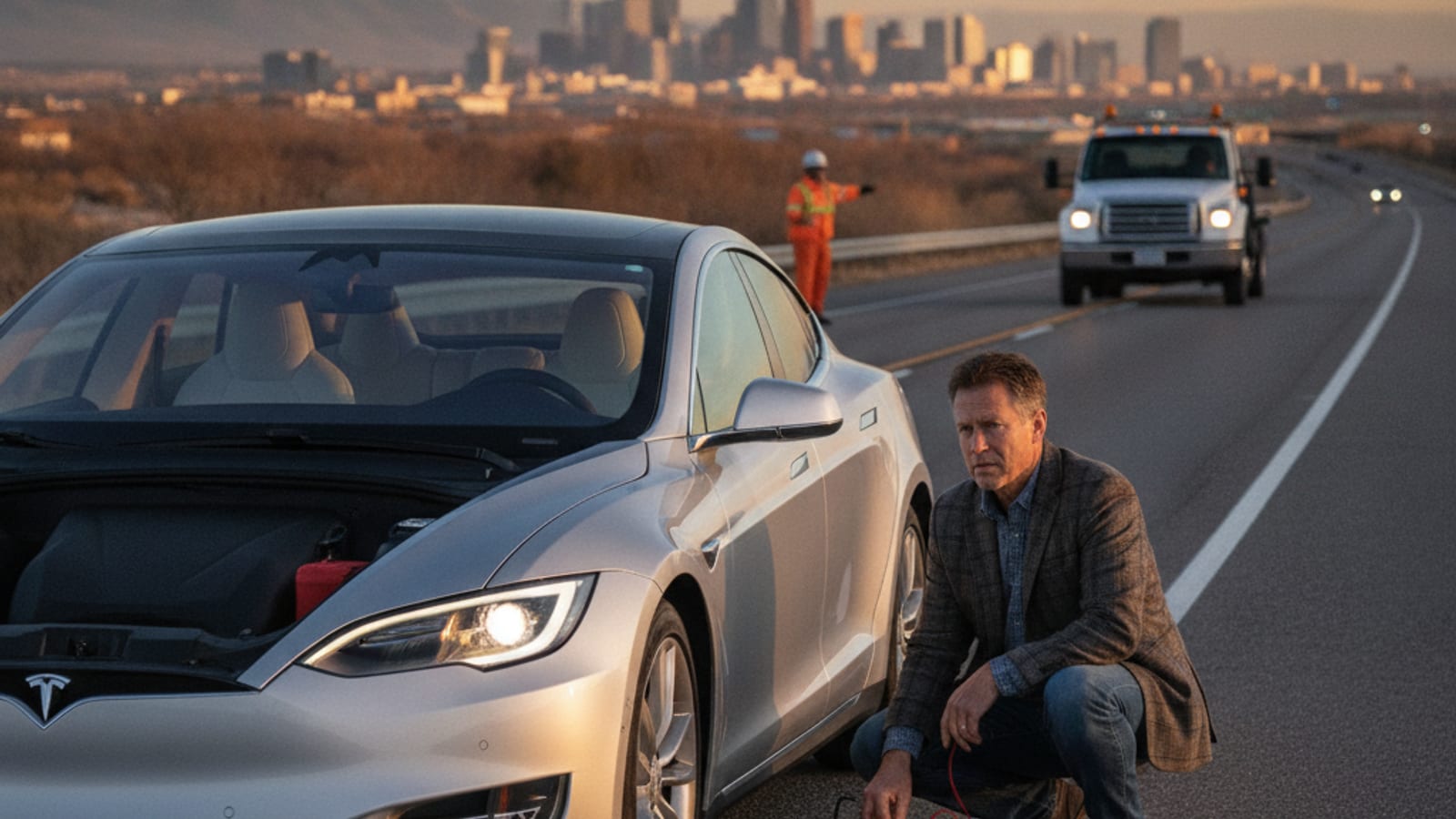
Tesla battery dead in a Denver cold snap usually means the 12-volt, not the traction pack. The traction pack is the big battery that moves the car. The 12-volt is the small battery that runs the computers, the contactors, the door handles, and the screens. When the 12-volt dies first, the car looks finished. The traction pack may still hold plenty of range. Charge Pro DEN does not diagnose which one failed. We refer drivers to independent local operators who can jump or replace the 12-volt on site, or who can add Level 2 range to an empty pack. Call (720) 738-6950 when you want that match.
Why Denver cold breaks this split
Denver sits at 5,280 feet on the high plains. January’s normal low around the city sits near 18 degrees. A sub-zero night in a parking lot is common, and a parked car that does not move for a week can sit through many cold cycles. The traction pack holds heat better than the small 12-volt. The 12-volt lives in different places on different Teslas (front trunk on most, under the rear seat on some Model S, under the hood on Model X). Cold does two things to it. The chemistry gives up cranking amps. The car’s battery management system also wakes up periodically to run thermal management on the traction pack, and that wake cycle pulls more from the small battery than a warm battery can spare.
The result: a car that drove home with 40 percent on the dash will sit in a lot for a week in the cold and look completely dead. The traction pack may still have 40 percent. The 12-volt is the reason nothing wakes up.
Recurrent Auto studied more than 30,000 U.S. EVs in winter. At 32 degrees, EVs kept about 78 percent of max range on average. At 20 degrees, the average dropped to about 70 percent. Cold eats real range, but the jump from “40 percent on the dash” to “the dash is dark” is usually the 12-volt, not the pack.
How to tell which one died
Three reads help you decide.
The Tesla app is the first read. Open it on a phone that still has battery. A car with a dead 12-volt usually shows nothing in the app. A car with an empty traction pack usually shows the actual state of charge and may still respond to climate commands.
The door handles are the second read. On most Teslas, the handles present when the 12-volt is alive enough to wake the car. They stay flush and the car looks locked when the 12-volt is too weak. Pulling the mechanical emergency key from the fob can open the driver’s door on most models. That key release is a per-model thing. The owner’s manual for that exact year is the place to confirm it.
The physical battery is the third read. Newer Model 3 and Model Y use a lithium-ion 12-volt. Older Teslas use a lead-acid 12-volt. The lithium-ion unit still fails in the cold. A visual check of a 12-volt does not tell you its voltage. Voltage on it does. Most service menus can show 12-volt state of charge, but the car will not get to that menu if it will not wake.
The point of these reads: they tell you what to call for. A dark car with a working app probably needs range added. A dark car with a dead app and locked handles probably needs the 12-volt jumped or replaced on site.
What the 12-volt actually powers
The 12-volt runs more than the radio and the lights. On a Tesla it runs the computers that wake the high-voltage contactors. The contactors are the heavy switches that connect the traction pack to the motor. No contactor close, no drive. A weak 12-volt can show a working dashboard one second and a brick the next, because the contactors fail to close as the voltage sags.
It also runs the door latches, the windows, the frunk and trunk releases, the alarm, and the charge port. A driver who tries to plug in with a dead 12-volt often finds the charge port will not unlock. The cable stays stuck in the car. That is a port problem and a 12-volt problem at once. The order matters: fix the 12-volt first, then the port release works.
What an empty pack actually looks like
An empty traction pack shows different signs. The 12-volt is usually still up. The app can still see the car. The state of charge shows a low number. The car may show a turtle icon or a “vehicle shutting down” notice as the pack crosses its lower limit. The windows and handles still work. The car just will not move.
A driver who ignored the last few low-charge warnings and pulled off the highway with 0 percent on the dash has an empty pack. A driver who charged to 80 percent on Monday and returned to a dark car on Friday has a 12-volt problem. The two scripts read differently and call for different fixes.
Operators we refer carry both options. They jump or replace a 12-volt on site when that is the job. They bring a 240-volt Level 2 source with a NACS plug when the pack is empty. Tesla drivers get the native NACS connector on the lead. Other EVs use a CCS or J1772 adapter from the same kit.
What Colorado state law lets you do while you wait
CRS 42-4-1202 covers a disabled vehicle on a highway. Outside a business or residential district, you may not stop on the paved main-traveled part of a highway, except a vehicle so disabled it cannot be moved off the roadway. Hazard lights must be on under CRS 42-4-230. A violation is a class B traffic infraction. The plain read of the law: you can sit on the shoulder with hazards on while you sort the fix.
CRS 42-4-1803 governs abandoned vehicles on public property. The statute sets no fixed clock. An officer uses reasonable grounds to decide what is abandoned, not a 24-hour or 72-hour count. State Patrol handles enforcement and dispatch, and it holds abandoned-vehicle authority.
If the car is in a travel lane or another dangerous place, call 911 first. Charge Pro DEN does not send a crew. The 911 call comes first. The referral match comes after everyone is safe.
What CDOT Safety Patrol actually does
CDOT Safety Patrol runs on covered metro freeway segments. The published list includes segments of I-25 South (120th Ave to Arapahoe Rd), I-70 East (Wadsworth to Airport Blvd), and portions of US-6, C-470 and I-225. The I-70 Mountain Corridor runs Morrison to Vail. Front Range weekday windows are 6:00 to 9:30 a.m. and 2:30 to 7:00 p.m. Weekend hours run from 10:00 a.m. to 7:00 p.m. Mountain Corridor hours run 6:00 a.m. to 7:00 p.m. Friday through Sunday and during significant weather.
CDOT’s published menu is tires, jump-starts, fuel, debris, and minor mechanical help. CDOT’s Safety Patrol and breakdown pages mention nothing about electric vehicles or EV charging. The free truck can wake a 12-volt on a covered segment. It will not add range to the traction pack. If the gauge was already at zero, skip the Safety Patrol call. If the car went dark after a freeze, a jump may finish it.
COtrip.org and the 511 line post I-70 closures and the traction-law activation status. Colorado is a one-party-consent state for recording (CRS 18-9-303). A participant may record a call without telling the other party.
Tesla roadside is its own script
Tesla has its own roadside path in the Tesla app. Read the coverage for the exact VIN and year. Tesla still sends contractors in most markets. Those contractors may bring a flatbed. They may bring a 12-volt jump pack. They generally do not bring a 240-volt Level 2 source for a stranded EV. Out-of-range assistance may be available but is not financially covered in the standard plan.
For the broader coverage comparison, read Tesla, AAA, and a local mobile rescue. That post stays on who covers which script. This one stays on telling the empty pack from the dead 12-volt.
When the 12-volt is the answer
The 12-volt is the answer when the car was charged within the last week, sat in a cold lot, and now shows nothing in the app. Operators we refer bring a portable jump pack sized for a Tesla. They open the front trunk (or the rear seat, or the hood, depending on the model) and clamp the proper jump points. The car wakes. They let the 12-volt recover before they hand the keys back. If the 12-volt will not hold a charge, the same operator can replace it on site with a customer-supplied unit. They quote the work before they start it.
For the on-site replace versus jump call, read Tesla 12-volt dead: jump it or replace it on site.
A driver who owns a small lithium jump pack can try a jump themselves. Follow the owner’s manual for that exact model. The jump points are per-model. A wrong clamp on a high-voltage orange cable is a real safety event. If the driver is not sure, do not improvise.
When the empty pack is the answer
The empty pack is the answer when the car was driven until the dash said zero, or when the car sat with a charge cord unplugged for many weeks in the cold. Operators we refer bring a 240-volt Level 2 source with a native NACS lead. Charging time adds about 10 to 20 miles in 15 to 30 minutes. The clock starts when charging starts, not before. The operator quotes before any cable goes in. They bill the driver directly for the work.
That added range lets the driver leave the shoulder under their own power. For the broader choice, read charge in place or tow. For the empty-pack recovery job, read out-of-charge recovery.
If the car is at a stall in Denver or anywhere in the metro and the cable is still locked in because the 12-volt is dead, fix the 12-volt first. The port release only works when the small battery is alive. For more on that split, read Can roadside jump an EV 12-volt.
What to do from a cold lot, in order
Step one: hazards on. Stay visible to traffic. Stay in the car if that is the safer choice. If the car is in a travel lane, call 911 first.
Step two: open the Tesla app on a phone with battery left. If the app reads the car, treat it as a pack issue. If the app reads nothing, treat it as a 12-volt issue. That is the read, not a diagnosis.
Step three: call (720) 738-6950. The line matches the driver to an independent local operator. Charge Pro DEN sets no price, promises no ETA, and publishes no hours. The operator quotes before work starts. The driver pays the operator directly.
Step four: if the car is on a covered CDOT Safety Patrol segment and the hours are right, that free jump is an option for a dark 12-volt. The state does not publish a charge service. Skip the Safety Patrol call when the pack was already at zero.
Step five: read the owner’s manual for that exact year before any owner-led jump. The jump points and the order are per-model.
Frequently asked questions
Will a dead 12-volt kill my Tesla’s traction pack?
No. The 12-volt and the traction pack are separate systems. A dead 12-volt means the car cannot wake up and run the contactors that connect the pack to the motor. The pack usually still holds the same state of charge it had when the car last drove. Jump or replace the 12-volt, and the car wakes up with whatever range the pack still holds. A long-term 12-volt problem left unfixed can drain the traction pack slowly through phantom wake cycles, so do not sit on a known weak 12-volt for weeks.
How do I tell if my Tesla is dead from the pack or the 12-volt?
Open the Tesla app first. If the app reads the car and shows a state of charge, the 12-volt is alive and the pack is the problem. If the app reads nothing and the door handles will not present, the 12-volt is the problem. The owner manual for that exact year is the final word on jump points and on the mechanical key release. Charge Pro DEN does not diagnose the cause.
Can a cold night kill a Tesla’s 12-volt?
Yes. Cold reduces the cranking amps a 12-volt can deliver, and the battery management system wakes periodically to run thermal management on the traction pack, which pulls extra current from the small battery. A car that sat in a Denver cold snap for a week can come back with a dead 12-volt and a fully charged traction pack. This page does not confirm a specific failure rate or a temperature threshold. The pattern is what owners and operators report in this metro.
Will Tesla roadside bring a charge for an empty pack?
Tesla roadside still uses contractors in many markets. Those contractors may bring a flatbed or a 12-volt jump pack. Tesla roadside generally does not bring a 240-volt Level 2 source for a stranded EV. Out-of-range assistance may be available but is not financially covered under the standard plan. Confirm the coverage for the exact VIN in the Tesla app before waiting on a truck.