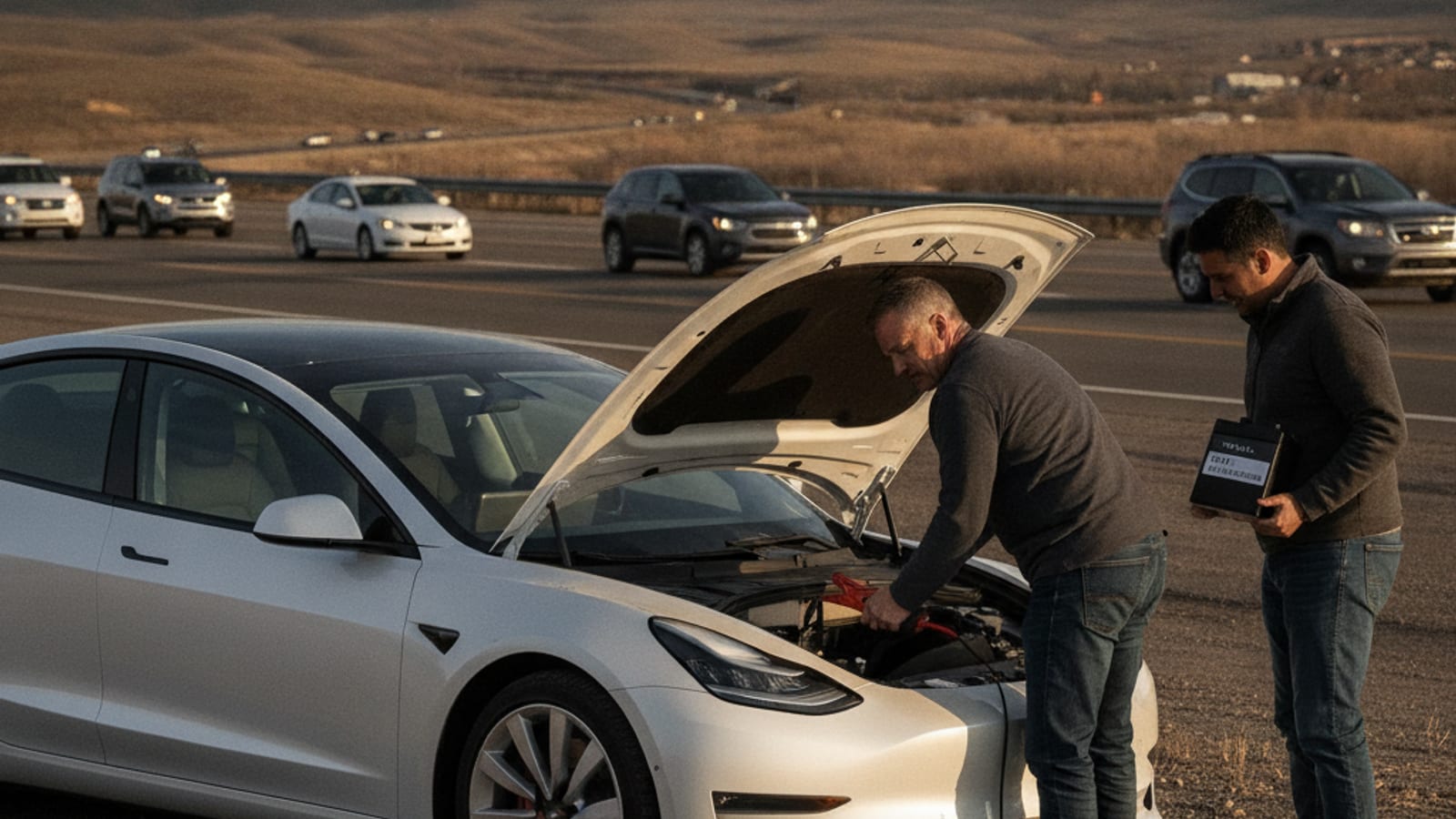
A Tesla with a dead 12-volt often just needs a jump. Sometimes it needs the battery swapped out right there. The operators we refer handle both jobs on site, and they quote the price before any cable goes in. Call (720) 738-6950 when you want that match in the Denver metro.
Why the 12-volt matters at all
A Tesla has two battery systems. The big high-voltage pack drives the wheels. The small 12-volt wakes the car up, runs the computers, latches the contactors, and powers the door locks. When the 12-volt fails, the whole car looks dead. The dash stays dark. The screen does not turn on. The doors may not unlock. The traction pack can sit at 60 percent and the car still will not move.
A cold Denver night is the usual trigger. Below about 15 degrees, the battery management system wakes periodically to keep the traction pack warm. That phantom drain pulls from the small battery too. Leave the car out for a week at DEN in January, and the 12-volt often will not have enough left to wake the car up. The traction pack still shows range. The 12-volt is the problem.
January’s normal low around Denver sits near 18 degrees. The all-time record cold sits around minus 29. A car that sat through one of those stretches is the textbook 12-volt case. The pack did not die. The battery that opens the pack’s contactors did.
How a Tesla 12-volt is different from a gas car 12-volt
The 12-volt in a Tesla is not under the hood in the same spot as a gas car. Tesla hides it, and the location changes by model. Model 3 and Model Y put the 12-volt under the frunk liner and the plastic trim. Model S puts it under the frunk near the firewall. Model X puts it under the frunk with a separate access panel. Cybertruck puts it under the hood on the passenger side. Each spot needs a specific access step.
Newer Model 3 and Model Y use a lithium-ion 12-volt, lighter and smaller than the older lead-acid unit. Lithium 12-volts still fail after a cold soak. The chemistry does not save them.
The jump points also live in different places. Most modern Teslas have dedicated positive and negative posts under the hood, marked red and black, designed for a low-voltage jump. You do not have to climb into the frunk cavity to reach the battery. That said, the procedure is still model-specific and the manual is the source of truth for your year and trim.
Jump first, replace when the jump does not hold
A jump is the right first move when the 12-volt is just low. The car wakes, the screen turns on, and you drive home. The traction pack recharges the 12-volt through the DC-DC converter while you drive. A jump is often all a stranded driver needs after a cold night.
A replacement is the right move when the 12-volt will not hold a charge, when it died under load, or when it has been weak for weeks. The tell is what happens after the jump. If the car wakes and then dies again within minutes, the 12-volt is not holding a charge. If the car wakes and stays awake but throws a 12-volt battery warning on the screen, the battery is failing and a swap is the real fix. If the car is more than six years old and the original 12-volt is still in place, the battery is at end of life.
The operators we refer carry small lithium and lead-acid 12-volts sized for each Tesla model. They quote the replacement before the swap. You pay them directly. There is no add-on from Charge Pro DEN for the referral itself.
Where Tesla roadside fits
Tesla has its own roadside path through the app. Confirm what your year and VIN get before you call anyone. Tesla roadside sends a contractor, not a Tesla employee. Tesla does not always bring a replacement 12-volt. The contractor may only carry jump gear. If the car needs more than a jump, the contractor often tows the car to a service center.
That tow can be a long wait in the Denver cold. A mobile operator with a replacement battery on the truck ends the call in one visit. Ask the operator on the phone whether they carry a 12-volt for your model before you wait.
CDOT Safety Patrol jumps but does not replace
CDOT Safety Patrol covers parts of the Denver metro freeways, including I-25 South from 120th Avenue to Arapahoe Road, I-70 East from Wadsworth to Airport Boulevard, portions of US-6, C-470 and I-225, and the I-70 Mountain Corridor from Morrison to Vail. The free menu is flat tires, jump-starts, emergency fuel, minor mechanical help, debris removal, and incident support. CDOT does not publish an EV charging service and the safety patrol menu does not list battery replacement.
A free patrol jump is a fine first call when the car is dark on a covered segment during published hours. Front Range metro hours run 6:00 to 9:30 a.m. and 2:30 to 7:00 p.m. weekdays. Weekend hours run 10:00 a.m. to 7:00 p.m. Mountain Corridor hours run 6:00 a.m. to 7:00 p.m. on Fridays through Sundays and during significant weather. Outside those hours, the patrol is not running on the Front Range.
A jump that wakes the car and lets you drive home is the end of the call. A jump that does not hold means you need a replacement, and the patrol does not carry a 12-volt for a Tesla. They will offer a tow instead.
E-470 jumps but does not replace
Stall on E-470 and you are on a cashless toll loop with no published EV charging service. Dial *470 for E-470’s own roadside assistance. The published menu is flat tires, fluid top-offs, jump-starts, phone help, and debris removal. Dial *CSP, which is *277, for State Patrol. E-470 will not bring a 12-volt replacement.
How the on-site replacement works
A mobile operator with a 12-volt on the truck pulls up to where the car is parked. They put hazards on. They pull the frunk liner or open the access panel for your model. They disconnect the negative post, then the positive, then lift the old battery out. They drop the new battery in. They reconnect positive first, then negative. They wake the car and confirm the dashboard comes up clean. They close the panel and you drive.
The full swap takes a working operator about 30 to 60 minutes depending on the model and the access. The Cybertruck is the easiest access in the current lineup. Model S is the most involved.
The operator quotes the price before any cable goes in. You can say no. There is no obligation to accept the quote. If you decline, the operator packs up and leaves. If you accept, you pay them on the spot by whatever method they accept.
How to tell what your Tesla needs
Start with the dash. If the dash is dark and the screen is dark, the 12-volt is likely the problem regardless of what the pack shows. If the pack is showing zero or near zero and the dash came up briefly, the empty pack is the problem and a 12-volt jump will not help.
A second tell is how the car acted before it died. If it threw a 12-volt battery warning on the screen in the days before the no-wake, the 12-volt is failing and a swap is the real fix. If it threw a low range warning, the pack is the problem and a mobile Level 2 charge is the answer.
A third tell is the age of the car. Tesla replaced many 12-volts under warranty for the first eight years or 100,000 miles on most models. Confirm what your VIN got. A car still under that coverage is a tow to a service center, not an on-site swap.
What a jump looks like on a Tesla
The jump points are under the hood on every modern Tesla. Open the frunk. Find the red positive post near the front. Find the black negative post near a marked ground. Connect the positive clamp from the donor source first, then the negative clamp to the marked ground, never to the negative battery post itself if you can avoid it. Wake the car. Confirm the dash and screen come up. Disconnect in reverse order.
The donor source can be a small lithium jump pack or another 12-volt battery. Tesla publishes a procedure in the manual for your model. Follow that procedure. Reverse polarity on a Tesla 12-volt jump is a real risk to the DC-DC converter.
The operators we refer carry the right jumper for Tesla 12-volt systems. They know the polarity and the post location for each model. That is the value of an on-site call. A wrong jump costs more than the visit.
Why the cold-soak case is so common here
Denver sits on a high plain at 5,280 feet. Cold arrives in fast arctic drops, not slow European-style cooling. A 40-degree swing in two days is not unusual. A car parked outside through that swing sees the 12-volt take a beating.
Cars parked at Denver International for a week in January see it worse. The DEN lots are flat and exposed. The wind is steady. The temperature drops below zero on most January nights. The 12-volt runs phantom drain the whole time. Many airport returns are the same story: the pack still shows range, the car will not wake.
Cars parked at Red Rocks through a winter show see a similar pattern. Long dwell, cold, marginal 12-volt. Cars parked at Park Meadows during a long shopping trip see it too. The pattern is dwell plus cold plus a weak 12-volt.
What to do if the doors will not unlock
A dead 12-volt can lock you out. The mechanical key still works on the driver’s door. Press the small tab on the handle and pull out the metal key. Unlock the driver’s door manually. The car still will not start until the 12-volt has power.
The operators we refer carry a small lithium jump pack for exactly this case. They can wake the car through the under-hood posts without entering the cabin. Once the car is awake, the doors work normally again.
What to do if the car is in a garage
An attached garage makes the call slower. The operator needs a path to open the hood or frunk. They may need the garage door open and the car pulled forward enough to reach the access panel. Be ready to move the car or open the door before the operator arrives.
A Tesla in a tight garage stall with a dead 12-volt is sometimes a tow to a service center instead of an on-site swap. The operator will tell you on the phone whether the access will work.
What the warranty covers
Tesla replaced 12-volt batteries under the new-vehicle warranty for the first eight years or 100,000 miles on most models built before 2022. The lithium-ion 12-volt on newer cars is covered on a shorter schedule. Confirm what your VIN got through the Tesla app.
A dead 12-volt outside that coverage is a mobile operator job. A dead 12-volt inside that coverage is a Tesla service center job, which means a tow. The tow to a service center is often faster than waiting for a mobile operator during a cold snap, and the work is covered. The operators we refer handle the out-of-warranty case.
How to keep the 12-volt alive in a Denver winter
Park inside a garage when one is available. Plug the car in so the battery management system can run from the wall current, not from the 12-volt. Drive the car at least once a week for a real drive, not just a move across the driveway. A short trip does not give the DC-DC converter enough time to recharge the 12-volt.
If the car sits for two weeks or more in a cold stretch, the 12-volt is at risk. The operators we refer handle the wake-up call when that risk turns into a real no-wake on a Denver morning.
What to do from a metro shoulder
Turn hazards on under CRS 42-4-230. Stay in or near the car. If you are on a covered CDOT Safety Patrol segment during published hours, that free jump is for a dark 12-volt. Skip it when the pack was already at zero. On E-470, try *470 for the same jump-and-tire list.
If the car is otherwise fine and the 12-volt is the problem, call for the on-site swap. A Tesla 12V battery jump referral brings the right battery and the right operator. The operator quotes you before they start work. You can read more about how the mobile EV charging referral works in the metro.
If the car will not roll at all, the job is a tow, not a swap. For a broader breakdown comparison, read Tesla, AAA, and a local mobile rescue for the call order. Then confirm the coverage in the Tesla app before you wait on any one program.
How a Denver metro referral call works
Call (720) 738-6950. Tell the operator where the car is, what model it is, and what the dash showed before it went dark. The dispatcher matches you with an independent operator who carries 12-volt batteries for Tesla models. That operator calls you back, quotes the work, and confirms the access. You say yes or no. If yes, they roll a truck.
Charge Pro DEN does not own trucks and does not employ crews. The operators we refer handle the work and bill you directly. There is no membership fee and no add-on. The number is the referral line. Treat it as a referral number, not a rolling promise.
Frequently asked questions
Does a Tesla 12-volt jump from another car work?
Yes, with the right procedure and the right polarity. The under-hood jump posts are designed for it. Follow the manual for your model and connect to the marked posts, not directly to the battery. Reverse polarity on a Tesla 12-volt jump can damage the DC-DC converter.
How long does a Tesla 12-volt replacement take on site?
A working operator with the right battery on the truck takes about 30 to 60 minutes for the swap, depending on the model and access. The car is awake and ready to drive when the operator leaves.
Does Tesla roadside replace the 12-volt on site?
Tesla roadside sends a contractor and may only carry jump gear. A contractor who can swap the 12-volt on the shoulder is not the default. Confirm what your year and VIN get in the Tesla app before you call.
Can a dead 12-volt drain the traction pack?
No. The two systems are separate. The traction pack can sit at 60 percent and the car will not wake if the 12-volt is dead. A dead 12-volt is a jump or replacement, not an empty-pack problem.
What is the typical life of a Tesla 12-volt in Denver cold?
Lead-acid Tesla 12-volts typically last about four to six years. Lithium-ion 12-volts on newer cars last longer, but cold-soak and phantom drain shorten that life. A Denver car parked outside through two or three winters should expect a 12-volt service event before year six.