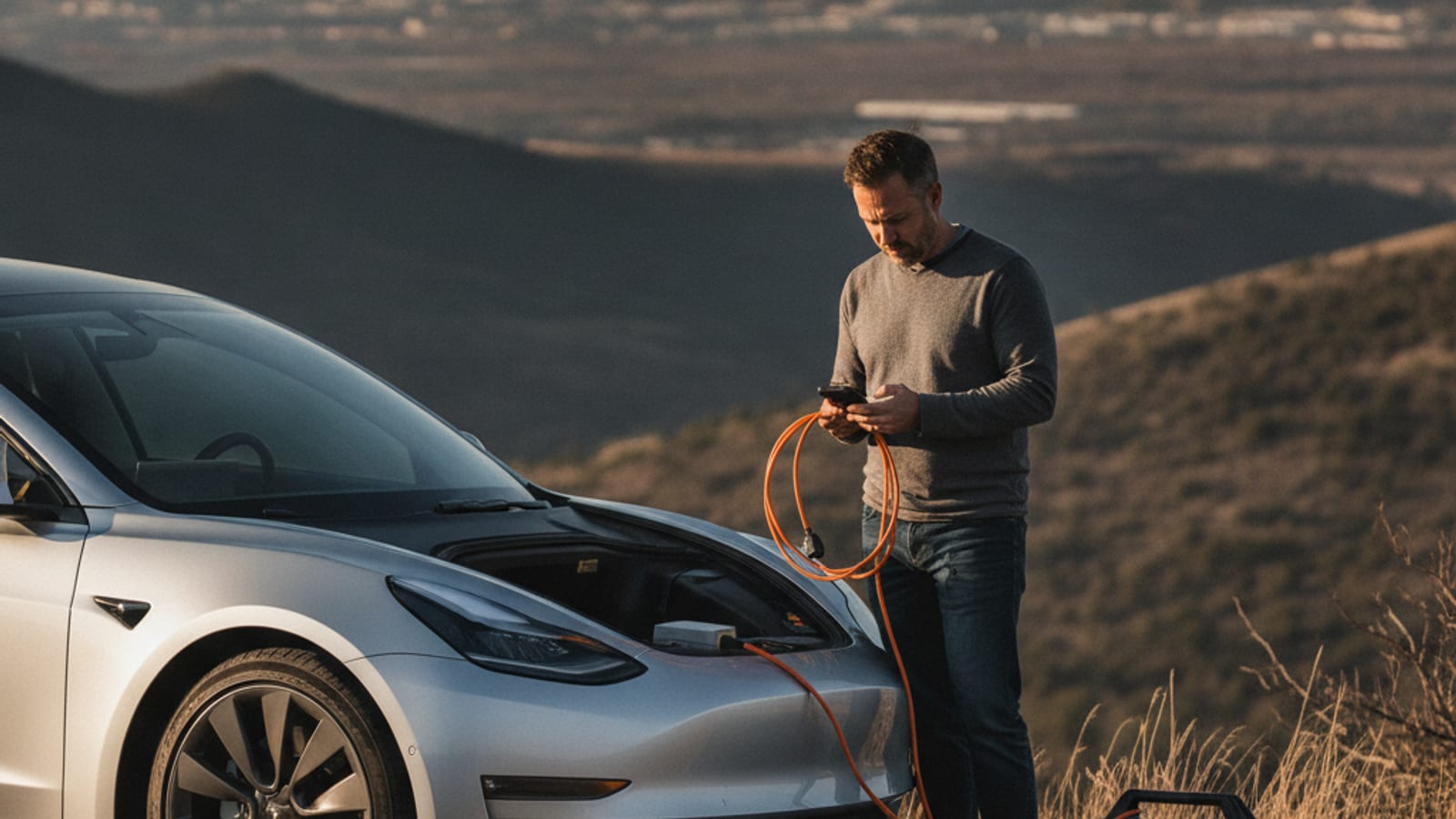
A Tesla mobile charger near me is a referral to an independent local operator who brings a 240-volt Level 2 source with a native NACS plug. Charge Pro DEN does not own trucks or equipment. We do not employ technicians. We match you with a licensed independent pro who quotes you before any cable goes in, and you pay them directly. If you are stuck on a Front Range shoulder or in a Denver lot right now, call (720) 738-6950. It is a referral number, not a rolling promise.
What a Tesla mobile charger actually brings
The kit is a 240-volt Level 2 source on wheels. Tesla drivers get a native NACS plug on the lead. That is the same connector on the Supercharger network, so it locks into the car without an adapter. Other EV brands use a CCS or J1772 adapter on the same operator truck. The operator carries both ends.
A typical roadside add is about 10 to 20 miles of range. That add happens in 15 to 30 minutes of charging. The clock starts when the cable is in, not before. It is not an arrival time and we do not promise one.
Operators we refer do not touch the traction pack outside of that Level 2 session. They do not replace a pack on site. They do not pull battery codes. They quote the job, run the cable, and bill you directly when it is done. For a separate read on what is and is not a mobile job, see mobile EV charging.
Why a mobile NACS call in Denver is different from a Supercharger run
A Supercharger needs you to roll up and plug in. That means driving, or being towed, to the stall. The metro has Tesla Superchargers in Lakewood, Denver, Thornton, Northglenn, Westminster, Arvada, Brighton, Longmont, Boulder, Highlands Ranch, Lone Tree, Centennial, and Castle Rock. Idaho Springs has eight stalls, and that is the last confirmed Supercharger before the Eisenhower-Johnson Memorial Tunnel from the Denver side. That is a long list, and most of the time you can reach one.
A mobile call answers the moment you cannot. Empty pack on the shoulder of US-36, dead 12-volt in a Cherry Creek garage, port frozen after a Denver night, low charge climbing C-470 toward the canyon. Those are mobile calls, not Supercharger runs. The operator comes to the car. You stay where you are.
The trade is money for time. A mobile charge costs more than a stall session. You are paying for a truck and a Level 2 source at your curb, not a stall you walked to. The exact number belongs to the operator who quotes you. Charge Pro DEN sets no price and never quotes a number over the phone.
Tesla roadside and what it actually covers
Tesla has its own roadside path in the Tesla app. The program sends a contractor, not a Tesla employee. It can jump a 12-volt. It can tow to a Tesla service center or a partner shop. It does not, in practice, send a 240-volt Level 2 truck to a Colorado shoulder. Confirm what your VIN and year are covered for in the app before you call anyone else.
The state has its own free program. CDOT Safety Patrol runs on listed Front Range freeway segments. Published coverage includes I-25 South (120th Ave to Arapahoe Rd), I-70 East (Wadsworth to Airport Blvd), portions of US-6, C-470 and I-225, and the I-70 Mountain Corridor Morrison to Vail. The published menu is tires, jumps, fuel, debris, and minor mechanical help. CDOT does not publish EV charging as a service. Its breakdown page is silent on EVs too.
What that means for you. CDOT Safety Patrol will try a 12-volt jump on a covered segment during its posted hours. It will not add range to the traction pack. If the gauge was already at zero, skip the wait. If the car went dark after a freeze, a jump may finish it.
Empty pack versus a dead 12-volt on a Tesla
These two failures look the same from outside the car. The dash will not wake. The port will not open. The screen is black. The right answer depends on which battery died.
A Tesla runs two batteries. The big one is the traction pack, the thing that moves the car. The small one is the 12-volt lithium-ion unit that runs computers, contactors, and door locks. When the 12-volt dies, the whole car looks finished. The traction pack may still hold plenty of range. A January morning in a Denver lot, with a weeklong cold soak, is the textbook 12-volt scenario.
Recurrent Auto studied more than 30,000 U.S. EVs in winter. At 32 degrees, the average pack kept about 78 percent of max range. At 20 degrees, about 70 percent. Heat-pump vehicles held roughly 10 points more at 32. Cold is the reason a comfortable buffer on the plains disappears by the time you reach Idaho Springs. It is not a reason to assume the car is empty.
If the gauge dropped first, treat it as an empty pack and a Level 2 charge. If the car sat dark through a cold night, start with a 12-volt jump. Operators we refer handle both. The kit covers NACS, CCS, and J1772, and the 12-volt jump goes on the same visit when that is the actual fault. For the broader question on the 12-volt jump versus a charge, read Tesla 12-volt jump on site.
The Denver metro call mix
A referral line in this region sorts into a few patterns.
Apartment and street-parking drivers. Over half of Denver’s housing predates 1980. A lot of those units have no driveway and no garage. Drivers in Capitol Hill, Five Points, Cherry Creek, and the older parts of Lakewood live on public charging. A cold morning on the street eats the buffer. The call is a Level 2 add, not a tow.
Commute strandings. US-36 between Denver and Boulder, I-25 between the Tech Center and Castle Rock, I-70 between Aurora and the mountains. Stationary traffic with the heater on drains the pack the same way a climb does. Drivers return home on the last of the charge and run short of a stall. The mobile NACS session adds the cushion to reach one.
Airport lots. A traveler leaves a Tesla at Denver International for a week in January. Returns to a car that will not wake. Usually the 12-volt, not the pack. The operator jumps it on site. You sign and drive off, no flatbed, no dealership queue.
Mountain approach. Idaho Springs is the last confirmed fast charging before the tunnel. Georgetown shows no Supercharger. A driver climbing I-70 with a low pack and a ski-weekend crawl has the loneliest range question on the metro map. A mobile call adds range before the climb or on the way back down. Recurrent’s Lucid test used about 3 percent of battery over a 77-mile descent from Loveland Pass, crediting regen. A Ioniq 5 used about 10 percent over 75 miles. Regen returns real range on the way back, and a mobile charge on the way up can be the margin that makes the tunnel work.
What happens when you call (720) 738-6950
You will reach a real person. We confirm whether this is a Level 2 charge or a 12-volt jump. We confirm the make, model, and where the car is. We match you with an independent local operator. That operator calls you back, quotes the job, and confirms timing on their end.
Charge Pro DEN sets no price. The operator quotes before any cable goes in. You agree or you do not. There is no membership, no fee to call, and no obligation. We do not promise an arrival time. We do not publish hours. We are a referral line. The work is the operator’s.
If the car is in a travel lane, on a highway shoulder where you cannot safely stand, or in any active emergency, call 911 first. Stay behind the barrier if there is one. Hazards on. Wait for help before you exit the car on a freeway. CRS 42-4-1202 covers a disabled vehicle on the shoulder with hazards lit. CRS 42-4-230 requires the hazards in the first place. Know your shoulder law so the wait is lawful.
How to choose the right service link
The site splits by job type. Pick the page that matches what the car actually needs.
- Mobile EV charging for an empty pack and a Level 2 add in place.
- Tesla roadside rescue for Tesla-specific breakdown work, including 12-volt.
- Out of charge recovery for a pack that hit zero.
- Tesla 12-volt battery jump for a dark dash and a suspected 12-volt.
- Non-Tesla EV rescue for a CCS or J1772 car at the curb.
If you are not sure which one fits, call and ask. We will narrow it down.
Frequently asked questions
Does a mobile Tesla charger use NACS?
Yes. Operators we refer roll a 240-volt Level 2 source with a native NACS plug on the lead. Tesla cars plug in directly. Other EV brands use a CCS or J1772 adapter on the same truck. The cable locks into the car the same way a Supercharger cable does.
Will Tesla roadside send a charger to my car?
Tesla roadside sends a contractor. The contractor can jump a 12-volt and tow to a service center. It does not in practice send a 240-volt Level 2 truck to a Colorado shoulder. Confirm what your VIN and year are covered for in the Tesla app before you call anyone else.
How much range will a mobile Level 2 add?
Typical rescue adds about 10 to 20 miles of range in 15 to 30 minutes of charging. The clock starts when the cable is in, not before. The exact number depends on the operator’s source, the car, and the temperature. That is why the operator quotes before starting work, not on a price list.
Do you cover the I-70 corridor?
We refer metro operators across the Front Range and up to the Clear Creek corridor. Idaho Springs, Georgetown, and Empire are all in scope. Georgetown has no Supercharger in the current inventory, so a mobile call is sometimes the only way to add range before the climb or after a stall failure on the way back. Confirm availability with the operator on the call.
Can the operator jump my 12-volt on the same visit?
Yes. If the dash is dark and the car will not wake, the operator jumps the 12-volt on site. If the pack is empty, the operator runs a Level 2 add. Both can happen in one visit when both are wrong. The operator confirms on the call which one fits and quotes it before any cable goes in.