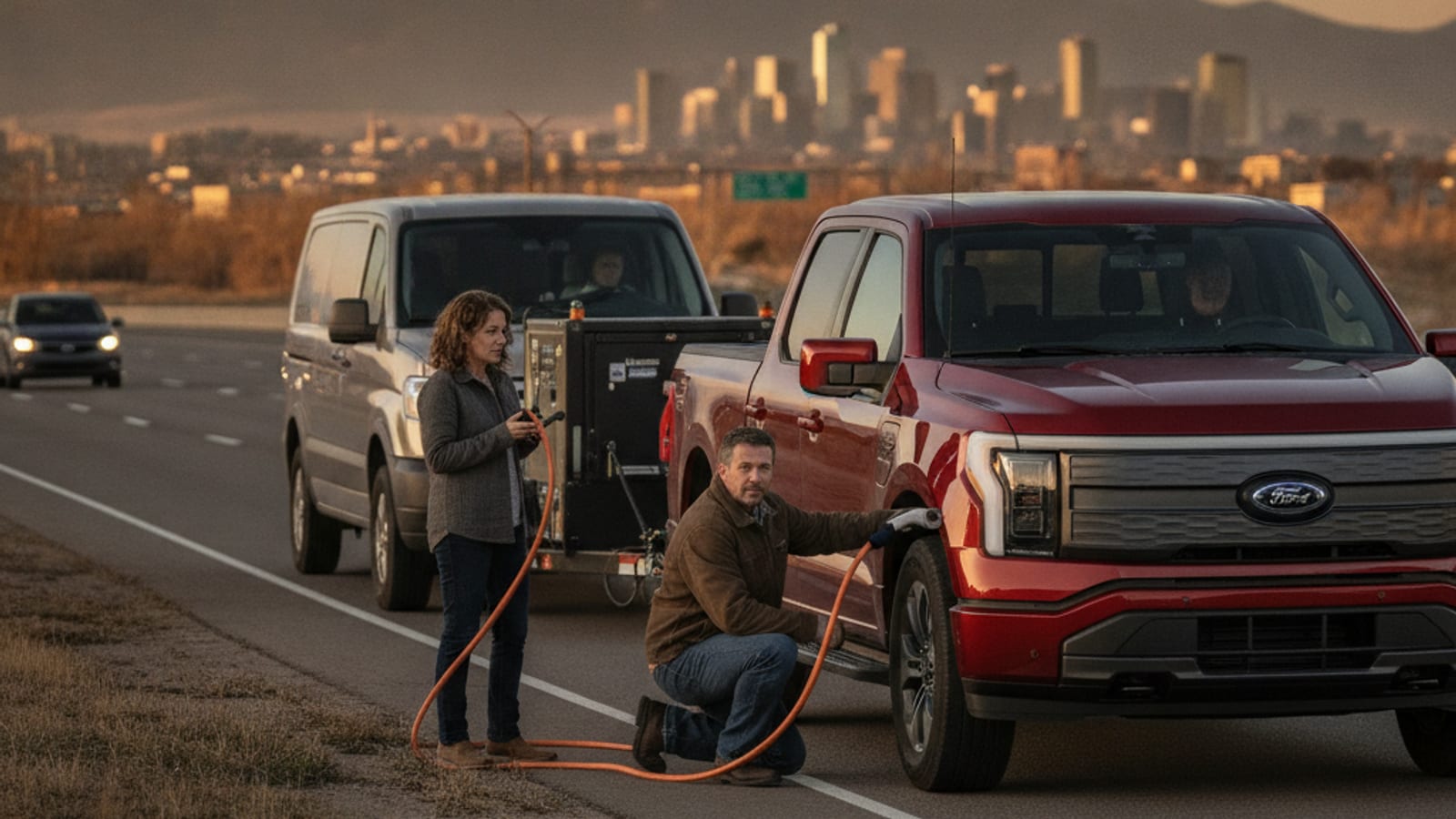
A mobile EV charge is the right answer for most stranded EVs in the Denver metro, and a tow is the right answer for fewer than most drivers expect. The choice depends on what actually broke. If the traction pack is empty and the rest of the car is fine, the operators we refer bring a 240-volt Level 2 source to the bumper. You get about 10 to 20 miles of range in 15 to 30 minutes of charging, and you drive away under your own power. If the car cannot roll, has damage, or has a drivetrain fault, a flatbed is the right tool. For the empty-pack case in the Denver metro, call (720) 738-6950. We match you with an independent local operator who quotes the work before any cable goes in.
What a tow to a stall really buys you
A flatbed tow solves one problem. It moves a car that cannot move itself. The destination matters. If the tow heads to a public stall, the clock does not stop at the stall arrival. You still wait for a working connector, pay the stall’s per-kWh rate or session fee, and sit for the time it takes to refill enough range to reach the next stop. On a Front Range weekday, a Supercharger session at a busy site like the Lakewood or Highlands Ranch location can stack behind a few other drivers. The tow plus the stall session is longer than the boost-in-place path almost every time the car is mechanically fine.
A tow is also a one-way street for the dollar. You pay the hook fee, you pay the mileage, you pay the stall. The operators we refer quote one job at one location. That single quote covers a 240-volt source, the cable, and the charging time. The pack adds back what it needs to clear the shoulder and reach a charger of your choice on your own clock.
What a mobile EV charge actually adds
Charge Pro DEN is a referral line for stranded drivers. We do not own trucks or employ technicians. The independent operator we match you with brings a 240-volt Level 2 source to the car. Tesla drivers get a native NACS plug on the lead. Other EVs use a CCS or J1772 adapter. Typical charging time adds about 10 to 20 miles of range in 15 to 30 minutes. The clock starts when charging starts. It is not an arrival time, and we do not promise one.
That range is enough to reach a Supercharger in Denver, Lakewood, Thornton, Westminster, Arvada, Brighton, Boulder, Longmont, Castle Rock, Highlands Ranch, Lone Tree, Centennial, or Idaho Springs. It is enough to clear the I-25 South shoulder at 120th Avenue and reach a stall. It is enough to get you off C-470, off US-6, and out of a hospital parking structure at the Denver Tech Center. A stranded driver wants to reach the next charger under their own power, not under a flatbed. That is the whole point of a Level 2 boost on the shoulder.
For the broader referral menu, read mobile EV charging in the Denver metro. For an empty pack with no power at all, read out of charge recovery in Denver.
The first decision: empty pack or dead 12-volt
Most stranded-EV calls are one of two patterns. The first is an empty traction pack. The dash showed low range first, and the car slowed before it stopped. The second is a dead 12-volt battery. The 12-volt runs computers, contactors, and door locks. When it fails, the whole car looks finished, but the traction pack may still hold plenty of energy. Cold makes the second pattern more common. A week in a Denver parking lot in January can kill a 12-volt without touching the pack.
Both patterns are answers the operators we refer can handle on site. An empty pack gets a 240-volt Level 2 source. A dead 12-volt gets a jump or, if it will not hold a charge, an on-site replacement. The operator asks which pattern fits when they call you back. They bring the right kit. A stuck charge port is a latch problem, not a tow problem. Ask the operator about the port before anyone hooks a winch.
AAA, Tesla, and the free state patrol, in that order
Many drivers try their club truck first. AAA is a membership club, and it has a tow network behind it. It does not automatically bring a charge to a dead pack. This page could not confirm a published AAA Colorado policy for on-site EV charging. Open the AAA app and read your membership booklet before you wait. Ask whether this will be a flatbed. Ask whether the truck carries EV charging gear. Many empty-pack calls still end as a flatbed to a stall. That is the answer the operators we refer solve without the stall.
Tesla has its own roadside path in the Tesla app. It sends contractors. It does not always bring a Level 2 source. Read Tesla roadside phone number, and a local backup for the call order. Then confirm what Tesla covers for your VIN and year.
CDOT Safety Patrol is free on listed Front Range freeways. It jumps a 12-volt on those listed segments. It does not charge the traction pack at all. Front Range metro weekday hours run 6:00 to 9:30 a.m. and 2:30 to 7:00 p.m. Weekend hours run 10:00 a.m. to 7:00 p.m. Mountain Corridor hours run 6:00 a.m. to 7:00 p.m., Friday through Sunday, and during significant weather. Don’t wait on a patrol that’s off shift.
E-470 publishes its own roadside assistance. Pull to the shoulder and dial *470 for E-470’s patrol. The authority lists flat tires, jump-starts, fluid top-offs, phone help, and debris removal. E-470 does not publish an EV charging service. State Patrol is *CSP (*277).
Why a tow to a charger costs more time, not less
The math on time is not what drivers expect. A flatbed to a working stall at a busy Supercharger site can take longer than a Level 2 boost in place. The flatbed must roll to your shoulder, load the car, and drive to a stall you have already confirmed works. You then wait in line. The total time from call to drive-away is usually longer with a tow for the empty-pack case. The boost-in-place option uses the 15 to 30 minutes you would have spent at the stall and skips the hook and the unhook.
The math on cost is something the operator quotes. We do not publish a tow-versus-charge dollar table. The independent operator we match you with confirms whether they can attempt charging or a tow they actually offer, then quotes you. You pay them. Charge Pro DEN does not set the price.
Law a stranded driver sits under
CRS 42-4-1202 covers a disabled vehicle on a highway. You may not stop on the paved main-traveled part of a highway. The exception is a vehicle so disabled it cannot be moved off. Hazard lights must be on under CRS 42-4-230. A violation is a class B traffic infraction. In plain English, you may sit on the shoulder with hazards on if the car genuinely could not be moved further.
CRS 42-4-1803 sets no fixed hour count for abandonment. No Colorado statute treats a disabled EV as a special class. The Colorado Towing Bill of Rights (HB22-1314) sets the rules for nonconsensual tows on private property: 24-hour written notice before most tows, limits on drop fees, required acceptance of cash and cards, and recovery of a vehicle after paying a set share of the fee. The Colorado Public Utilities Commission regulates towing carriers.
Cold-climate math the trip meter doesn’t show
Recurrent Auto studied more than 30,000 U.S. EVs in winter. At 32 degrees, EVs kept about 78 percent of max range. At 20 degrees, they kept about 70 percent. AAA reported about a 39 percent range loss at 20 degrees. Denver’s January normal low runs around 18 degrees. Cold plus altitude pulls range faster than the dash first suggests. Cabin heat on I-25 and I-70 adds another hit. A margin that looked fine at the trailhead can vanish by Golden on a January morning.
This is the case for a boost in place rather than a tow to a stall. The driver who runs out of charge at 5,280 feet on a 10-below morning does not need a flatbed to a Supercharger in Castle Rock. They need 10 to 20 miles of range in the next 30 minutes so they can drive to a charger of their own choosing. That is the job the operators we refer do every week in the Denver metro.
What to try from the shoulder before you call
Turn your hazards on and stay visible to traffic. Stay in the car if that is the safer choice. If you are on a listed CDOT Safety Patrol segment, check the clock. During published hours, that free jump is for a dark 12-volt. Skip it when the pack was already at zero.
On E-470, try *470 for the same jump-and-tire list. If you hold AAA, ask about a flatbed and ask whether anyone on the truck carries EV charging equipment. Write the answers down before you hang up.
If the car is otherwise fine and the pack is empty, call for range. The operators we refer serve the Denver metro from the plains to the foothills. They quote you before they start work. Call (720) 738-6950. Treat it as a referral number, not a rolling promise.
When the answer really is a tow
A roadside charge does not straighten bent suspension. If the car cannot roll, you need a tow. If the car must reach a specific shop, a charge may delay the hook. The flatbed is also the right tool if the traction pack is damaged, if there is a fluid leak, or if the 12-volt and the traction pack are both dead at once. Charge Pro DEN does not refer tows. We refer a mobile Level 2 source and on-site 12-volt work. For a car that cannot roll, AAA and the towing carriers regulated by the Colorado PUC are the next call.
Frequently asked questions
Will a mobile EV charge get me home in Denver?
If the traction pack is empty and the rest of the car is fine, yes. The operators we refer add about 10 to 20 miles of range in 15 to 30 minutes. That is enough to reach a Supercharger near your route and continue home. They quote the work before any cable goes in.
Why not just tow to the nearest Supercharger?
A flatbed plus a stall session takes longer than a Level 2 boost in place for an empty pack. The flatbed must reach the shoulder, load the car, and drive to a working stall. You then wait behind other drivers at the stall. A boost in place uses the 15 to 30 minutes the stall would have taken and skips the hook. Cost is something the operator quotes. We do not publish a tow-versus-charge dollar table.
Will AAA bring a charge instead of a tow?
This page could not confirm a published AAA Colorado policy for on-site EV charging. Many empty-pack calls still move as flatbed tows. Open the AAA app and read your membership booklet before you wait. Ask whether the truck carries EV charging gear. A mobile operator is the party that brings Level 2 to the car.
Does CDOT Safety Patrol charge EVs?
CDOT Safety Patrol jumps a 12-volt on listed metro segments. It does not publish an EV charging service. Hours follow the windows CDOT posts on its site. Front Range metro weekday windows run 6:00 to 9:30 a.m. and 2:30 to 7:00 p.m. Weekend hours run 10:00 a.m. to 7:00 p.m.
What about a tow in cold weather?
Cold drains range and stresses the 12-volt. A 10-below morning is the most common reason a Denver driver ends up on the shoulder. A mobile charge from the operators we refer adds range without forcing you to sit at a stall. They work across the Denver metro, from the plains to the foothills. Call (720) 738-6950 to get matched.