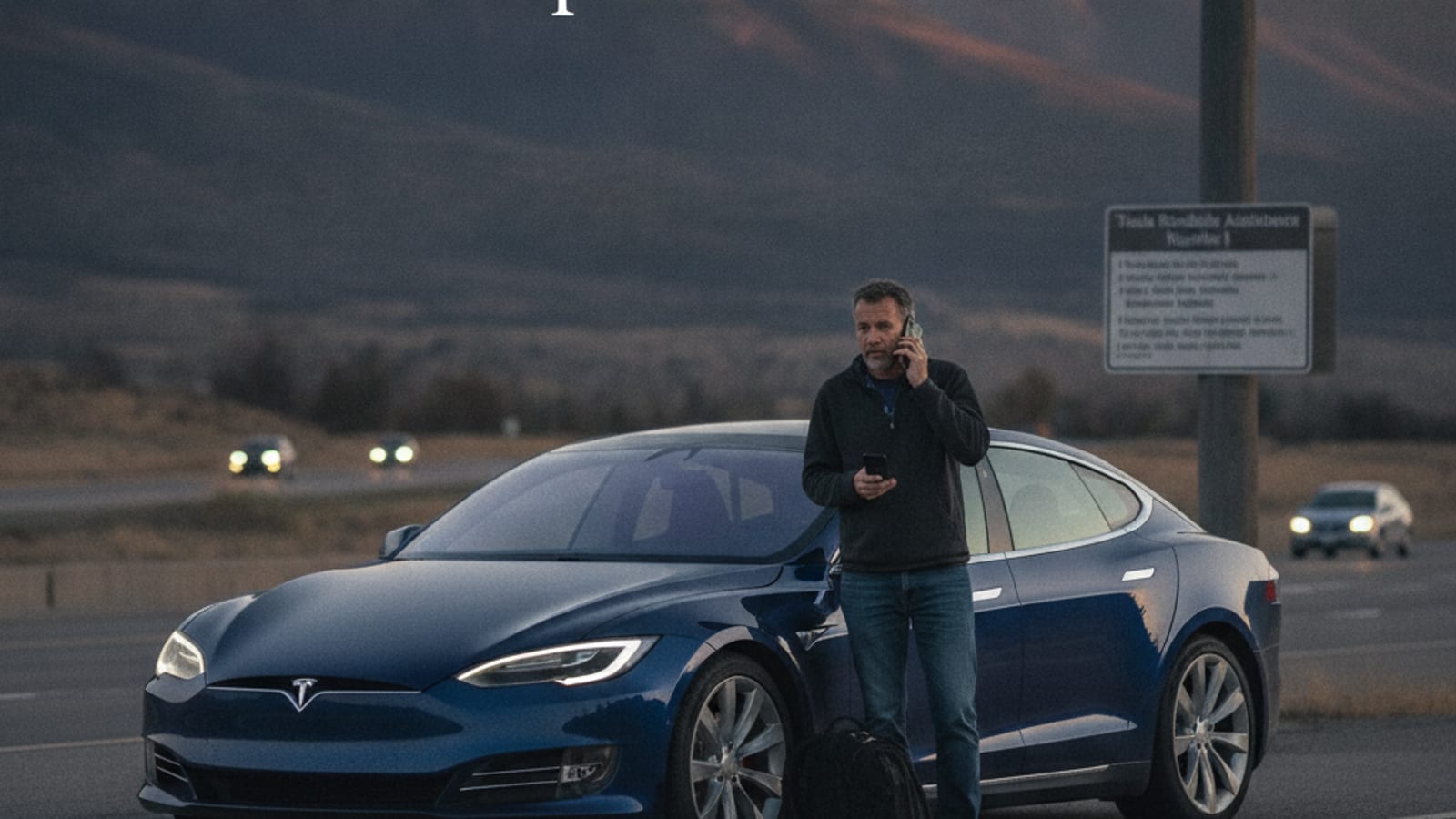
Tesla’s first path for roadside is the Tesla app. This page does not reprint a Tesla phone number as Tesla’s documented first path. For a local operator in the Denver metro who brings a 240-volt Level 2 source or a 12-volt jump, call (720) 738-6950. Charge Pro DEN is a referral line. The operators we refer quote you before any work starts.
Why the Tesla app is the documented first path
Tesla handles roadside through the Tesla app, not through a printed support number. Tesla’s own materials put the request flow inside the app: log in, pick the car, open Roadside, choose the issue, confirm the location. If the car is on a low charge or a flat, the app is where the request starts.
Out-of-range assistance may be available, but Tesla’s published coverage notes that it isn’t a free benefit the way some clubs treat it. Coverage depends on the year, the trim, the mileage, and the situation. Read what shows up in the app for your VIN before you trust it. Don’t assume a screenshot someone shared on a forum is your coverage.
Tesla still sends a contractor, not a Tesla-owned truck, on most calls. The contractor may be a flatbed, a tire service, or a jump truck. The contractor is rarely a mobile Level 2 charge. If the pack is at zero and you need range where the car sits, Tesla’s app path may end in a tow to a Supercharger. That is the gap this page fills.
What a local operator adds
An independent mobile EV operator brings a 240-volt Level 2 source to the bumper. Tesla drivers get a native NACS plug on the lead. Other EVs use a CCS or J1772 adapter. Typical charging time adds about 10 to 20 miles of range in 15 to 30 minutes of charging. The clock starts when charging starts, not before. It is not an arrival promise, and we don’t make one.
Those miles let you drive under your own power to a Supercharger, a public stall, or home. You’re not waiting on a flatbed, then waiting on a stall. The operators we refer handle Tesla and every major EV brand. A stuck charge port is a latch problem, not a tow problem. Ask the operator about the port before anyone hooks a winch.
For the broader choice, read charge in place or tow. For a Tesla-specific call, see Tesla roadside rescue. The operator’s quote is theirs, not a published rate on this site.
Colorado recording consent is one-party
Colorado is a one-party-consent state. CRS 18-9-303 says a participant may record a call without telling the other party. Tesla’s line, the club’s line, and the operator’s line may all record you under that rule. Disclosing anyway is good practice. The difference matters if you cross into a two-party-consent state on a long trip.
If you call Charge Pro DEN, expect a short intake. We take the year, model, current charge or state, exact location, and the safest shoulder position. We don’t promise a price or a clock time. We match you with an operator who quotes before work begins.
Why the Denver metro is its own situation
A January morning in Denver can swing from 47 to minus 19 in about 48 hours. That drop kills a weak 12-volt long before it kills a traction pack. Recurrent Auto studied more than 30,000 U.S. EVs in winter. At 32 degrees, EVs kept about 78 percent of max range. At 20 degrees, that drops to about 70. AAA’s 2026 dynamometer study put the loss at about 39 percent at 20. Cold plus grade plus a running heater is the combination that eats a margin that looked fine on the plain.
A week in a cold DEN parking lot is its own pattern. The traction pack may still show range. The 12-volt runs the computers, the contactors, the door locks, and the thermal management. Below about 15 degrees, the BMS wakes and runs thermal management. The phantom drain is real. A driver who returns to the lot and finds a dark car is looking at a 12-volt first, the pack second. Read Can roadside jump an EV 12-volt for the split.
CDOT Safety Patrol is free. It still isn’t a charger
CDOT’s Division of Maintenance and Operations runs the Safety Patrol. Help is free on listed metro freeway segments. Coverage includes I-25 South from 120th Avenue to Arapahoe Road, I-70 East from Wadsworth to Airport Boulevard, and portions of US-6, C-470, and I-225. The I-70 Mountain Corridor runs Morrison to Vail.
The published menu is ordinary roadside work. Flat tires, jump-starts, emergency fuel, minor mechanical help, debris removal, incident support. CDOT’s Safety Patrol page, read in September 2026, doesn’t mention electric vehicles. The agency’s breakdown page is silent on EV charging too. There is no charging-specific service on either page.
Patrol can jump a 12-volt on a dark Tesla. Patrol does not bring 240-volt power to a charge port. Front Range weekday windows are 6:00 to 9:30 am and 2:30 to 7:00 pm. Weekends run 10:00 am to 7:00 pm. Mountain Corridor hours run 6:00 am to 7:00 pm Friday through Sunday and during significant weather. Don’t wait on a patrol that’s off shift. For the after-hours fork, see Tesla roadside, CDOT patrol, or a local boost.
E-470 publishes its own free roadside. Pull to the shoulder on the eastern loop and dial *470 for the E-470 truck. *CSP (*277) reaches State Patrol. E-470 does not publish an EV charging service. No EV toll discount exists on E-470.
Save the numbers before you stall
Save Tesla roadside in the app, not only in a screenshot. The app ties the request to your VIN and your year. Save your club number if you pay for one. Save *470 if you use E-470. Save 511 for CDOT. Save (720) 738-6950 for a local Level 2 charge or a 12-volt jump in the Denver metro.
Call Tesla for a tire, a lockout, a flatbed they’ll authorize, or whatever the app path confirms for your VIN. Call Safety Patrol or *470 for a jump or a tire on their roads during published hours. Call a local operator when the pack needs energy where the car sits. Don’t double-call the same issue. Each desk opens its own dispatch and its own clock.
Colorado shoulder law while you wait
A stalled Tesla follows the same shoulder rules as a gas car. CRS 42-4-1202 is the disabled-vehicle statute. Outside a business or residential district, you may not stop on the paved main-traveled way. The exception is a vehicle so disabled it can’t leave the roadway. Hazard lights must be on under CRS 42-4-230. A violation is a class B traffic infraction.
You may sit on the shoulder if the car truly couldn’t go farther. Keep the hazards on. The statute doesn’t give you a charge, a tow, or a patrol truck. It does give you a lawful place to wait for one.
Colorado has no EV-specific breakdown statute. A stranded EV is governed by the same laws as any car. Abandoned-vehicle rules sit in CRS 42-4-1803 to 1805. An officer decides on reasonable grounds. The statute sets no fixed hour threshold. Colorado State Patrol handles enforcement, crash response, and dispatch. It also holds abandoned-vehicle removal authority under that statute.
When the local line is the right call
If the car is otherwise fine and the pack is at zero, the local line is the first call. If the car is dark and the pack was full yesterday, start with a 12-volt jump. If the suspension is bent or the car won’t roll, it is a tow and a Tesla or club path. Use the line that matches the failure, not the brand in your driveway.
The operators we refer roll a 240-volt Level 2 source and quote before any cable goes in. Tesla drivers get a NACS lead. The clock on the charge is the operator’s, not yours. If a 12-volt is the actual failure, the operator can jump it or replace it on site. They also bill you directly. Charge Pro DEN doesn’t set the price and doesn’t roll a truck.
Frequently asked questions
Does Tesla have a phone number for roadside?
Tesla’s documented first path is the Tesla app, not a printed support number. Open the app, pick the car, open Roadside, choose the issue. Coverage for your VIN shows up there. Tesla roadside still sends a contractor, not a Tesla-owned truck, on most calls.
What if Tesla sends a flatbed when I need a charge?
Tesla’s contractor is rarely a mobile Level 2 charger. If the pack is at zero and you need range where the car sits, Tesla’s path may end in a tow to a Supercharger. That is when a local operator is the right call. The operators we refer bring a 240-volt Level 2 source and quote before any work starts. For the broader choice, read Tesla roadside or a local rescue.
Is the local line free to call?
The line itself is free. The work the operator does is not. The operator quotes you before any cable goes in. Charge Pro DEN doesn’t set the price. The operator bills you directly for the work they do. There is no membership with Charge Pro DEN.
Does CDOT Safety Patrol charge EVs?
CDOT’s published menu is tires, jumps, fuel, debris, and minor mechanical help. The Safety Patrol and breakdown pages don’t mention EV charging. Patrol will jump a 12-volt on a dark Tesla on a listed segment during posted hours. Patrol won’t bring 240 volts to the charge port. For an EV-specific charge, call (720) 738-6950.