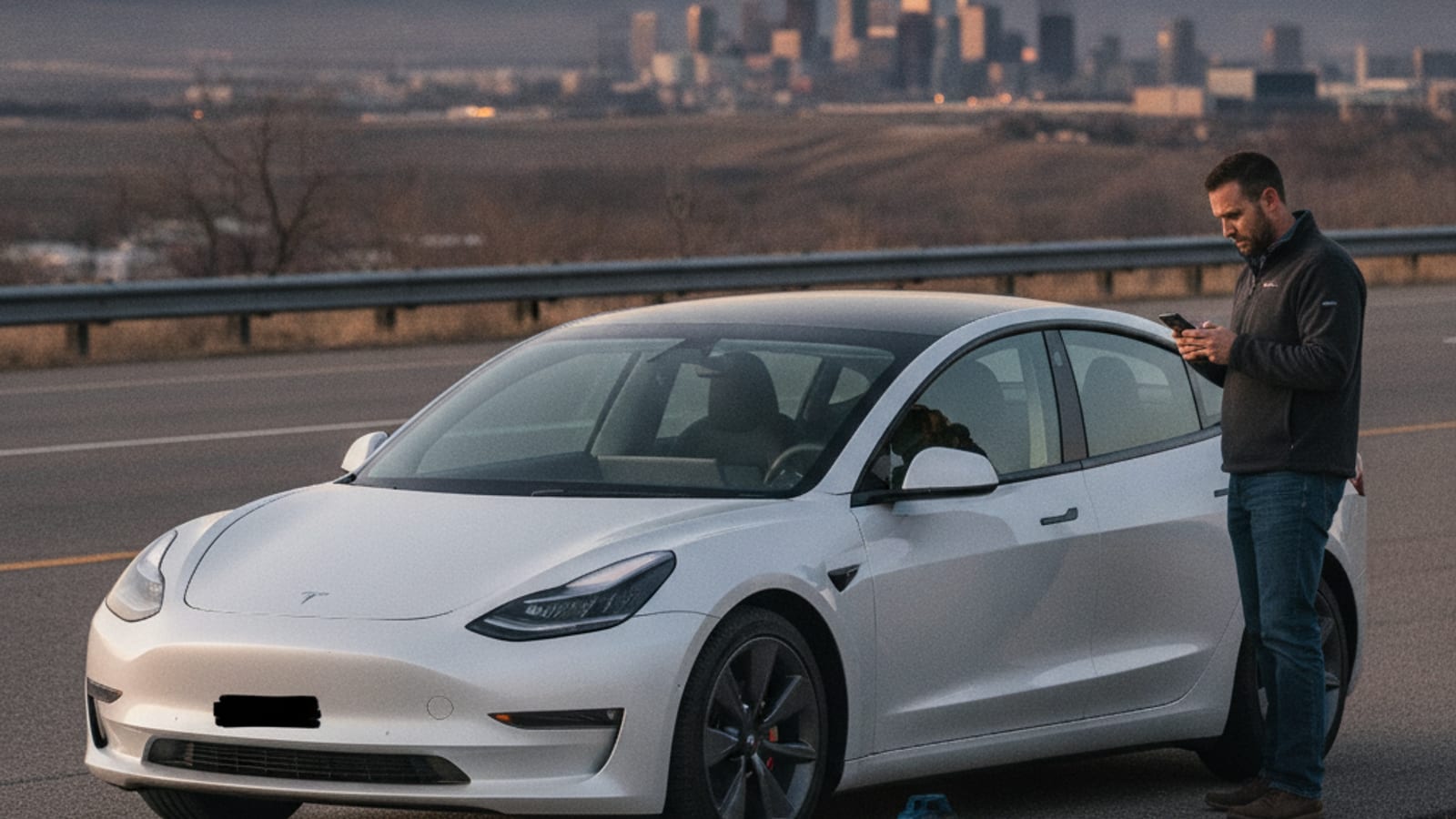
A Tesla charging service is two different things in the Denver metro. One is Tesla’s own roadside program, requested inside the Tesla app. The other is an independent local operator who brings a 240-volt Level 2 source to your car. If your pack is empty, the second one is the call that actually adds range. Call (720) 738-6950 to reach Charge Pro DEN’s referral line. We match you with an operator who quotes you before any cable goes in.
Tesla’s own roadside runs through the app
Tesla roadside is a Tesla-operated program. The request lives inside the Tesla app, not at a 1-800 number you can dial from any phone. Out-of-range assistance is described in Tesla’s own materials, and it is not always free. The coverage depends on your VIN, your year, your warranty window, and the plan you selected. Treat the Tesla app as the first script to try, and read what it offers for your specific car before you assume anything.
Tesla’s roadside has limits that matter in the Denver metro. The contractor Tesla dispatches is a third-party tow operator in most markets. That contractor carries flatbed and tire gear. A 240-volt Level 2 charge on a metro shoulder is not the default tool Tesla sends. If your car shows zero on the gauge, the Tesla app may offer to tow you to a Supercharger. That is one path. It is not the only path.
If you are in a travel lane, on a freeway shoulder with cars flying past, or anywhere unsafe, call 911 first. Hazards on. Stay visible. A stranded Tesla in the travel lanes of I-70 west of Golden is a different problem than one parked at a Supercharger.
What a local Tesla charging service actually is
A local Tesla charging service is independent of Tesla. The operator carries a 240-volt Level 2 source in a truck. They pull up to your car, plug in a native NACS connector, and add range while you wait in or near the vehicle. Typical charging time adds about 10 to 20 miles of range. That happens in 15 to 30 minutes of charging. The clock starts when charging starts, not before.
Charge Pro DEN is a referral line for that service. We don’t own trucks. We don’t employ technicians. We don’t set prices. We don’t promise arrival times. We match you with an independent operator who serves the Denver metro. That operator quotes you before the cable goes in. You pay the operator directly for the work.
For a Tesla with an empty pack, a mobile EV charging referral adds range in place. You drive away under your own power. For a Tesla with a dead 12-volt battery, the job is a Tesla 12-volt jump or on-site 12V replacement. Same number. Different kit on the truck.
The Denver angle: cold and grade eat range first
Range questions in the Denver metro start with altitude. Denver sits at 5,280 feet. Evergreen climbs above 7,000. Idaho Springs hits 7,526. The Eisenhower-Johnson Memorial Tunnel sits at 11,158 feet on its west portal, the highest point on the U.S. Interstate system. A heater running against sub-freezing air plus a grade plus a pack that started cold is the exact combination that eats range faster than the trip meter predicts.
Recurrent Auto studied more than 30,000 U.S. EVs in winter. At 32 degrees, the average EV retains about 78 percent of its max range. At 20 degrees, the average drops to about 70 percent. The worst models in the study dropped to about 69 percent. Heat-pump vehicles hold about 10 points more range at 32 than resistive-heater vehicles. Cold is why a morning buffer can vanish on I-70 west of Golden. It is not a reason to guess the next charger.
Add the grade. Climbing the I-70 Mountain Corridor from Idaho Springs toward the Eisenhower Tunnel costs real range, especially with the heater running and ski traffic crawling. The current charging inventory shows a Tesla Supercharger at Idaho Springs with 8 stalls. From Denver, Idaho Springs is the last confirmed Supercharger before the tunnel. Georgetown, in between, shows no Supercharger in the current inventory.
The useful counterpart is the descent. Regenerative braking on the way down returns a large share of the energy spent climbing. A Lucid Air GT used about 3 percent of its battery over a 77-mile descent from Loveland Pass, crediting regen. A Hyundai Ioniq 5 used about 10 percent over a 75-mile descent, crediting regen. Drivers often dial regen down on icy descents for traction. Either way, the energy math on a mountain round trip is not symmetric.
What Tesla roadside will not bring to a Denver shoulder
Tesla roadside is a tow-and-tire program with a contract network behind it. It is not a mobile charging program in most markets. The Colorado climate adds a wrinkle: the metro runs cold for months, and a long cold dwell can kill the 12-volt battery, not the traction pack.
A few patterns a Denver driver should recognize before picking up the phone.
- Empty pack on a Denver shoulder. Your Tesla shows zero. The traction pack is the system that needs range. A Level 2 mobile charge is the right tool. Tesla’s contractor may offer a tow to the nearest Supercharger instead. Both are valid. The mobile charge keeps you in place.
- Dark car after a cold night. The traction pack may still hold plenty of energy. The 12-volt battery runs computers, contactors, and door locks. When it dies, the whole car looks finished. The fix is a 12-volt jump or on-site 12V replacement. Read can roadside jump an EV 12-volt for the split.
- Frozen charge port in a metro lot. The latch is stuck. A gentle thaw and a manual release usually frees it. The pack is fine. The cable is fine. The port is the problem.
- Flat tire on a Front Range highway. The traction law can require M+S or winter tires from November through spring on the I-70 Mountain Corridor. A flat in winter is a different problem than a flat in July. CDOT Safety Patrol will change a tire on listed segments. They will not charge the pack.
What CDOT Safety Patrol does on a metro shoulder
CDOT Safety Patrol is the state’s free roadside assistance. The patrol covers segments of I-25 South from 120th Avenue to Arapahoe Road, I-70 East from Wadsworth to Airport Boulevard, and portions of US-6, C-470, and I-225. The I-70 Mountain Corridor runs Morrison to Vail. The patrol’s published menu is tires, jumps, fuel, debris, and minor mechanical help.
The Safety Patrol page does not mention electric vehicles. CDOT’s own my-car-broke-down page is also silent on EV charging. That is silence in state guidance, not a guess. The free truck can wake a 12-volt on a listed segment during published hours. It cannot add miles to a traction pack sitting at zero.
Hours follow the windows CDOT publishes. Front Range weekday windows run 6:00 to 9:30 a.m. and 2:30 to 7:00 p.m. Weekend hours run 10:00 a.m. to 7:00 p.m. Mountain Corridor hours run 6:00 a.m. to 7:00 p.m. Friday through Sunday and during significant weather. Don’t wait on a patrol that is off shift.
E-470 will jump, not charge
Stall on E-470 and you are on a cashless toll loop. Pull to the outside shoulder and stay out of the lanes. Dial *470 for E-470’s own roadside assistance line. The authority lists flat tires, jump-starts, fluid top-offs, phone help, and debris removal. Dial *CSP, which is *277, for State Patrol. E-470 does not publish an EV charging service. No EV-specific toll discount exists on E-470.
Colorado shoulder law and a dark Tesla
CRS 42-4-1202 covers a disabled vehicle on a highway. Outside a business or residential district, a driver may not stop on the paved main-traveled part of a highway, with one exception: a vehicle so disabled it is impossible to avoid stopping and to move it off the roadway. Hazard lights must be on under CRS 42-4-230. The plain read is that being stuck on the shoulder is lawful when the car genuinely could not be moved further, with hazards on.
CRS 42-4-1803 sets no fixed hour count for abandonment. A vehicle is abandoned on officer discretion, not on a 24-hour or 72-hour clock. After a tow, defined notice and sale timelines follow. A stranded Tesla is governed by the same disabled-vehicle statutes as any car. No Colorado statute treats a disabled EV as a special class.
Tesla roadside sends a contractor, not a Tesla tech
Tesla’s own program dispatches a third-party contractor in most markets. The contractor is a tow operator who carries flatbed and tire gear. They will jump a 12-volt in many cases. They will not bring a 240-volt Level 2 source to your bumper unless their truck is set up for it. Confirm what the truck carries before you wait.
Charge Pro DEN refers to independent operators whose trucks carry Level 2 sources with NACS as the native plug. Tesla drivers get a native connector. Other EVs use a CCS or J1772 adapter. Non-Tesla EV rescue works the same way, with a different adapter on the lead.
The script a Denver driver should run from a shoulder
A simple order of operations gets a stranded Tesla moving in most metro situations.
- Hazards on. Stay visible. If you are in a travel lane, call 911 first.
- Look at the gauge. If the pack showed low range before you stopped, treat it as an empty pack.
- If the car was fine and now is dark after a cold night, start with the 12-volt. The traction pack may still hold range.
- On a listed CDOT Safety Patrol segment during published hours, that free jump is for a dark 12-volt during winter or summer. Skip it when the pack was already at zero.
- On E-470, dial *470 for the same jump-and-tire list.
- If the car is otherwise fine and the pack is empty, call for range. A mobile EV charging referral adds range in place.
- If the dash, locks, and screens are dark, the 12-volt is the problem. Tesla 12-volt jump is the right call.
- If the car cannot roll, call for a flatbed. A charge does not straighten bent suspension.
For the broader choice, read out of charge on I-70 and the mobile EV charging overview.
How Charge Pro DEN fits into the Denver metro
Charge Pro DEN is a referral line, not a tow company and not a charging company. We serve the Denver metro from the plains to the foothills, including Denver, Aurora, Lakewood, Westminster, Thornton, Boulder, Centennial, Highlands Ranch, and the rest of the 50-place service area. The operator we refer quotes you before any work starts. You pay the operator directly.
We don’t set prices. We don’t promise arrival times. We don’t publish hours. We match you with a local operator who serves your part of the metro and quotes first. Treat the number as a referral line, not a rolling promise. Call (720) 738-6950 when you want that match.
Frequently asked questions
What is a Tesla charging service?
A Tesla charging service is a 240-volt Level 2 charge brought to a stranded Tesla by an independent operator. Tesla roadside, by contrast, is the OEM program requested in the Tesla app. The two are different services with different coverage and different kits.
Will Tesla roadside bring a charge to my car?
Tesla roadside dispatches a third-party contractor in most markets. The contractor carries flatbed and tire gear. A Level 2 charge is not the default tool Tesla sends. Confirm what the truck carries before you wait. Charge Pro DEN refers to independent operators whose trucks carry Level 2 sources with NACS as the native plug.
What is the difference between a Level 2 charge and a tow?
A Level 2 charge adds range to the traction pack while the car stays in place. A tow moves the car to a Supercharger, a shop, or another location. An empty pack in a safe spot usually calls for a Level 2 charge. A car that cannot roll calls for a tow. A dark 12-volt usually calls for a jump first.
Does CDOT Safety Patrol charge electric cars?
CDOT’s Safety Patrol page does not mention electric vehicles. The patrol will jump a 12-volt on listed segments during published hours. The patrol will not add miles to a traction pack sitting at zero. An independent mobile operator is the party that brings Level 2 to the car.
What if my Tesla won’t unlock and the screen looks dead?
A frozen 12-volt battery can leave the car locked and dark. The traction pack may still hold range. The fix is a 12-volt jump or on-site 12V replacement, not a charge to the traction pack. Call (720) 738-6950 and ask for a Tesla 12-volt jump.