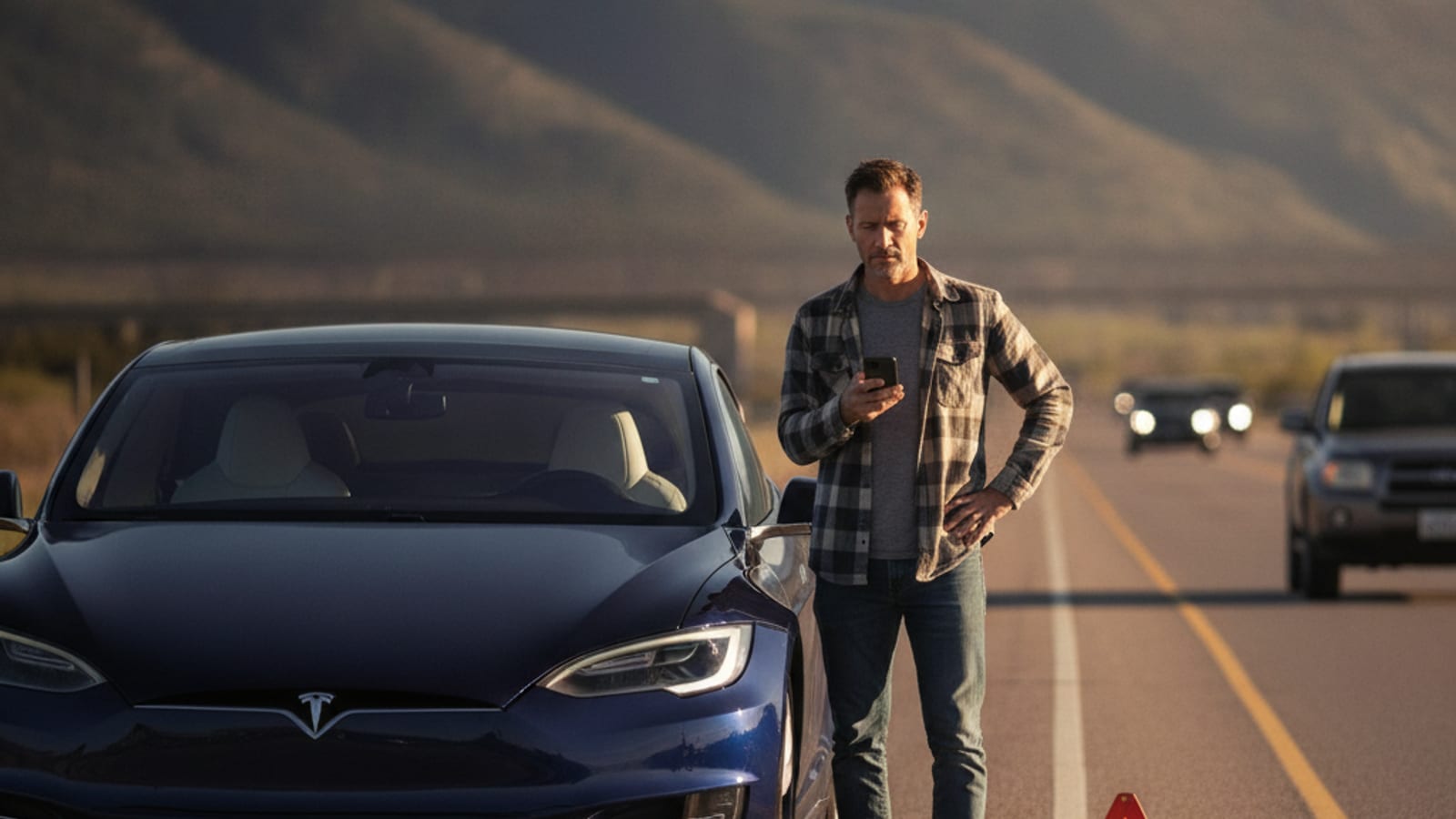
What to do if your EV runs out of battery on I-70 in the Denver metro comes down to four calls in a fixed order. Pull fully off the travel lane and turn your hazards on. Confirm CDOT Safety Patrol is on shift and on your segment, because it will jump a 12-volt but will not bring a charge. Ask Tesla roadside in the app for the OEM path. Then call (720) 738-6950 to reach a Charge Pro DEN referral for a local Level 2 boost from an independent operator. That four-step order keeps you safe and gets the pack question sorted before anyone hooks up.
CDOT Safety Patrol covers parts of I-70, not the pack
CDOT Safety Patrol is the state’s free roadside program. It runs through CDOT’s Division of Maintenance and Operations. On a Denver-metro run, it covers I-70 East from Wadsworth to Airport Blvd. On the climb, the I-70 Mountain Corridor is covered from Morrison to Vail. The service is free for the help it lists. The published list is flat tires, jump-starts, emergency fuel, minor mechanical help, debris removal, and incident support.
The list does not include EV charging. The Safety Patrol page is silent on electric vehicles. CDOT’s own “my car broke down” page is silent on EVs too. A jump-start covers a 12-volt battery, which is the small battery that runs the computers, the contactors, and the door locks. A 12-volt jump is not a charge. It will not add miles to the traction pack. If your gauge was already at zero, skip this call. If your car went dark after a freeze and still showed pack range before it died, the jump may finish the job.
Hours are posted on CDOT’s site, and they are not 24/7. Front Range metro weekday windows run 6:00 to 9:30 a.m. and 2:30 to 7:00 p.m. Weekend hours run 10:00 a.m. to 7:00 p.m. Mountain Corridor hours run 6:00 a.m. to 7:00 p.m., but only Friday through Sunday, plus during significant weather events along that corridor. If you are on I-70 outside those windows, do not wait for a free truck that is not on shift. The COtrip.org site and the 511 line post I-70 closures and the current status of the traction law and chain law.
Colorado shoulder law lets you wait for help
CRS 42-4-1202 covers a disabled vehicle on a highway. The plain read of the law: outside a business or residential district you may not stop or leave a vehicle on the paved main-traveled part of a highway. The exception is a vehicle so disabled it is impossible to avoid stopping and to move it off the roadway. Hazard lights must be on under CRS 42-4-230. A violation is a class B traffic infraction.
So sitting on the shoulder is lawful when you could not move further and your hazards are on. It is not lawful to sit in the lane. Pull past the fog line. Aim for the widest paved area available. Stay in the car with your seatbelt on if traffic is moving past. Stand uphill and away from the car only if you must exit.
Traction law and chain law matter here too. CDOT can impose the Passenger Vehicle Traction Law or, in severe storms, the Passenger Vehicle Chain Law. The traction law allows AWD or 4WD vehicles with M+S or winter tires at 3/16-inch tread, and 2WD vehicles with chains or an approved device. The chain law requires every vehicle to run chains or a device. Both are activated by highway signage and posted on COtrip. The fine for non-compliance starts at $100 plus a $33 surcharge, and rises to $500 plus a $157 surcharge if your non-compliance closes a lane. The traction law is how the law activates, not a fixed seasonal window.
Where the last charge sits before the Eisenhower tunnel
Idaho Springs sits at 7,526 feet. The current charging inventory shows eight Tesla Supercharger stalls there. That is the last confirmed fast charge before the road climbs to the Eisenhower-Johnson Memorial Tunnel at 11,158 feet. Georgetown sits between Idaho Springs and the tunnel. It shows no Supercharger in the current inventory. The stretch from Idaho Springs to the west side of the tunnel is the candidate gap. If you leave the metro with a comfortable margin and watch it vanish on the grade, the question is whether you reach Idaho Springs or stop on the shoulder between Idaho Springs and the tunnels.
The counterpart that often gets missed: coming back down returns a large share of the climb. InsideEVs covered real tests on this corridor. A Lucid Air GT used about 3% of its battery over a 77-mile descent from Loveland Pass. A Hyundai Ioniq 5 used about 10% of its battery over a 75-mile descent from the same pass. Both tests credited regenerative braking for the return. The honest caveat is that drivers often dial regen down on icy descents for traction, so the return is real but not automatic.
Beyond the tunnel, the first Superchargers on the west side sit in Silverthorne and Frisco. The west-side stretch is not the stranding case this page covers, but a driver who needs to know the next stop past the divide should plan for Silverthorne and Frisco first.
Cold matters before you commit to the climb. Recurrent Auto studied more than 30,000 U.S. EVs in winter. At 32 degrees, EVs retained about 78% of max range. At 20 degrees, that figure dropped to about 70%. The best model held 88% and the worst held 69%. AAA’s 2026 dynamometer study measured about a 39% range loss at 20 degrees. Heat-pump vehicles held about 10 points more at 32 degrees than vehicles without heat pumps. Cold plus grade plus heater is the triple that eats a metro-sized margin. A 70-mile pull out of Denver in January is a different drive than a 70-mile pull in May.
What a mobile EV charge does on a freeway shoulder
Charge Pro DEN is a referral line for stranded drivers. We do not own trucks, employ technicians, or set prices for a visit. We match you with an independent local operator who serves the Denver metro and the I-70 corridor. The operator quotes you before any cable goes in. They bill you directly for the work they do. There is no membership with Charge Pro DEN.
The kit is a 240-volt Level 2 source. Tesla drivers get a native NACS plug on the lead. Other EVs get a CCS or J1772 adapter. Typical charging time adds about 10 to 20 miles of range. That add happens in 15 to 30 minutes of charging, once the cable is in. The clock starts at charging time, not before. It is not an arrival time, and we do not promise one. For an empty pack, use the out-of-charge recovery path. For the broader charge-versus-tow choice, see mobile EV charging for the service side.
The miles the boost adds let you drive under your own power to a public stall. They are not a full charge. They are a bridge. A driver on I-70 west of Idaho Springs with a dead pack can often make it back down to the Idaho Springs Supercharger on a 10 to 20 mile boost. A driver east of the metro with a dead pack may need a different plan, because services thin fast east of Watkins and Bennett toward the plains.
Order of calls from a Colorado shoulder
The four calls in the right order save time. First, hazards on and stay visible to traffic. Move to the outside shoulder if you are still rolling. Second, if you are on a CDOT Safety Patrol segment during published hours, dial 511 or check COtrip.org for confirmation. The free truck is a jump, not a charge. Skip it when the pack was already at zero. Third, open the Tesla app if you drive a Tesla. The OEM has its own roadside path and may send a contractor. Fourth, call (720) 738-6950 for a mobile EV charge referral. The operator quotes before work starts.
If your car is a non-Tesla EV, skip the Tesla step and keep the order otherwise. If your car will not wake and the dash showed pack range before it went dark, treat the fault as a 12-volt first, not an empty pack. A cold soak in a metro lot often kills the 12-volt while the pack still has energy. Operators we refer can jump a 12-volt on site, and they can replace one on site when that is the job. The 12-volt versus empty-pack split is covered in can roadside jump an EV 12-volt.
For a wider look at who covers what, including E-470, AAA, and Tesla roadside compared, see Tesla, AAA, and a local mobile rescue. For the I-70 corridor specifically, see EV roadside assistance in Idaho Springs and out of charge on E-470. Those posts stay on the corridor geometry.
When the right answer is a tow, not a charge
A roadside charge does not straighten bent suspension. A charge does not fix a flat. A charge does not wake a car with a contactor failure. If the car cannot roll under its own power, you need a tow. Colorado’s disabled-vehicle statutes apply the same to an EV as to any other car. There is no Colorado statute that treats a disabled EV as a special class.
Colorado’s Towing Bill of Rights, HB22-1314, governs nonconsensual tows. The bill requires 24-hour written notice before most private-property tows. It limits drop fees for a tow halted on residential property. It allows recovery of a vehicle after paying a set share of the fee. It requires acceptance of cash and cards. It does not allow towing for expired plates alone, absent a law-enforcement order. The Colorado Public Utilities Commission regulates towing carriers. Read the bill’s terms before you sign anything at a lot.
If the car must reach a specific shop, or if the car cannot roll, a tow may be the right first call. If the car can roll and the pack is empty, a Level 2 boost on the shoulder is usually faster than a flatbed to a public stall.
What Charge Pro DEN is and is not
Charge Pro DEN is a referral brand. We do not install chargers. We do not send crews. We do not set prices. We do not promise arrival windows. We do not publish hours. We do not hold a trade licence. The operators we refer are independent local businesses. They carry their own insurance and bill you directly for the work. We match you to one of them when you call, and we stay out of the work itself.
The service area for this site is the Denver metro and the I-70 corridor west to the Clear Creek County towns. The 50 covered places sit in nine regions, from Denver and Glendale on the plain to Idaho Springs, Georgetown, and Empire on the climb. The site covers mobile EV charging for the broader choice, EV roadside assistance for the umbrella, and Tesla roadside rescue for the Tesla-specific path.
Frequently asked questions
Does CDOT Safety Patrol bring a charge to a dead EV on I-70?
No. CDOT Safety Patrol covers listed segments of I-70, and the published list includes the Mountain Corridor from Morrison to Vail. The published service list is tires, jumps, fuel, minor mechanical help, debris removal, and incident support. CDOT’s Safety Patrol page and CDOT’s “my car broke down” page are silent on EV charging. A Safety Patrol truck can jump a 12-volt battery. It does not bring a charge for the traction pack.
Is it legal to sit on the I-70 shoulder with hazards on?
Yes, when the car could not be moved further. CRS 42-4-1202 makes a disabled vehicle on the shoulder lawful in that case, with hazard lights on under CRS 42-4-230. A violation is a class B traffic infraction. Sitting in the travel lane is not lawful. Pull past the fog line to the outside shoulder.
Will I make it back to a charger by regen on the descent?
Often, yes, on the I-70 corridor. Real tests on Loveland Pass show a Lucid Air GT using about 3% of its battery over a 77-mile descent and a Hyundai Ioniq 5 using about 10% over a 75-mile descent, both crediting regen. The caveat is that drivers often dial regen down on icy descents for traction, so the return is real but not guaranteed.
What if my car will not wake at all after a cold night?
Treat that as a 12-volt fault first. The traction pack may still hold range. The 12-volt runs the computers, the contactors, and the door locks. A cold soak in a metro lot can kill a 12-volt while the pack still shows plenty of energy. Operators we refer can jump a 12-volt on site, and they can replace one on site when that is the job. Call (720) 738-6950 and tell them the car went dark after a freeze.
Who do I call first from an I-70 shoulder?
Turn hazards on, pull to the outside shoulder, then call in this order. If CDOT Safety Patrol covers your segment and is on shift, the free jump is for a dark 12-volt. Skip it when the pack was already at zero. If you drive a Tesla, open the Tesla app for the OEM path. Then call (720) 738-6950 for a mobile Level 2 boost from an independent operator. The operator quotes before work starts.