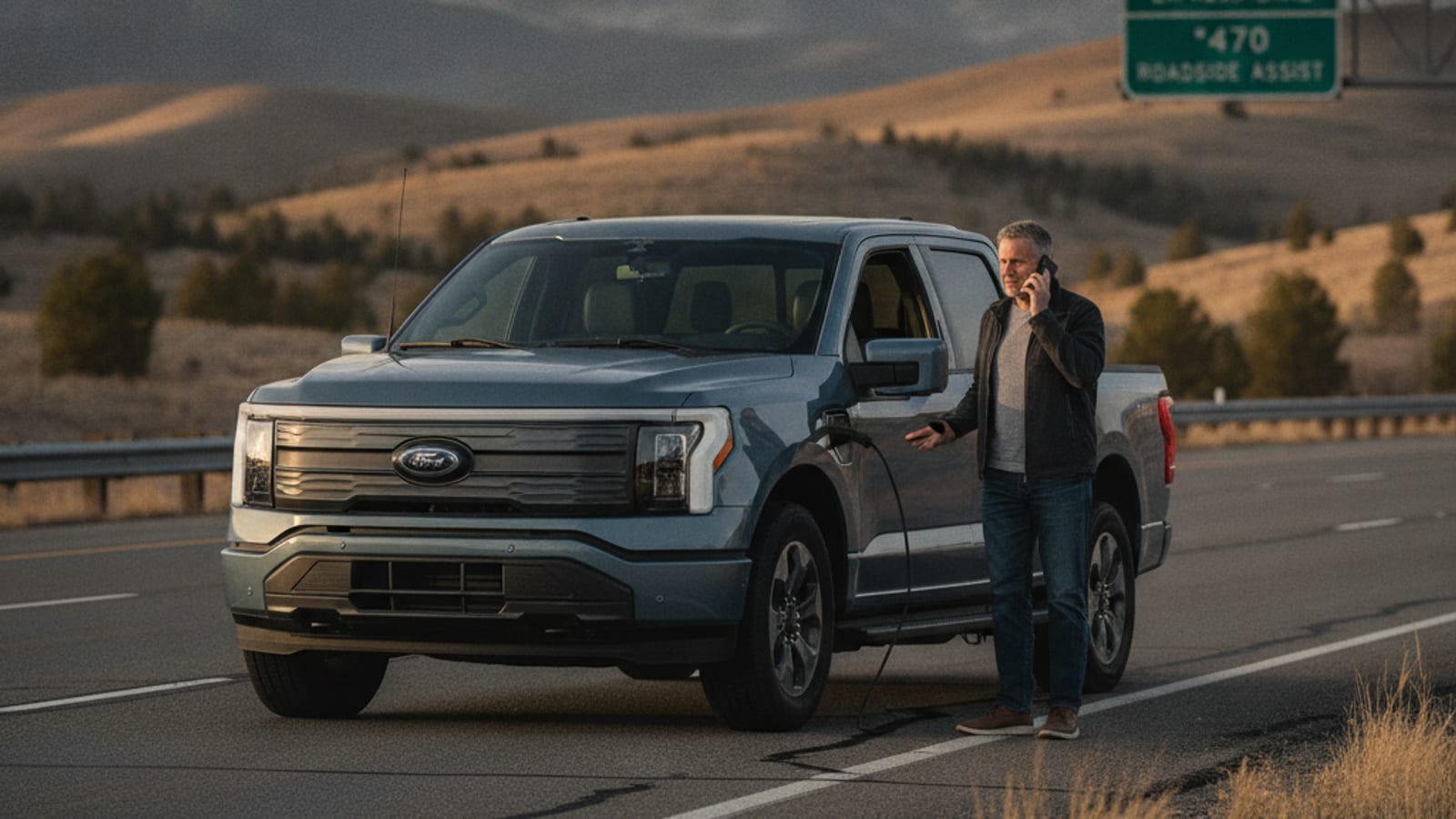
Mobile EV charging on E-470 comes down to one question: what *470 can do, and what it cannot. E-470 is the eastern-metro toll loop, all-electronic and cashless. The E-470 Public Highway Authority runs a free roadside service you reach by dialing *470 from your phone. That service covers flat tires, fluid top-offs, jump-starts, phone help, and debris removal. It does not publish an EV charging service. E-470 also does not offer any EV-specific toll discount. For an empty pack on the E-470 shoulder, a mobile EV charging referral from Charge Pro DEN is the answer. Call (720) 738-6950 and we match you with an independent local operator. They quote you before any cable goes in.
What E-470 is and who runs it
E-470 is a cashless toll road that loops the east side of the Denver metro. The E-470 Public Highway Authority operates it. Tolls are collected by ExpressToll transponder or by license-plate billing, with no toll booths at all. The road connects the south end of the metro near Lone Tree up through Centennial and Aurora, then east toward Watkins and the airport corridor before turning back south toward the I-25 spine. It is the eastern answer to C-470 on the west side, and it carries the bulk of Douglas County and Airport East traffic that does not want to fight I-25.
The cities that sit on or right next to E-470 are some of the metro’s most EV-dense. Highlands Ranch, Lone Tree, Centennial, Parker, Aurora, Watkins, and Foxfield all touch the loop or sit just off it. Almost everyone in those cities charges at home. The E-470 strandings are road-specific, not no-home-plug ones, and the loop is the path most of those drivers take when they run low.
What *470 will do for you
Pull to the outside shoulder with your hazards on. Dial *470. E-470’s own dispatcher answers. The service is free and the published menu is the same menu a state highway patrol would offer for the simple stops. Flat tires get changed or inflated. Out of washer fluid, low on gas, the operator tops you off. A dead 12-volt battery gets jumped. A piece of debris that came off your car or another gets cleared. Your phone gets a charge if yours is dying. None of that requires an appointment and none of that costs the driver anything directly.
The jump is the headline for an EV driver. A Tesla or any modern EV that will not wake up after a cold soak in January, or that drained its 12-volt sitting through a long lunch in the Lone Tree tech corridor, often comes back to life when the small battery is energized. The traction pack may still hold plenty of range. The car looks completely dead because the contactors will not close. *470 can fix that exact problem, on the shoulder, in a few minutes.
The published hours of E-470’s roadside service are not something this page states. Call *470 from the shoulder and find out. If the line does not answer, dial *CSP, which is *277, for Colorado State Patrol. State Patrol has crash and enforcement authority on E-470 the same way it does on I-25 or I-70.
What *470 will not do
E-470 does not publish an EV charging service. The same free menu that covers your flat tire and your jump does not include a 240-volt source. If your traction pack reads zero on the dash and the car will not move under its own power, *470 is not the answer. The Authority’s own pages describe the same five items every time. There is no hidden EV option, and there is no EV-specific toll credit or discount that would change the picture.
This is the gap the Authority leaves open on purpose. State troopers and toll-road patrols do not run mobile Level 2 trucks. They are not in the charging business. CDOT Safety Patrol covers I-25 South and I-70 East, plus portions of US-6, C-470, and I-225, and is also silent on EV charging in CDOT’s own published guidance. E-470’s loop is not on the CDOT list. The free jump from *470 stays the only state-or-authority hand on E-470 for a dead 12-volt. For a dead pack, the help has to come from someone else.
The cities E-470 runs through
The north stretch of E-470 climbs from I-25 near Centennial up through Aurora toward the airport corridor and Watkins. The Aurora end is dense, diverse, and the home of the Anschutz Medical Campus. A long dwell in a hospital parking structure in January is exactly the pattern that kills a 12-volt on a marginal battery. Aurora drivers also launch east on E-470 toward the plains, and the eastern edge of the loop is where services thin fast toward Bennett and the Kansas line.
The south stretch runs through Centennial, Highlands Ranch, Lone Tree, and Parker. The whole corridor is CORE Electric Cooperative territory, not Xcel. Home charging is nearly universal. The call mix is road-specific: the C-470 and University commute, the long dwell at Park Meadows in Lone Tree, the I-25 south climb through Monument Hill. E-470 is the launch for both the airport and the south-Douglas runs, and it is also the loop that takes a Parker or Highlands Ranch driver over to I-70 east without going through Denver traffic.
Cold weather and the empty pack on E-470
Cold is what flips a comfortable margin into a problem on E-470. Denver’s January normal low sits around 18 degrees. The eastern half of the loop is more exposed than the western metro, with wind off the open plains coming straight down the corridor. A car that left Centennial or Lone Tree with a 60% state of charge in the morning can be sitting at 25% by the time it reaches the Aurora end of E-470, with a heater running and a driver watching the gauge drop faster than the miles.
Recurrent Auto studied more than 30,000 U.S. EVs in winter. At 32 degrees, EVs kept about 78 percent of max range. At 20 degrees, the average dropped to about 70 percent. The worst cars in the study lost more than 30 percent. Heat-pump vehicles held about 10 points more at 32 degrees than models without a heat pump. A driver who runs cold-climate tires on E-470 in January accepts that the gauge will lie about the trip home. The trip home up a grade from the airport end toward Parker eats the rest.
Empty pack versus dead 12-volt
This is the split that decides who you call. The 12-volt is the small battery that runs the computers, the contactors, the door locks, and the dashboard. The traction pack is the big battery that drives the wheels. A car that was driving fine and then sat dark through a cold night is almost always a 12-volt problem. A car that was driving and ran the gauge to zero is an empty pack. The two problems look the same from outside the windows but they have nothing in common.
*470 can solve the first one on the E-470 shoulder. A mobile EV charge solves the second one. If you are not sure which one you have, read can roadside jump an EV 12V for the full split. If the dash showed low range first, treat it as an empty pack. If the car went dark after a freeze and the screen would not wake, start with *470 and a jump.
What a mobile EV charging referral actually is
Charge Pro DEN is a referral line for stranded drivers. We don’t own trucks, and we don’t employ technicians. We match you with an independent local operator. That operator quotes you before any cable goes in. They bill you directly for the work they do.
The kit is a 240-volt Level 2 source. Tesla drivers get a native NACS plug on the lead. Other EVs use a CCS or J1772 adapter. Typical charging time adds about 10 to 20 miles. That add happens in 15 to 30 minutes of charging. The clock starts when charging starts, not before. It is not an arrival time, and we don’t promise one. The operator confirms equipment, access, and price with you on the phone before they roll.
For the broader choice between a boost and a tow, read charge in place or tow. For the recovery case specifically, use out-of-charge recovery. For an EV that will not wake because the 12-volt is dead on E-470, the operators we refer handle that too. A stuck charge port is a latch problem, not a tow problem. Ask the operator about the port before anyone hooks a winch.
What to do in the next two minutes on E-470
Hazards on first. Pull as far onto the outside shoulder as you can. The shoulder on E-470 is not wide, so put every wheel you can on the paved shoulder and keep your body out of the travel lane. Stay in the car if that is the safer choice. Set your parking brake and turn the car fully off so the 12-volt stops trying to power anything.
If your phone still works, dial *470. The dispatcher will tell you what is on the published menu and whether a jump is the right call. If your phone is dead, use the car itself if it has even a flicker of life left. If you have no phone at all, walk to the nearest call box or flag a passing Authority vehicle. Do not stand in the lane to flag help.
If the operator on *470 confirms a jump is the right answer and they are on the way, wait inside or beside the car on the shoulder side. If the operator says the problem is an empty pack and they cannot help, that is when you call Charge Pro DEN at (720) 738-6950. The operators we refer can roll a 240-volt source to your shoulder on E-470 from anywhere in the metro. Tell them where you are between exits and they will quote you on the phone.
CRS 42-4-1202 covers a disabled vehicle on a highway. You may not stop on the paved main-traveled part of a highway, with the exception of a vehicle so disabled it cannot be moved off. Hazard lights must be on under CRS 42-4-230. CRS 42-4-1803 governs abandoned vehicles. The statute sets no fixed hour count for abandonment. The Colorado Public Utilities Commission regulates towing carriers.
When the right answer is still a tow
A roadside charge does not straighten bent suspension. If the car cannot roll under its own power, even after a jump, you need a tow. AAA and other clubs exist for that kind of work. If the car has to reach a specific shop, a charge may delay the hook.
For a longer comparison of the choices, read AAA vs mobile EV charging when the pack is dead. That post stays on the charge-versus-tow call. This one stays on what E-470 will and will not bring to a stranded driver.
How the call works from an E-470 shoulder
You dial (720) 738-6950. We ask where you are between which two exits. We tell you the operator we will match you with. The operator calls you back directly to confirm equipment, access, and timing. They tell you the price before any cable goes in. They roll a 240-volt Level 2 source with the right plug for your car. They add 10 to 20 miles in 15 to 30 minutes once the cable is in. You pay them direct. We do not add a fee on top of theirs.
The whole metro is in scope. From Watkins on the east end to Highlands Ranch on the south end, the operators we refer cover E-470 and the surface streets around it. For a broader service menu, read EV roadside assistance in the Denver metro. Treat the number as a referral line, not a rolling promise.
Frequently asked questions
Will E-470 come charge my EV?
No. E-470’s free roadside service covers flat tires, fluid top-offs, jump-starts, phone help, and debris removal. The Authority does not publish an EV charging service and does not offer any EV-specific toll discount. For an empty pack on E-470, call Charge Pro DEN at (720) 738-6950 and we match you with an independent operator who brings a 240-volt Level 2 source.
What does *470 actually cover?
Flat tires, fluid top-offs, jump-starts for a dead 12-volt battery, phone help, and debris removal. The service is free and it is run by the E-470 Public Highway Authority. It is the right call when the car will not wake because the small battery is dead. It is not the right call when the traction pack is at zero.
How long does a mobile EV charge take on E-470?
A 240-volt Level 2 source adds about 10 to 20 miles of range in 15 to 30 minutes once the cable is in. The clock starts when charging starts, not before. The operator we refer quotes you before they roll, and they confirm equipment, access, and timing on the phone.
Can I stay in my car on the E-470 shoulder?
Yes, if that is the safer choice. Hazards on. Pull as far onto the shoulder as you can. CRS 42-4-1202 lets a disabled vehicle remain on the shoulder with hazards on. If you have to step out, exit on the shoulder side away from the travel lane.
Does AAA help on E-470?
AAA may jump a 12-volt battery and AAA may arrange a flatbed tow. This page could not confirm a published AAA Colorado policy for on-site EV charging. Ask AAA directly before you wait on a truck. An independent mobile operator is the party that brings Level 2 to the car on the E-470 shoulder.