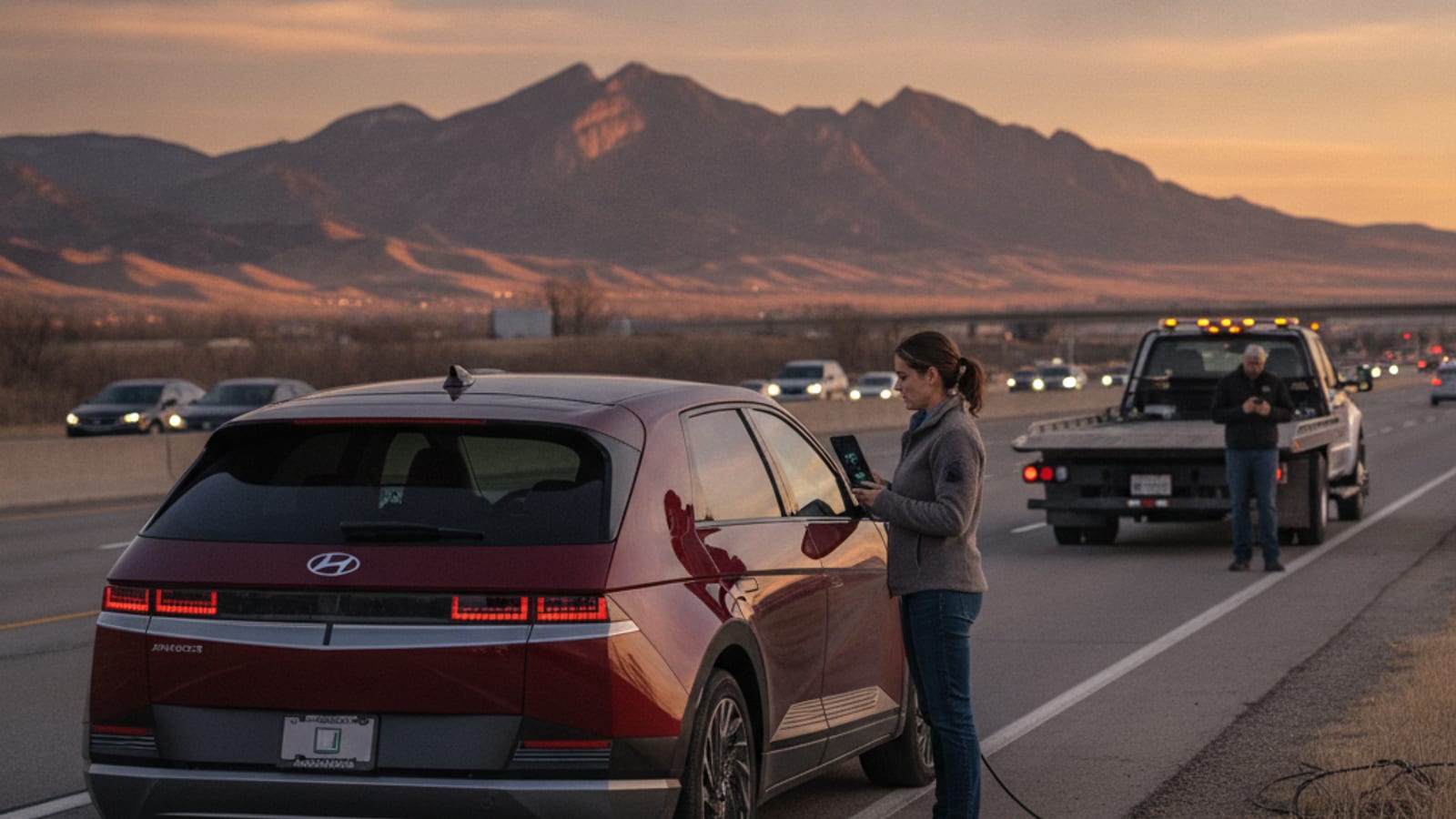
Mobile EV charging cost vs tow comes down to what the car actually needs. Many empty-pack calls on Front Range shoulders and parking lots only need a 240-volt Level 2 boost from a local operator. A flatbed tow to a stall is a different job, with a different bill, and Colorado’s Towing Bill of Rights (HB22-1314) shapes how a nonconsensual tow has to go. The choice depends on the condition of the car, the time of day, where it sits, and whether anyone can legally bring a charge to the spot. For an empty pack on a safe shoulder, call (720) 738-6950. We match you with an independent operator who quotes before any cable goes in.
Colorado’s towing rules apply if the tow happens
HB22-1314 is the Colorado Towing Bill of Rights, effective August 10, 2022. It sets the rules for nonconsensual tows on private property: a written 24-hour notice before most private-property tows, limits on drop fees when a tow is halted on residential property, recovery of a vehicle after paying a set share of the fee, and required acceptance of cash and cards. The Colorado Public Utilities Commission regulates towing carriers. Specific fee and percentage caps were not verified for this page, so this post does not publish a number.
For an empty-pack call from a highway shoulder, the rules look different. CRS 42-4-1202 covers a disabled vehicle on the main-traveled part of a highway. A driver may not stop on the paved main-traveled part of a highway, except a vehicle so disabled it is impossible to move it further. Hazard lights must be on under CRS 42-4-230. A driver who can still roll to the shoulder is required to do so. A driver who genuinely cannot move the car may wait with hazards flashing for help.
HB22-1314 does not change disabled-vehicle law on a highway shoulder. It governs tows ordered by a property owner, a landlord, or a parking operator without the driver’s consent, the kind that happens when a car is left in a lot past a posted window. Read the cost and coverage guide before any nonconsensual tow, and ask the tow operator for the written notice and the fee breakdown the bill requires.
What an empty pack actually looks like
An empty pack reads near zero on the dash, the car will not move, and the high-voltage contactors will not close. There is no motor to spin, no wheel to lift, nothing for a flatbed to do that a Level 2 source cannot. The 12-volt battery is usually fine on an empty-pack call, because the car died after the traction pack was already depleted. Operators bring a 240-volt Level 2 source to the bumper. Typical charging time adds about 10 to 20 miles of range in 15 to 30 minutes of charging. That is charging time on the pack, not an arrival promise, and it is enough range to reach a Supercharger, get to a home charger, or finish a short trip under the driver’s own power.
For an empty pack on a safe shoulder or in a drivable position in a lot, out-of-charge recovery is the right path. The operator does not need to lift the car. The car does not need a shop. The work happens where the car sits.
A tow to a stall is a different job. A flatbed is the right tool when the car cannot roll under its own power, when the traction pack is damaged, when the car has been in a collision, or when the driver wants the car at a specific shop. Towing does not charge the pack. The car ends up on a charger at the destination, which adds time, mileage on the tow, and a stall fee at the public site. For a drivable empty-pack call, a tow is the longer path to the same destination.
When a dead 12-volt changes the picture
A dead 12-volt looks like an empty pack from the driver’s seat. The dash goes dark, the doors will not open, the car will not ready. The traction pack can still hold plenty of energy. The 12-volt runs computers, contactors, and door locks, and when it dies the whole car looks finished. A long sit in a cold DEN lot, a week of airport parking in January, or a hard freeze after a long workweek dwell are common causes. Recurrent Auto’s winter study of more than 30,000 U.S. EVs found EVs retain about 78 percent of max range at 32 degrees and about 70 percent at 20 degrees on average, which means a cold morning hides a margin that looked fine the night before, and a weak 12-volt will not wake after that soak.
CDOT Safety Patrol will jump a 12-volt on listed Front Range segments. It will not charge the traction pack. The operators we refer jump a 12-volt on site and replace one on site when that is the job. They price both before starting and bill the driver directly. If the dash showed low range first, the call is an empty pack. If the car sat dark through a freeze, start with the 12-volt. Read can roadside jump an EV 12V for the full split.
Where the tow happens matters
The same tow billed on a private lot, a residential street, or a highway shoulder follows different Colorado rules. A nonconsensual tow from a private lot triggers HB22-1314, including the 24-hour notice rule, the cash-and-cards acceptance rule, and the residential drop-fee limit. A highway shoulder tow by the driver’s request, with hazards on and a phone call to a club or carrier, is a consensual tow governed by standard commercial terms. A mobile EV charge avoids the private-lot tow question entirely because the operator comes to the car and the car stays where it sits.
For Denver, Aurora, Lakewood, Westminster, and Littleton drivers, a charge-in-place path is the usual call. For a car that cannot roll, a flatbed is still the right tool. Read the situation before you dial.
Cost factors neither side publishes
Charge Pro DEN does not publish a tow-versus-charge dollar table, and it does not promise that an on-scene charge is cheaper than a tow. Charging time depends on state of charge, battery capacity, the vehicle’s onboard charger, the operator’s equipment, and the electrical service available at the curb. A tow fee depends on mileage, hookup fees, after-hours surcharges, dollies versus flatbed, and the carrier. Independent operators confirm whether they can attempt the charge, then quote you. You pay them. Charge Pro DEN does not set the price on any job.
That rule protects the driver from a comparison that nobody can verify. The honest version is two questions: can the car roll under its own power, and does it need a stall it cannot reach. If the answer is yes and no, a charge is the right call. If the answer is no and yes, a flatbed is the right call. If the answer is yes and yes, either path works, and the operator quote is the deciding factor.
How to choose from a metro shoulder
Turn the hazards on and stay visible to traffic. Move to the outside shoulder if the car can still roll. Stay in the car if that is the safer choice. If you are on a listed CDOT Safety Patrol segment during published hours, the free jump is for a dead 12-volt. It will not bring a charge to an empty pack. On E-470, *470 handles the same jump-and-tire list and will not bring a charge to the pack. Neither will a club truck by default. Read Tesla, AAA, and a local mobile rescue for the coverage comparison across the major scripts.
If the car is otherwise fine and the pack is empty, call for range. A mobile EV charging referral adds that range in place. The operator quotes you before any cable goes in. We serve the Denver metro from the plains to the foothills, and the operator covers that geography. Call (720) 738-6950 when you want the match. Treat it as a referral number, not a rolling promise.
When a tow is still the right tool
A roadside charge does not straighten bent suspension. A charge does not clear a stuck charge port if the latch is broken. A charge does not move a car that cannot roll. A flatbed is the right tool when the car has been in a collision, when the traction pack is physically damaged, when a wheel is locked, or when the driver wants the car at a specific shop. Towing is also the right tool when the driver is out of cell range or out of patience for a wait, and would rather have the car at a charger now. Read EV rescue vs repair in Denver for the boundary between roadside help and shop work.
CRS 42-4-1803 covers abandoned vehicles on public property. There is no fixed hour count for abandonment, and no Colorado statute treats a disabled EV as a special class. A driver who cannot reach the car in time should call the Colorado State Patrol non-emergency line before the car moves from its spot.
How the referral works
Charge Pro DEN is a referral line for stranded drivers in the Denver metro. We do not own trucks, and we do not employ technicians. We do not set prices for the visit. We match you with an independent local operator who covers the Denver metro from the plains to the foothills. That operator quotes you before any cable goes in. They bill you directly for the work they do. You pay them, not a Charge Pro DEN invoice.
The kit is a 240-volt Level 2 source. Tesla drivers get a native NACS plug on the lead. Other EVs use a CCS or J1772 adapter. Typical charging time adds about 10 to 20 miles. The clock starts when charging starts, not before. It is not an arrival time, and we do not promise one. Read mobile EV charge, who quotes in Denver for the full referral flow.
Frequently asked questions
Does Colorado law guarantee a 24-hour notice before a tow?
Yes for most nonconsensual private-property tows. HB22-1314 requires written notice before most private-property tows and limits what a property owner can charge when a tow is halted on residential property. The notice rule is a driver protection, not a permission to leave the car indefinitely. Read the electric-car cost and coverage guide before any nonconsensual tow.
Is a mobile charge cheaper than a tow in Colorado?
Charge Pro DEN does not publish a tow-versus-charge dollar table. Charging time and tow fees depend on state of charge, battery capacity, mileage, hookup fees, equipment, after-hours surcharges, and the carrier. The independent operator quotes before starting. You pay them, not a Charge Pro DEN invoice.
Can a tow company refuse to take cash?
No, not for a nonconsensual tow covered by HB22-1314. The bill requires acceptance of cash and cards. If a carrier refuses cash, ask for the written notice and the fee breakdown the bill requires. Keep the receipt and the time stamp.
Does CDOT Safety Patrol charge the traction pack?
No, CDOT Safety Patrol does not publish an EV charging service. Its published menu is tires, jumps, fuel, debris, and minor mechanical help. The free truck can wake a 12-volt battery on listed segments during published hours. It cannot add miles to the traction pack.