Your electric car died on a Denver freeway shoulder. The dash tells you the next step, not a guess. A confirmed empty pack points to a mobile charge. Dark screens and silent locks often mean the 12-volt. An unknown fault, or a stop nobody can reach, points toward a tow. CRS 42-4-1202 lets a disabled EV sit on the shoulder. You just have to be unable to move it farther. Keep the hazard lights on under CRS 42-4-230.
The law treats a dead EV like any disabled car
Colorado doesn’t have a separate breakdown statute for electric cars. A 2026 read of the traffic code confirmed that gap. CRS 38-33.3-106.8 and CRS 42-4-1213 cover HOA charging and stall parking. Neither statute is a breakdown rule for a stranded EV. Your stall uses the same disabled-vehicle rule as a gas car.
Outside a business or residential district, you can’t stop on the paved travel lanes. That’s the core rule inside CRS 42-4-1202. The exception is a vehicle so disabled you couldn’t avoid stopping. You also couldn’t move it off the roadway. A violation is a class B traffic infraction.
If you’re still in a live lane, that’s an emergency. Call 911 and follow the dispatcher from there. Don’t invent a push, a roll, or a neutral release. The owner’s manual for your year is the only source for movement. If the car won’t move, stay put and describe the stop.
Abandoned-vehicle rules sit in CRS 42-4-1803 to 1805. An officer can treat the car as abandoned on reasonable grounds. The statute sets no fixed hour threshold at all. Colorado State Patrol handles crash response and abandoned-vehicle removal.
CDOT can jump a 12-volt, not the pack
CDOT Safety Patrol is free on covered metro freeway segments. That includes parts of I-25 South from 120th Ave to Arapahoe Rd. It covers I-70 East from Wadsworth to Airport Blvd. Portions of US-6, C-470, and I-225 are on the list too. The I-70 Mountain Corridor is covered from Morrison to Vail.
Front Range metro hours are 6:00-9:30 am and 2:30-7:00 pm weekdays. Weekend hours run from 10:00 am to 7:00 pm. Mountain Corridor hours are 6:00 am to 7:00 pm Friday through Sunday. Those mountain hours also run during significant weather.
The Safety Patrol page mentions jump-starts, flat tires, and emergency fuel. It says nothing about EV charging on that page. CDOT’s breakdown page is silent on electric cars too. That’s a real gap in the state’s published guidance. A patrol truck can often jump a 12-volt. It doesn’t bring a charge to a stranded EV.
For I-70 closures and traction-law status, use COtrip.org or 511. CDOT can impose the Passenger Vehicle Traction Law by signage. In severe storms it can impose the Chain Law.
Read the dash before you name the problem
“Died” isn’t a full diagnosis on its own. One driver sees an empty driving-battery warning on the dash. Another sees black glass and a silent phone app. Those two reports point to two different jobs.
Read every warning message word for word, exactly. Note whether the cluster, interior lights, or locks still answer. Check the phone app and the charge-port door. If a remaining percentage still shows, report it as displayed without interpreting it. Say whether the car quit while moving, or wouldn’t wake after a park.
A displayed empty-pack warning supports talking about out-of-charge recovery. Blank screens may lead a tech toward the 12-volt. That still isn’t permission to pop a cover. Procedures differ by make, model, and model year. Use the current owner’s manual for your car. If you don’t have it, say so before any work starts.
Our Tesla pack versus 12-volt guide helps you sort symptoms. It can’t diagnose your specific car from here. The Department of Energy EV overview is general background only.
Cold makes this mix-up more common along the Front Range. Denver’s January normal low sits around 18 degrees. The January 2024 arctic blast hit the metro hard. Denver fell from 47 to minus 19 in about two days. Recurrent Auto’s 30,000-EV winter study found about 78% range left at 32 degrees. At 20 degrees the average sits near 70%. A low displayed range after a soak isn’t a dead 12-volt. Report both the percentage and what still powers on.
Name the road, the direction, and the stop type
“Somewhere in the metro” wastes the first minutes of a call. “Northbound I-25 near Thornton” is a usable report, and so is US-36 toward Boulder. Westbound I-70 near Wheat Ridge, before the foothills, works too. Peña Boulevard toward Denver International is city-maintained, and it’s the only road into the airport. Eastbound I-70 toward Aurora and the Anschutz campus needs that same precision.
Say if you’re on the shoulder, in a lane, or in a garage. Mention gates, height bars, tight ramps, and security desks. An operator has to know if a service vehicle can legally reach you.
On the I-25 North and US-36 Express Lanes, CDOT built a minimum 8-foot outside shoulder. If you stall there, move to the right outside shoulder when the car still can. “No shoulder in the express lane” isn’t accurate on those two corridors.
On E-470 the road is cashless, with published free roadside help. Pull to the shoulder and dial *470 for jumps, tires, and debris. It doesn’t publish an EV charge as a service. Dialing *CSP at *277 reaches Colorado State Patrol. The Northwest Parkway roadside number wasn’t confirmed in our research.
If you’re in a Tech Center garage after work, say the building and the level. A Red Rocks lot after a show in Morrison does too. If police or CDOT already own the scene, their directions beat phone troubleshooting.
A climb toward Golden, Evergreen, or Idaho Springs changes the energy math. Denver sits at 5,280 feet, and Golden near 5,675. Evergreen is about 7,200 feet, and Idaho Springs 7,526.
Charge, jump, or tow: pick from confirmed facts
The right branch is symptoms, the manual, and the stop. “My electric car died” is only the opener.
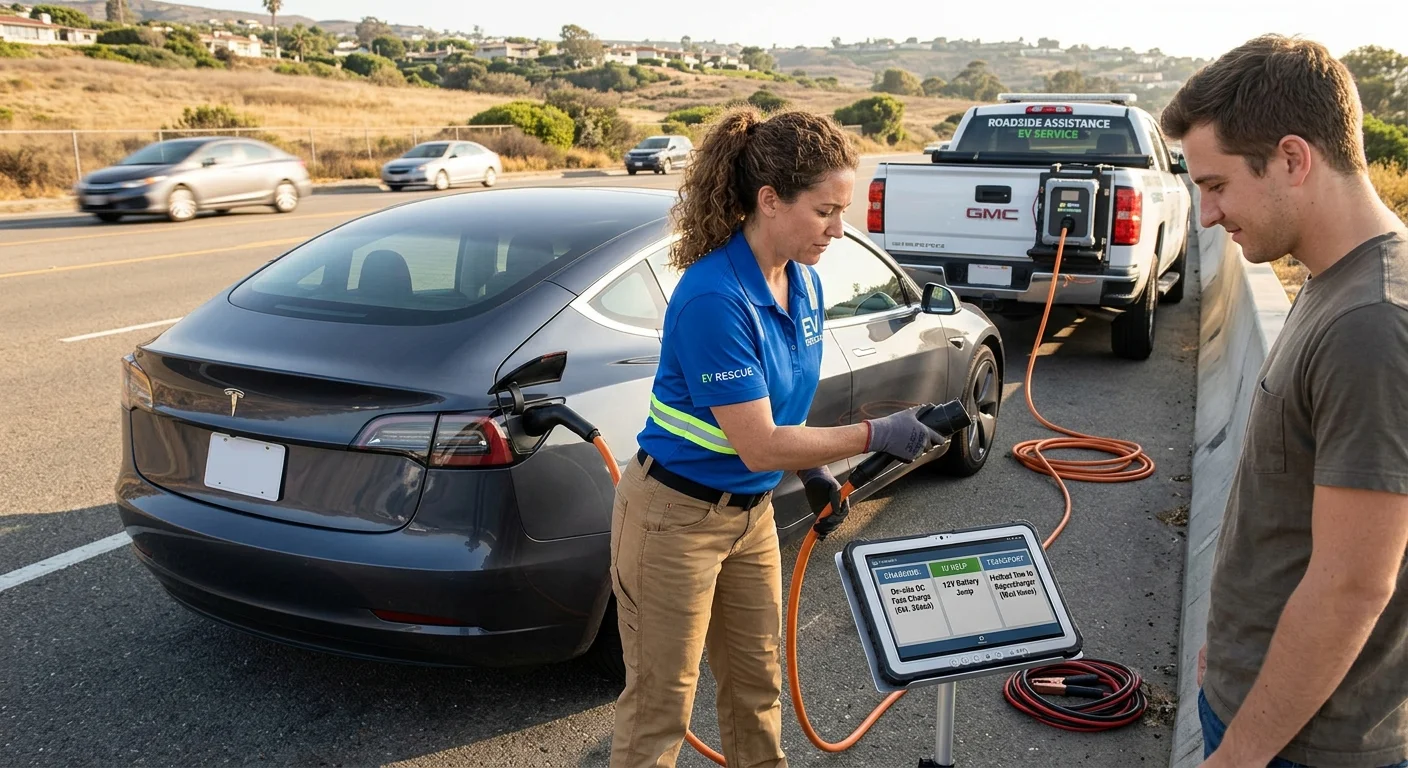
Talk charging when the traction battery looks empty. Share the displayed percent, the warning text, and the charge-port status. Independent operators who take our referrals bring a 240-volt Level 2 source to the car. Tesla cars take a native NACS plug for this service. Other EVs use a CCS or J1772 adapter. That charge typically adds 10 to 20 miles of range. That’s 15 to 30 minutes of charging time, never a promise of when someone arrives. Mobile charging still may not fit if the car can’t accept a charge. Our charge in place or tow comparison lays out the questions.
Talk a jump only after low-voltage trouble looks likely. Our how to jump an EV 12-volt piece is background for that call. The operator still checks your year against the manufacturer steps. Pros we connect you with can jump or replace a dead 12-volt on site.
Talk a tow when on-site service doesn’t fit. Unknown cause, collision damage, or a stall a truck can’t reach belongs there. The tow method has to follow the current instructions for that vehicle. Don’t coach a driver on dollies or which wheels may roll. Colorado’s Towing Bill of Rights, HB22-1314, covers nonconsensual private-property tows. The Public Utilities Commission regulates towing carriers in Colorado. Ask the carrier for the current price before you authorize anything.
What to put in the first call
Start with make, model, year, and the displayed charge. Read warnings exactly, then say what happened right before it quit. You might have been parked after errands in Lakewood, or climbing US-36 toward Boulder. State only what you saw, not a diagnosis. If there was an impact, smoke, heat, or a pack smell, tell 911 first. List cluster, locks, interior lights, app, charge-port door, and gear selector. Give a pin if you can, plus the nearest exit or garage level. Name the city: Denver, Aurora, Lakewood, Boulder, Thornton, Castle Rock. Say whether someone who can authorize service is standing there. For later planning, the Denver metro charging hub is the map.
How Charge Pro DEN makes the connection
Charge Pro DEN is a referral line for stranded drivers. We match stranded EV drivers with independent local mobile rescue operators. We don’t hold a trade license, own trucks, or employ technicians. We don’t set prices, promise an arrival time, or publish hours. The operator quotes you before starting and bills you directly. Ask them to confirm the scope and the current price. The pros we connect you with are licensed and insured. They handle Tesla and every major EV brand. The independent operator then reviews the car, the manual, and the stop. They tell you whether a charge, a 12-volt jump, or a tow actually fits. If the cause isn’t confirmed, say unknown at the start. Our EV roadside assistance page covers the core city, north metro, and CORE towns. Call (720) 738-6950 and we’ll connect you with a local EV rescue operator.