The independent operator who reaches your car is the one who sets the mobile EV charging service cost. Charge Pro DEN does not. We match stranded EV drivers in the Denver metro with local mobile rescue operators. That operator quotes you before a cable goes in, then bills you directly.
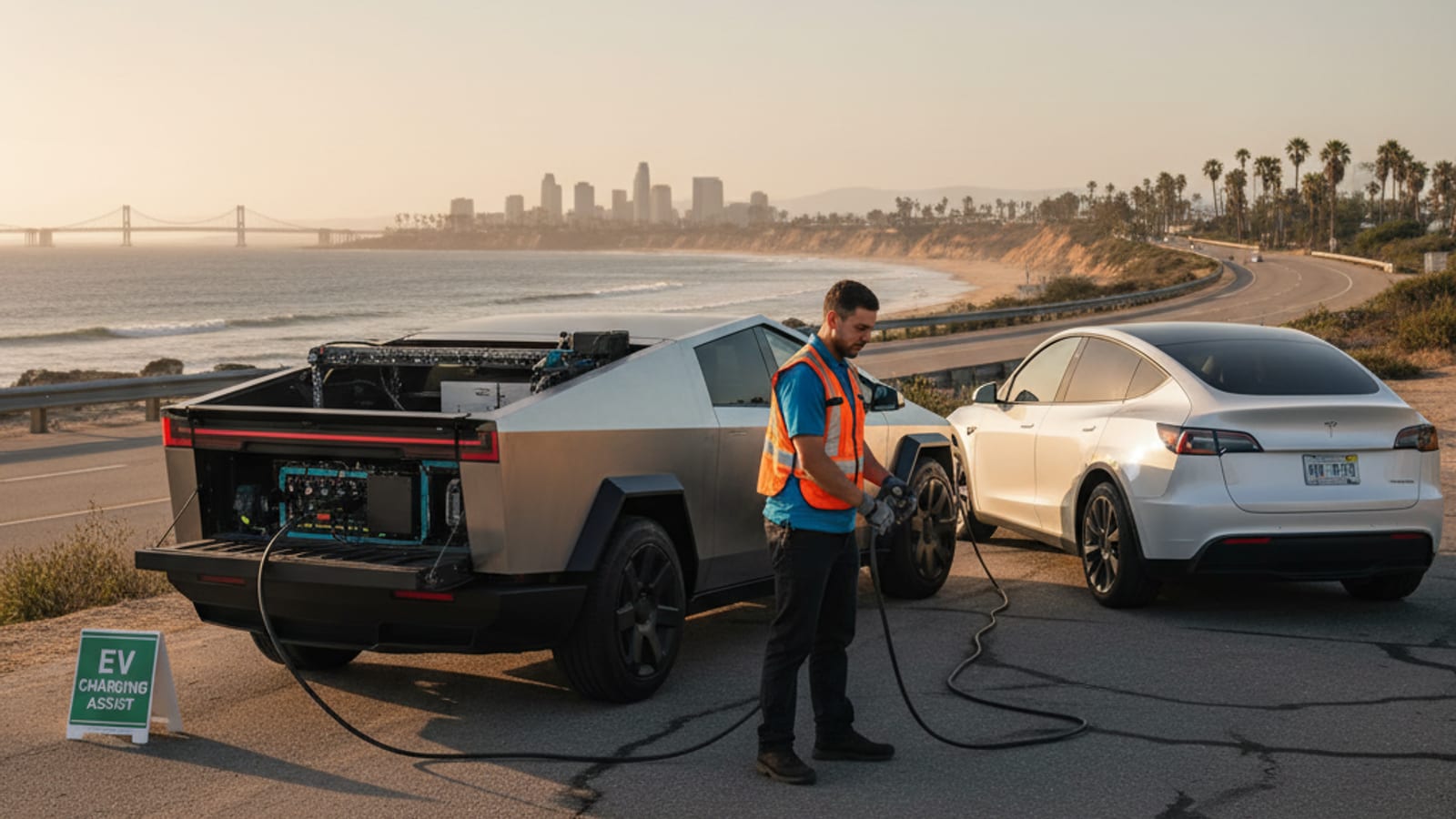
People search this because they want a number they can hold. A lot of pages invent one. A real quote is not a published menu. It is a conversation at the shoulder, in a garage, or in a lot, between you and the person who will do the work.
The figure you want is not on this page
Charge Pro DEN does not publish a rate card. We do not hold a trade license. We do not own trucks, yards, or chargers. We do not employ technicians. We do not promise when someone will arrive. Those facts matter for cost, because cost lives with the operator, not with the match.
If a page lists a tidy range next to a brand name, ask who is actually billing you. In this network, the answer is the independent operator. You hear the quote first. You can decline it. Nothing starts until you agree.
That is the whole pricing model. The rest of this page is context for why two quotes on the same night can differ, and why a referral line is the wrong place to look for a sticker price.
Colorado has no statute that sets a roadside EV charging rate. A stranded EV is treated like any other disabled vehicle. The operator names a price for the job in front of them. You accept it, or you do not.
How a quote actually happens
You call. You say where you are, what you drive, and what the car is doing. An empty traction pack is one job. A 12-volt that will not wake the car is another. A public stall that will not start a session is a third. The person taking the call is matching you, not selling you a package.
An operator looks at that picture and names a price for the work they are willing to do. They bill you. Charge Pro DEN is not on that invoice.
Bring the details that change a quote. Pin your exact spot, not just the city. I-25 through Thornton is not the same stop as a driveway in Highlands Ranch or a garage at Park Meadows. Name the make and the plug. Tesla uses NACS. Most other EVs use CCS or J1772. The operators we connect you with carry a native NACS plug and adapters for the rest.
Say how much range you think you need. The usual roadside job is not a full pack. Operators typically add 10 to 20 miles in 15 to 30 minutes of charging. That window is charging time once the cable is in. It is not a promise of when someone shows up.
If the quote is not a fit, say so. You are not locked into a dispatch you never accepted. For how the match itself works, see mobile EV charging near me in the Denver metro.
What a quote is actually covering
Operators build a quote from the work, not from a metro-wide menu. The pieces usually look like this, even when they are bundled into one number.
Travel to you is part of it. A stop on a surface street in central Denver is a different run than a shoulder on I-70 west of Golden, a lot at Denver International, or a street in Castle Rock. The operator is moving a 240-volt source to your car. Distance, access, and a safe place to park all show up in the quote they give you.
Setup is part of it. Cones, hazard lights, the right adapter, and a stable plug-in on a live lane take time. That time is work, even before kilowatt-hours move.
Energy delivered is part of it. You are not buying a full charge on the shoulder. You are buying enough to roll to a public stall or home. Ask for the miles you need, not a full pack you do not need delivered at the roadside.
Time of day can change it. A weekday stop in ordinary traffic is not the same job as a night stop in a freeze, or a holiday run when fewer operators are out. The operator will say so in the quote. Do not guess a night premium from a blog.
Vehicle type can change it, but not because Tesla is “special” in this network. A NACS car and a CCS car are both in the normal kit. What changes the work is whether the car will accept a Level 2 session at all, and whether the real problem is the pack or the 12-volt.
Charge Pro DEN does not add a line item on top. We do not take a cut you have to reverse-engineer. The number you hear is the operator’s number.
Where you are in the metro changes the job, not a published rate
The Denver metro is not one place with one travel cost. Coastal-style copy that swaps city names would fail here. Housing, elevation, utilities, and the roads themselves split the map.
Central Denver, Glendale, and the Capitol Hill blocks sit at the official mile-high mark, the 13th step on the west side of the State Capitol. Street parking and garage dwells are the usual story. A car that sat through a workday in the cold can fail to ready even when the pack still has miles. That is often a 12-volt job, and the quote should match that job.
The Tech Center in Greenwood Village and Centennial, plus Park Meadows in Lone Tree, are long-dwell garage territory. You leave a car for hours, come back, and it will not wake. Confirm whether the dash is dark or the pack is empty before you ask for a charge you may not need.
North metro stops on I-25 run through Northglenn, Thornton, and Westminster. United Power and Xcel split some of those cities street by street. That split does not set the roadside quote. It does set who bills a home charger later, which is a different invoice entirely.
South metro stops in Highlands Ranch, Castle Pines, Parker, and Castle Rock sit on CORE Electric Cooperative, not Xcel. CORE’s residential COREV Charge program is at capacity and closed to new applications. That is a home-charging fact. It is not a roadside price. Do not call Xcel from a Castle Rock shoulder and expect them to dispatch a charger to the car.
West metro and foothills stops in Lakewood, Wheat Ridge, Golden, Morrison, and Evergreen add elevation. Golden sits near 5,675 feet. Evergreen sits near 7,200. Idaho Springs sits at 7,526, and Georgetown at 8,530. The Eisenhower-Johnson Memorial Tunnel west portal is 11,158 feet, the highest point on the U.S. Interstate system. Climbing spends energy. Descending can give a large share of it back through regen, which is well documented, including corridor tests off Loveland Pass. Drivers still ease regen on ice for traction. None of that is a published adder on a mobile quote. It is why the car got short in the first place.
East metro stops toward Aurora, Watkins, and Bennett, and the only road into DEN, Peña Boulevard, run across open plains. Peña is city-maintained, not a state highway, and it is more than 11 miles from I-70 to the terminal. A week in a cold airport lot is a classic 12-volt failure, not proof the pack is empty. Tell the operator which one you think it is.
E-470 is a cashless toll loop. If you are on that shoulder, E-470’s own line is *470 for flat tires, jump-starts, fluids, and debris. It does not publish an EV charging service. The I-25 North and US-36 express lanes were built with a minimum 8-foot outside shoulder. Move right, hazards on, then call.
Cold is why the call happens. It is not a secret surcharge.
Denver’s January normal low sits around 18 degrees. The January 2024 arctic blast dropped the city from 47 to minus 19 in about 48 hours. That kind of swing is hard on both the traction pack and the 12-volt.
Recurrent Auto’s winter range-loss study, covering more than 30,000 U.S. EVs, found that cars keep about 78 percent of max range at 32 degrees and about 70 percent at 20 degrees, on average. Heat-pump models held about 10 points more at 32 degrees. AAA’s 2026 dynamometer work reported about 39 percent range loss at 20 degrees. Use those as planning facts. Do not treat them as a formula for what an operator will charge you.
Cabin heat, preconditioning, and a climb on I-70 or SH-74 toward Evergreen all spend miles you thought you had. A show at Red Rocks, then a cold lot, is the same pattern. The quote still comes from the operator who will stand next to your car, not from a weather table.
Home charging bills and roadside quotes are different invoices
A lot of cost confusion starts here. The utility that bills your garage is not the company that quotes you on the shoulder.
Xcel Energy, Public Service Company of Colorado, covers the core metro and the Boulder County municipalities: Denver, Aurora, Lakewood, Golden, Wheat Ridge, Littleton, Englewood, Sheridan, Cherry Hills Village, Greenwood Village, Boulder, Louisville, Superior, Lafayette, and the Clear Creek towns of Idaho Springs, Georgetown, and Empire. Xcel’s published EV program names include EV Accelerate At Home, EV Home Wiring Rebate, Optimize Your Charge, Charging Perks, the RE-TOU residential time-of-use rate, the Residential EV Rebate, and the Public Charging Acceleration Network. Those programs are about home and public infrastructure. They are not a roadside rate.
CORE Electric Cooperative owns the south-metro Douglas corridor: Centennial, Highlands Ranch, Lone Tree, Parker, Castle Rock, Castle Pines, and the Douglas CDPs, plus Conifer and Bennett. Program names on CORE’s own pages include COREV Connect, COREV Charge, and COREV Community Charge. COREV Charge is at capacity. Confirm that on CORE’s site before you plan around it.
United Power owns much of the north and northeast, and it splits territory with Xcel inside Thornton, Northglenn, Westminster, Arvada, Broomfield, and Erie. It is the electric utility for Brighton, where Xcel supplies only gas, and it serves Commerce City. Program names include United EV, the EV Make-Ready Wiring Rebate, the EV Home Charge Panel Upgrade Rebate, and the RTD1 time-of-use rate.
Longmont Power and Communications is the City of Longmont’s municipal utility. Longmont rebate and public-charging questions go to the City, not Xcel.
In the split cities, confirm the utility by address. A wrong utility name will not change a roadside quote, but it will send you to the wrong home-charging page. For the home side of the bill, who bills a Tesla charge in the Denver metro walks the map without pretending the roadside operator is your utility.
Free patrols will jump a 12-volt. They will not charge the pack.
CDOT Safety Patrol, run by CDOT’s Division of Maintenance and Operations, provides free help on covered metro freeway segments: flat tires, jump-starts, emergency fuel, minor mechanical help, debris, and incident support. Denver-metro coverage includes segments of I-25 South from 120th Ave to Arapahoe Rd, I-70 East from Wadsworth to Airport Blvd, and portions of US-6, C-470, and I-225. The I-70 Mountain Corridor is covered Morrison to Vail.
Published hours are Front Range metro 6:00 to 9:30 a.m. and 2:30 to 7:00 p.m. weekdays, and 10:00 a.m. to 7:00 p.m. weekends. Mountain Corridor hours are 6:00 a.m. to 7:00 p.m. Friday through Sunday and during significant weather.
CDOT’s Safety Patrol page and its “my car broke down” page mention nothing about electric vehicles, EV charging, or a charging-specific service. That absence was checked on 2026-09-18. The free state program will jump a 12-volt and change a tire. It does not bring a charge to a stranded EV.
E-470’s *470 line is the same shape: useful for a jump or a tire, silent on packing a Level 2 source to your port. COtrip.org and the 511 line are the right places for I-70 closures and traction-law status. Traction law activates by highway signage and COtrip, not by a blog’s invented calendar.
If the pack is empty, you are not waiting on CDOT for electrons. You are choosing a mobile charge, a public stall you can still reach, or a tow. Mobile charge or tow: which a stranded Denver EV actually needs is the decision page for that fork.
Charge in place, tow, or wait: cost without invented ranges
A tow gets the car to a stall, a shop, or home. It does not put miles in the pack on the shoulder. Colorado’s Towing Bill of Rights, HB22-1314, regulates nonconsensual tows: notice rules, drop-fee limits on residential property, recovery after paying a set share, cash and card acceptance, and a ban on towing for expired plates alone unless law enforcement orders it. The Colorado Public Utilities Commission regulates towing carriers. Exact tow-fee figures are not confirmed in the research behind this page, so they are not published here. Confirm the current rate with the carrier before you sign.
Waiting for a public stall only works if you can still drive to one. Tesla Superchargers are dense across the metro. Named sites in the current inventory include multiple Denver locations, Park Meadows in Lone Tree, Centennial, Highlands Ranch, Lakewood, Boulder, Thornton, Northglenn, Westminster, Arvada, Brighton, Longmont, Castle Rock, and Idaho Springs. Idaho Springs is the last Supercharger on I-70 west before the tunnel from the Denver side. Electrify America and EVgo add DC fast coverage. Do not treat a named site as a guarantee of an open stall when you arrive.
Asking another EV to charge you is not a plan. Most cars cannot do vehicle-to-vehicle charging. A Lightning with the right hardware is a rare exception, not a network you can count on at 9 p.m. on C-470.
Manufacturer roadside, Tesla included, is a separate program with its own rules. Tesla roadside often means a contractor, and a jump or a tow is a different product than a mobile Level 2 session. Check Tesla’s own support pages for what your car still includes. Do not assume a local operator will bill Tesla for you.
AAA and auto-insurance roadside plans vary. Some reimburse a charge. Many still think in jumps and tows. Read your own policy. Charge Pro DEN cannot tell you what Allstate, Geico, USAA, or AAA will pay, because we are not those companies and we do not set their benefits.
A mobile Level 2 session is the middle path when the car cannot move and you want to drive it off the shoulder. For what that session actually is, charging levels that actually help a stranded Denver EV and what a mobile EV charger actually brings to a stranded car stay on the equipment, not on a fake price list.
Empty pack and dead 12-volt are different quotes
If the screens are dark, the door handles are dead, and the car will not unlock, start with the 12-volt. That small battery runs computers, contactors, and locks. Cold parking kills it even when the traction pack still has energy. A jump or an on-site 12-volt replacement is the right ask. A pack charge will not wake a car that cannot close its contactors.
If the car is on, the range reads zero or near zero, and it will not make the next stall, that is a pack job. The operator brings a 240-volt Level 2 source to the port. You get enough miles to roll, typically 10 to 20, in 15 to 30 minutes of charging.
Tell the operator which picture you are in. A wrong ask wastes a trip and produces a quote for work that will not move the car. Charge in place or tow is the other way to frame the same choice when the shoulder is the problem, not the brand.
What the operator brings, since that is what you are buying
The operators we connect you with bring a 240-volt Level 2 source to the car. Tesla gets a native NACS plug. Non-Tesla EVs get a CCS or J1772 adapter. That covers Tesla and every major EV brand on the road here.
This is not a DC fast stall on wheels. It is not a full pack. It is enough to leave the shoulder, the lot, or the driveway and reach a charger you choose. That is the product. The quote is for that product, in that place, at that hour.
If you want the slower, cheaper electrons, that is home charging on your utility’s rate, overnight, on your own hardware. Roadside is the backup when that plan has already failed. The mobile EV charging page is the service description. This page is only about who names the price.
How to get a quote you can actually use
Stay with the car if you can do it safely. CRS 42-4-1202 is the disabled-vehicle-on-the-shoulder rule. Outside a business or residential district you may not stop on the paved main-traveled part of a highway, except a vehicle so disabled it is impossible to avoid stopping and to move it off the roadway, with hazards on under 42-4-230. A violation is a class B traffic infraction. Plain read: it is lawful to be stuck on the shoulder if the car genuinely could not go farther, hazards on.
Abandoned-vehicle rules are CRS 42-4-1803 to 1805. There is no fixed 24-hour or 72-hour clock in the statute. An officer uses reasonable grounds. Do not wait on a number a blog invented. If you must leave the car, say so in the call so the operator knows they are meeting an empty vehicle.
Have this ready before you ask for a number:
Your exact pin, freeway, direction, and mile marker or cross street. City name alone is not enough in a metro this large.
Make, model, and year. Tesla, Rivian, Ioniq, Mach-E, Lyriq, and a Bolt do not all fail the same way in the cold.
What the car is doing: no unlock, no ready, zero miles, charge port stuck, or a stall that says connected and does nothing.
Whether you need miles or a 12-volt jump. Guessing this wrong is the most common way a quote turns into a second call.
Whether you are on E-470, an express lane, Peña, or a neighborhood street. Access changes the work.
Colorado is a one-party-consent state for recording under CRS 18-9-303. A participant may record a call without telling the other party. You can still ask the operator to repeat the quote. Write it down. The number you agree to is the number that should appear on their bill.
No Colorado statute carves out a disabled EV or sets a mobile charging tariff. The only EV-specific statutes in the research are HOA charging-access rights and charging-space parking enforcement. Neither is a breakdown law. Price is a private quote.
What does not belong in a quote conversation
Do not ask Charge Pro DEN to beat a number you saw on another site. We do not set the number.
Do not ask for an arrival window disguised as a price. We do not promise arrival. The operator can tell you what they can do. Treat that as their statement, not ours.
Do not treat a Supercharger stall count as a reason the operator should discount the job. Highlands Ranch and Castle Rock show 16-stall Superchargers in the current inventory. Idaho Springs shows 8. A stall that exists on a map is not a stall that is open, working, and in range from your pin.
Do not mix the state EV registration and road-usage fee, or the 2026 Innovative Motor Vehicle Credit, into a roadside quote. Those are DMV and Department of Revenue items. They have nothing to do with a cable on a shoulder.
Do not assume an EV HOV or express-lane break still exists. Colorado’s clean-vehicle lane program ended May 31, 2020, and the federal Clean Air Vehicle decal authorization expired September 30, 2025. Tolls on E-470 and the I-70 Mountain Express Lane are their own bills. No EV-specific E-470 discount is published.
Statewide, Colorado crossed 200,000 registered EVs by October 2025, per the Colorado Energy Office. Battery-electric vehicles were 12.5 percent of new Denver-metro registrations year-to-date through June 2026, down from 23.7 percent a year earlier. That is adoption context. It is not a reason your quote should be lower or higher.
Lower the odds you need the quote at all
Leave the house with a buffer. Cold, wind on the plains, and a climb will spend it.
Precondition the cabin and the pack while you are still plugged in at home, on your utility’s off-peak window if you have one. Xcel’s RE-TOU, United Power’s RTD1, and CORE’s member rates are home tools. They do not follow you onto I-25.
Watch the 12-volt as closely as the range bar. A car that sat a week at DEN, or overnight on Capitol Hill with no driveway plug, can look “dead” with miles still in the pack.
Use the charging apps before you commit to a long dwell. A stall that was fine last month can be down tonight. If the car will still roll, a working public session is usually the cheaper electron. If it will not roll, you are back to a quote.
Keep the referral number saved so you are not searching on a shoulder. The operators we connect you with still have to quote you. Saving the number only skips the hunt.
Broomfield is its own city and county, carved out in 2001. Brighton’s electric is United Power. Longmont’s electric is the City. The south metro’s electric is CORE. Get those right for home charging. For a dead car, the operator still quotes the stop in front of them.
Frequently asked questions
Who sets the price when a mobile charger reaches my car?
The independent operator who does the work sets it. Charge Pro DEN is a referral line. We do not set prices, we do not bill you for the charge, and we do not take the job ourselves. You get the quote before charging starts. You can decline it. The operator bills you directly.
What am I paying for if I only need enough miles to reach a stall?
You are paying for the operator to bring a 240-volt Level 2 source to that pin, set up safely, and deliver enough energy to roll. Typical roadside charging adds 10 to 20 miles in 15 to 30 minutes of charging time. Ask for the miles you need. A full pack on the shoulder is usually the wrong product.
Will CDOT, E-470, or my insurance pay the operator?
CDOT Safety Patrol and E-470’s *470 line will jump a 12-volt and handle tires and debris on covered segments. They do not publish an EV charging service. Insurance and club roadside plans vary. Check your own policy for reimbursement. Charge Pro DEN cannot confirm what a carrier will cover, because we are not the carrier and we do not set the operator’s price.
If you want that quote, call (720) 738-6950 with your pin, your car, and whether you need miles or a 12-volt jump. The operator names the number. You decide before anything starts.