If your EV won’t ready on a Denver shoulder, you don’t need a dealer bay. You need a roadside operator who can jump the 12-volt. They can also add miles in place. Searching EV service in Denver pulls both of those jobs. Mixing them up leaves the car sitting while you wait on the wrong desk.
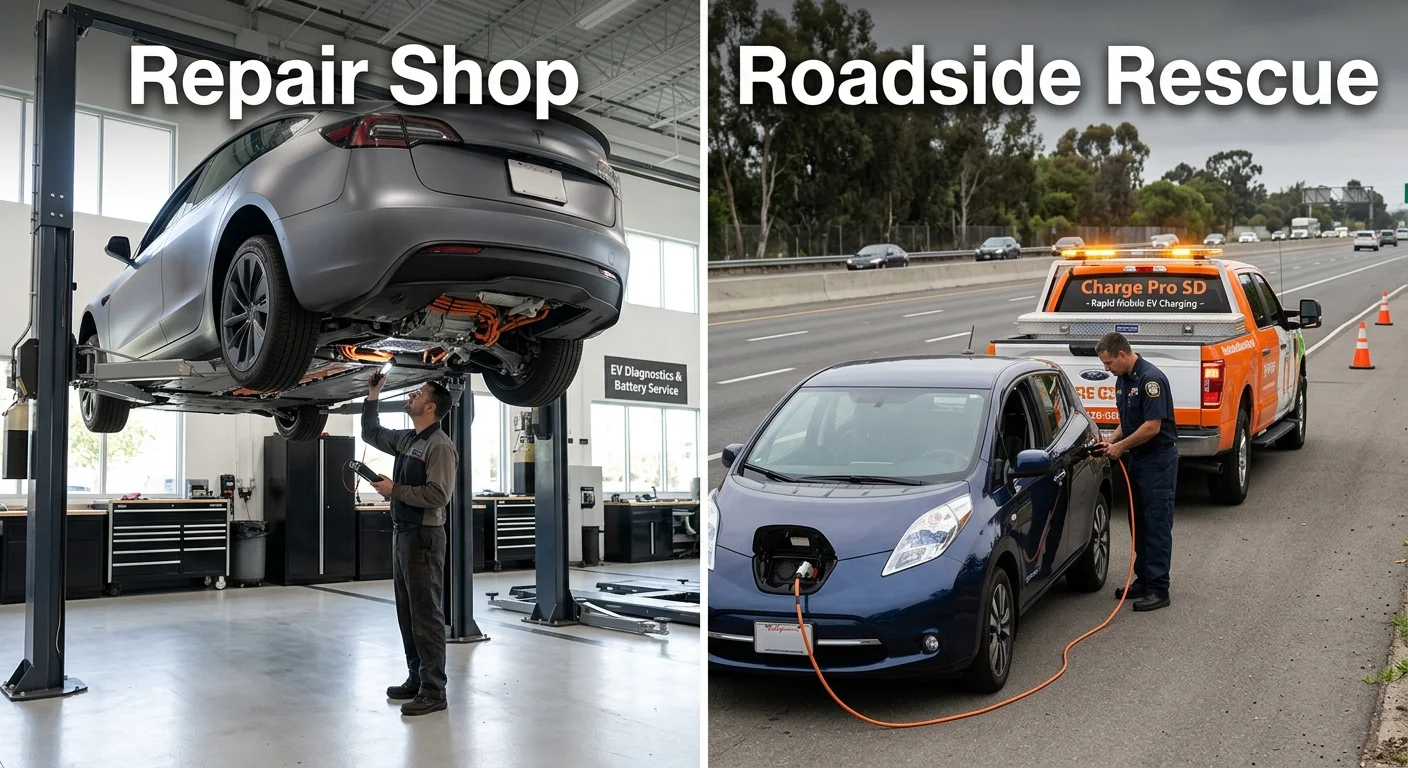
Two desks, two toolkits
EV service in a search bar is vague. Dealers mean a scheduled bay. Drivers mean the car already died. Those desks don’t share a lift, a truck, or a parts room.
A shop in Greenwood Village can read modules and update software. That work needs the car on a hoist. It doesn’t help you on I-25 with hazards flashing.
A mobile operator works the other direction. They come to the car. They don’t open the high-voltage pack. They add miles, or they wake a dead 12-volt.
If you can still drive to the appointment, that’s repair. If you can’t move the car safely, that’s rescue.
Why this metro keeps mixing the two
Denver’s official elevation is 5,280 feet at the Capitol step. January’s normal low sits around 18 degrees. In January 2024 the city fell from 47 to minus 19. That drop took about two days. Cold hits the small 12-volt first. The traction pack can still show a healthy percentage.
That’s why a week in a cold DEN lot often needs a jump. It isn’t a pack replacement. The same pattern shows after a long sit at Park Meadows. It shows after a Red Rocks night when the car won’t unlock.
Recurrent Auto’s winter study found EVs keep about 78% of max range at 32 degrees. At 20 degrees that average falls to about 70%. Those figures don’t diagnose a car that won’t ready in a garage.
So the first question isn’t which dealer. It’s which battery failed.
Empty pack versus a silent 12-volt
Every EV here still has a low-voltage battery, Tesla and Rivian included. That 12-volt runs computers, locks, and contactors. Newer Teslas use a small lithium stand-in. If it dies, the big pack can be full. The car still sits.
Watch for a 12-volt failure:
- Screens stay black.
- Door handles won’t present.
- The app can’t wake the car.
- You hear no contactors clunk.
Watch for an empty traction pack:
- The car did ready, then range hit zero.
- You were already thin climbing toward Evergreen.
- Accessories still work, but Ready won’t hold.
For the 12-volt path, a Tesla 12-volt jump on site is rescue. The dealer can wait until the car rolls. For a true empty pack, out-of-charge recovery is the roadside job. A service writer can’t charge you on I-70.
The split is spelled out in Tesla looks dead: empty pack or 12-volt.
Shop work if the car can still roll
Book a service center when the car still drives. Persistent warning lights belong in a bay. Shops also handle warranty and recall work. They run software updates that need a dealer tool. They diagnose a high-voltage pack you can’t open on a shoulder.
That’s EV repair. It isn’t a shoulder job. CRS 42-4-1202 lets a truly disabled car sit on the shoulder with hazards on. It doesn’t turn that shoulder into a garage. If you can creep to a bay in Lakewood or Centennial, do that. Don’t call a mobile operator for a rattle.
Home charging is a third meaning of EV service. A wall unit isn’t rescue. Xcel Energy covers Denver, Aurora, Boulder, and much of the core metro. CORE Electric Cooperative covers the Douglas County south metro. That includes Castle Rock, Parker, Highlands Ranch, and Lone Tree. United Power covers much of the north and northeast. It splits streets with Xcel in Thornton, Westminster, Arvada, Broomfield, and Erie. Confirm your utility by address. None of that helps a car already stuck on C-470.
Roadside rescue if the car won’t move
Call for rescue when the car won’t move under its own power. An empty pack on the I-25 shoulder is that call. A 12-volt that died overnight in a Denver Tech Center garage is that call. A car that won’t ready after Peña Boulevard toward the airport is that call.
EV roadside assistance here is charge-in-place and 12-volt work. Charge Pro DEN connects you with independent local operators. Those operators bring a 240-volt Level 2 source to the car. Teslas take a native NACS plug. Other brands use a CCS or J1772 adapter. On-car charging time is typically 15 to 30 minutes. That window is cable time. It isn’t an arrival clock. Drivers usually leave with about 10 to 20 miles. That’s enough to roll to a public stall.
They can also jump or replace a dead 12-volt on site. They handle Tesla and every major EV brand. The operator quotes you before they start. They bill you directly. Charge Pro DEN doesn’t own the truck. It doesn’t set the price. It doesn’t employ the tech.
A flatbed is a last step, not the first. If the car only needs miles or a 12-volt wake, skip the flatbed. Towing that car is a shop-shaped answer to a roadside problem. Charge in place or tow walks that choice.
What CDOT and E-470 will actually do
CDOT Safety Patrol covers parts of I-25 South, I-70 East, US-6, C-470, and I-225. Mountain Corridor coverage runs Morrison to Vail. Front Range weekday hours are 6:00 to 9:30 a.m. and 2:30 to 7:00 p.m. Weekends run 10:00 a.m. to 7:00 p.m. Mountain hours are 6:00 a.m. to 7:00 p.m. Friday through Sunday. They also run during significant weather.
That patrol will jump a 12-volt. It changes a tire. CDOT’s breakdown pages don’t mention EV charging. The free state program doesn’t bring a charge to a stranded EV. Overnight, that limit matters more.
On E-470, pull to the shoulder and dial *470. The authority publishes help for flats, jump-starts, fluids, and debris. It doesn’t publish a mobile EV charge.
COtrip.org and 511 are the live sources for I-70 closures and traction-law status. Those rules show on signs and on COtrip. They don’t change who can charge the car.
Colorado has no statute that treats a disabled EV as a special class. The same shoulder law covers a Tesla and a gas sedan. There’s no EV carve-out in the breakdown rules.
Where the wrong desk costs you a night
A week in a cold DEN lot is a classic 12-volt failure. The traction pack can still hold energy. You need a jump or an on-site 12-volt swap. You don’t need a pack quote you can’t drive to.
After a long dwell at the Denver Tech Center, screens stay dark. The app won’t connect. A service advisor will ask you to bring it in. You can’t, because it won’t ready.
Park Meadows in Lone Tree has a 10-stall Supercharger. Highlands Ranch has 16. Centennial has 12. Those sites help a car that can still drive. They don’t help a car that won’t unlock.
If the pack is already thin when you leave the flats, that’s range. If the car won’t wake in a Lakewood lot, that’s the 12-volt.
What Charge Pro DEN is, and what it isn’t
Charge Pro DEN is a referral line for the Denver metro. It matches stranded drivers with independent local mobile rescue operators. It holds no license. It owns no trucks, no yard, and no parts inventory. It promises no arrival time. The operator on the call does the work.
The pros we connect you with are licensed and insured. They don’t replace a service center.
If the car still readies, they’ll point you to a shop. That’s the honest split. Rescue is for a car that can’t leave. Repair is for a car that can.
A metro walkthrough of that split is EV roadside assistance for Denver metro drivers.
Sort the call before you spend the night
Stay with the car if you’re on a freeway shoulder. Keep hazards on. CRS 42-4-1202 is the disabled-vehicle rule. You’re lawful there if the car truly couldn’t keep moving.
If it won’t unlock or ready, think 12-volt. If range hit zero while you were driving, think empty pack. If you can still roll to a stall or a dealer, book that. It isn’t a rescue truck.
Charge Pro DEN serves the Denver metro. When the car is the one that won’t wake, call (720) 738-6950. The operator quotes before any cable goes on. You pay that operator directly.