CDOT Safety Patrol will jump a 12-volt on covered Front Range freeways. It won’t bring a charge to a stranded EV. That’s how roadside assistance for an EV works in the Denver metro. You’re not looking for a shop. You’re looking for a rescue that wakes the 12-volt. Or one that puts miles back in the pack. Charge Pro DEN is a referral line. We match stranded drivers with independent local operators. Those operators quote you before they start. They bill you directly.
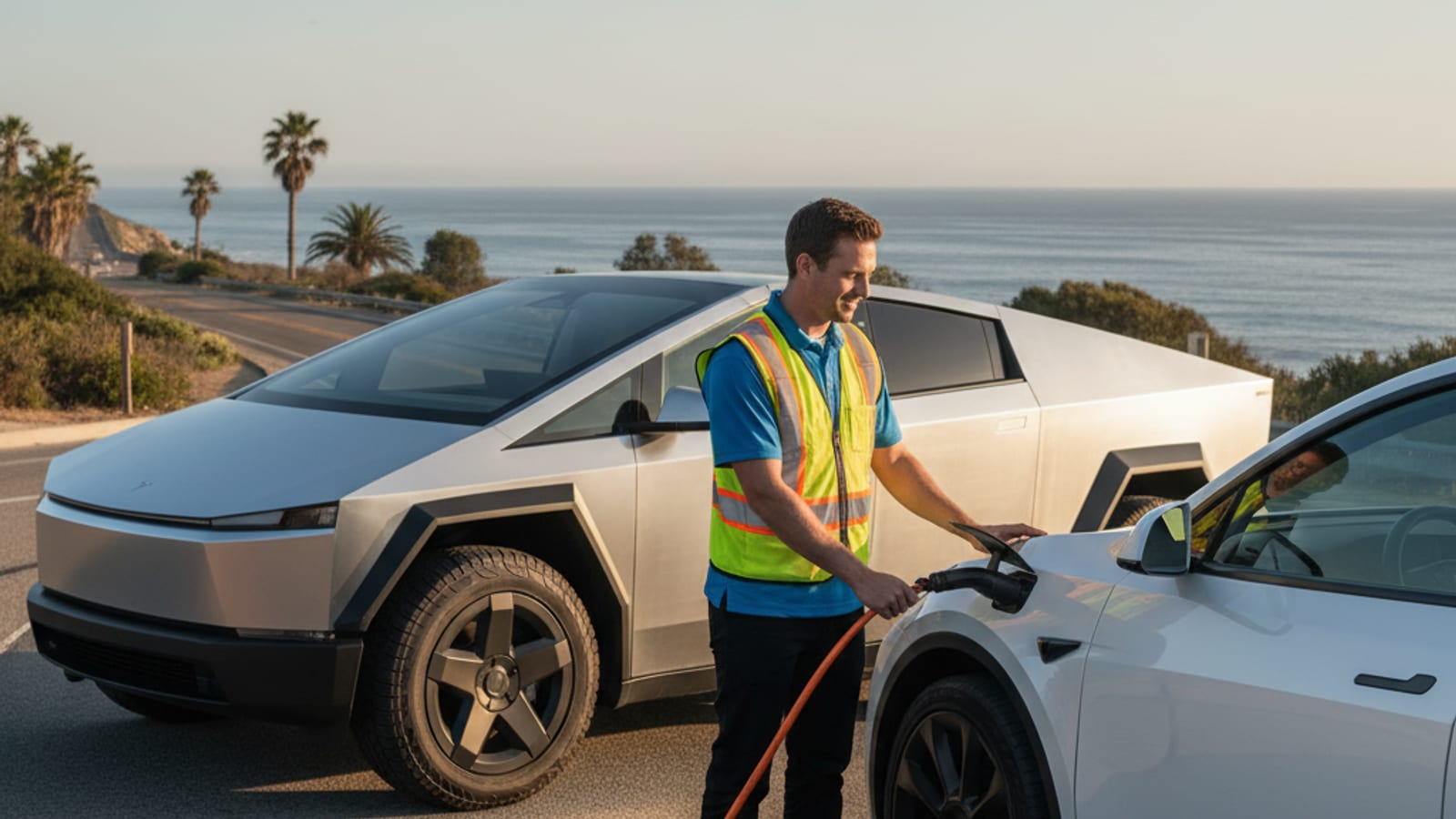
Safety Patrol will jump you. It won’t charge you
CDOT’s Safety Patrol is a real, free program. The Division of Maintenance and Operations runs it. On covered segments, a patrol driver can change a flat. They can jump-start a 12-volt. They can handle emergency fuel for a gas car. They also clear debris and help at a crash scene. Front Range weekday hours are 6:00 to 9:30 a.m. Afternoon coverage is 2:30 to 7:00 p.m. Weekends run 10:00 a.m. to 7:00 p.m. Mountain Corridor hours are 6:00 a.m. to 7:00 p.m. That’s Friday through Sunday, and during significant weather.
Coverage is specific, not metro-wide. On I-25 South it runs from 120th Avenue to Arapahoe Road. On I-70 East it runs from Wadsworth to Airport Boulevard. Portions of US-6, C-470, and I-225 are in the program. The I-70 Mountain Corridor is covered from Morrison to Vail. If you’re on those lanes during those hours, a jump is on the table. A tire change is too.
CDOT’s Safety Patrol page doesn’t mention electric vehicles. The agency’s “my car broke down” page is silent on charging too. That’s an observed absence as of September 18, 2026. The free state program will jump a 12-volt. It won’t bring a Level 2 source to your charge port. There’s no Colorado statute that creates a special EV breakdown service. A stalled EV sits under the same disabled-vehicle rules as any other car.
E-470 is its own system. The E-470 Public Highway Authority runs a cashless toll loop on the east metro. A disabled driver pulls to the shoulder and dials *470. E-470 publishes free roadside help for flats, jump-starts, fluid top-offs, phone help, and debris. Dial *CSP (*277) for Colorado State Patrol. Nothing in that published menu is a pack charge. It’s the same pattern as Safety Patrol. Useful for a 12-volt. Silent on EV charging.
There’s a separate walkthrough of Tesla roadside versus CDOT patrol.
The stall that looks dead is often the small battery
Most EVs have two electrical systems. The traction pack moves the car. A separate 12-volt battery wakes the computers, the contactors, and the locks. When the 12-volt dies, the car can look fully dead. Screens stay dark. Doors may not release. The pack can still hold miles. Drivers on a cold Capitol Hill curb hit this more than they expect. So do drivers who left a car in a DEN garage for a week.
January’s normal low around Denver sits near 18 degrees. The January 2024 arctic blast dropped the city from 47 to minus 19. That swing took about 48 hours. A tired October 12-volt can fail after a night like that. Safety Patrol can jump that battery on a covered freeway. So can the operators we connect you with. Those operators can also replace a dead 12-volt on site. That’s the move when a jump won’t hold.
The Tesla 12-volt jump page walks through that call. There’s more on whether roadside can jump an EV.
If the 12-volt is fine and range hit zero, a jump won’t help. That’s an out-of-charge event. Traditional roadside then wants a tow. A mobile EV operator brings a 240-volt Level 2 source to the car instead. Native NACS for Tesla. A CCS or J1772 adapter for everyone else. Typical charging time is 15 to 30 minutes. That window is charging time, not a promise of when someone arrives. Operators usually add about 10 to 20 miles of range. That’s often enough to roll to a Supercharger or a home plug.
That’s mobile EV charging, not a shop visit. It’s also the point of out-of-charge recovery.
Named roads, named chargers, and why the climb matters
The Denver metro isn’t one driving environment. Downtown sits at 5,280 feet on the Capitol step. Golden sits near 5,675 feet, last flat ground before the canyon. Evergreen sits near 7,200 feet. Idaho Springs sits at 7,526 feet. Georgetown sits at 8,530 feet. The west portal of the Eisenhower-Johnson Memorial Tunnel is 11,158 feet. That’s the highest point on the U.S. Interstate system.
A westbound climb on I-70 spends energy. Regen on the way back recovers a large share of that spend. A Lucid Air GT used about 3 percent of pack over 77 miles downhill from Loveland Pass. A Hyundai Ioniq 5 used about 10 percent over 75 miles. Drivers still ease regen on ice for traction. That’s the Front Range pattern. You pay on the climb. You get some of it back coming home. A cold pack has less to give either way.
Recurrent Auto studied more than 30,000 U.S. EVs in winter. Packs held about 78 percent of max range at 32 degrees. At 20 degrees the average was about 70 percent. Heat-pump models held about 10 points more at 32 degrees. An AAA dynamometer study reported about 39 percent range loss at 20 degrees. None of that’s a Denver-only lab. The Park Meadows to C-470 squeeze after errands is a winter pattern. The same squeeze shows up after a show at Red Rocks. It shows up after a long dwell at the Denver Tech Center.
Public charging here is real and named. Tesla Superchargers sit across the core metro. Sites include Denver, Lakewood, Boulder, Thornton, and Northglenn. Westminster, Arvada, Brighton, Longmont, and Castle Rock have them too. Park Meadows in Lone Tree has a 10-stall Supercharger. Centennial has a 12-stall site. Highlands Ranch has a 16-stall site. Idaho Springs has an 8-stall Supercharger on the I-70 mountain side. Silverthorne and Frisco have Supercharger sites west of the tunnel. EVgo lists 24 Colorado sites. Electrify America adds DC fast coverage across the metro. Colorado crossed 200,000 registered EVs by October 2025. Battery-electric vehicles were 12.5 percent of new Denver-metro registrations year-to-date through June 2026. That’s about one in nine, not the old pull-forward spike.
That’s when EV roadside assistance is a charge in place, or a 12-volt jump. It isn’t a wait for a bay at a shop. A dark dash on the shoulder is a rescue job.
Peña Boulevard is the only road into Denver International Airport. It’s city-maintained, not a state highway. It runs more than 11 miles of open plains from I-70. Ground blizzards can shut it. It closed in the March 2019 bomb cyclone. A week in a cold DEN lot often kills the 12-volt. That’s not an empty pack. That’s a jump or an on-site 12-volt swap. It isn’t a shop diagnosis on the garage floor.
Express lanes still have a shoulder. Use it.
I-25 North and US-36 Express Lanes were built with a minimum 8-foot outside shoulder. If you stall in those lanes, you move to the right, outside shoulder. “No shoulder in the express lane” isn’t accurate on those two corridors. Courtesy patrol presence is part of how CDOT describes those projects. That still isn’t a pack charge.
The I-70 Mountain Express Lane runs roughly 12 miles. It sits between the Veterans Memorial Tunnels near Idaho Springs and Empire Junction. Westbound has used dynamic tolling since November 25, 2024. Eastbound uses a posted schedule. Toll amounts change. Confirm the overhead signs or COtrip. Don’t guess a number from memory.
Colorado State Patrol handles enforcement, crash response, and dispatch. Abandoned-vehicle removal sits under CRS 42-4-1803. An officer decides “reasonable grounds,” not a published hour count. After a tow, the statute sets notice and sale timelines. It doesn’t set a clock that says you’ll be towed at a fixed hour. Don’t treat a rumor as the rule.
Shoulder law is the same for an EV as for a gas car
CRS 42-4-1202 is the disabled-vehicle-on-the-shoulder statute. Outside a business or residential district, you may not stop on the paved travel lanes. Exception: the car was so disabled you couldn’t keep going. You also couldn’t move it off the roadway. Hazards have to be on, under CRS 42-4-230. A violation is a class B traffic infraction. Plain read: if the car truly couldn’t go farther, the shoulder with hazards is lawful. Sitting in a live lane isn’t.
No Colorado statute addresses a disabled EV or mobile roadside charging. CRS 38-33.3-106.8 is about HOA charging-access rights. CRS 42-4-1213 is charging-space parking enforcement. Neither is a breakdown law. Your EV is a disabled vehicle. Treat it that way.
CDOT can impose the Passenger Vehicle Traction Law. In a severe storm it can impose the Passenger Vehicle Chain Law. Traction law means AWD or 4WD. It also allows M+S winter tires with at least 3/16-inch tread. Two-wheel-drive needs chains or an approved traction device. Chain law means every vehicle needs chains or a device. Activation is by highway signage and on COtrip.org. The 511 line carries the same status. Don’t rely on a calendar rumor. Check the signs and COtrip before you commit to I-70 west of Morrison.
The Colorado Towing Bill of Rights (HB22-1314) regulates nonconsensual tows. It requires 24-hour written notice before most private-property tows. It requires cash and cards. It bars towing for expired plates alone without a law-enforcement order. The Colorado Public Utilities Commission regulates towing carriers. Exact fee figures aren’t confirmed here. Ask the carrier for the written rate before you sign. If the car can’t take a charge and can’t be jumped, use a flatbed. Drive wheels on the pavement can damage an EV. Charge Pro DEN doesn’t tow. We refer rescue. When a flatbed is the honest call, that’s a towing carrier, not a charger.
Charge, jump, or tow from a Denver shoulder lays out that fork.
Your utility won’t meet you on the shoulder
Three electric regimes cover this metro, plus Longmont’s municipal utility. Xcel Energy serves the core and the Boulder County cities. That list includes Denver, Aurora, Lakewood, Golden, and Wheat Ridge. It also includes Littleton, Englewood, Sheridan, Cherry Hills Village, and Greenwood Village. Boulder, Louisville, Superior, and Lafayette sit on Xcel too. It also includes the Clear Creek corridor towns. CORE Electric Cooperative owns the south-metro Douglas County corridor. That’s Centennial, Highlands Ranch, Lone Tree, Parker, Castle Rock, and Castle Pines. The Douglas CDPs, Conifer, and Bennett sit on CORE too. United Power owns much of the north and northeast. It splits streets with Xcel inside Thornton, Northglenn, Westminster, Arvada, Broomfield, and Erie. Brighton electric is United Power. Longmont Power and Communications is the City of Longmont’s utility.
Home programs have names you can look up. Xcel lists EV Accelerate At Home and the EV Home Wiring Rebate. It also lists Optimize Your Charge, Charging Perks, RE-TOU, the Residential EV Rebate, and PCAN. CORE lists COREV Connect, COREV Charge, and COREV Community Charge. CORE’s own page says COREV Charge is at capacity and closed to new applications. United Power lists United EV and the EV Make-Ready Wiring Rebate. It also lists the EV Home Charge Panel Upgrade Rebate and RTD1 with Simple Saver. Longmont has the LPC EV Charger Rebate. Rebate dollar amounts aren’t confirmed here. Confirm with the utility by address, especially in the split cities. Broomfield is its own city and county. Don’t assume Adams County rules apply.
None of those programs roll a charger onto I-25. They’re billing and home-install tools. Roadside assistance for an EV is a different job.
What the operators we connect you with actually do
Charge Pro DEN doesn’t hold a trade license for this work. We don’t own trucks, a yard, or a fleet. We don’t employ technicians. We don’t set prices or publish hours. We connect you with independent local mobile rescue operators. The pros we send are licensed and insured. The operator quotes before starting. The operator bills you directly.
What they bring is a 240-volt Level 2 source. Tesla cars take a native NACS plug. Other brands take CCS or J1772 through an adapter. They handle Tesla and every major EV brand. They can jump or replace a dead 12-volt on site. They typically add 10 to 20 miles of range. That takes 15 to 30 minutes of charging. That’s time on the plug. It isn’t an arrival window.
A shop wants a bay, a work order, and a wait. Rescue wants the car able to leave the shoulder under its own power. If you’re already stopped, start with EV roadside assistance rather than a dealer hold.
If you’re already on the shoulder
Get out of the travel lane if the car can still creep. Hazards on. Stay in the car with the belt on. That’s the rule on I-25, I-70, C-470, I-225, and US-36. Don’t walk the freeway.
Decide which failure you have. Dark screens, no unlock, and no “ready” usually mean the 12-volt. A pack that still showed miles an hour ago fits that too. A car that drove until the range hit zero: think empty pack. A stuck charge cable is a third problem. Cold melt in the port is a fourth. Don’t keep hammering a public stall if the car won’t wake.
On a Safety Patrol segment during published hours, a jump or a tire is a fair ask. On E-470, try *470 for the same class of help. For a pack charge, those numbers won’t deliver one. Manufacturer roadside varies by brand and by plan year. Tesla’s program, like others, is worth a call. It still may not put Level 2 on your bumper. That’s when a local mobile operator is the remaining tool.
Give the operator a mile marker, an exit, and a direction of travel. Name the city. Thornton isn’t Castle Rock. US-36 in Louisville isn’t Peña Boulevard. Broomfield isn’t “north Denver.” Precision saves a wrong-ramp search.
Keep climate and infotainment down if you still have a sliver of pack. You want lights and locks more than a heated steering wheel.
Cut the odds before you leave the driveway
Start the day with a real buffer in January. Recurrent and AAA both show large winter losses at 20 degrees. Most metro drivers stay off the shoulder with home Level 2. Confirm who serves your street before you blame the car. CORE territory isn’t Xcel. United Power streets sit inside cities people assume are Xcel.
Watch the 12-volt as hard as you watch the pack. A car that sits at the Anschutz campus through a cold snap is a 12-volt candidate. So is one at Buckley or in a DEN economy lot. If the car warns about 12-volt health, put it on your shop schedule. Don’t leave it as a mystery for I-70.
Check COtrip and 511 before a mountain run. Traction law is by signage, not by a date you heard at a trailhead. Map a Supercharger you can actually use. That includes the Idaho Springs site on the way west. It includes the Castle Rock or Highlands Ranch sites on a south I-25 return.
Keep a referral number in the phone for the case Safety Patrol can’t cover. For a local match, call (720) 738-6950. The operator you’re connected with quotes before any cable goes in.
Frequently asked questions
Will Safety Patrol charge my EV on a Denver freeway?
No. CDOT Safety Patrol will jump a 12-volt and change a tire on covered segments. It also handles the other published tasks. Its pages don’t list EV charging. E-470’s *470 program is the same pattern on that toll road. For a pack that’s empty, you need a mobile Level 2 rescue.
What should I do if my EV hits zero in the Denver metro?
Pull to the shoulder if you can. Hazards on, and stay in the car on a freeway. A jump won’t refill an empty pack. The operators we connect you with bring 240-volt charging to the car. They typically add 10 to 20 miles in 15 to 30 minutes of charging. Then you roll to a Supercharger or home.
Can a regular tow truck move my EV?
It can, if it’s a flatbed. The operator still needs to know how to load a dead EV. Wheels on the ground can damage the drivetrain. Charge Pro DEN refers rescue, not tows. Ask for a flatbed when a jump or a charge won’t get you moving.