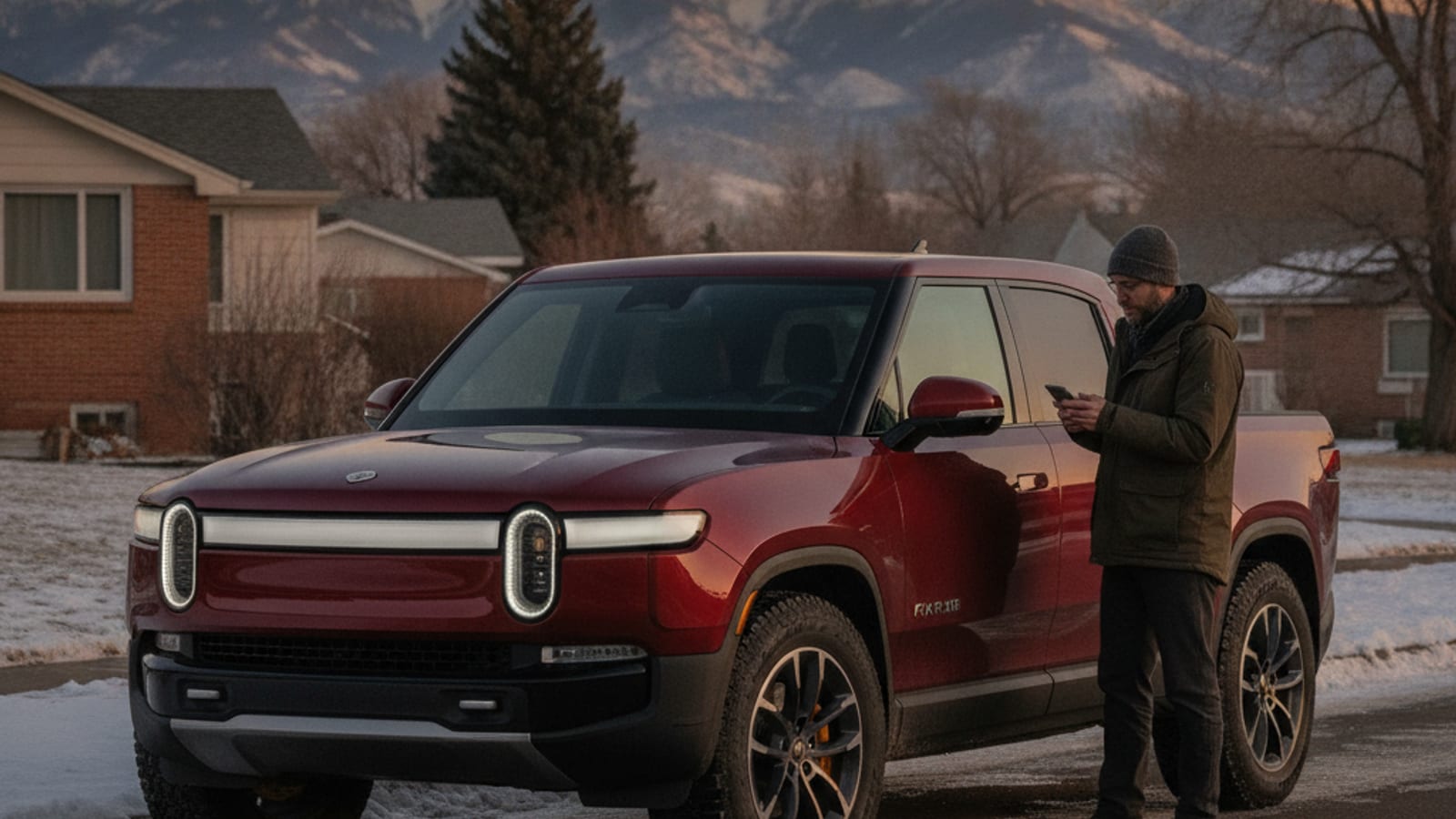
A Rivian R1T or R1S that won’t start in Denver cold usually has a dead 12-volt battery, not an empty traction pack. The big pack still holds plenty of range. The 12-volt runs the computers, the contactors, and the door handles. When it goes flat after a cold soak, the whole truck looks dead. The dashboard is dark, the doors don’t unlock, the app can’t reach the car. That’s a 12-volt symptom, not a pack symptom, and the fix is a jump or an on-site 12-volt replacement. If you can’t get the truck to wake up on your own, call (720) 738-6950 and the operators we refer can take it from there.
Why a Front Range freeze kills a Rivian’s 12-volt first
Denver sits at 5,280 feet. January’s normal low sits around 18 degrees, per NWS Boulder climate normals. The all-time record cold in Denver is minus 29, set on January 9, 1875. During the January 2024 arctic blast, Denver went from 47 to minus 19 in about 48 hours. That kind of swing is exactly what kills a marginal 12-volt.
A Rivian R1T and R1S use a small 12-volt battery to wake the truck up. The traction pack drives the wheels, but the 12-volt closes the contactors, runs the infotainment, handles the door releases, and keeps the cell modem alive so the app can talk to the truck. When the 12-volt is too weak to close the contactors, the pack can be at 80 percent and the truck will still look completely dead. The lights don’t come on. The horn doesn’t work. The charge port door won’t open. The gear shifter doesn’t respond.
Cold is the usual trigger. A lead-acid 12-volt loses a real share of its cranking power below freezing, and lithium-ion 12-volts (which Rivian moved toward in newer model years) also lose usable capacity in extreme cold when the truck sits parked for days. If the 12-volt is already a few years old, a Front Range cold snap finishes it off.
This is also why a Rivian that sits at the airport for a week in January often comes back with a dead truck. The traction pack still shows range on the app. The truck won’t wake. Same story: the 12-volt gave up while the truck sat.
How to tell a 12-volt problem from a pack problem
The split matters because each one leads to a different fix. The pack is for driving. The 12-volt is for waking up. A Rivian with range left in the pack that won’t wake up has a 12-volt problem. A Rivian that wakes up but won’t drive because the gauge is at zero has a pack problem.
Four signs point to the 12-volt:
- The Rivian app loses connection to the truck and won’t reconnect. The app shows the truck as offline.
- The key fob doesn’t unlock the doors or open the charge port.
- The dashboard stays dark when you press the brake or push the start button. No lights, no clicking, no chime.
- The interior lights, dome lights, and door handle lights do not come on at all.
Four signs point to the pack instead:
- The truck wakes up normally and the dashboard lights up.
- The app shows the state of charge at or near zero percent.
- The gauge or the battery icon shows empty.
- You hear the contactors close and the screens come on, but the truck won’t move.
If you see the first list, the Rivian won’t start because of a 12-volt issue. If you see the second list, the pack is the issue and you need a mobile EV charge or a tow to a charger.
The two problems can also happen together. A Rivian that ran out of charge at a stall in single-digit weather might still have a working 12-volt, or the cold soak might have killed a weak 12-volt at the same time the pack ran low. The operators we refer confirm which battery is the problem before they quote the work.
The Rivian 12-volt basics
On the R1T and R1S, the 12-volt sits under the hood. The exact location and the type of battery (lead-acid versus lithium) change by model year. The Rivian owner’s manual for that specific VIN is the source of truth, not this article. Rivian has used both chemistries across model years, and the jump procedure is similar but the locations differ.
What doesn’t change is the pattern. A 12-volt in good shape holds enough charge to wake the truck after sitting for a few days in moderate weather. A 12-volt near the end of its life loses that margin fast in a hard freeze. A 12-volt that sat outside overnight in single digits and won’t wake up in the morning is the most common Rivian no-start in this metro. A 12-volt that sat in a heated garage and still won’t wake is still the most likely cause.
The traction pack has nothing to do with the no-wake. The pack is the energy storage for driving. The 12-volt is the system that lets the truck turn on. A jump on the 12-volt gives the truck enough power to close the contactors and read the pack. From there, the operator or the driver decides whether to drive, charge, or tow.
What to try before you call
Three checks are worth running before the call. None require tools. None require pulling anything apart.
First, look at the key fob. A Rivian key fob with a weak coin cell can mimic a 12-volt problem. The truck doesn’t know it’s you. The doors won’t unlock. Try the Rivian app on your phone instead. If the app can reach the truck and unlock it, the fob is the problem. Replace the fob battery or use the app as the key.
Second, look at the truck’s lights. A Rivian with a dead 12-volt shows nothing. A Rivian with a working 12-volt shows running lights, puddle lamps, and a glowing door handle when you walk up. If the lights respond and the truck wakes up, the 12-volt is fine and the issue is somewhere else. If the lights don’t respond, the 12-volt is flat.
Third, look at the Rivian app. Open the app and check the truck’s status. If the truck shows offline and the last known state of charge was 40 percent or higher, the 12-volt is the most likely cause. If the truck shows online and the state of charge was at zero before the truck went quiet, the pack is the most likely cause and the 12-volt may be flat because the truck shut down with a dead pack.
The Rivian roadside assistance phone number post walks through the manufacturer channel and a local backup. If the manufacturer path is going to take hours, the operators we refer are the faster option for a Denver-area no-wake.
What to do if the truck is on a shoulder
A Rivian that won’t wake on a home driveway is one thing. The same truck sitting on the shoulder of US-36, I-70, or C-470 is something else. The truck is no longer in a place to wait for a thaw.
CRS 42-4-1202 covers a disabled vehicle on a highway. Outside a business or residential district you may not stop or leave a vehicle on the paved main-traveled part of a highway, except a vehicle so disabled it is impossible to move it off the roadway. Hazard lights must be on under CRS 42-4-230. The pull-off shoulder is the lawful place to wait. Stay in or near the truck with hazards flashing until the operator arrives.
CDOT Safety Patrol covers segments of I-25 South from 120th Avenue to Arapahoe Road and I-70 East from Wadsworth to Airport Boulevard, plus portions of US-6, C-470, and I-225. The Mountain Corridor runs from Morrison to Vail. CDOT’s Safety Patrol menu covers tires, jumps, fuel, debris, and minor mechanical help. The Safety Patrol page does not mention electric vehicles, and CDOT’s breakdown page is silent on EV charging as well. So the free state truck can wake a 12-volt on those listed segments. It can’t add miles to the traction pack.
Front Range weekday Safety Patrol hours run 6:00 to 9:30 a.m. and 2:30 to 7:00 p.m. Weekend hours run 10:00 a.m. to 7:00 p.m. Mountain Corridor hours run 6:00 a.m. to 7:00 p.m. on Fridays through Sundays and during significant weather. Don’t wait on a patrol that’s off shift.
E-470 runs its own roadside assistance. Dial *470 for flat tires, jump-starts, fluid top-offs, phone help, and debris removal. E-470 doesn’t publish an EV charging service.
If the Rivian is on a shoulder and the 12-volt is the problem, the operators we refer handle that case. Call (720) 738-6950 and the call gets routed to an independent local operator who brings a 12-volt jump pack or a portable 12-volt to swap in on site. For the broader coverage comparison, see Denver EV roadside assistance guide.
Why cold also eats the apparent range
The 12-volt is the front-line no-wake cause, but cold does also eat the pack’s apparent range. Recurrent Auto studied more than 30,000 U.S. EVs in winter. At 32 degrees, EVs kept about 78 percent of max range. At 20 degrees, EVs kept about 70 percent. Heat-pump vehicles held about 10 points more range at 32 degrees. AAA’s 2026 dynamometer study found about a 39 percent range loss at 20 degrees.
A Rivian that wakes up but shows 30 percent less range than it did in October isn’t broken. The pack is fine. The cold has pulled a real share of the apparent range off the gauge. The buffer that looked comfortable in fall disappears in a January cold snap. The trip to Evergreen or up US-285 that felt routine at 50 degrees feels tight at 10 degrees because the climb plus the heater plus the cold-soak margin all draw on the same pack.
If the Rivian made it to a charger before going fully dead, the issue is the pack and a mobile EV charge is the right call. If the Rivian never made it to a charger and the gauge is at zero plus the truck is dark, the 12-volt is the first place to look. The operators we refer can confirm which battery is dead on site.
What the operator will and will not do
Charge Pro DEN is a referral line. We don’t own trucks, and we don’t employ technicians. The operators we refer are independent local pros who quote the job before any work starts and bill the driver directly. For a Rivian, ask for non-Tesla EV rescue so the operator brings the right adapters and a 12-volt jump pack.
The operator’s first move is to confirm whether the 12-volt is the cause or the pack is. A portable jump pack on the 12-volt posts under the hood takes a few minutes and either wakes the truck up or it doesn’t. If the truck wakes, the operator reads the state of charge and the dashboard. If the state of charge is low, the operator can add a mobile EV charge at 240 volts Level 2 with the right adapter for a Rivian. That charge adds about 10 to 20 miles of range in 15 to 30 minutes, which is enough to reach a charger or a Rivian service center.
If the truck doesn’t wake on a jump, the 12-volt is more than just flat. It could be deeply discharged, internally shorted, or it could have a separate electrical fault that the jump won’t fix. The operator can swap a 12-volt on site in most cases. A Rivian with a separate electrical fault is a flatbed job. The operator will tell a driver that honestly.
Out-of-charge recovery is the right service to ask for if the Rivian made it to a charger but the truck is dark because the 12-volt died after the pack ran out. That situation looks like both problems at once. The operator untangles them on site.
A short checklist for a cold Rivian that won’t start
Look at the key fob. Try the Rivian app to see if the truck shows online and what the state of charge is. Look at the lights. If nothing responds, the 12-volt is the most likely cause. If the truck wakes but the gauge is empty, the pack is the issue.
If the truck is on a shoulder, turn on the hazards and stay in or near the truck with the doors locked if traffic is moving past. CRS 42-4-1202 lets you wait on the shoulder with hazards on. Call (720) 738-6950 and the operators we refer will quote the work and bring a 12-volt jump pack.
If the truck is in a driveway and you want to try the jump yourself, Rivian’s owner’s manual for that VIN lists the 12-volt location, the type of battery, and the recommended jump procedure. Use a portable jump pack rated for the 12-volt chemistry in that Rivian. Don’t try to jump a lithium 12-volt with a charger rated for lead-acid and don’t try to use another running vehicle as the jump source unless the manual explicitly allows it.
If the truck is at the airport after a long sit, the same checklist applies. The pack may still show range. The 12-volt is what won’t let the truck wake up. The operators we refer handle airport-lot no-wakes for Rivians as well as Teslas.
Frequently asked questions
Why won’t my Rivian start in the cold but the app shows range?
The 12-volt battery is most likely flat. The traction pack holds the energy for driving. The 12-volt runs the contactors, the screens, the door handles, and the cell modem. When the 12-volt is dead, the truck looks dead even with a full pack. A jump on the 12-volt usually wakes the truck up.
Is a dead 12-volt covered by Rivian roadside?
Rivian roadside may cover a 12-volt jump depending on the account and the VIN. Verify the current coverage in the Rivian app. The manufacturer program may take hours to reach a Denver shoulder. A local operator referral is the faster fallback when the program can’t get to the truck.
Will warming up the battery fix the no-start?
Warming up the battery helps if the 12-volt was on the edge. A 12-volt that just barely fails at 5 degrees may work at 40 degrees. A 12-volt that is internally shorted or deeply discharged won’t recover from warming. Move the truck into a heated garage if you can and wait an hour. If the truck still won’t wake, the 12-volt is more than cold.
Can I jump a Rivian 12-volt from another car?
Follow the manual. Rivian publishes a jump procedure for each model year that covers the 12-volt location, the chemistry of the battery, and the safe way to attach a jumper. Some model years allow a jump from another running vehicle. Some require a portable jump pack with the right voltage settings. Don’t guess. Confirm in the manual for that VIN before attaching any clamps.
What if the truck is on a shoulder and the operator can’t come for a while?
Stay in or near the truck with hazards on. CRS 42-4-1202 lets you wait on the shoulder with hazards flashing. Pull as far off the travel lane as possible. Stay visible. Don’t stand behind the truck. If the situation becomes unsafe, call 911 for traffic control. The operators we refer will give you an ETA when the call goes through.