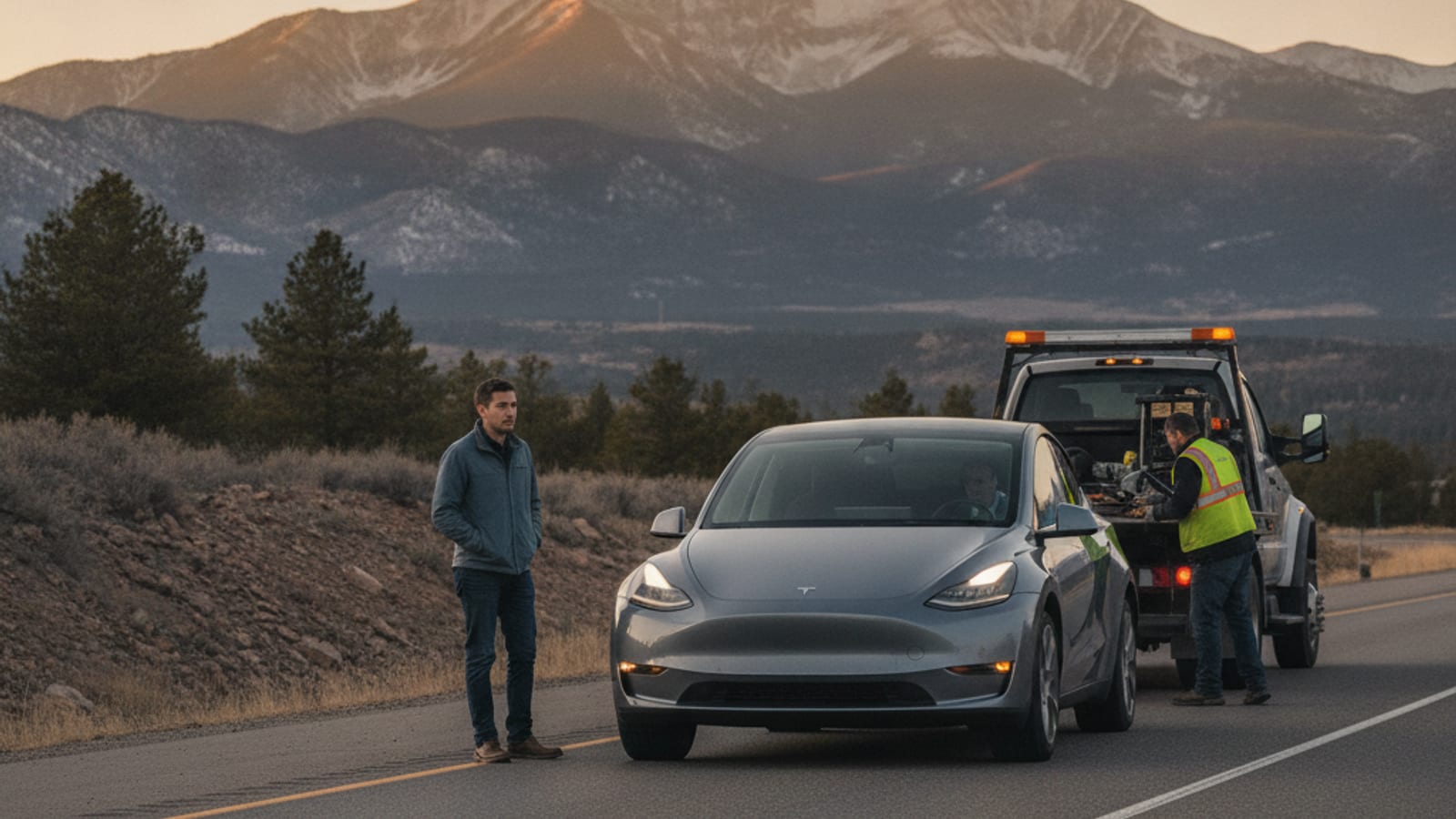
EV roadside assistance in Georgetown for a Model Y comes down to one fact about this stretch of I-70. The current charging inventory shows no Supercharger in Georgetown. Idaho Springs has one eight-stall Supercharger at 7,526 feet, and it is the last confirmed fast charge before the Eisenhower-Johnson Memorial Tunnel at 11,158 feet. If you roll past Idaho Springs low, Georgetown is the loneliest point on the climb. A mobile Level 2 charge from a local operator is the way to clear the grade. Call (720) 738-6950 to start that match. Charge Pro DEN is the referral line. We don’t own trucks. The operators we refer do the work and bill you directly.
Why Georgetown is the squeeze point on I-70
Georgetown sits at roughly 8,530 feet in Clear Creek County, on I-70 between Idaho Springs and the Continental Divide. It is a preserved Victorian mining town with a year-round population near 1,100. The road climbs hard on both sides. Westbound out of Georgetown the highway gains elevation through the Loveland Pass approach. Eastbound out of Georgetown the road drops back down to Idaho Springs.
For a Model Y, the climb is the cost. Cold, grade, and a running heater all pull range out of the pack at the same time. A driver who left Denver with a comfortable margin can watch that margin vanish between the Loveland Pass exit and the tunnel. Georgetown sits right in the middle of that stretch.
The charging math is also tight here. Idaho Springs has a Tesla Supercharger with 8 stalls, and it is the last fast charge before the Eisenhower-Johnson Memorial Tunnel from the Denver side. Silverthorne (two sites) and Frisco (two sites) are the first fast charges on the other side of the tunnel. Georgetown shows no Supercharger in the current inventory. The model that gets a Model Y out of trouble is a mobile Level 2 charge from an operator who can roll to your shoulder or pull-off.
What a mobile charge does for a Model Y on this climb
The kit is a 240-volt Level 2 source with a native NACS plug. The Tesla gets the lead directly. The operator rolls to wherever the car sits. That could be the Georgetown exit, a scenic pull-off near the Georgetown Loop Railroad, or the shoulder of I-70 in a safe spot with hazards on.
Charging time adds about 10 to 20 miles of range in 15 to 30 minutes once the cable is in. The clock starts when charging starts, not before. The number is a range added, not an arrival promise. For an empty pack at zero, the right service is out-of-charge recovery. For the broader picture of charging in place versus a tow, read mobile EV charging.
For a Tesla on a mountain corridor, the goal of a mobile boost is simple. Get enough range back to roll downhill to Idaho Springs under your own power and top up at the Supercharger there. Ten miles is often enough to clear the descent to Idaho Springs and add the missing margin at a real stall.
The cold makes the climb worse
Georgetown in winter is a different drive than Georgetown in summer. Snow arrives early and stays late. The traction law can activate on I-70 between Morrison and Vail Pass during storms. That law requires M+S or winter tires with at least 3/16-inch tread on AWD and 4WD, or chains on a 2WD car. It is enforced by highway signage and posted on COtrip.org. Don’t plan a Sunday return over the pass without checking the posted status first.
Cold also pulls range out of the traction pack on its own. Recurrent Auto studied more than 30,000 U.S. EVs in winter. At 32 degrees, the average EV kept about 78 percent of its maximum range. At 20 degrees, the share fell to about 70 percent. AAA has measured closer to a 39 percent loss at 20 degrees in separate testing. The exact number depends on the car, but a Model Y climbing the Continental Divide in January is not the same car as a Model Y cruising at 70 on the plains in July.
Below roughly 15 degrees the battery management system wakes to keep the pack in a safe band. That phantom drain shows up overnight as a pack that is lower than the pack you left. A Model Y that has been parked at a trailhead or a hotel lot in Georgetown for a few days can come back with a meaningful chunk of range already spent.
What CDOT Safety Patrol will and won’t do here
CDOT Safety Patrol covers the I-70 Mountain Corridor from Morrison to Vail. On that stretch, the patrol publishes hours of 6 a.m. to 7 p.m., Friday through Sunday, and during significant weather. CDOT’s own menu on the Safety Patrol page is flat tires, jump-starts, emergency fuel, minor mechanical help, debris removal, and incident support. The page says nothing about electric vehicles or EV charging. CDOT’s separate breakdown page is silent on EV charging too. That is silence in the state’s published guidance, not a guess.
So the free state truck will jump a 12-volt battery on a covered I-70 segment during posted hours. It will not bring a charge to your traction pack. If the gauge was already at zero when the car stopped, skip the patrol and call for a mobile boost instead. If the car went dark after a freeze, the 12-volt is the place to start. Operators we refer can jump a 12-volt on site, and they can replace one on site when that is the job.
The 12-volt problem in the cold
A Model Y that will not wake on a Georgetown shoulder in January is more often a 12-volt story than an empty-pack story. The 12-volt runs computers, contactors, and door locks. A long cold soak weakens it. When it dies, the whole car looks finished, but the traction pack may still hold plenty of energy.
A few signs point one way or the other. If the dash showed low range first, treat it as an empty pack. If the car sat dark through a freeze and the screen never lit, start with the 12-volt. CDOT patrol can try a jump on a covered I-70 segment. The operators we refer can do the same on site, and they can replace the battery on site if the jump does not hold. For the full split between jump and replace on a Tesla, read Tesla 12V jump or replace on site.
Recurrent Auto also notes that heat-pump vehicles hold about 10 percentage points more range at 32 degrees than vehicles without a heat pump. A newer Model Y with the heat pump starts the climb in a stronger position than an older Model 3 with resistive heat.
Regen on the way down
The honest counterpart to a hard climb is regen on the descent. A widely cited InsideEVs analysis puts recovered energy at roughly two-thirds of what the climb spent. Real corridor tests back that up. A Lucid Air GT used about 3 percent of its battery over a 77-mile descent from Loveland Pass. A Hyundai Ioniq 5 used about 10 percent over a 75-mile descent from the same area. Both tests credited regenerative braking.
A Model Y running back east from Silverthorne to Idaho Springs will see the gauge climb on the descent. Drivers commonly dial regen down on icy descents for traction. That is a real tradeoff worth making on a snow-packed Georgetown afternoon, even if it costs you some of the recovered range.
Xcel runs the electricity here
Georgetown is Xcel Energy territory. Xcel owns the historic Georgetown hydro plant, so the local distribution is on the same utility that serves Denver, Boulder, and Idaho Springs. Home-charging questions for a Georgetown house or a rental cabin go to Xcel. The current Xcel EV program names include EV Accelerate At Home, EV Home Wiring Rebate, Optimize Your Charge, Charging Perks, RE-TOU, Residential EV Rebate, and PCAN. Those are the program names. Dollar figures are not on this page.
A Model Y driver staying in a vacation rental in or near Georgetown typically does not have a 240V plug at the door. The realistic options are the Supercharger in Idaho Springs, public Level 2 around town if any stall is open, or a mobile boost when those don’t add up.
Colorado law you should know on the shoulder
CRS 42-4-1202 covers a disabled vehicle on a highway. You may not stop on the paved main-traveled part of a highway. The exception is a vehicle so disabled it is impossible to avoid stopping and to move it off the roadway. Hazard lights must be on under CRS 42-4-230. A violation is a class B traffic infraction.
CRS 42-4-1803 to 1805 govern abandoned vehicles. A vehicle is abandoned on officer discretion, on reasonable grounds to believe, not on a fixed clock. The statute sets no 24-hour or 72-hour threshold. After an abandoned-vehicle tow, defined notice and sale timelines follow. No Colorado statute treats a disabled EV as a special class. A stranded Model Y is governed by the same disabled-vehicle rules as any other car.
Colorado is a one-party-consent state for recording under CRS 18-9-303. A participant may record a call without telling the other party. The referral line records for quality, and that is lawful here.
If the car is in a dangerous place
If the car is in a travel lane, a live traffic lane, or another dangerous position, call 911 first. Do not wait on a referral number with the car sitting in active traffic. Once the car is safely out of lanes and visible, with hazards on, call Charge Pro DEN.
For a wreck, a bent suspension, a flat that won’t take a spare, or a car that simply cannot roll, a roadside charge is not the right tool. AAA and other clubs exist for that work. The mobile charge is the right tool when the car is otherwise drivable and the traction pack is empty or the 12-volt is dead.
How to plan the next Model Y trip over the pass
A few patterns help a Model Y driver clear the Georgetown stretch in any season.
Top up in Idaho Springs. That eight-stall Supercharger at 7,526 feet is the last fast charge before the tunnel. A full session there is the difference between a comfortable climb and a shoulder stop.
Watch the low-battery warning as the moment to act, not the moment to ignore. Range drops faster below about 20 percent, and the cold makes that fall steeper. If the warning lights up west of Idaho Springs, treat it as the start of a rescue, not the end of a day.
Pre-condition the cabin while the car is still plugged in at a stall. That uses grid power for cabin heat instead of pack range. Schedule a departure time in the Tesla app when you can.
Check COtrip.org for traction law status and I-70 closures before you leave. The Mountain Corridor hours for Safety Patrol run 6 a.m. to 7 p.m. on weekends and during significant weather. If you break down outside those windows on the corridor, the free state truck is not rolling. A local operator still is, with a quote first.
Charge Pro DEN matches you with an independent local operator who can roll a 240V Level 2 source to your shoulder or pull-off on the I-70 stretch through Georgetown. The operator quotes you before any cable goes in. They bill you directly for the work. Call (720) 738-6950 when you want that match. Treat it as a referral number, not a rolling promise. We serve the mountain corridor as part of the Denver metro referral network. The operator confirms the timing once they accept the job, not before.
Frequently asked questions
Is there a Supercharger in Georgetown?
No. The current charging inventory shows no Tesla Supercharger in Georgetown. The last Supercharger before the Eisenhower-Johnson Memorial Tunnel from the Denver side is in Idaho Springs, with 8 stalls. The first on the other side of the tunnel is in Silverthorne and Frisco.
Can CDOT Safety Patrol charge my Model Y on I-70 near Georgetown?
No. CDOT Safety Patrol covers the I-70 Mountain Corridor, and its published menu is flat tires, jump-starts, emergency fuel, minor mechanical help, debris removal, and incident support. CDOT’s Safety Patrol page and its breakdown page both say nothing about EV charging or electric vehicles. The free state truck will jump a 12-volt. It will not bring a charge to the traction pack.
What does a mobile EV charge add to my Model Y in Georgetown?
Operators bring a 240V Level 2 source with a native NACS plug. Typical charging time adds about 10 to 20 miles of range in 15 to 30 minutes once the cable is in. The clock starts when charging starts. It is not an arrival time and we don’t promise one. The goal is enough range to roll downhill to the Idaho Springs Supercharger under your own power.
Does cold really cut Model Y range that much on the climb?
Recurrent Auto’s study of more than 30,000 U.S. EVs found about 78 percent of max range retained at 32 degrees and about 70 percent at 20 degrees on average. AAA has measured closer to a 39 percent loss at 20 degrees in separate testing. Grade and a running heater add more cost on top of cold air. The exact number depends on the car and the conditions, but the direction is real.
Will regen on the descent back to Idaho Springs really help?
Descending recovers a meaningful share of what the climb spent. A Lucid Air GT used about 3 percent of its battery over a 77-mile descent from Loveland Pass. A Hyundai Ioniq 5 used about 10 percent over a 75-mile descent. Drivers commonly dial regen down on icy descents for traction, which is a sensible tradeoff in winter even if it costs some recovered range.
Who do I call about a home charger if I live in Georgetown?
Georgetown is Xcel Energy territory. Xcel owns the historic Georgetown hydro plant, and the local distribution is on the same utility that serves Denver and Boulder. The current Xcel EV program names include EV Accelerate At Home, EV Home Wiring Rebate, Optimize Your Charge, Charging Perks, RE-TOU, Residential EV Rebate, and PCAN. For dollar figures, check Xcel directly. For an in-place charge on a mountain shoulder, the operators we refer handle that separately and quote before work starts.