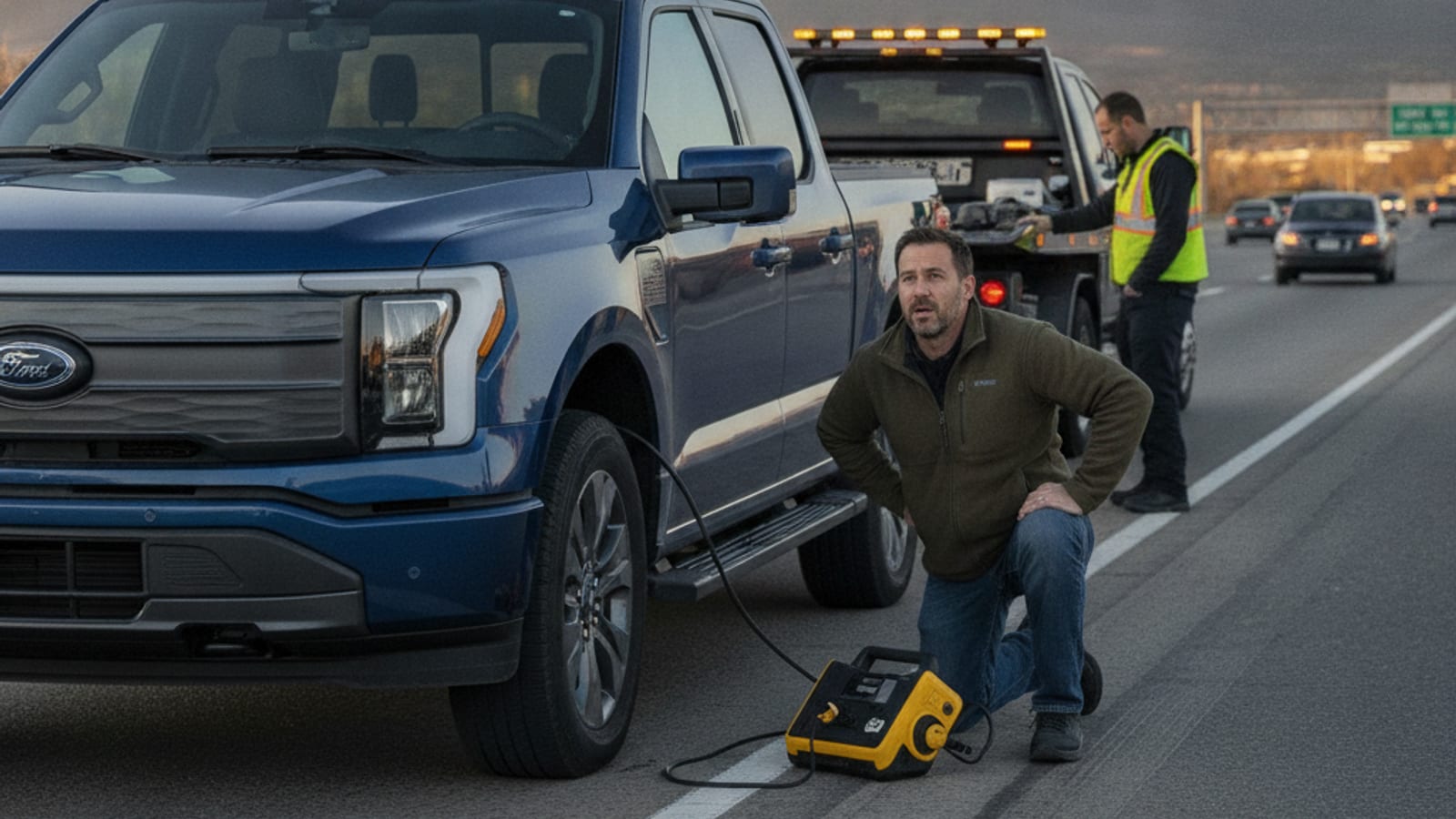
Non tesla ev roadside assistance denver comes down to who carries the right plug. A Rivian, a Hyundai Ioniq 5, a Ford Mustang Mach E, a Chevy Equinox EV, a Polestar 2, a Lucid Air, a Mercedes EQE, or a Kia EV6 all charge through a CCS or J1772 inlet, not the Tesla plug. If your car is in a travel lane or another dangerous place, call 911. If your car is off the road and you need a Level 2 charge brought to the bumper, Charge Pro DEN is a referral line. We match you with an independent local operator. Call (720) 738-6950.
What “non-Tesla” actually means for the plug
The metro is full of EVs that are not Teslas, and they take one of two plugs. Most non-Tesla EVs sold in the last few years use the Combined Charging System, or CCS, for fast charging. CCS is a J1772 connector (the round five-pin plug that handles Level 1 and Level 2 AC) plus two large lower pins that handle DC fast charging. A CCS inlet is one combined socket. For Level 2 AC charging, only the upper J1772 portion is used.
Some older non-Tesla EVs use the J1772 plug for all their charging and have no DC fast charging at all. A Nissan Leaf, a Chevy Bolt (early model years), and a Ford Focus Electric all fall in this bucket. J1772 tops out at about 19.2 kilowatts on a Level 2 station, and it accepts the standard Level 2 mobile source an operator carries.
A small and growing group of non-Tesla EVs are switching to the NACS, or J3400, plug. Many 2024 and 2025 model-year non-Tesla EVs ship with a NACS inlet. These still need an adapter for older CCS public stalls, but for a Level 2 boost from a mobile operator, the same portable Level 2 brick works either way.
Charge Pro DEN does not inventory a connector catalog as Charge Pro equipment. Share the year, the pin layout, and what still responds on the dash. The operator confirms the inlet before any cable goes in.
What a non-Tesla rescue call looks like
Most calls follow a pattern. A driver pulls into a parking lot, a charger fails to start, the gauge drops past the buffer, and the car will not make it to the next stall. Or a driver returns from a hike, a meeting, or a weekend at a cabin to a car that will not wake, often with a 12-volt that died in the cold. Or a driver commits to the climb up I-70 from Golden toward Idaho Springs on a margin the cold then eats.
For an empty pack on a non-Tesla, the fix is a 240-volt Level 2 boost at the car. Charge Pro DEN matches you with an independent operator who rolls a portable Level 2 brick with the right adapter. The operator confirms the inlet and quotes you before any cable goes in. You pay them directly. Typical charging time adds 10 to 20 miles of range in about 15 to 30 minutes of charging once the cable is in. The clock starts when charging starts, not before, and it is not an arrival promise.
For a dead 12-volt on a non-Tesla, the fix is a 12-volt jump at the terminals, or an on-site 12-volt replacement when the battery has reached the end of its life. Many non-Tesla EVs, including Ioniq 5, Mach E, EV6, and Polestar 2, run a small 12-volt that runs the contactors, the computers, and the door locks. When that 12-volt dies, the whole car looks finished even with range still showing on the dash. The operators we refer carry 12-volt jump gear for the common non-Tesla platforms. Read non-Tesla EV rescue in Westminster when the public stall fails you for the North Metro version of the same story.
Why CDOT Safety Patrol and AAA usually will not bring a charge
CDOT Safety Patrol is a free state program on listed metro freeway segments. It covers I-25 South from 120th Avenue to Arapahoe Road, I-70 East from Wadsworth to Airport Boulevard, portions of US-6, C-470, and I-225, and the I-70 Mountain Corridor from Morrison to Vail. The published menu is tires, jumps, fuel, debris, and minor mechanical help. CDOT’s Safety Patrol page does not mention EV charging. Its my-car-broke-down page does not mention EV charging either. That is silence in state guidance, not a guess. A CDOT truck can wake a 12-volt battery. It will not bring a charge to your traction pack.
AAA is a membership club. Calling AAA for a flat tire, a lockout, or a wreck still makes sense. A dead pack often shows up as a flatbed tow to a public stall. Open your AAA app and ask whether the truck carries EV charging gear before you wait on the shoulder. This page could not confirm a published AAA Colorado policy for on-site EV charging. Many empty-pack calls still move as flatbed tows.
On E-470, dial *470 for the loop’s free roadside. The published menu is flat tires, fluid top-offs, jump-starts, phone help, and debris removal. E-470 does not publish an EV charging service. Dial *CSP, which is *277, for State Patrol on the same stretch.
For the broader metro picture, read Tesla roadside, CDOT patrol, or a local boost. That post walks the OEM, the state program, and the local referral option side by side.
How a referral works in plain terms
Charge Pro DEN is a referral line for stranded drivers. We do not own trucks, and we do not employ technicians. We do not set prices for the visit, and we do not promise an arrival time. We match you with an independent local operator who serves the Denver metro. That operator quotes you before any cable goes in. They bill you directly for the work they do.
The kit on the truck is a 240-volt Level 2 source with the adapters that match the inlet on your car. A CCS car gets a CCS connector. A J1772-only car gets a J1772 connector. A NACS car gets a NACS connector. Tesla drivers are covered by a sister service on the same line. Read Tesla roadside, CDOT patrol, or a local boost for the call order when the OEM is one of the options.
Operators we refer handle every major EV brand on the road today. A stuck charge port is a latch problem, not a tow problem. Ask the operator about the port before anyone hooks a winch. For the broader non-Tesla equipment conversation, read What a mobile EV charger actually brings to a stranded car and When a roadside Level 2 charger is the right call.
What the Denver metro adds to the picture
A non-Tesla rescue here is not a non-Tesla rescue in a warm flat city. The metro is a high plain at 5,280 feet that tilts up on its west edge into the Front Range. Three things shape the call mix for non-Tesla drivers.
Cold eats range first. Recurrent Auto studied more than 30,000 U.S. EVs in winter. At 32 degrees, EVs kept about 78 percent of max range. At 20 degrees, that drops to about 70 percent. The AAA study puts the 20-degree loss at roughly 39 percent. A non-Tesla driver in Arvada or Aurora or Westminster who left the metro on a comfortable-looking gauge can watch the buffer vanish by the time they reach Boulder or Longmont. Cold plus grade plus heater is the range-eater, not distance alone.
The I-70 climb is a flagship problem. From Denver, the last confirmed fast charge before the Eisenhower-Johnson Memorial Tunnel is the Tesla Supercharger in Idaho Springs. A non-Tesla driver without a CCS adapter has no fast charge on the climb. Even with an adapter, the grade plus a sub-freezing heater can pull a margin that looked fine on the plain. Read Out of charge on I-70: what to do on the shoulder next for the shoulder law and the climb.
The Denver metro spans three utility regimes plus a municipal one. Xcel Energy covers the core and the Boulder County cities. CORE Electric Cooperative covers the south-metro Douglas corridor, including Highlands Ranch, Centennial, Lone Tree, Castle Rock, and Parker. United Power covers the north and northeast and splits territory street by street with Xcel inside Thornton, Northglenn, Westminster, Arvada, Broomfield, and Erie. Longmont runs its own municipal utility, Longmont Power and Communications. A home-charger question in the south metro goes to CORE, not Xcel. CORE’s residential COREV Charge program is at capacity and closed to new applicants. Use program names only; never publish a rebate dollar figure.
What Colorado law lets you do while you wait
CRS 42-4-1202 covers a disabled vehicle on a highway. Outside a business or residential district, you may not stop on the paved main-traveled part of a highway. The exception is a vehicle so disabled it cannot be moved off the roadway. Hazard lights must be on under CRS 42-4-230. A violation is a class B traffic infraction. Read the law plainly: it is lawful to be stuck on the shoulder with hazards on if the car genuinely could not be moved further.
CRS 42-4-1803 to 1805 govern abandoned vehicles on public property. A vehicle is abandoned on officer discretion, not on a fixed clock. The statute sets no 24-hour or 72-hour threshold. After a tow, defined notice and sale timelines follow. No Colorado statute treats a disabled EV as a special class. There is no Colorado EV breakdown statute. A stranded non-Tesla is governed by the same disabled-vehicle statutes as any car. The Colorado Towing Bill of Rights (HB22-1314) requires 24-hour written notice before most private-property tows and sets other guardrails. Exact fee and percentage caps are not in the public ledger.
What to have ready when you call
The operator will ask a few questions before they roll. Have these answers ready so the truck arrives with the right adapter and the right 12-volt jump pack, if that is what is needed.
- Year, make, and model of the car (a 2023 Ioniq 5, a 2024 Mach E, a 2022 EV6, a 2025 Equinox EV).
- Pin layout: CCS, J1772 only, or NACS (J3400).
- What still responds: does the dash light up, does the infotainment come on, does the car attempt to shift, or is the car completely dark.
- Where the car is parked (address, lot name, cross street, or mile marker on a freeway).
- Whether the car is on a public road, in a private lot, in a garage, or off the shoulder in a residential area.
- Whether you have already tried a public stall and what the stall said when it failed.
If the car is at an apartment complex or a private lot, ask management whether a non-Tesla mobile operator is allowed on site. Most complexes allow it. Some HOAs and a few downtown towers restrict third-party vendors. Read CRS 38-33.3-106.8 for the Colorado HOA charging-access rights, which are separate from the breakdown case.
When a tow is still the right tool
A roadside charge does not straighten bent suspension, and it does not fix a pack that has failed internally. If the car cannot roll, you need a tow. CRS 42-4-1803 governs what happens after a tow, and the Colorado Public Utilities Commission regulates towing carriers. If the car must reach a specific shop, a charge may delay the hook.
A non-Tesla on E-470 with a dead pack is the case where the metro has the thinnest coverage. E-470’s free roadside (*470) does not bring a charge. CDOT Safety Patrol coverage ends at Wadsworth on I-70 East. Past that, the operator referral is the call. The same is true for any non-Tesla stuck past Watkins or Bennett on the I-70 east run toward the plains, where services thin fast.
How to choose from a metro shoulder
Turn your hazards on and stay visible to traffic. Stay in the car if that is the safer choice. If you are on a listed CDOT Safety Patrol segment, check the clock. Front Range weekday windows run 6:00 to 9:30 a.m. and 2:30 to 7:00 p.m. Weekend hours run 10:00 a.m. to 7:00 p.m. During published hours, that free jump is for a dark 12-volt. Skip it when the pack was already at zero.
If the pack is empty, call for range. A mobile Level 2 referral adds that range in place. The operator quotes you before they start work. We serve the Denver metro from the plains to the foothills. Call (720) 738-6950 when you want that match. Treat it as a referral number, not a rolling promise.
If the car is otherwise fine and the issue is the 12-volt, the same operator carries a 12-volt jump pack for the common non-Tesla platforms. Read Can roadside jump an EV 12-volt for the split between pack empty and 12-volt dead.
Frequently asked questions
What plug does a non-Tesla EV use for Level 2 charging?
Most non-Tesla EVs use CCS, which combines a J1772 upper portion for Level 1 and Level 2 AC with two lower pins for DC fast. Some older non-Tesla EVs use J1772 only. A growing group of 2024 and later non-Tesla EVs ship with NACS (J3400). The operator confirms the inlet before any cable goes in.
Does CDOT Safety Patrol charge non-Tesla EVs?
CDOT Safety Patrol does not publish an EV charging service. Its published menu covers tires, jumps, fuel, debris, and minor mechanical help. A CDOT truck can wake a 12-volt battery on listed segments. It will not bring a charge to the traction pack.
Will AAA bring a charge to a non-Tesla in Colorado?
This page could not confirm a published AAA Colorado policy for on-site EV charging. Many dead-pack calls still move as flatbed tows to a public stall. Ask AAA directly whether the truck carries EV charging gear before you wait.
What does a non-Tesla rescue cost in the Denver metro?
Charge Pro DEN is a referral line. We do not set prices. The independent operator quotes you before any cable goes in. You pay them directly for the work they do. No membership with Charge Pro DEN.
Can a non-Tesla charge at a Tesla Supercharger in the Denver metro?
Many newer non-Tesla EVs can charge at Tesla Supercharger sites with an adapter, but adapter availability and stall access vary by site and by model. Confirm in your charging app before you roll. For the broader question, the metro offers DC fast coverage across Tesla Superchargers, EVgo, and Electrify America, with 7,804 public charging ports statewide.