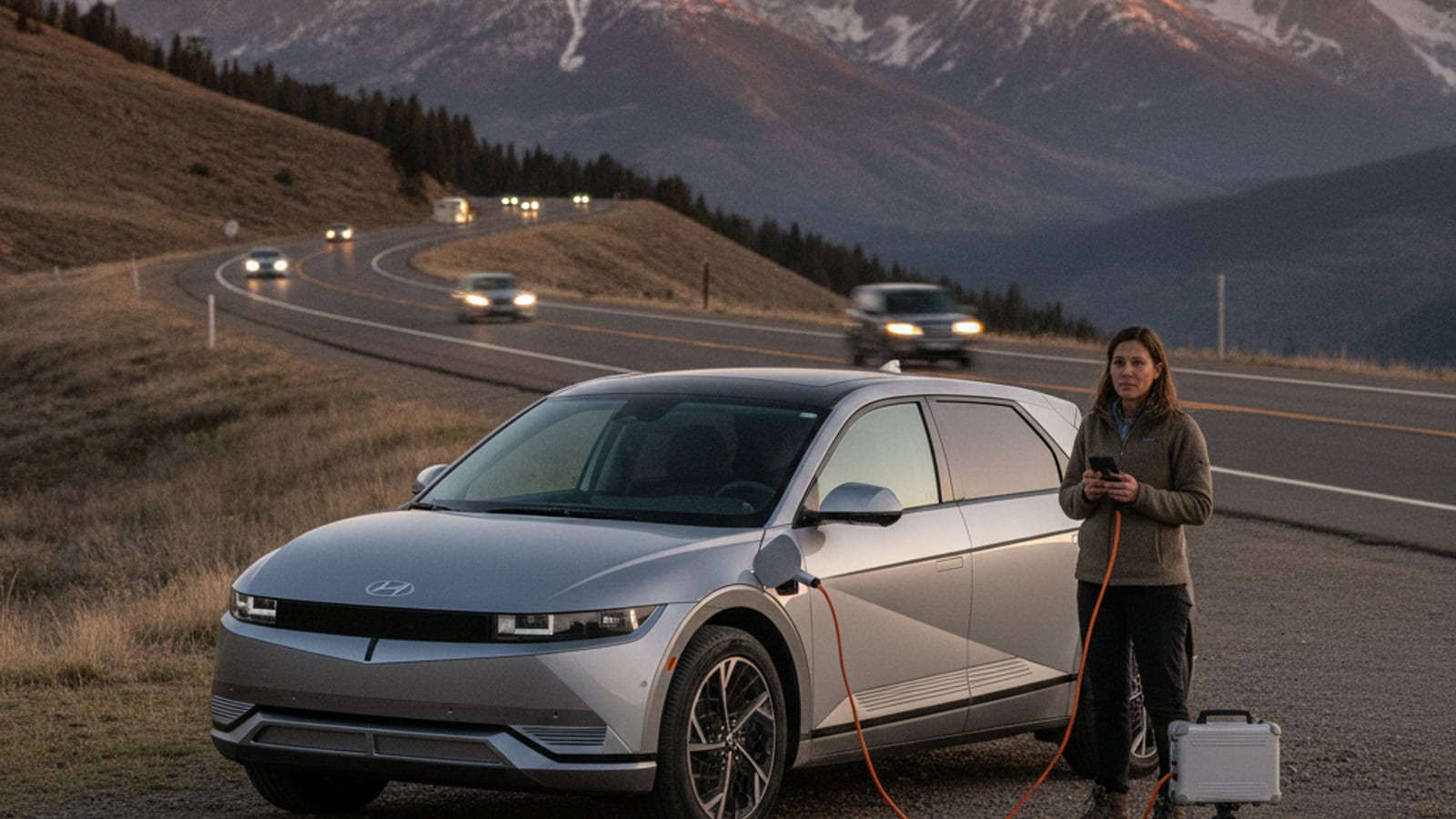
A mobile EV charger for roadside use is the right call when your traction pack is low but not dead, and the nearest public stall is just out of reach. An independent operator brings a 240-volt Level 2 source to your bumper and adds about 10 to 20 miles of range. That margin is usually enough to roll under your own power to a charger you already trust. If you are on a metro shoulder, in a parking lot, or on a side street in the Denver metro, you can call (720) 738-6950 for a referral to a local operator.
What a roadside Level 2 charger actually is
A roadside Level 2 charger is a portable 240-volt AC source rolled out of a service truck. The operator brings a generator or inverter pack, a long cable, and the connector your car uses. Tesla drivers get a native NACS plug on the lead. Other EVs use a CCS or J1772 adapter. The truck parks near your car, runs the cable to your charge port, and the car charges while you stand or sit nearby.
This is different from a DC fast charger. A roadside Level 2 source runs on the same kind of 240 volts your home charger uses. The current is lower than what a Supercharger or EVgo stall delivers, so the rate is slower per minute. The trade is that the operator is at your car. There is no drive, no app, no stall failure to debug in the cold. The clock starts when charging starts, and that is the part that matters when you are watching a gauge.
The kit on the truck is the operator’s. We refer independent local pros who run their own equipment. They bill you directly for the work they do. Charge Pro DEN does not own trucks, set prices, or promise an arrival time. The operator quotes you before the cable goes in. For a longer description of what the truck looks like, read what a mobile EV charger actually brings to a stranded car.
When 10 to 20 miles gets you out
The 10 to 20 mile boost is the whole point. That range is rarely meant to finish your trip. It is meant to clear a gap.
A few real cases that fit:
- You are three miles from a Supercharger in Lone Tree, but the gauge reads zero and the car will not move.
- Your last DC fast charger was in Boulder, and US-36 home to Westminster is uphill with a wind.
- You parked at Red Rocks for a show, came back to a low pack, and the nearest stall is back in Lakewood.
- You miscounted on I-25 north and rolled onto the shoulder at 120th Avenue with no charge left and a 6-mile gap to the next stall.
In each case the call is the same. You do not need a full charge. You need enough range to leave the shoulder under your own power and reach a stall you can use. A Level 2 boost buys that margin.
The same idea fits the foothills. Drivers in Evergreen climb SH-74 home in the cold, and the climb plus the heater eats the margin they had on the plain. A boost that adds 10 miles before the climb turns a borderline day into a comfortable one. For the deeper cold-soak pattern, read range anxiety in the Denver metro.
When the pack is empty enough that you should call
Some signs tell you a Level 2 boost is what you need:
- The dash reads zero, but the car still has power and the contactors will close.
- You rolled onto a shoulder or a parking lot and the car will not move under its own power.
- A public stall failed and you are now stranded near it, not at it.
- You are in a safe spot with hazards on and a phone at 30 percent.
Some signs tell you the call should be a jump, not a charge:
- The car is dark. The screens will not wake.
- The doors will not unlock.
- The pack still shows range, but the dash is dead.
That second pattern is almost always a dead 12-volt battery, not an empty pack. A week-long cold soak in a DEN parking lot commonly kills the 12-volt while the pack still holds plenty of energy. The 12-volt runs the computers, the contactors, and the locks. When it dies, the whole car looks finished. A boost will not fix that. A jump or on-site 12-volt replacement will. For the full split, read can roadside jump an EV 12-volt.
If you are not sure which one you have, tell the operator when you call. They will ask whether the dash showed low range first or whether the car sat dark after a freeze. That single answer narrows the call.
How it differs from a tow and from a public stall
Three options, three jobs:
A public stall is the goal when you can reach it. You drive there, plug in, charge at your own rate, and leave. The catch is you need to reach it. On a shoulder with no charge, you cannot.
A tow is the right tool when the car cannot roll. Bent suspension, a locked wheel, a pack that is genuinely empty and cannot be charged on site. A tow moves the car to a shop or a stall. The catch is you wait for the truck, then you wait on the stall.
A mobile Level 2 charge is the in-between. It does not straighten bent metal. It does not refill a pack. It adds enough range to drive away under your own power. For a closer comparison, read mobile charge or tow: which a stranded Denver EV actually needs.
The trade in plain terms: a tow costs more time, a public stall costs more planning, and a Level 2 boost costs a few minutes at your bumper. Drivers in the Denver metro use it when the gap is short and the car is otherwise sound.
What the operator brings, in plain terms
The truck usually carries a 240-volt inverter or generator pack. The cable runs out 25 feet or more so the truck does not have to park on top of your car. The lead ends in whatever connector your car takes: a NACS plug for Tesla, a CCS adapter for most non-Tesla EVs sold since about 2024, and a J1772 adapter for older EVs and some plug-in hybrids.
The operator does the safety check before anything starts. Hazards on, parking brake set, port cleared, no visible damage to the cable. The clock starts when the cable goes in. The operator confirms the rate on your dash before stepping back. Charging duration depends on state of charge, battery capacity and type, the vehicle’s onboard charging capacity, equipment output, and electrical service. The operator stays nearby while the pack climbs. If the dash shows a fault, they stop and talk you through the next step.
For an EV that will not wake, the same operator carries a 12-volt jump pack sized for an EV. They attach it to the 12-volt terminals under the hood or in the service panel, wake the car, and confirm the dash reads. If the 12-volt is too weak to hold a charge, they replace it on site with a unit they carry. Operators we refer handle Tesla and every major EV brand for both jobs.
Safety first: when you should not wait
A Level 2 boost is the right call when you are in a safe spot. It is the wrong tool when you are not.
- If the car is in a travel lane or another dangerous place, call 911 first. Colorado’s CRS 42-4-1202 lets you stay on the shoulder if the car could not be moved further, with hazards on. If the car blocks a lane, that is a State Patrol call.
- If you smell coolant, hear a loud pop, or see smoke from the pack, step away. Stay uphill and upwind. Do not charge a damaged pack.
- If the car sits in a tight garage with the engine bay or charge port hot, do not start a charge in there. Move the car outside if you can. If you cannot, wait for the operator to assess.
- If conditions on the shoulder are unsafe (heavy traffic, no shoulder, oncoming glare at night), stay in the car with the seatbelt on until help arrives. Hazards on, doors locked.
The Colorado safety-net law on a shoulder is real and useful. A class B traffic infraction is the fine for stopping where you cannot. A genuinely disabled car on the shoulder, with hazards on, is permitted. The Colorado State Patrol handles disabled-vehicle calls on state highways through *CSP, which is *277.
How a referral works in the Denver metro
Charge Pro DEN is a referral line. We do not own trucks, employ technicians, or set prices for the visit. We match you with an independent local operator who serves the Denver metro from the plains to the foothills. The operator quotes you before any cable goes in. They bill you directly for the work they do.
The process:
- Call (720) 738-6950.
- Tell us where the car is and what the dash shows.
- We match you with an independent operator who covers that part of the metro.
- The operator calls you back with a quote for the boost or the jump.
- They roll a truck, hook up, and confirm the rate on the dash.
- You pay the operator directly for the work.
There is no membership. There is no fee for the referral. The number is the same number as on every other page: (720) 738-6950. Use it when you need a match.
For the wider menu, mobile EV charging is the umbrella, and out-of-charge recovery is the empty-pack service that most often pulls in a Level 2 boost. For the broader explainer on the truck itself, read what a mobile EV charger actually brings to a stranded car.
Frequently asked questions
How long does a roadside Level 2 boost take?
Typical charging time adds about 10 to 20 miles of range in 15 to 30 minutes of Level 2 charging. The clock starts when charging starts, not before. It is a charging window, not an arrival promise.
Can any mobile operator charge a Tesla?
Operators we refer carry a native NACS plug on the lead for Tesla, plus CCS and J1772 adapters for other EVs. The connector on the truck matches the connector on your car. Confirm your port type before the operator rolls.
Is this the same as a Supercharger?
No. A Supercharger is a DC fast charger on a fixed site. A roadside Level 2 source is a 240-volt AC source brought to your bumper. The rate is slower per minute, but the operator is at the car. Reach the stall first if you can; call for the boost when you cannot.
When should I call for a jump instead?
Call for a jump when the car is dark and the screens will not wake. That is almost always a dead 12-volt battery, not an empty pack. A Level 2 boost will not wake a dark car. The operator carries a 12-volt jump pack and a replacement 12-volt for the cases where a jump is not enough. Read can roadside jump an EV 12-volt for the split.
Will a roadside boost get me home across the foothills?
A boost that adds 10 to 20 miles is meant to clear a gap, not to replace a full charge. It gets you to the next stall or the next exit where you can plug in. For a long climb home to Evergreen or Conifer, you still want to start the day with a full pack. The boost buys the margin when you miscounted, not the whole trip.