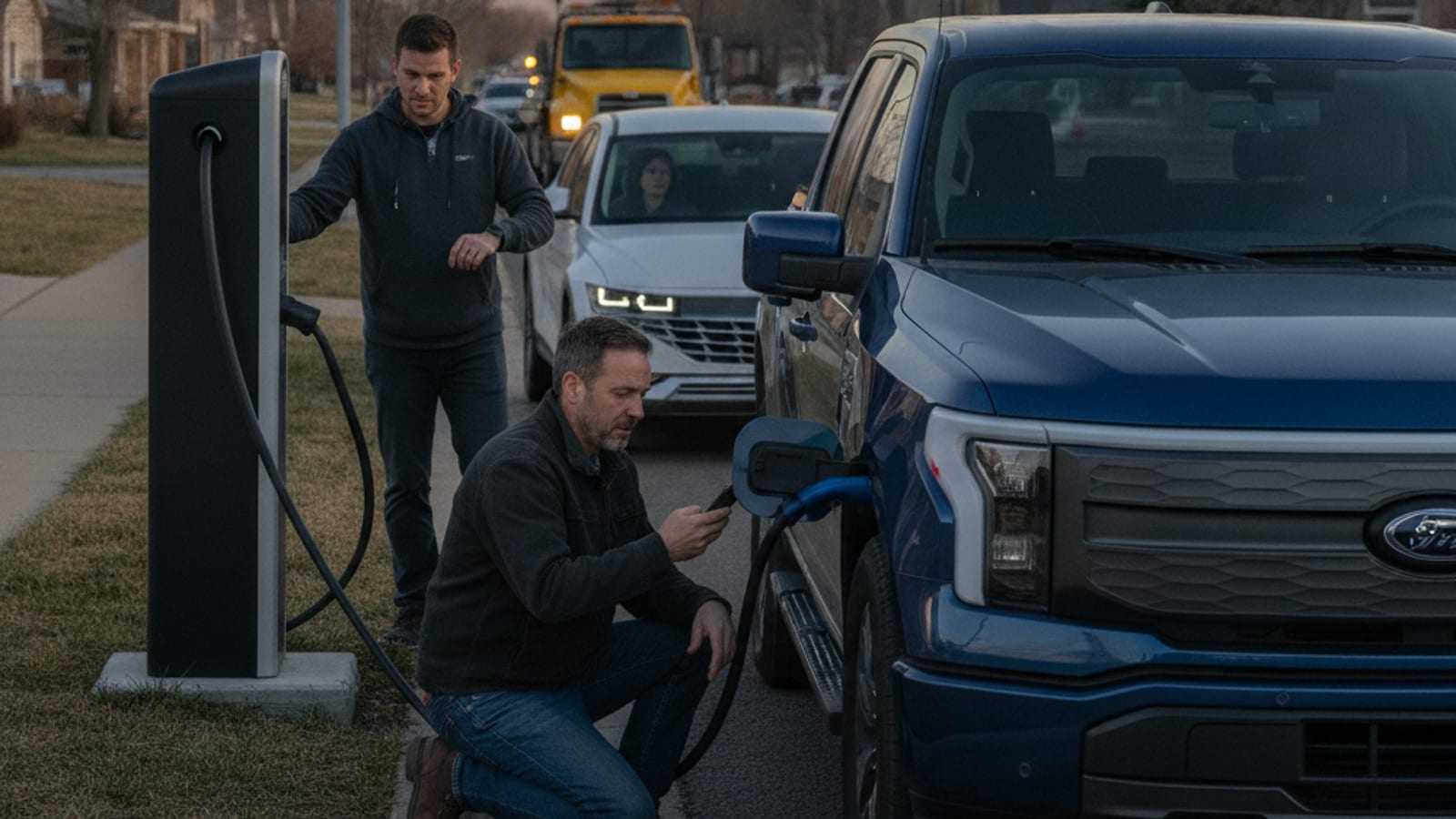
A non-Tesla EV rescue in Westminster still gets you a boost when the public CCS stall or the J1772 box fails. Charge Pro DEN is a referral line, not a crew. We match a non-Tesla driver with an independent local operator who brings a 240-volt Level 2 source, the right adapter for CCS or J1772, and a quote before any cable goes in. Call (720) 738-6950 and share the year, the pin location, and what the dash still does.
What “non-Tesla” means for a Westminster rescue
Non-Tesla in the Denver metro means CCS1 for most fast-charge-capable cars (the Ioniq 5, EV6, F-150 Lightning, ID.4, Lyriq, Blazer EV, Ariya, Mach-E, the e-tron line) and J1772 for older J1772-only cars (the first-generation Leaf, the older Fiat 500e, some compliance cars). A handful of newer cars sit on NACS, the Tesla-style plug, even though they are not Teslas. Operators we refer carry native NACS for the Teslas, J1772 adapters for the older cars, and CCS1 adapters or a CCS1 lead for the rest of the field. Confirm the inlet before anyone rolls.
Westminster sits at the Adams and Jefferson line, north of Denver, with US-36 (the Boulder Turnpike) cutting through it on the way to Boulder. Many of the calls are a non-Tesla driver on the US-36 commute who pulls into a public stall at a Westminster shopping center, plugs in, and the stall either fails to handshake, throws an error, or takes the connector and never closes the session. A failed public stall is a parking-lot call. The operator brings Level 2 to the bumper so the driver can roll under their own power to a working stall or home.
The utility split is the local hook
Westminster appears on United Power’s own service-area list and inside Xcel Energy territory at the same time. There is no published street-by-street map that names where the boundary sits. A Westminster EV driver who calls Xcel about a home-charger program may get told they are not an Xcel customer, and the same call to United Power may bounce the other way. The safe move is to confirm by address on the utility’s own service-area lookup before you sign up for a rebate program.
United Power publishes program names: United EV (a ChargePoint Home Flex charger on a monthly service agreement), the EV Make-Ready Wiring Rebate, the EV Home Charge Panel Upgrade Rebate, and the RTD1 time-of-use rate with Simple Saver scheduling. Xcel’s published program names include EV Accelerate At Home, EV Home Wiring Rebate, Optimize Your Charge, Charging Perks, RE-TOU, Residential EV Rebate, and PCAN. Dollar figures for either utility are not published in this site because the underlying pages blocked scripted extraction. Use names only, then call your utility to confirm the offer.
Why this matters for a rescue. A Westminster driver whose Level 2 install never happened because of the utility mix is the driver most likely to depend on public charging, and most likely to end the day at a stall that did not work. If you charge at home, the stall failure is a nuisance. If public charging is your only option, the stall failure is a stranded car.
What an operator brings to a non-Tesla in Westminster
A mobile charge is a different kind of job than a tow. The operator rolls a portable 240-volt Level 2 source, plugs in the matching lead or adapter, and adds miles while you sit in the car. Typical charging time adds about 10 to 20 miles of range in 15 to 30 minutes of charging. The clock starts when charging starts, not before. It is not an arrival time, and we do not publish one.
Charge Pro DEN matches you with an independent operator. We do not own trucks, and we do not employ technicians. We do not set prices for the visit, and we do not bill you. The operator quotes you before any cable goes in and bills you directly for the work they do.
For a non-Tesla on CCS, that usually means a CCS1 lead. For a non-Tesla on J1772, a J1772 lead. For a non-Tesla on NACS (the Ford, Rivian, Lucid, and the newer GM shift), a NACS lead or an adapter from the operator’s kit. Operators we refer handle Tesla and every major non-Tesla EV brand. Confirm the inlet before the operator dispatches, so the truck shows up with the right plug.
The driver is in charge of safety. Hazards on. Stay out of the travel lane. Pull as far off the road as the situation allows. If the car is in a travel lane or another dangerous place, call 911 first. Then call Charge Pro DEN for the referral.
US-36 and the Westminster commute
US-36 is the spine. Westminster commuters run east to Denver in the morning and west to Boulder in the evening, often in stationary express-lane traffic with the heater running against a January morning. The express lanes were built with a minimum 8-foot outside shoulder for breakdowns plus added courtesy-patrol presence, so a driver who stalls has somewhere to pull. The trap is dwell, not distance. A long sit at five miles an hour eats the same range a steady forty would have, and the bathroom-and-coffee stop at a Westminster shopping center often ends at a stall that will not handshakes.
Federal Boulevard, Sheridan Boulevard, Wadsworth, and 120th Avenue are the arterials that take over when US-36 jams. Standley Lake and the Westminster Promenade area sit on the west side, and the older east-side neighborhoods around Federal Heights and the 84th Avenue corridor have the apartment and no-home-plug pattern that makes a public-stall failure an evening problem, not an inconvenience.
A failed CCS stall in the cold
January’s normal low around Denver sits near 18 degrees. Recurrent Auto studied more than 30,000 U.S. EVs in winter: at 32 degrees, EVs kept about 78 percent of max range. At 20 degrees, about 70 percent. Cold is why a buffer that looked fine in the garage is gone by the time you pull into a Westminster stall at dusk. Cold is also why a stalled handshake at a public stall happens more in winter than in summer.
The mechanic is well known: the battery management system wakes to run thermal management (the “phantom drain” mechanism), the connector is stiffer in the cold, and a marginal stall is more likely to throw an error before the session closes. A failed handshake is not a broken car. It is a stall that will not talk to the car. The fix is to back out, find a different stall, or call for a Level 2 boost.
When the 12-volt is the real problem
A non-Tesla driver in Westminster who comes back to a car that will not wake is usually looking at the 12-volt, not the pack. The traction battery can sit at 40 percent for a week and still drive the car. The 12-volt runs the computers, the contactors, the door locks, and the infotainment. When it dies, the whole car looks finished.
A week in a Westminster parking structure, a week at the old Westminster Mall site, or a cold overnight on Federal Heights street parking can drain a marginal 12-volt to nothing. CDOT Safety Patrol will jump a 12-volt on listed segments (I-25 South from 120th Ave to Arapahoe Rd, I-70 East from Wadsworth to Airport Blvd, and portions of US-6, C-470 and I-225), but the program is silent on EV charging. That silence is in the state’s own published guidance, not a guess. CDOT’s published menu is tires, jumps, fuel, debris, and minor mechanical help. No mention of an EV charge.
Operators we refer can jump a 12-volt on site. They can replace one on site when that is the job. If the dash showed low range before the stall, treat it as an empty pack. If the car sat dark through a freeze and the gauge read plenty, start with the 12-volt.
E-470 is right next door
Westminster drivers heading south toward the airport, or east toward Aurora and the Tech Center, often cross E-470. E-470 publishes free roadside assistance: pull to the shoulder and dial *470 for the authority’s own service (flat tires, fluid top-offs, jump-starts, phone help, debris removal). For State Patrol, dial *CSP, which is *277. E-470 does not publish an EV charging service, and there is no EV-specific toll discount on the road. A non-Tesla on E-470 with a dead pack still needs a referral for a Level 2 charge, not a *470 jump.
Colorado shoulder law is on your side
CRS 42-4-1202 covers a disabled vehicle on a highway. Outside a business or residential district, you may not stop on the paved main-traveled part of a highway. The exception is a vehicle so disabled it cannot be moved off the roadway, and the hazard lights must be on under CRS 42-4-230. The plain read of the law: it is lawful to be stuck on the shoulder with hazards on, while you sort a jump or call for a boost. A violation is a class B traffic infraction, so the standard matters.
CRS 42-4-1803 sets no fixed hour count for abandonment. A vehicle is abandoned on officer discretion, not on a 24-hour or 72-hour clock. That means a non-Tesla driver on a Westminster shoulder who has called for help is not racing a clock.
How to choose from a Westminster parking lot
Turn your hazards on and stay visible to traffic. Stay in the car if that is the safer choice. Note which stall you tried, and what error the screen or the app showed. That note becomes the operator’s first question.
If you are on a listed CDOT Safety Patrol segment, check the published hours. Front Range weekday windows run 6:00 to 9:30 a.m. and 2:30 to 7:00 p.m. Weekend hours run 10:00 a.m. to 7:00 p.m. A free jump may be available during those windows for a dead 12-volt, not for an empty pack.
If you hold a club membership, ask whether the truck carries EV charging gear before you wait. Many dead-pack calls still move as a flatbed to a public stall, which is its own kind of wait.
For a Level 2 charge in place, call for a referral. We match non-Tesla drivers in Westminster, Broomfield, Thornton, Arvada, and Northglenn with an independent operator. The non-tesla ev rescue denver metro page walks the broader network. For a stranded call that is actually an empty pack, out-of-charge recovery is the right service. For the broader Level 2 option, see mobile EV charging.
The operator quotes you before they start work. Call (720) 738-6950 when you want that match. Treat it as a referral number, not a rolling promise.
Frequently asked questions
Does a non-Tesla EV rescue in Westminster need a specific adapter?
Most non-Teslas in the metro use CCS1 or J1772. The operator brings the matching lead or adapter. Confirm the inlet (CCS1, J1772, or NACS) when you call, so the truck shows up with the right plug.
What if my car is sitting at a Westminster public stall that failed to charge?
Back out and try a second stall before you call for help. Many “failed” handshakes are a single-stall problem. If a second stall also fails, a Level 2 boost is the next move. Operators we refer roll 240 volts to the bumper so you can drive under your own power to a working stall or home.
Does Xcel or United Power matter for a rescue?
It does not matter for the rescue itself. It matters for the home-charger program you may want later. Westminster is split between Xcel and United Power by address. Confirm your utility on the utility’s own service-area lookup before you sign up for any rebate program.
Can a Westminster non-Tesla call CDOT Safety Patrol for a charge?
CDOT Safety Patrol will jump a 12-volt on listed segments during published hours. The program does not publish an EV charging service. A failed pack on a Westminster shoulder is a referral-line call, not a free-state-patrol call.
Is there an EV-specific toll discount on E-470?
No. E-470 publishes free roadside assistance (dial *470), but there is no EV-specific toll discount on the road, and the authority does not publish an EV charging service.