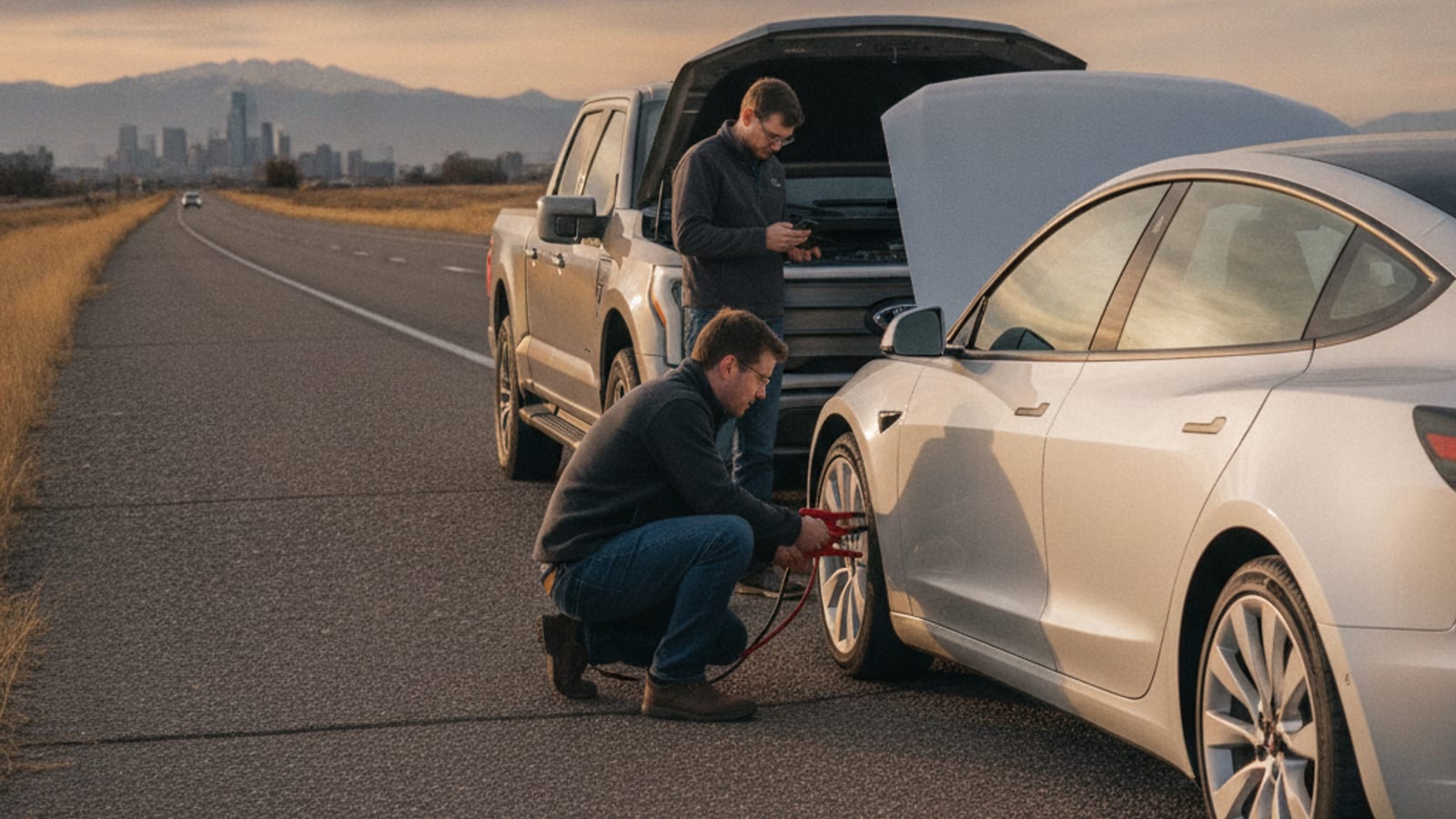
How to jump start a Tesla starts with one question: is the traction pack empty, or is the 12-volt battery dead? In the Denver metro, the answer is almost always the 12-volt. A long cold night in a garage, a parking structure, or a DEN lot kills it long before the traction pack runs out. The car looks finished, but the real pack may still hold plenty of range. If you are stuck right now, call (720) 738-6950. Charge Pro DEN is a referral line. We match you with an independent local operator who can reach you. The operator quotes you before any cable goes in and bills you directly for the work.
Denver cold is what kills the 12-volt
Denver sits on the high plains at 5,280 feet. January normal lows run around 18 degrees, and the January 2024 arctic blast swung Denver from 47 to minus 19 in about 48 hours. Sub-freezing nights pull the 12-volt down faster than the rest of the year. Two factors stack on top of each other. Cold cuts battery capacity, and the car’s thermal management wakes during long soaks to keep the traction pack warm. That drain on the 12-volt is why a Denver Tesla that sat overnight often will not wake in the morning.
The newer lithium-ion 12-volt in some 2023 and later Model 3 and Model Y cars does not freeze the way a lead-acid battery does, but it still loses voltage in the cold, and a marginal one can drop below the threshold the car needs to boot. Older lead-acid 12-volts in earlier Model S and Model X cars are more vulnerable. The pattern is the same. Cold soak, no wake, dashboard dark.
When this happens, the traction pack may still show plenty of range. The car will not unlock, will not shift into drive, and the touchscreen stays black. That is the 12-volt, not an empty pack. The fix is a 12-volt jump, not a Level 2 charge. For the broader Denver winter range picture, read Battery care for a Denver winter.
How to tell which Tesla you have before you jump
Tesla has changed the low-voltage battery and its location across model years. Knowing which car you have matters because the jump terminals are not always in the same place.
Model 3 and Model Y built before late 2021 use a lead-acid 12-volt mounted under the frunk cowl. Open the hood and you will see a red plastic cover that lifts off the positive terminal. The negative terminal is a chassis ground nearby.
Model 3 and Model Y built from late 2021 forward switched to a lithium-ion 12-volt. The lithium 12-volt sits in the same general area, but the jump procedure uses different posts. Tesla’s own roadside guide for these years shows hood-mounted jump terminals accessed through small access panels on the driver and passenger sides of the frunk. The procedure unlatches the hood but does not require you to open it fully.
Model S built through about 2021 used a lead-acid 12-volt in the front trunk area. Model S Plaid and later refreshed Model S use a lithium-ion 12-volt. Model X follows a similar pattern. The owner’s manual for your year is the source for the exact terminal locations. If you do not have it, the Tesla app shows your VIN and year. For more on the lithium 12-volt, read Do Teslas have a 12V battery in cold.
You should not improvise. A 12-volt jump on a Tesla uses dedicated posts, not the high-voltage orange cabling. Crossing the wrong terminals or shorting the pack can damage the car or hurt you. Read the manual first.
What CDOT Safety Patrol will and will not do
CDOT’s Safety Patrol covers listed Front Range freeway segments. I-25 South runs from 120th Ave to Arapahoe Rd. I-70 East runs from Wadsworth to Airport Blvd. Portions of US-6, C-470, and I-225 are on the same list, and the I-70 Mountain Corridor runs Morrison to Vail. Front Range patrol hours are 6:00 to 9:30 a.m. and 2:30 to 7:00 p.m. weekdays, with 10:00 a.m. to 7:00 p.m. weekends. Mountain Corridor hours run 6:00 a.m. to 7:00 p.m. Friday through Sunday, plus significant weather days. If you are stuck on a listed segment during those hours, dial 511 for a reference or use the road signs to reach them.
The Safety Patrol menu is flat tires, jump-starts, fuel, debris, and minor mechanical help. CDOT’s own page does not mention electric vehicles, and the breakdown page is silent on EV charging as well. So if your Tesla is dark after a cold soak and you are on a covered segment during open hours, the patrol will jump the 12-volt. They will not bring a Level 2 source to refill the traction pack. That is a separate job.
If the car is on E-470, dial *470 for the authority’s own roadside assistance. They will jump a 12-volt. They do not publish an EV charging service. On Peña Boulevard, the road is city-maintained, not CDOT, so the patrol list does not apply. The City of Denver handles that highway. For the airport-corridor case specifically, read EV out of charge on Peña Boulevard.
What an operator jump or on-site replacement looks like
Charge Pro DEN matches you with an independent local operator. We do not own trucks, employ technicians, or set prices. The operator who takes the job brings a 12-volt jump pack rated for the Tesla low-voltage system. They connect positive first to the marked terminal, then negative to a chassis ground. Most Teslas wake within a minute of a clean 12-volt connection. The operator then checks that the car is holding voltage before they hand it back to you.
If the 12-volt does not hold a charge, it needs replacement. Operators we refer carry common Tesla 12-volt batteries on the truck. Lead-acid 12-volts for older Model S and Model X, lithium-ion 12-volts for newer Model 3 and Model Y. They swap the battery at your location, dispose of the old one, and confirm the car will boot and shift. The cost depends on the battery and the operator, and they quote you before any work starts.
Operators we refer cover Tesla and every major EV brand. They carry a native NACS plug for Level 2 charging if the traction pack is also low, plus CCS and J1772 adapters for non-Tesla cars. They quote you for the jump, the replacement, or the charge before they start. They bill you directly. The full job list lives on Tesla 12V battery jump service and Tesla roadside rescue.
Stay visible and stay safe on the shoulder
If the no-wake happens on the freeway, get to the outside shoulder before you do anything else. The I-25 North and US-36 Express Lanes were built with a minimum 8-foot outside shoulder for breakdowns. Move to that right shoulder, not the gore. Turn your hazards on. CRS 42-4-1202 allows a vehicle so disabled it cannot be moved off the main traveled part to remain there with hazard lights on under CRS 42-4-230. Stay in the car if that is safer than standing next to it.
If you are on E-470, dial *470. If you are on a covered CDOT segment during open hours, the Safety Patrol can jump the 12-volt. If you are off those corridors or outside the posted windows, call (720) 738-6950 and we will reach an operator for you. Do not try to flag another car for a jump on a metro shoulder. The 12-volt system in your Tesla is not the right tool to jump a stranger’s gas car, and a passing stranger’s car is not the right tool to jump your Tesla. For the rules on using one Tesla to help another, read Can a Tesla jump another car in the metro.
When you still need a tow
A dead 12-volt is a jump or a battery swap. A car that has been wrecked, has bent suspension, or will not roll needs a flatbed. If the Tesla cannot roll under its own power after the 12-volt is back, the operator will tell you. Tesla’s own roadside program in the app is one path, and independent flatbed service is another. Neither brings a Level 2 source to the shoulder. For the tow side of the same problem, read Tow a Tesla with no power in Colorado.
CRS 42-4-1803 governs abandoned vehicles, and the standard is officer discretion, not a fixed clock. No Colorado statute treats a disabled EV as a special class. If the car has to leave the shoulder on a flatbed, that is the right call, and the operator will tell you when they see the car.
Tesla’s own roadside is a separate program
Tesla has a roadside program in the Tesla app. Confirm what your VIN and year are covered for before you wait on a truck. Tesla roadside still sends contractors in many cases, not Tesla employees. A local operator can quote you a jump or a 12-volt replacement separately. For the broader coverage comparison, read Tesla, AAA, and a local mobile rescue and Tesla roadside vs local Denver options. For the cold-weather 12V failure picture across the metro, read Tesla 12V failure in Denver cold.
How to choose from a metro shoulder
Pull to the right shoulder. Turn on your hazards. Check your VIN and year against the manual so you know which jump procedure your Tesla uses. Stay in the car if traffic is heavy.
If you are on a covered CDOT segment during open hours, the Safety Patrol will jump a 12-volt. They will not bring a Level 2 charge. If you are on E-470, dial *470. Otherwise, call (720) 738-6950. We serve the Denver metro from the plains to the foothills. The operator quotes you before any work starts, and they bill you directly. Treat (720) 738-6950 as a referral number, not a rolling promise of arrival.
Frequently asked questions
Will jumping a Tesla 12-volt hurt the car?
Connecting to the marked 12-volt jump terminals on a Tesla is safe for the low-voltage system. The high-voltage pack is on a separate circuit and is isolated from the 12-volt side. The risk is crossing the wrong terminals or shorting the 12-volt posts. Use the manual for your year, and use the chassis ground for negative, not a random metal part near the pack.
Can CDOT Safety Patrol jump a Tesla on I-70?
CDOT Safety Patrol covers I-70 East from Wadsworth to Airport Blvd and the I-70 Mountain Corridor Morrison to Vail. Front Range patrol hours are 6:00 to 9:30 a.m. and 2:30 to 7:00 p.m. weekdays, with 10:00 a.m. to 7:00 p.m. weekends. Mountain Corridor hours run 6:00 a.m. to 7:00 p.m. Friday through Sunday and during significant weather. On those segments during those hours, the patrol will jump a 12-volt. They do not bring a charge to the traction pack.
Is the traction pack the same as the 12-volt?
No. The traction pack powers the wheels. The 12-volt powers the computers, the contactors, the door locks, and the touchscreen. When the 12-volt dies, the car looks finished but the pack may still hold a lot of range. A cold-soak no-wake is almost always the 12-volt, not an empty traction pack. For the pack-versus-12V split, read Tesla pack vs 12V replacement in Denver.
Do I need to replace the 12-volt or just jump it?
If the 12-volt holds voltage after the jump and the car will boot and shift, a jump is enough. If the car will not boot again within a day or two, the 12-volt is at end of life. Operators we refer carry common Tesla 12-volt batteries and can swap one on site. They quote you before any work starts.