Your EV isn’t broken when a Denver morning sits near 18 degrees. Range falls hard below freezing. That’s documented winter loss, not a pack defect. Electric vehicle battery maintenance here is about heat, overnight soaks, and a hill buffer. It isn’t one charge-limit number that fits every model.
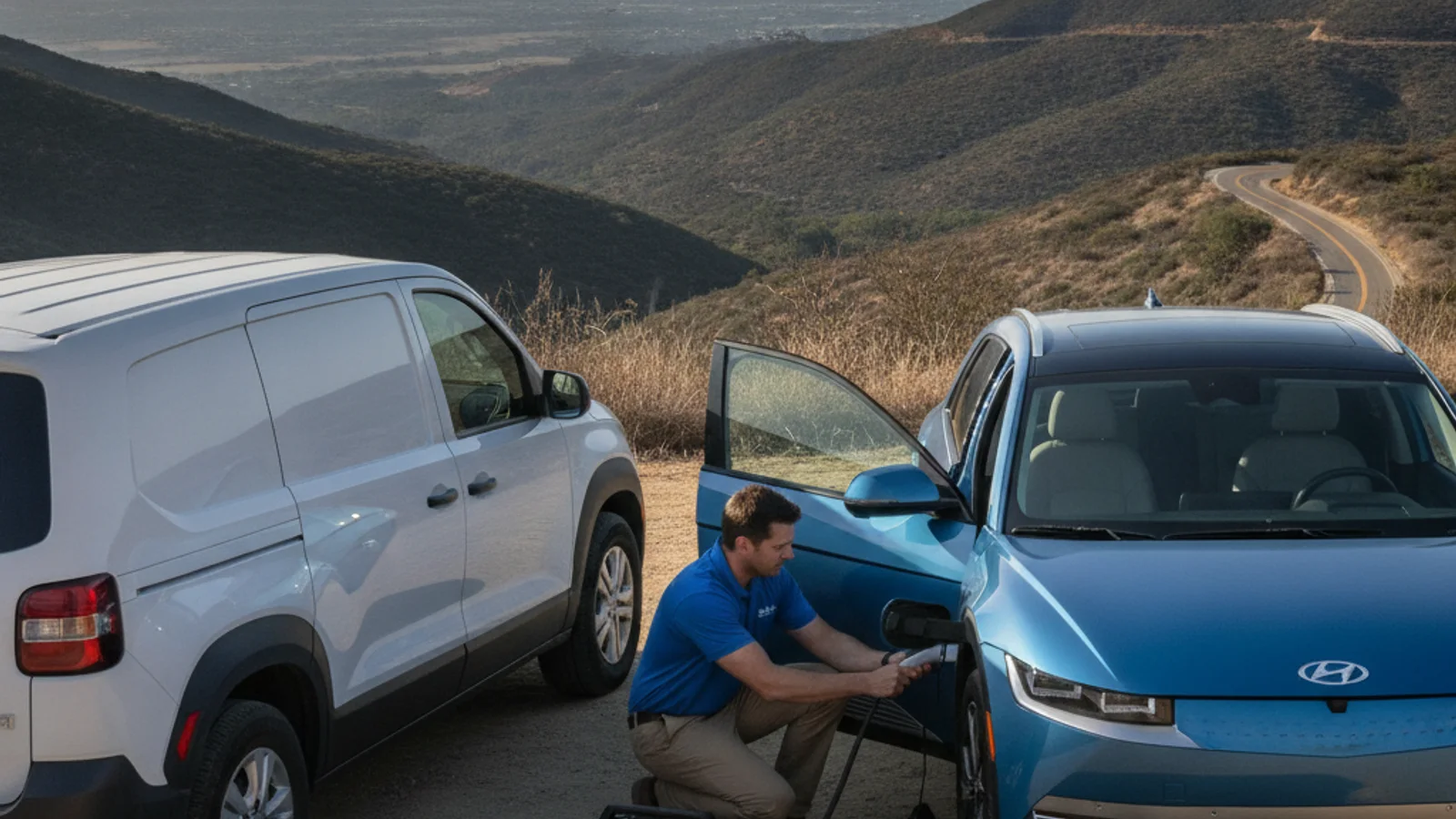
Cold cuts range. That isn’t a failed pack.
NWS Boulder climate normals put Denver’s January low around 18 degrees. That’s colder than the 20-degree mark testers use. Recurrent Auto’s winter study covered more than 30,000 U.S. electric vehicles. At 32 degrees, packs kept about 78% of max range on average. At 20 degrees, they kept about 70%. The best model in that set held 88%. The worst held 69%. Heat-pump cars held about 10 points more at 32 degrees.
AAA’s 2026 dynamometer study found about 39% range loss at 20 degrees. It also found about 35.6% efficiency loss at that temperature. Those are fleet and lab figures, not a promise for your VIN. They still explain a January commute that looks shorter than October.
Cabin heat comes from the same pack that moves the car. Battery warming does too. A car that sat outside all night starts the day already spending energy. That isn’t wear you caused by driving wrong. It’s chemistry slowing down in the cold. Denver’s official elevation is 5,280 feet at the State Capitol. Thinner air and cold stack on the same morning drive. We can’t verify a single mile-loss number for that mix. Trust the range display that morning.
The January 2024 arctic blast is the extreme version. Denver went from 47 degrees to minus 19 in about 48 hours on January 16 and 17. If the car woke with less range, the air is the reason. It isn’t proof the traction pack is dying. Annual snowfall here runs in the low-to-mid 50s of inches. You’ll see a lot of nights near 18.
The Front Range isn’t one winter
A downtown Denver car doesn’t live the same winter as one in Evergreen. Downtown sits at a mile high, with city heat and shorter climbs. Evergreen sits around 7,200 feet. Nights run colder there, and SH-74 is a real grade home. Golden sits around 5,675 feet, by the Colorado School of Mines. Idaho Springs sits at 7,526 feet on I-70. Loveland Pass is 11,990 feet. CDOT operates the Eisenhower-Johnson Memorial Tunnel. Those elevations change how hard the pack works, and how cold it soaks overnight.
South-metro towns add a utility twist, not just elevation. Highlands Ranch, Parker, Castle Rock, Castle Pines, Lone Tree, and Centennial sit on CORE Electric Cooperative, not Xcel Energy. North-metro streets can split between United Power and Xcel in Thornton, Northglenn, Westminster, Arvada, Broomfield, Commerce City, and Erie. Brighton electric is United Power. Longmont is Longmont Power and Communications, the city’s municipal utility.
If you plug in at home, confirm the utility by address. Calling Xcel is wrong for a large share of the metro. CORE’s residential COREV Charge program is at capacity and closed to new applications, per CORE’s own page. Xcel publishes home programs such as EV Accelerate At Home. United Power publishes United EV. We can’t confirm rebate dollar amounts. Check the program name with your utility before you spend.
Peña Boulevard is city-maintained, not a state highway. It’s still the only road into Denver International. A car that sat in a cold airport lot often has a 12-volt problem.
Two batteries, two winter failures
Owners say the battery died for two different parts. Mixing them up sends you to the wrong help.
The traction pack is the big one that drives the motors. It’s the range number on the dash. When it’s low, you still get warnings. The car usually keeps moving until the pack can’t.
The 12-volt battery is the small one. It runs locks, screens, and the computers that wake the high-voltage system. When that 12-volt is dead, the car can look fully dead. Doors may not answer. The screen may stay dark. The traction pack can still be full. Cold parking is hard on that small battery. A week in a Denver International lot is a classic 12-volt soak. The car comes back needing a jump or a 12-volt swap. It doesn’t automatically need a pack charge.
Our guide to which battery matters on the roadside walks through that split. Tesla owners can also read why cold parking kills a Tesla 12-volt.
CDOT Safety Patrol will jump a 12-volt on covered freeway segments. Metro coverage includes parts of I-25 South, I-70 East, C-470, and I-225. Mountain coverage runs Morrison to Vail. Published hours are limited. The patrol’s pages say nothing about charging an EV. The free state program can jump. It doesn’t bring a 240-volt source to the car.
A Tech Center garage, a Park Meadows lot, or a Red Rocks lot after a show all sit cold. The car may refuse to wake even with miles left on the pack. That’s the 12-volt again. If the car won’t wake at all, start with the 12-volt. If the dash still counts down miles, you’re in pack territory.
What you can actually control at home
We can’t publish one charge-limit percentage that fits Tesla, Rivian, Ford, Hyundai, Chevrolet, and Kia. Makers change that guidance, and chemistry differs by model. Your owner’s manual and the maker’s app are the only sources built for your VIN. Start there. Don’t start with a guessed number from a blog.
Plug in overnight when you can, so the pack can warm on wall power. Use the maker’s preconditioning if the app offers it, while you’re still plugged in. That spends grid energy, not the miles you need at dawn. Keep the charge port clear of snow and melt.
Level 1 overnight charging is slow in January. Whether it’s enough depends on your commute, not a metro-wide rule. A 240-volt home circuit recovers more before a cold dawn. We don’t set those install prices. The electrician you hire does. Match the home program to the meter on your street.
For Tesla range on a cold day, see how long a Tesla charge lasts through Denver winter. Tires and cabin filters live in our cold-night EV maintenance notes. This page stays on the pack, the 12-volt, and winter range.
Public stalls still matter when you didn’t plug in at home. Tesla Superchargers sit in Denver, Lakewood, Highlands Ranch, Castle Rock, Boulder, and Idaho Springs, among other metro sites. EVgo and Electrify America add DC fast sites too. Treat a map check as part of maintenance.
Climbs spend energy. Descents can give some back.
A loaded EV climbing I-70 west of Golden is working. That’s grade plus cold plus cabin heat. Coming back, regen can recover a large share of the climb. A widely cited InsideEVs analysis puts recovery around two-thirds of the energy spent going up. A Lucid Air GT used about 3% of its battery over a 77-mile descent from Loveland Pass. Those are published test runs, not your commute.
Ice changes the advice. Drivers often dial regen down on slick descents for traction. That’s a handling choice. It means you keep less of the downhill recovery. Check COtrip.org, or 511, for traction-law status before you commit to the mountain. CDOT activates Passenger Vehicle Traction Law or Chain Law by signage. We won’t invent a season window the agency didn’t confirm here.
If you’re on a shoulder, CRS 42-4-1202 is the disabled-vehicle rule. You may not stop on the paved main-traveled way outside a business or residential district. The exception is a car that truly couldn’t be moved, with hazards on. A stranded EV follows the same statute as any car. Colorado has no separate disabled-EV law.
Leave room in the pack for the last hill home. That buffer is maintenance too. It isn’t a defect when the estimate drops as the cabin heater runs. Plan the return from Idaho Springs, Morrison, or Boulder with the morning temperature in mind.
Shop care versus a roadside charge
If the car charges, drives, and wakes, and you only want a health readout, that’s a service-center question. State-of-health tests belong with the maker or an authorized shop. Roadside operators don’t diagnose long-term pack wear. Charge Pro DEN is a referral line. We match you with independent mobile rescue operators. We don’t hold a shop license, and we don’t do the work. The pros we connect you with are licensed and insured.
If the traction pack is empty on an accessible street, that’s a charge-in-place call. The mobile EV charging the pros we send bring is a 240-volt Level 2 source. Native NACS on Tesla, with CCS or J1772 adapters for other brands. They typically add 10 to 20 miles of range in 15 to 30 minutes of charging. That’s charging time, never an arrival time. The operator quotes you before starting and bills you directly.
If the car is silent and you suspect the 12-volt, start with a jump or an on-site 12-volt replacement. Don’t assume the pack is empty because the screens are dark. The operator decides whether a boost gets you to a stall. That call happens in person.
If the pack already feels too low
Don’t sit on a live lane to think it through. Get to a legal shoulder, hazards on. Then sort pack versus 12-volt from what the car is doing. A range countdown is a pack problem. A car that won’t unlock is often the 12-volt.
If you need a local operator, call (720) 738-6950. We’ll connect you with an independent mobile rescue pro in the Denver metro. They quote before they start. They don’t speak for Tesla, CDOT, or your utility. They get the car moving again, or they tell you it needs a tow.