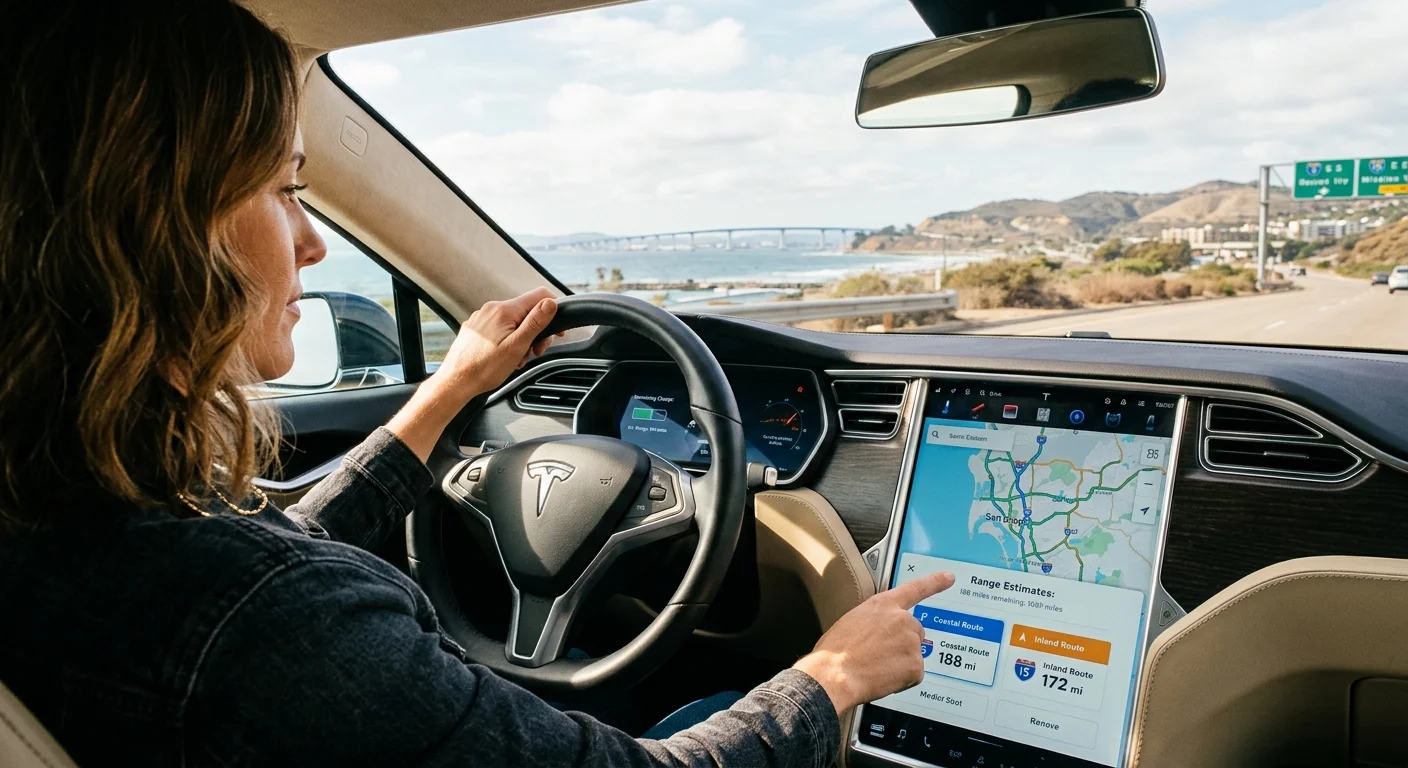
A Tesla that looked full last night can run short by afternoon. January in Denver does that to a day’s charge. Cabin heat and a cold pack pull from the same battery. Cold air and Front Range climbs take more still. The miles on the screen are a live estimate, not a guarantee.
Cold is what cuts today’s Tesla miles
Denver’s January normal low sits around 18 degrees. Recurrent Auto studied more than 30,000 U.S. EVs in winter. Packs kept about 78 percent of max range at 32 degrees. At 20 degrees that average fell to about 70 percent.
Those are fleet averages, not your car’s number. Tesla hasn’t published a Denver-specific daily range in any source we could confirm. Treat the studies as a warning, not a calculator.
January 2024 made the point without a spreadsheet. Denver dropped from 47 degrees to minus 19 in about 48 hours. A pack that covered errands on the 16th felt different on the 17th. Plan around a morning in the teens, not a brochure number.
Cabin heat is the quiet drain on a January day. The traction battery warms the cabin and itself. That work happens while you sit in traffic on I-25. Elevation adds another pull across the metro. Denver sits at 5,280 feet on the Capitol’s west steps. Evergreen is about 7,200 feet. The Eisenhower-Johnson Memorial Tunnel west portal is 11,158 feet. That’s the highest point on the U.S. Interstate system.
A climb toward Evergreen or I-70 west costs energy a brochure never shows. Descent gives some of it back through regen. Published Loveland Pass tests show regen recovering a large share of climb energy. Tesla-specific descent numbers weren’t confirmed in sources we could read. Drivers often ease regen on ice for traction. That means less recovery on the way down.
Wind across the plains toward the airport is another real cost. Peña Boulevard runs more than 11 miles of city-maintained freeway from I-70 to DEN. The March 2019 bomb cyclone shut Peña, I-70, and I-25. A car that sat through that kind of event can wake with a dead 12-volt.
Two questions hide in the same search
People type “how long does tesla battery last in a day” and mean two things. One is today’s remaining drive. The other is how many years the pack stays useful.
Today’s charge is the one that strands you on a cold commute. Long-term pack life is an ownership question. We cover that in how long Tesla batteries last through Denver winters. A weak day in January doesn’t mean the pack is failing. A healthy pack can still leave you short at 18 degrees.
Keep the two apart when you plan. Ownership lifespan won’t tell you if this charge reaches Highlands Ranch and back. One empty afternoon won’t tell you when the pack needs replacement.
Read your car before you trust any published figure
Start with the Tesla in the driveway. Note the model, the percentage, and the estimated distance. Recheck after you add a destination. Recheck again if you change the route.
The displayed estimate is a planning input, not a contract. A number from a review or a neighbor’s Model Y may not match your car. Configuration, tire size, and current battery state all change the math. Tesla’s own site didn’t yield a confirmed daily range for this page. Use the screen in front of you.
Then map the whole day, not the first stop. Outbound, errands, the return, and the last stretch to a charger all count. A commute that ends at a home Level 2 plug is one kind of day. A long sit at the Denver Tech Center, then a climb toward Evergreen, is another.
Charging speed shapes the backup, not the miles you have now. The U.S. Department of Energy describes the common levels. Level 1 on 120-volt AC adds about five miles per hour for a midsize EV. Level 2 on 240-volt power adds about 25 miles per hour. Real speed varies with pack size, state of charge, and air temperature. Confirm the connector and the equipment before you count on a stall.
Home charging sits under more than one utility here. Xcel Energy covers Denver and much of the core metro. CORE Electric Cooperative serves the south-metro Douglas corridor, including Highlands Ranch, Castle Rock, and Centennial. United Power covers much of the north and northeast, including Brighton. Longmont Power and Communications is the City of Longmont’s utility. Confirm the account by address before you blame the car. More on winter pack care is in how to care for an EV battery through a Denver winter.
A Front Range day is several different drives
I-25 is the north-south spine, from Thornton through Castle Rock. I-70 cuts east toward Aurora and west through Golden toward the tunnel. C-470 and E-470 loop the south and east. US-36 is the Boulder Turnpike. Peña Boulevard is the only road into Denver International.
Write the stops in order. Then pick a charger on that actual corridor, plus a second option. Tesla Superchargers sit across the metro. Confirmed sites include Denver, Park Meadows, Highlands Ranch, Boulder, Castle Rock, and Idaho Springs. EVgo and Electrify America add DC fast sites across the metro. A charger on the other side of the metro isn’t a backup. It isn’t useful merely because it appears on a map.
Don’t invent a fixed mile penalty for wind, traffic, or a grade. No verified figure in our claims supports a universal Denver subtraction. Watch the estimate as the route changes. We couldn’t confirm a Tesla-authored Denver range number.
The return trip is where days fail. Reaching Red Rocks Amphitheatre or the Tech Center is only half the problem. The drive home still has to fit. A comfortable morning number can look thin after cabin heat, a queue, and a climb.
The 12-volt can end the day even when the pack isn’t empty
A Tesla that won’t wake isn’t always out of traction charge. The 12-volt battery runs the computers that close contactors and unlock the car. A week in a cold DEN lot is a classic 12-volt failure, not an empty pack. CDOT Safety Patrol will jump a 12-volt on covered freeway segments during published hours. Coverage includes stretches of I-25, I-70, US-6, C-470, and I-225. CDOT’s pages mention nothing about EV charging. The patrol can jump a 12-volt and change a tire. It doesn’t bring a charge to a stranded EV.
If the car won’t unlock or the screen stays dark, start with the 12-volt. If the car is awake and the miles are too low, that’s a range problem. Our Tesla roadside rescue page covers the referral path for both.
Act while a charger is still reachable
Low charge is easier when you stop adding stops. If the estimate no longer covers the original day, cut the extra errand. Pick a compatible charger the car can still reach. Confirm the stall through the network before you drive there.
Don’t treat “in the area” as arrival. You need the actual entrance, the garage ramp, the last block. If the first stall is down, switch while you still have margin.
If the Tesla is already very low, write down where you are. Road, direction, nearest exit, parking level, or a named landmark. That’s what an operator needs.
What to do when an EV is running low walks the decision before you hit zero. Don’t keep driving toward a charger you can no longer reach.
Charge there, bring a charge, or move the car
If usable charge remains and a stall is still in range, go charge. Confirm the stall, then watch the number on the way.
If no stall is reachable, ask whether a mobile Level 2 charge can meet the car. Independent operators bring a 240-volt source to the Tesla. A typical session adds 10 to 20 miles in 15 to 30 minutes of charging time. That’s charging time, never an arrival time. Charge Pro DEN doesn’t own trucks or send employees. We connect you with a local operator. The operator quotes you before work starts and bills you directly. Out-of-charge recovery is the referral page for that call.
Transport is the option when a charge in place isn’t available or isn’t safe. Let the operator sort charge versus tow. Charge Pro DEN doesn’t set prices and doesn’t warrant the work. You contract with the professional. If the car already hit zero, Tesla hit zero on the road covers charge, jump, or tow.
When to call
Call when the remaining estimate no longer supports a safe drive to a reachable charger. Call when you need an operator to weigh a mobile charge against a tow. Call Charge Pro DEN at (720) 738-6950. We’ll connect you with a local EV rescue operator.