A Tesla that won’t wake is a 12-volt job, not a donor pack. People search “can a Tesla jump start another car” after they see frunk jumper posts. Those posts take power in. They don’t feed a starter on the car beside you.
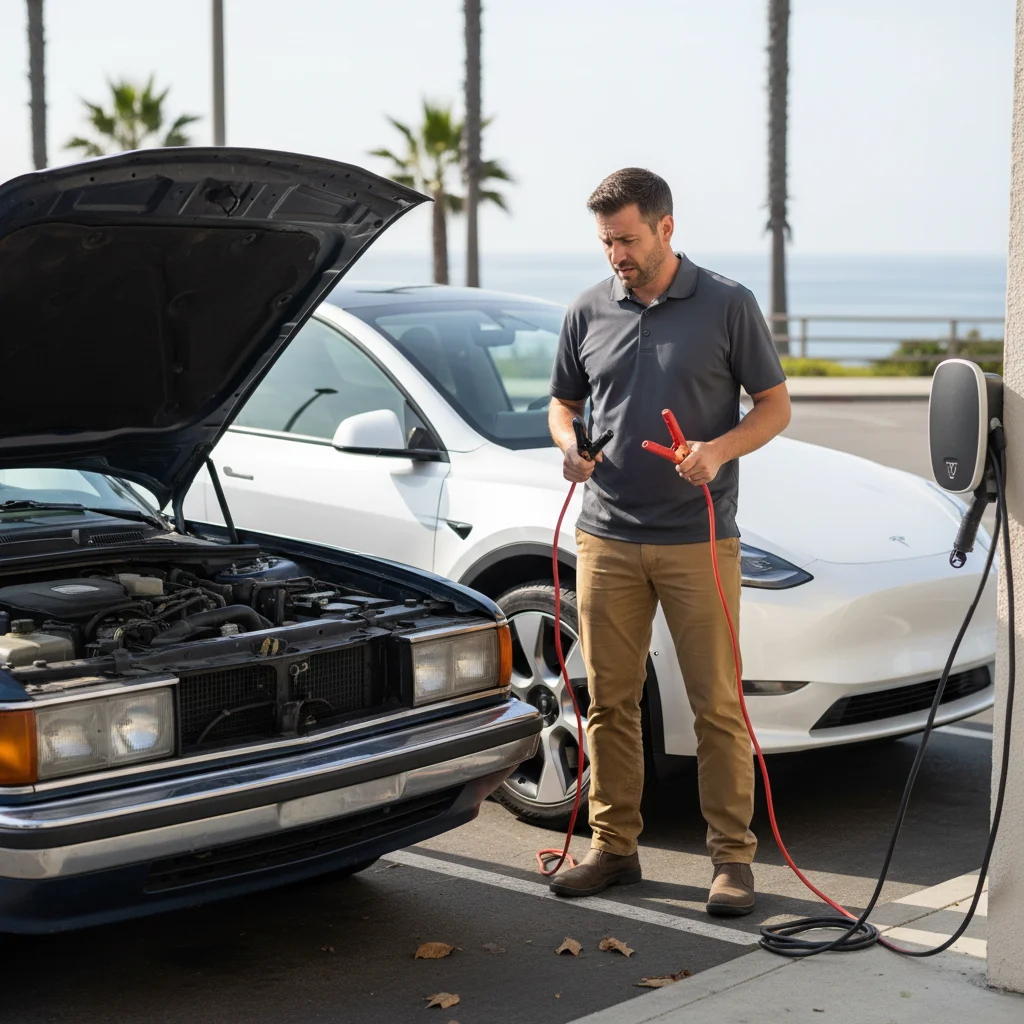
Two 12-volt jobs that aren’t the same
A gas car with a flat battery needs a hard crank. A Tesla with a quiet 12-volt needs a gentle wake. Current flows in opposite directions for those jobs.
If your Model 3, Y, S, or X sits dark, you may need a jump. You’re not the driver with spare cranking amps. The high-voltage pack can still hold range in that stall. The small 12-volt battery is what went to sleep.
We split that mix-up in Tesla looks dead: empty pack or 12-volt. Start there if the silent car is yours.
What a Tesla 12-volt actually does
A Tesla still has a 12-volt battery. Older cars used a small lead-acid unit. Newer Model 3 and Model Y cars often use a lithium 12-volt. Neither one is a starter battery.
Its work is quiet. It feeds computers, the screen, the locks, and the lights. It also closes the contactors that tie the high-voltage pack to the drive unit. No 12-volt wake means no traction pack, even when miles remain.
A DC-to-DC converter keeps that 12-volt topped off from the main pack. The system is built for a steady, low draw. It isn’t built to dump a huge pulse into another car’s starter.
That’s the point of Do Teslas have a 12-volt battery, and why cold parking kills it. The little battery is a gateway. It isn’t a donor.
Why a Tesla shouldn’t jump another car
A gas car’s 12-volt exists to spin a starter. It’s sized for a short, brutal load. Tesla’s low-voltage side isn’t.
Clip cables from Tesla jump posts to a gas car and you reverse that design. You ask a small battery and a sensitive converter to feed a starter motor. That surge can damage the DC-to-DC converter. It can ruin the 12-volt battery itself. It can also upset the modules that run doors, screens, and contactors.
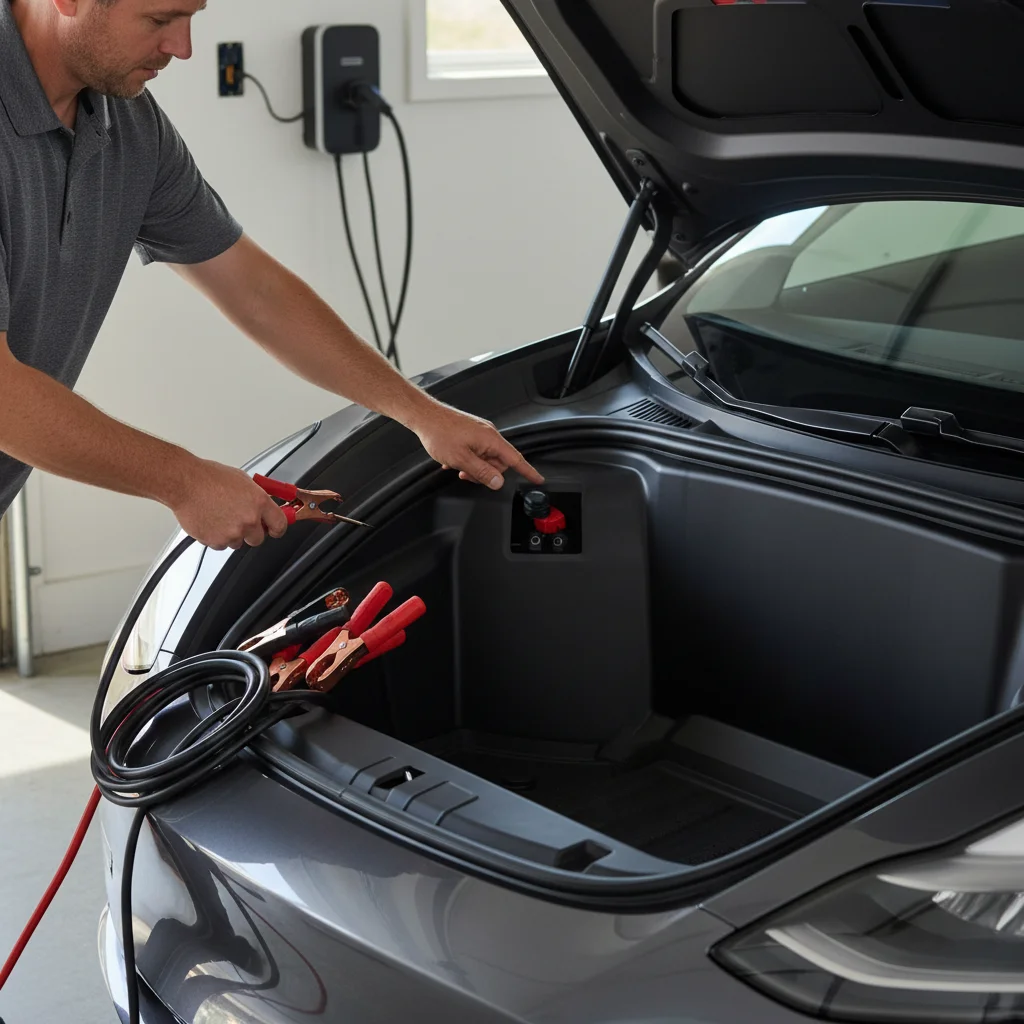
Tesla’s owner’s manuals tell you not to jump-start another vehicle with the car. The same manuals explain how to receive a jump when your 12-volt is dead. The posts in the frunk are an inbound path. They exist so an external source can wake your low-voltage system. They aren’t an outlet.
The same don’t-donate rule applies beyond Tesla. See Can an EV jump-start a gas car from a metro shoulder. We also cover Why you should not jump a gas car from your Tesla. Carry a portable jump pack if you like helping. Keep your Tesla out of the circuit.
Cold parking along the Front Range
Denver sits at 5,280 feet, measured at the State Capitol’s west steps. January’s normal low sits around 18 degrees. In January 2024, an arctic blast dropped Denver from 47 to minus 19. That swing took about 48 hours. That soak is hard on a small 12-volt, lead-acid or lithium.
A week in a cold DEN lot is a classic setup. You fly out on Peña Boulevard. The car sits. You come back and nothing wakes. Drivers assume the traction pack went empty. More often the 12-volt quit first. The pack can still hold charge. The computers never got the signal to connect it.
The same stall shows up after a long sit at Park Meadows in Lone Tree. It shows up after work in a Denver Tech Center garage in Greenwood Village. It shows up on Capitol Hill with no driveway plug. The car was fine when you parked. Cold and time pulled the 12-volt down.
Recurrent Auto’s winter range-loss work is about the traction pack, not this little battery. EVs as a group keep about 78% of max range at 32 degrees. They keep about 70% at 20 degrees. Your 12-volt can fail on a shorter clock than that.
Colorado Energy Office counted more than 200,000 registered EVs statewide by October 2025. Battery-electric vehicles were 12.5% of new Denver-metro registrations year-to-date through June 2026.
A Supercharger stall won’t wake a dead 12-volt
Tesla Superchargers are dense across the metro. You’ll find sites in Denver, Lone Tree, Centennial, Highlands Ranch, Lakewood, and Boulder. Idaho Springs has an 8-stall Supercharger on I-70. It sits west of Denver, before the Eisenhower-Johnson Memorial Tunnel.
None of those stalls wake a car whose 12-volt is already dead. The car has to talk to the stall. The contactors have to close. Towing to a Supercharger doesn’t fix a dead 12-volt. You still need a 12-volt jump first.
If the pack is empty and the car will wake, use a Supercharger. Don’t treat a silent Tesla as an empty pack until the 12-volt is up.
If the dead Tesla is yours
Treat a silent Tesla as a 12-volt check first. Doors that won’t unlock point that way. So does a black screen, or a car that ignores the app. A “12V Battery Needs Service” warning is the same story.
Confirm the owner’s manual steps for your model before you clip anything to the posts. Model 3, Y, S, and X hide those posts in slightly different places. We map that in How to jump a Tesla 12-volt on Model 3, Y, S, and X.
If the 12-volt is healthy, an empty pack needs energy in the charge port. That’s a different call. Independent operators can bring a 240-volt Level 2 source to the car. Native NACS for Tesla. CCS or J1772 adapters for other brands. Charging time is typically 10 to 20 miles of range in 15 to 30 minutes. That’s charging time, never an arrival time. Operators also handle a Tesla 12-volt battery jump on site.
Charge Pro DEN is a referral line. We match stranded EV drivers with independent local mobile rescue operators. We hold no license. We own no trucks. We employ no technicians. We set no prices. The operator quotes you before starting and bills you directly.
Cold 12-volt failures: Tesla 12-volt failure in Denver cold: when it happens and why.
What CDOT Safety Patrol can do, and what it can’t
CDOT Safety Patrol is free on covered metro freeway segments. It handles flat tires, jump-starts, emergency fuel, minor mechanical help, debris, and incident support. Denver-metro coverage includes I-25 South from 120th Ave to Arapahoe Rd. It also covers I-70 East from Wadsworth to Airport Blvd. The I-70 Mountain Corridor is covered from Morrison to Vail.
Front Range metro weekday hours are 6:00 to 9:30 a.m. and 2:30 to 7:00 p.m. Weekend hours are 10:00 a.m. to 7:00 p.m.
CDOT’s Safety Patrol pages mention nothing about electric vehicles. The “my car broke down” page is silent on EV charging too. The free state program will jump a 12-volt battery. It won’t bring a charge to a stranded EV. If your Tesla needs a wake, a patrol jump may fit. That’s during those hours, on those segments. If the pack is empty, it isn’t.
On E-470, a disabled driver pulls to the shoulder and dials *470. E-470’s own assistance lists jump-starts, flat tires, and debris removal. There’s no EV-specific charging service in that list. *CSP, which is *277, reaches State Patrol.
COtrip.org and the 511 line are CDOT’s source for I-70 closures. They also show traction-law status. Traction law activates by highway signage and by COtrip. We didn’t confirm a fixed seasonal date range from an agency page. Check the signs before you commit to a mountain run.
Shoulder law doesn’t care that it’s a Tesla
No Colorado statute addresses a disabled EV or mobile roadside EV charging. A stranded Tesla sits under the same disabled-vehicle rules as a gas car.
CRS 42-4-1202 covers a disabled vehicle on the shoulder. Outside a business or residential district, don’t stop on the paved travel lanes. The exception is a vehicle so disabled you can’t avoid stopping. You also couldn’t move it off the roadway. Hazards must be on, under CRS 42-4-230. A violation is a class B traffic infraction. It’s lawful on the shoulder if the car truly couldn’t go farther.
CRS 42-4-1803 to 1805 govern abandoned vehicles on public property. Abandonment is officer discretion. The statute sets no 24-hour or 72-hour clock. Don’t assume you have a fixed window. Colorado State Patrol handles enforcement, crash response, and dispatch.
If you want to help the other driver
Leave your Tesla out of the jump. A portable lithium jump pack is the tool that belongs in a frunk. It’s built to crank a gas car. Your 12-volt isn’t.
You can help the other driver call their insurer or a roadside club. Stay off the travel lanes. Offer a ride to a safer lot if that’s what they need. None of that puts your converter in the circuit.
Don’t clip Tesla posts to another Tesla as a favor either. If their car is a Tesla that won’t wake, they need a 12-volt jump.
A show night at Red Rocks in Morrison is a common version of this scene. Your Tesla isn’t the donor they need. A portable pack, a ride, or a call for a 12-volt jump still helps.
Home charging won’t wake a 12-volt that already died
Xcel Energy covers much of the core metro and Boulder County cities. CORE Electric Cooperative covers the south-metro Douglas County corridor. United Power covers much of the north and northeast. It splits streets with Xcel in Thornton, Northglenn, Westminster, Arvada, Broomfield, and Erie. A Level 2 at home needs a car that will accept a plug. A silent Tesla often won’t.
Frequently asked questions
Can a Tesla jump start another car?
No. Don’t use a Tesla as a donor. Its 12-volt system wakes the car. It doesn’t crank someone else’s engine.
Can you jump a Tesla from another car?
A Tesla with a dead 12-volt can take external power on the published posts. Follow the owner’s manual for your model. A portable pack or a trained operator is cleaner than another vehicle.
What should I do if my Tesla won’t wake in the Denver metro?
Treat it as a 12-volt failure first. On a covered freeway in patrol hours, CDOT Safety Patrol can jump a 12-volt.
If your 12-volt is dead, don’t donate a jump to anyone else. Call (720) 738-6950 and we’ll connect you with a local operator. That operator quotes you before starting and bills you directly.