Most EVs can jump start a gas car from the 12-volt, not the pack. The traction battery never joins that jumper circuit. A gas starter still wants a huge surge. That surge can kill the EV’s small 12-volt. On a metro shoulder, CRS 42-4-1202 still applies. You’re lawful there if the car couldn’t move, with hazards on. A legal stop isn’t a reason to jump someone else’s engine.
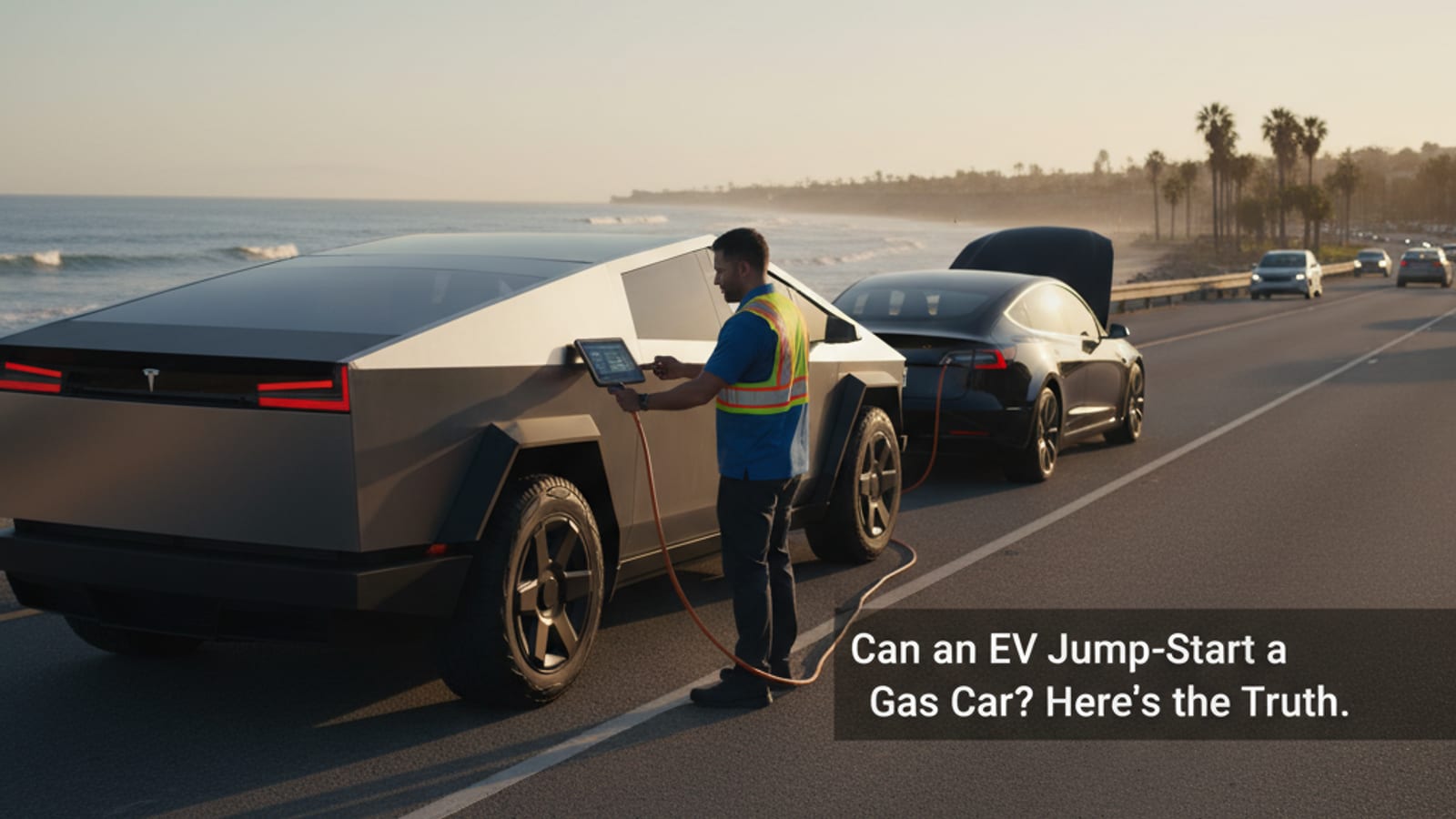
Lawful on the shoulder isn’t a jump permit
Colorado treats a disabled EV like any other disabled car. There’s no EV carve-out in the breakdown statutes. CRS 42-4-1202 covers paved highways outside a business or residential district. You can’t stop on the traveled part of those lanes. The exception is a vehicle so disabled you couldn’t move it off the roadway. Hazard lights have to be on under CRS 42-4-230. A violation is a class B traffic infraction.
That covers the gas car that won’t crank. It also covers your EV if you flatten your own 12-volt trying to help. Colorado State Patrol can treat a left vehicle as abandoned under CRS 42-4-1803. Officers decide that on reasonable grounds, not a posted clock. The statute doesn’t set a 24-hour or 72-hour threshold.
I-25 North Express Lanes and the US-36 Express Lanes have a minimum 8-foot outside shoulder. CDOT’s guidance is to move to that right, outside shoulder. Don’t occupy a travel lane for jumper cables. On E-470, pull over and dial *470 for their listed jump-starts. It doesn’t list a charge for an empty EV pack. COtrip.org and 511 carry live I-70 closure status.
Why the pack can’t save a starter
The large pack turns the wheels, while the 12-volt wakes computers, locks, and lights. In a gas car, that 12-volt also cranks a starter motor. An EV 12-volt was never sized for that spike. A DC-DC converter tops it up from the pack when the car is awake. It’s not a hidden jumper pack.
Newer Teslas and some other EVs use a lithium 12-volt. Those units trip protection under a hard starter pull. Older lead-acid EV 12-volts still aren’t truck starter batteries. Tesla’s published owner guidance tells drivers not to jump another vehicle from the car. Treat that as a hard no on I-25 or I-70. See Can a Tesla jump-start another car for the Tesla-only version. A voltage spike can hurt the EV’s low-voltage computers and the DC-DC converter. Then two cars sit dead on the same shoulder.
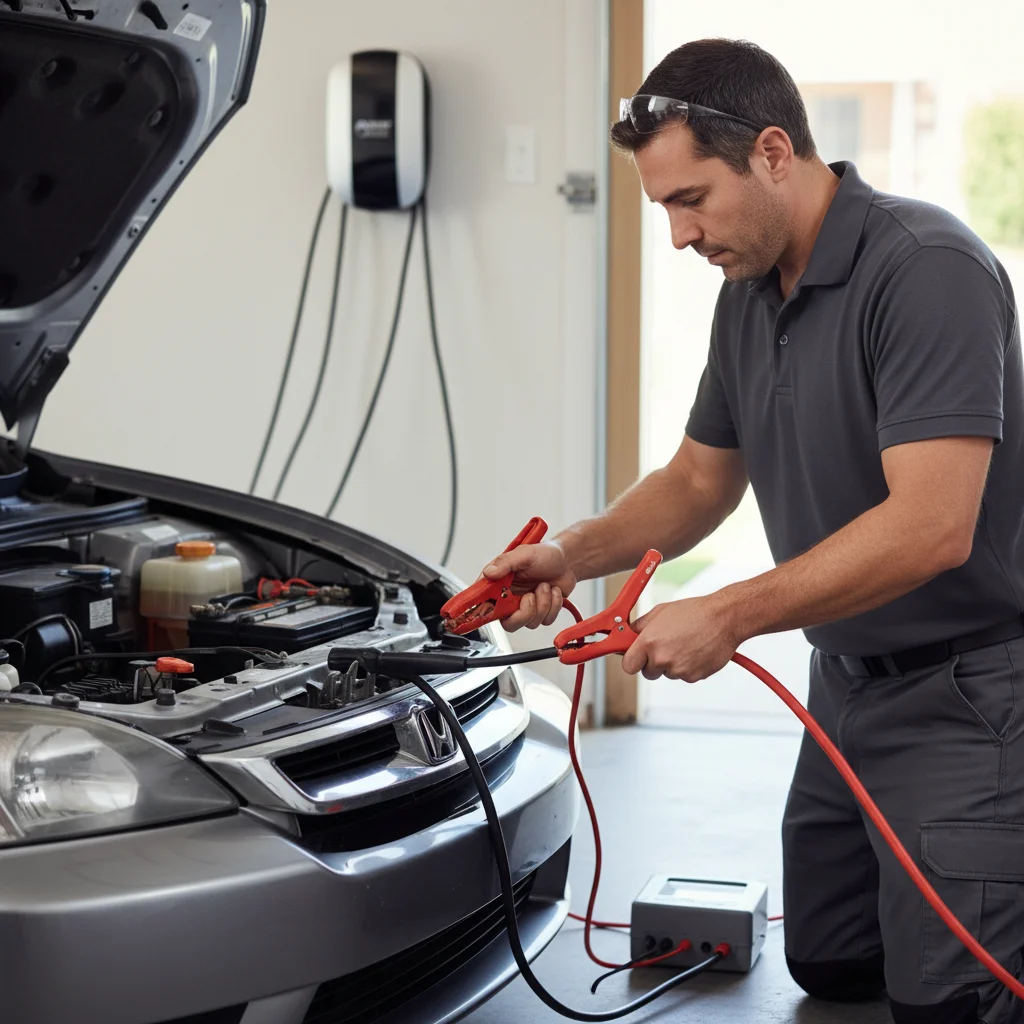
What CDOT Safety Patrol will actually do
CDOT Safety Patrol is free on covered metro freeway segments. It publishes jump-starts, flat tires, emergency fuel, minor mechanical help, debris, and incident support. Coverage includes I-25 South from 120th Ave to Arapahoe Rd. It also includes I-70 East from Wadsworth to Airport Blvd. Portions of US-6, C-470, and I-225 are listed. The I-70 Mountain Corridor is covered from Morrison to Vail.
Front Range weekday patrols run 6:00 to 9:30 am and 2:30 to 7:00 pm. Weekend hours are 10:00 am to 7:00 pm. Mountain Corridor hours are 6:00 am to 7:00 pm Friday through Sunday, plus significant weather.
CDOT’s Safety Patrol pages mention nothing about electric vehicles or a roadside charge. The free program will jump a 12-volt. It won’t bring Level 2 power to a dead pack. If the gas car needs a jump, call the patrol. Don’t offer your Tesla as the donor. If your EV is the dead one, read can roadside assistance jump-start an EV.
A January normal low around 18 degrees already stresses 12-volt batteries. The January 2024 arctic blast dropped Denver from 47 to minus 19 in 48 hours. That’s when this mix-up shows up on metro shoulders.
If your EV is the car that won’t wake
Don’t assume the pack is empty. A dead 12-volt can lock you out with a full traction battery. Keep hazards on and stay off the traveled lanes. The pros we send jump or replace a dead 12-volt on site. They also bring a 240V Level 2 source when the pack is the issue. They use a native NACS plug, with CCS or J1772 adapters for other EVs. You typically gain 10 to 20 miles in 15 to 30 minutes of charging. That’s charging time, never an arrival time.
Tesla 12-volt battery jump is the path when the small battery is the culprit. Use EV roadside assistance when you’re not sure. The charge, jump, or tow fork is in electric car died: charge, jump, or tow.
Call a booster, not your charge port
Stay in the vehicle if traffic is close. Don’t stand between bumpers on I-25. Send a gas-car jump to CDOT Safety Patrol or to *470 on E-470. If your own 12-volt is fading, don’t donate what’s left. Charge Pro DEN is a referral line. It matches stranded EV drivers with independent local mobile rescue operators. It doesn’t own trucks, set prices, or promise a clock. The operator quotes you before work starts and bills you directly. Call (720) 738-6950 when you need that match. The Tesla-only list is why you should not jump a gas car from your Tesla.
Can an EV jump start a gas car at all?
Yes, in a narrow electrical sense. Current comes from the EV’s 12-volt, never the drive pack. Manufacturers, Tesla included, tell you not to. The starter surge can flatten or damage that 12-volt. Then your EV won’t ready either.
Is it legal to sit on a Denver metro shoulder for a jump?
CRS 42-4-1202 allows that stop when the car couldn’t be moved, hazards on. That’s not a permit to occupy a shoulder for convenience. If both cars still roll, you shouldn’t stop on the highway to jump.
Will CDOT bring a charge to a stalled EV?
Safety Patrol won’t bring a charge to a stalled EV. It publishes jump-starts and fuel, not EV charging. Confirm current coverage and hours on CDOT’s Safety Patrol page. A pack charge or EV 12-volt needs a mobile operator, not the free patrol.