You parked at Denver International for a week. January sat on the car the whole time. You get back, the handles stay flush, and the screen never wakes. The search that follows is usually how much is a Tesla battery.
That query is a shop question. On a frozen DEN lot, it is almost never the first answer.
The search and the stall are different problems
How much is a Tesla battery can mean two parts. People mix them up because both can leave the car looking lifeless.
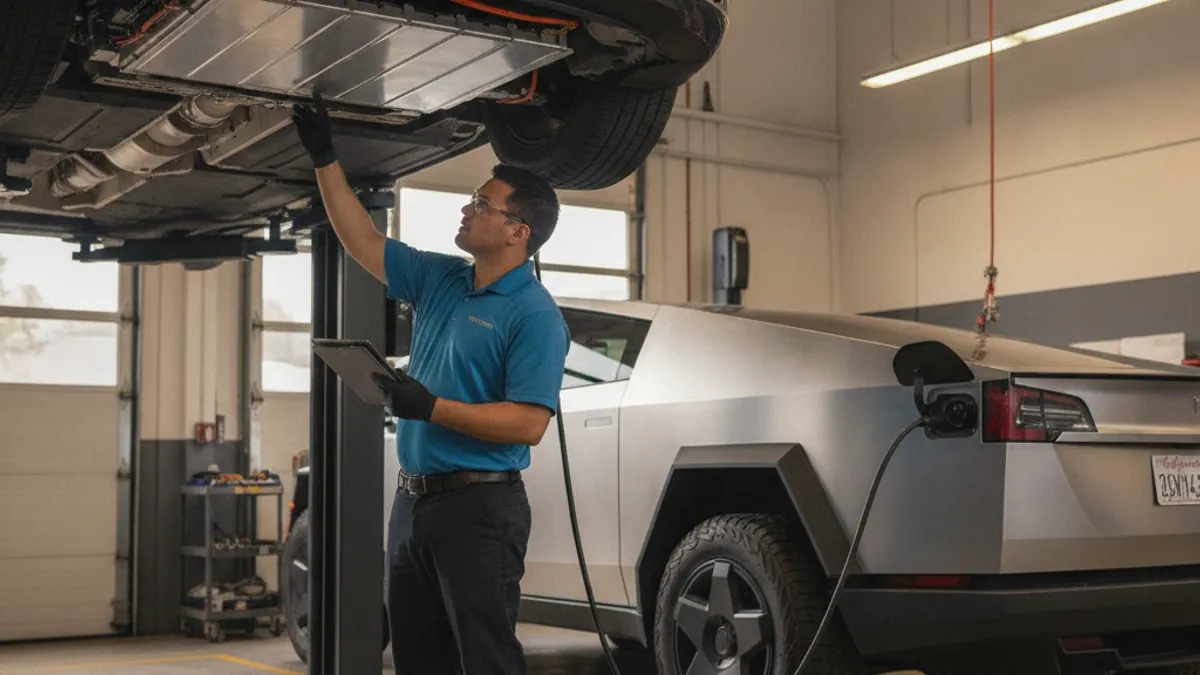
The traction pack under the floor is the expensive one. It stores the energy that turns the motors. Replacing it is a lift job at Tesla service or a qualified independent EV shop. Out of warranty, it is a major repair. There’s no public rate card, and we will not invent one. Model, labor, and whether a module can be saved all move the quote. The shop prices your VIN after it looks at the car.
The 12-volt is the other battery. On newer Model 3 and Y cars it is a small lithium pack. It wakes computers, latches, and the contactors that let the big pack do anything. When it is dead, the traction pack can still be full. The car just can’t use it.
A week in the East or West garage at DEN is a 12-volt story. So is a shuttle lot off Peña Boulevard. Accessories sip while the car sits. Cold thickens the chemistry. January’s normal low around here sits near 18 degrees. In January 2024 Denver dropped from 47 to minus 19 in about 48 hours. That is how a parked Tesla comes back dark.
Start with Tesla looks dead: empty pack or 12-volt before you budget for a pack. Tesla 12-volt failure in Denver cold is the same fork, written for this climate.
A pack swap is a shop job
The traction pack is built into the floor. Swapping it means the car goes on a lift. The underbody comes apart. High-voltage connections get isolated. A new or remanufactured pack goes in. Then the car needs software and calibration.
That isn’t a shoulder visit. Charge Pro DEN is a referral line. We match you with independent local operators. Those operators bring a 240-volt Level 2 source to the car, with a native NACS plug for Tesla. They can also jump or replace a dead 12-volt on site. They don’t open a traction pack.
If the pack is the real failure, you need Tesla service or an EV shop. Roadside help can only get a driveable car to that appointment. Or it can confirm the 12-volt was the actual problem.
What actually moves a pack quote
Forums will throw numbers at you. Treat them as scale, not a bid.
The model changes the parts cost. A Model S or Model X pack is larger than a Model 3 or Model Y pack. Labor changes it next. A Tesla service center and an independent shop won’t bill the same hour. Some cars take longer to strip than others. The biggest swing is whether a failed module or cell group can be repaired instead of a full pack swap. Only a shop diagnosis can tell you that.
How the pack failed matters for who pays. A manufacturing defect inside Tesla’s battery and drive unit warranty is often a warranty conversation. That warranty runs eight years, with mileage caps that vary by model. Crash damage or water intrusion isn’t a warranty event. That’s an auto-policy claim, usually collision or other physical-damage coverage. Insurers know pack work is a large line item, so those claims get more review than a bumper. Don’t assume underbody damage means a full replacement. Get Tesla or an EV-certified shop to inspect it first.
Tesla pack warranty vs a dead 12-volt is the coverage map for that split.
Ordinary winter range loss isn’t a pack failure. Recurrent Auto’s winter study found EVs keep about 78 percent of max range at 32 degrees, and about 70 percent at 20 degrees, on average. Heat-pump cars hold about ten points more at 32. That’s reduced range on I-25 or US-36, not a brick in a garage.
Gradual wear over a long life is the normal path. How long Tesla batteries last when you drive winters like Denver is about that curve.
Why Front Range parking looks like a dead pack
A Tesla that won’t ready after a long sit at the Denver Tech Center is doing a common thing. Same story at Park Meadows after a long dwell, or on a Capitol Hill street overnight. The 12-volt gave up. The traction pack didn’t.
You may have been plugged in at home and still woken to a dark car. That can be a 12-volt that won’t close contactors, not a utility that failed to deliver power. The metro splits across Xcel Energy, CORE Electric Cooperative in the south Douglas corridor, United Power in much of the north and northeast, and Longmont Power and Communications in the city of Longmont. Confirm your utility by address if you’re chasing a home-charging mystery. Don’t start with a pack replacement.
CDOT Safety Patrol will jump a 12-volt on covered segments of I-25, I-70 East, US-6, C-470, and I-225 during its published hours. It won’t bring a charge to an empty pack. On E-470, *470 is the authority’s own roadside line for jump-starts and flats. Same limit: no EV charge.
Colorado has no statute that treats a disabled EV as a special case. CRS 42-4-1202 is the disabled-vehicle-on-the-shoulder rule. If the car couldn’t be moved further, hazards on, you’re in that exception. A dark Tesla on Peña Boulevard is a disabled vehicle, not proof the pack is finished.
What a roadside operator can quote you
If the 12-volt is dead, the operator can jump it or replace it on site. See Tesla 12-volt battery jump for that path. If the pack is truly empty, they can add a Level 2 charge. Typical added range is 10 to 20 miles in 15 to 30 minutes of charging time. That’s charging time. It isn’t an arrival time.
What moves that roadside quote is distance to you, time of day, and how many miles you need to reach a Supercharger or a driveway plug. The operator quotes you before starting and bills you directly. Charge Pro DEN doesn’t set the price and doesn’t perform the work.
A mobile visit can’t tell you if a module inside the pack can be saved. That’s a shop call. If you’re choosing between a boost and a flatbed, charge in place or tow is the local fork.
When the pack really is the problem
Persistent capacity loss well beyond winter range loss belongs in a shop. So do isolation faults, thermal warnings that won’t clear, and visible underbody damage after a hit. Those are pack conversations.
A dark screen after a week at DEN isn’t. Colorado had crossed 200,000 registered EVs by October 2025, and the Denver metro still holds the state’s highest EV share. Plenty of those cars live through Front Range winters on the original pack.
If you can’t tell which battery failed, call (720) 738-6950. We connect you with a local operator who can jump a 12-volt or add enough range to reach a charger. They quote before they start. They don’t swap a traction pack on the shoulder.
Frequently asked questions
Is a dark Tesla after a cold lot a pack failure?
Usually no. A car that won’t wake after sitting in the cold is typically the 12-volt. The traction pack can still hold energy underneath.
How do I get a real pack-replacement number?
Ask Tesla service or a qualified EV shop for a VIN quote. Model, labor, and module repair versus a full swap all move the bill. Forum posts aren’t a bid.
Can roadside help replace the main Tesla battery?
No. Operators jump or replace the 12-volt, or they add a short Level 2 charge. A pack swap is a lift job at a shop.