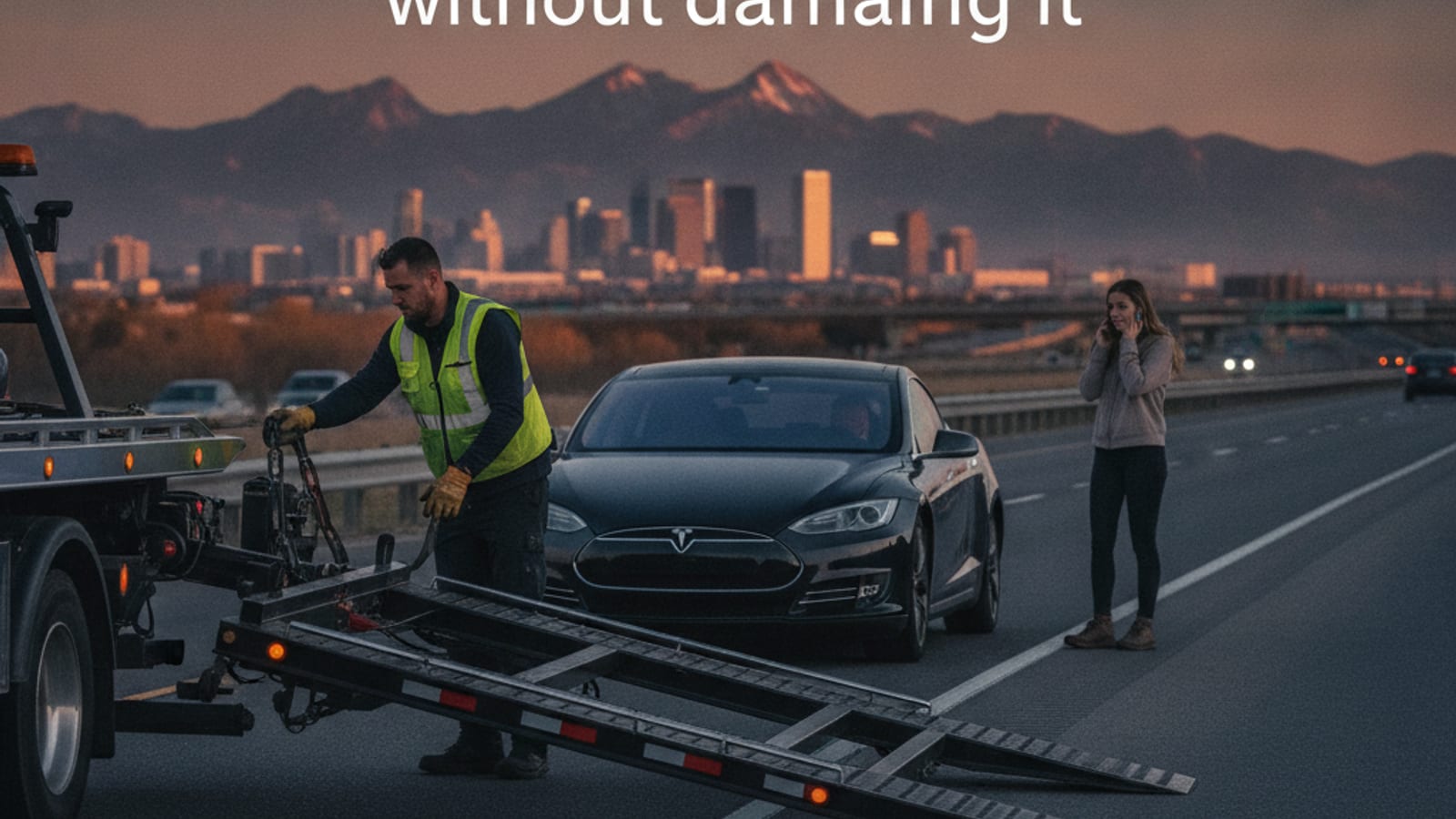
How to tow a Tesla with no power starts with a flatbed, not a hook. Teslas do not have a neutral that frees the rear wheels without power. Towing with two wheels on the ground can damage the motor and the gearbox, and it can void warranty coverage. The right answer is a flatbed that lifts all four wheels clear. On a Colorado shoulder, the law lets you sit with hazards on while you sort the call. Charge Pro DEN is a referral line that matches stranded Tesla drivers with independent local operators. We don’t own trucks, employ technicians, or set prices. The operator quotes you before any cable goes in, and bills you directly for the work. Call (720) 738-6950 when you want that match.
Why a no-power Tesla needs a flatbed
Tesla publishes Transport Mode procedures in that year’s Tesla owner’s manual, in the section called Instructions for Transporters. The book spells out a flatbed as the standard method. Tow dollies are not approved for all-wheel drive vehicles unless the drive axle is decoupled. A standard tow truck with a hook and sling can damage the battery pack, the low-voltage wiring, and the air suspension. This page is not reprinting the year’s Transport Mode steps, because those vary by model and year. Read them in your owner’s manual before the truck arrives.
The traction pack is the large battery under the floor. The 12-volt battery is a separate, smaller battery that powers contactors, computers, door locks, and the screen. When the 12-volt is dead, the car looks finished even if the traction pack still has range. A jump on the 12-volt can wake the car and put it in Transport Mode. From there, a short low-speed tow to a flat area is sometimes possible. That detail belongs in the manual, not on this page.
What Colorado law says about sitting on a shoulder
CRS 42-4-1202 covers disabled vehicles on Colorado highways. Outside a business or residential district, you may not stop or leave a vehicle on the paved main-traveled part of a highway. The exception is a vehicle so disabled that it is impossible to avoid stopping and impossible to move it off. CRS 42-4-230 requires hazard lights once a vehicle is stopped on the roadway. Plain read: it is lawful to be stuck on the shoulder with hazards on, if the car could not be moved further. A violation is a class B traffic infraction.
The statute sets no fixed hour count for abandonment. CRS 42-4-1803 leaves abandonment on officer discretion. The Colorado State Patrol holds abandoned-vehicle authority, not a towing carrier. If a CSP officer decides the car is abandoned, the post-tow timelines apply (reporting within 10 working days, a 30-day claim window, sale between 30 and 60 days after notice). Colorado has no special carve-out for disabled EVs. The same shoulder rules apply to a Tesla as to any other vehicle.
Move to the outside shoulder first
Most Colorado interstate construction built a minimum 8-foot outside shoulder on the I-25 North and US-36 express lanes. A driver who breaks down on those corridors moves to the right or outside shoulder. The I-70 Mountain Express Lane runs roughly 12 miles between the Veterans Memorial Tunnels near Idaho Springs and Empire Junction. That stretch uses dynamic tolling westbound since late November 2024. A stalled Tesla in the Mountain Express Lane should still be moved to the outside shoulder if it can roll. If it cannot roll at all, stay in the car with hazards on and call for help.
CDOT Safety Patrol covers portions of I-25 South, I-70 East, US-6, C-470, and I-225 in the Denver metro. The Mountain Corridor coverage runs Morrison to Vail. CDOT’s published menu is tires, jumps, emergency fuel, minor mechanical help, debris removal, and incident support. CDOT’s pages mention nothing about electric vehicles, EV charging, or a charging-specific service. The free state truck can jump a 12-volt on a listed segment. It will not bring a charge to an empty traction pack.
Tesla roadside versus a local operator
Tesla roadside is requested in the Tesla app. Coverage varies by year, model, and VIN. Out-of-range assistance may be available but is not financially covered in every case. Confirm what your Tesla roadside plan covers before you wait on a truck. Tesla still sends a contractor rather than a Tesla employee in most metro calls. The contractor may be a tow company, not a charging operator.
Charge Pro DEN is a referral line, not a tow company or a charging operator. We match stranded drivers with independent local operators. An operator brings a 240-volt Level 2 source or a 12-volt jump depending on the call. For an empty traction pack, the operator adds 10 to 20 miles in roughly 15 to 30 minutes of charging, starting when the cable goes in. For a dead 12-volt, the operator can jump or replace the small battery on site. Typical work is quoted before any cable is connected. The clock is the operator’s, not ours. We don’t promise an arrival time. We don’t quote a price. We don’t set hours we keep.
E-470 and State Patrol dial-codes
Stall on E-470 and you’re on a cashless toll loop. Pull to the shoulder and stay out of the travel lanes. Dial *470 for E-470’s own roadside assistance. E-470 lists flat tires, fluid top-offs, jump-starts, phone help, and debris removal. Dial *CSP, which is *277, for Colorado State Patrol. E-470 does not publish an EV charging service. The closest fast charging back toward the metro is in Aurora and Lone Tree.
For a flatbed tow off a Colorado highway, AAA and other clubs still exist for that work. Some club trucks carry Level 2 charging gear and some don’t. Open the AAA app and read your membership booklet before you wait. Ask whether the truck carries EV charging equipment. Ask whether the dispatch is a flatbed tow. Get that answer while you still have phone battery.
A 12-volt jump may wake the car first
A cold-soak on a Colorado shoulder often kills the 12-volt, not the traction pack. Denver’s January normal low sits around 18 degrees. A long sit in a cold lot can pull a weak 12-volt down to the point where the car will not wake. The traction pack still shows range on the dash. A jump on the 12-volt terminals wakes the car, the contactors close, and the screen comes back. From there you can put the car in Transport Mode and load it on a flatbed under power.
The hood terminals unlatch only on most current Tesla models. Don’t pry the hood without reading the manual. Don’t connect jumper cables backwards. Don’t try to jump the traction pack directly. Operators we refer can jump a 12-volt on site. They can also replace a 12-volt on site when that’s the job. Ask the operator about the 12-volt before anyone hooks a winch.
When a tow is still the right tool
A Level 2 charge in place doesn’t straighten bent suspension. If the car can’t roll, you need a flatbed. If the car must reach a specific shop, a flatbed may save time over a charge that adds 10 to 20 miles and a slow drive across town. The Colorado Towing Bill of Rights (HB22-1314) regulates nonconsensual tows from private property. Most of its provisions apply to private-property tows, not highway breakdowns. The 24-hour written-notice rule is the most-cited piece. Highway shoulder calls are still handled under CRS 42-4-1202 and CSP dispatch.
A Tesla with no power that will not wake and that sits in a travel lane is the case to call 911 first. Then call Charge Pro DEN at (720) 738-6950. We will refer you to an operator who quotes the work before they start. The operator brings a flatbed or a Level 2 source depending on the call.
What to do from a Colorado shoulder
Turn your hazards on and stay visible to traffic. Stay in the car if that’s the safer choice, especially on I-70 west of Idaho Springs. If you can roll the car to the outside shoulder, do that. If you can’t, stay put with the seatbelt on. Read the Tesla owner’s manual for that year’s Transport Mode steps while you wait. Look up your VIN’s Tesla roadside coverage in the app.
If the car is on a listed CDOT Safety Patrol segment, check the clock. During published hours, the free patrol will jump a 12-volt. CDOT won’t charge the traction pack. Skip the patrol when the pack was already at zero.
If the pack is empty but the car will wake, call for a mobile EV charging referral. If the car will not wake and the 12-volt is dead, ask for a Tesla 12V battery jump referral. The operator we refer can sort the 12-volt on site, then load the car on a flatbed if needed. For an out-of-charge recovery on a metro shoulder, the operator adds enough range to drive to a stall under your own power. We serve the Denver metro from the plains to the foothills. Call (720) 738-6950 when you want that match. Treat it as a referral number, not a rolling promise.
Frequently asked questions
Can a Tesla be flat towed with no power?
No. A standard tow truck with a hook and sling can damage the motor, the gearbox, and the battery pack. The Tesla owner’s manual calls for a flatbed that lifts all four wheels clear. Tow dollies are not approved for all-wheel drive Teslas unless the drive axle is decoupled. Read the Transport Mode steps in that year’s manual before the truck arrives.
Is it legal to wait on a Colorado shoulder with a dead Tesla?
Yes, under CRS 42-4-1202. Outside a business or residential district, you may not stop on the paved main-traveled part of a highway. The exception is a vehicle so disabled it cannot be moved off. CRS 42-4-230 requires hazard lights. A driver with a dead Tesla on the shoulder, hazards on, is following the statute. A violation is a class B traffic infraction. The statute sets no fixed hour count for waiting.
Will Tesla roadside bring a flatbed to Denver?
Tesla roadside coverage varies by model and year. Confirm what is covered for your VIN in the Tesla app before you wait. Tesla sends a contractor in most metro calls. The contractor may be a tow company. Tesla does not promise a charging truck to a stranded driver in every case. Charge Pro DEN refers independent local operators who quote before any cable goes in.
Can a 12-volt jump wake a Tesla with no power?
Often yes. The 12-volt is a separate battery that runs contactors, computers, door locks, and the screen. When it dies, the car looks finished even if the traction pack still has range. A jump on the hood terminals wakes the car. Operators we refer can jump or replace a 12-volt on site. Don’t try to jump the traction pack directly. Don’t connect jumper cables backwards.
Does CDOT Safety Patrol charge electric cars?
No. CDOT’s published menu is tires, jumps, emergency fuel, minor mechanical help, debris removal, and incident support. CDOT’s Safety Patrol and breakdown pages mention nothing about electric vehicles or EV charging. The free patrol will jump a 12-volt on a listed segment. It will not bring a charge to a traction pack.