Tesla roadside, CDOT Safety Patrol, and a local operator are three different calls. Tesla roadside is included while your Basic Vehicle Limited Warranty is open, then Tesla bills you. CDOT Safety Patrol is free on named freeway segments during published hours. It will not put energy into an empty pack. A local operator quotes the job before starting and bills you directly. That is the real cost picture in the Denver metro.
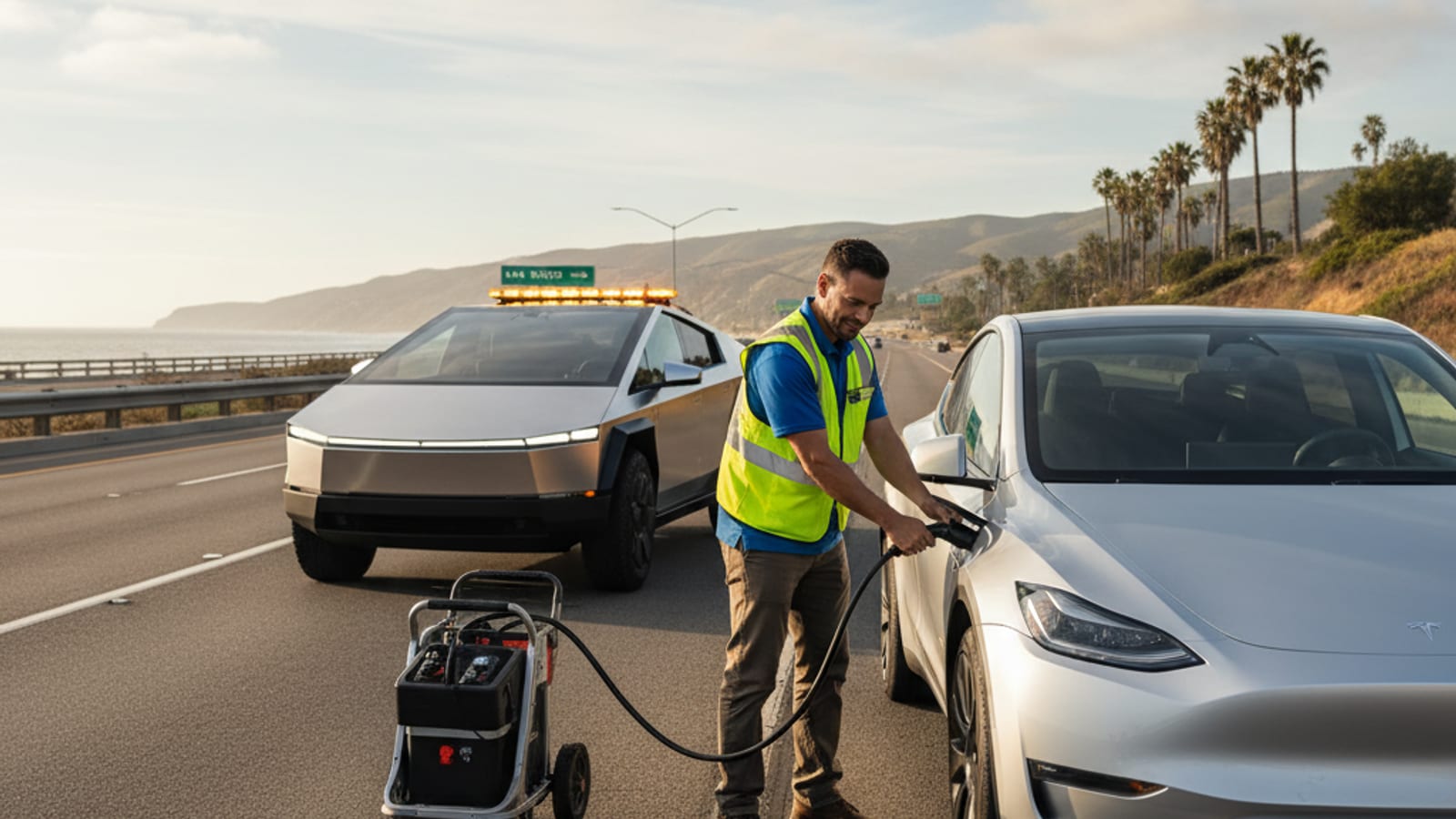
Three calls that are not the same job
A Tesla that will not ready on I-25 looks like one problem. It is not. The pack may be empty. The 12-volt may be dead. A tire may be flat. Each failure points at a different truck.
Tesla roadside is Tesla’s dispatch. A contractor usually arrives, not a Tesla employee. You request it in the app. Coverage depends on warranty status and on what Tesla lists for that service.
A local mobile operator is an independent pro. Charge Pro DEN is a referral line that matches you with one. The brand owns no trucks and sets no prices. The operator quotes you first.
After hours, this Tesla roadside, CDOT, or local boost comparison is the next read.
Tesla roadside during the warranty window
Tesla’s Basic Vehicle Limited Warranty typically includes roadside help for four years or 50,000 miles. Coverage ends at whichever comes first. Check the Tesla app and Tesla’s support site for your car. Model year and purchase date change the dates.
Inside that window Tesla commonly dispatches for a flat, a lockout, and 12-volt help. It also tows when a warranty-covered defect leaves the car undriveable. Out-of-charge help is usually a tow to a Supercharger or a Tesla Service Center. Tesla often treats that as discretionary. Confirm it on the coverage screen before you wait.
Tesla generally does not send a mobile charger. An empty pack is a tow, not a charge in the lane. What Tesla roadside will and will not cover is the split in plain terms.
Extended Service Agreements and Certified Pre-Owned contracts can stretch the window. Read the contract you actually signed. Do not assume the original four-year term still applies.
Tesla roadside after the warranty ends
Tesla can still send a contractor. You pay. Tesla’s public pages did not publish a verified 2026 per-call menu for this article. Forum screenshots are not a rate sheet. Open the app, request the service, and read Tesla’s quote before you accept. Tesla sets the number at dispatch. This page will not invent one.
CDOT Safety Patrol, the free state option
CDOT’s Division of Maintenance and Operations runs Safety Patrol. On covered metro segments the truck helps with flats, jump-starts, and emergency fuel. It also handles minor mechanical work, debris, and incident support.
Metro coverage includes I-25 South from 120th Avenue to Arapahoe Road. It includes I-70 East from Wadsworth to Airport Boulevard. Portions of US-6, C-470, and I-225 are covered too. The I-70 Mountain Corridor is covered from Morrison to Vail.
Hours are not all day. Front Range metro patrols run 6:00 to 9:30 a.m. and 2:30 to 7:00 p.m. on weekdays. Weekends run 10:00 a.m. to 7:00 p.m. The Mountain Corridor runs 6:00 a.m. to 7:00 p.m. Friday through Sunday, and during significant weather.
CDOT’s Safety Patrol page and its “my car broke down” page mention nothing about electric vehicles or a charging service. The free truck can jump a 12-volt. It can change a tire. It cannot charge a Tesla.
COtrip.org and the 511 line are CDOT’s live source for I-70 closures and for traction-law status.
A local operator when the car needs energy
When the pack is empty, Tesla’s typical move is a flatbed toward a Supercharger. A local operator’s move is a 240-volt Level 2 charge where the car sits. Native NACS for Tesla. CCS or J1772 adapters for other brands. Typical charging adds 10 to 20 miles of range in 15 to 30 minutes of charging time. That figure is charging time. It is not an arrival time.
Charge Pro DEN does not perform the work. The independent operator quotes you before starting and bills you directly. Mobile EV charging is that path.
Empty pack, dead 12-volt, or a flat
From the driver’s seat these stalls look the same. The car is dark. The phone app will not connect. Doors may not unlatch the way you expect.
An empty traction pack needs energy. Tesla roadside typically tows toward a Supercharger. Named metro Superchargers include sites in Denver, Park Meadows in Lone Tree, Centennial, Highlands Ranch, Lakewood, Thornton, Northglenn, Westminster, Arvada, Brighton, Longmont, and Castle Rock. A tow to one of those sites is a Tesla-roadside outcome. A charge in the lane is not.
A dead 12-volt is often a jump. Teslas still use a 12-volt battery to close the high-voltage contactors, run locks, and wake the screens. Cold parking kills that small battery even when the pack still holds range. Denver’s January normal low sits near 18 degrees. The January 2024 arctic blast dropped the city from 47 to minus 19 in about 48 hours.
CDOT can jump a 12-volt on a covered shoulder during patrol hours. Tesla can send 12-volt help. A local operator can jump or replace it on site. Tesla 12-volt battery jump is the local call when you already know the 12-volt is the problem.
A flat is a third job. Tesla or CDOT can handle a tire. A mobile charger will not.
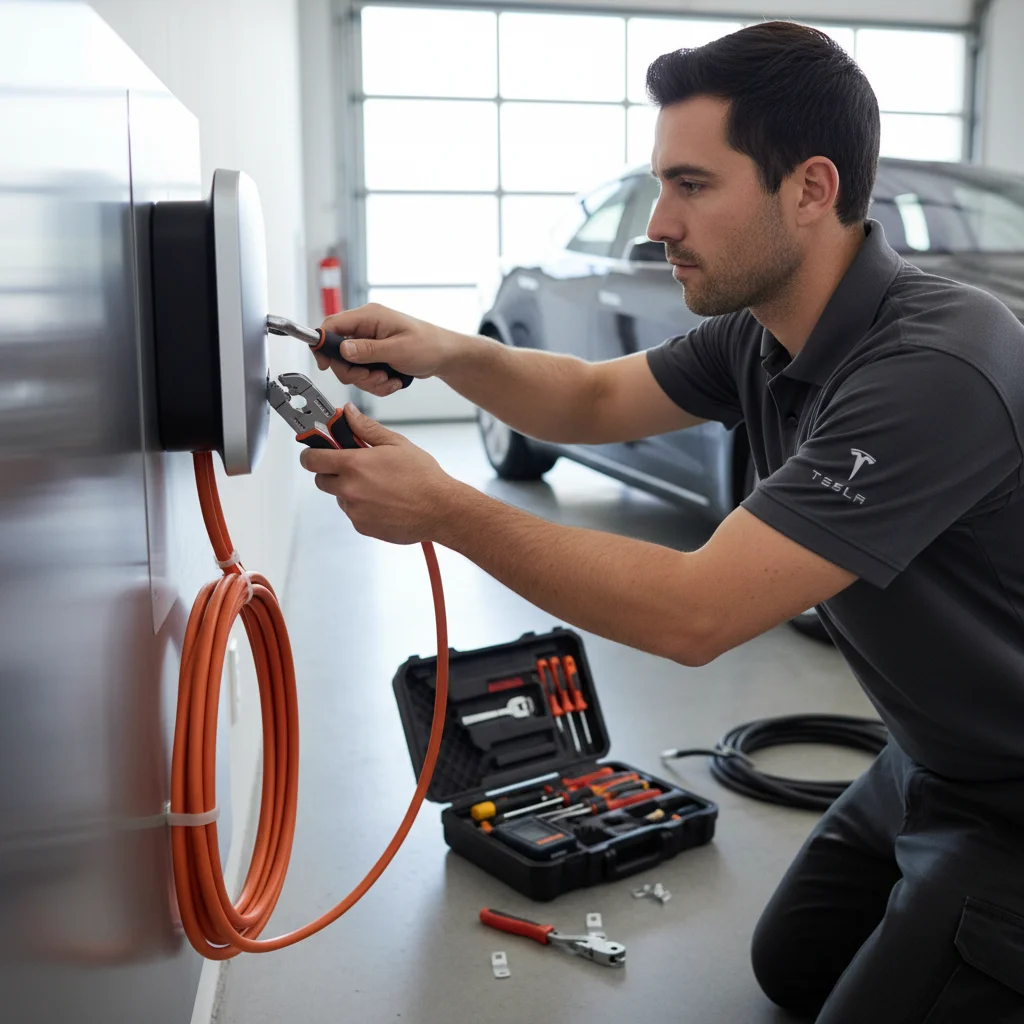
Where you stall changes who can help
Colorado treats a disabled EV like any other disabled car. No statute carves out roadside charging. CRS 42-4-1202 bars stopping on the paved main-traveled part of a highway outside a business or residential district. The exception is a vehicle so disabled it cannot be moved off the roadway. Put the hazards on, as CRS 42-4-230 requires. A violation is a class B traffic infraction.
Abandoned-vehicle rules under CRS 42-4-1803 to 1805 do not run on a fixed clock. An officer uses discretion. There is no 24-hour number in the statute. Do not wait on one.
I-25 through the core and the south metro
I-25 is the stall most drivers picture. Safety Patrol covers I-25 South from 120th Avenue to Arapahoe Road during the hours above. North of 120th, or outside those hours, the free truck is not the plan. Tesla, a local operator, or State Patrol for traffic control are the remaining options.
An empty pack on that spine has a set shoulder sequence. See stranded with no charge on I-25. Tesla may tow toward a Supercharger in Denver, Northglenn, Thornton, Centennial, or Castle Rock. A mobile Level 2 charge aims to add enough miles to roll to one under your own power.
I-70 east, Peña Boulevard, and DEN
I-70 East from Wadsworth to Airport Boulevard is inside Safety Patrol coverage. Peña Boulevard is not. Peña is an 11-plus-mile city-maintained freeway, the only road into Denver International. It sits on open plains. It closed in the March 2019 bomb cyclone, along with I-70, I-25, and the airport runways.
A Tesla left for a week in a DEN lot often comes back with a dead 12-volt. That is not an empty pack. It is a jump or an on-site 12-volt replacement. Tesla roadside or a local operator can take that job. Do not treat it as an out-of-charge tow unless the app shows the pack at zero.
E-470, C-470, and the south loop
E-470 has its own free roadside at *470. Pull to the shoulder for flats, jump-starts, fluids, a phone, and debris. Dial *CSP (*277) for Colorado State Patrol. C-470 has Safety Patrol on portions. Park Meadows, Centennial, Highlands Ranch, and Castle Rock Superchargers are the usual Tesla-tow destinations on that side. A charge in place is for the driver who does not want a flatbed first.
I-70 west toward Golden and the tunnel
West of Wheat Ridge and Golden the road starts to climb. Idaho Springs is the last Supercharger before the tunnel from the Denver side. Tesla’s typical answer on that corridor is still a tow. CDOT’s Mountain Corridor patrol runs Morrison to Vail Friday through Sunday and during significant weather. Neither call puts Level 2 power into the pack on the shoulder.
Traction law can be active on that climb. CDOT posts it on COtrip and on highway signs. Passenger Vehicle Traction Law means AWD/4WD or M+S/winter tires with at least 3/16-inch tread. Two-wheel-drive needs chains or an approved device. Chain Law is stricter. Confirm current penalties on CDOT’s traction-law page. Tesla roadside can handle a flat. It will not rewrite traction law.
Which number to try first
Hazards on. Get off the traveled lanes if you can. That is CRS 42-4-1202.
If you are on a covered CDOT segment during patrol hours, try the free state truck first. Use it for a tire, a 12-volt jump, or debris. It will not charge the pack.
If the pack is at zero and you want Tesla to tow you to a Supercharger, use the Tesla app. Read the coverage screen. If you are out of warranty, read the price Tesla shows before you tap accept.
Cold makes the same stall more likely. Recurrent Auto’s winter study of more than 30,000 U.S. EVs found cars keep about 70% of max range at 20 degrees, on average.
If you want the car charged where it sits, that is a local operator. It is not Tesla. It is not CDOT. Call (720) 738-6950 and Charge Pro DEN will connect you with an independent operator who quotes first.
For a side-by-side of Tesla, AAA, and a local rescue, see Tesla, AAA, and a local mobile rescue.
Frequently asked questions
How much is Tesla roadside assistance under warranty?
It is included during the Basic Vehicle Limited Warranty, typically four years or 50,000 miles. Confirm your dates in the Tesla app. After that window Tesla bills the dispatch. A public 2026 per-call rate was not verified for this article.
Does CDOT Safety Patrol charge an empty Tesla?
No. The program is free on covered freeway segments during published hours. It will jump a 12-volt and change a tire. CDOT’s own pages do not describe EV charging or a mobile charge.
Will Tesla roadside charge my car on the shoulder?
Usually no. Tesla typically arranges a tow to a Supercharger or a service center. A local operator brings Level 2 power to the car in place.