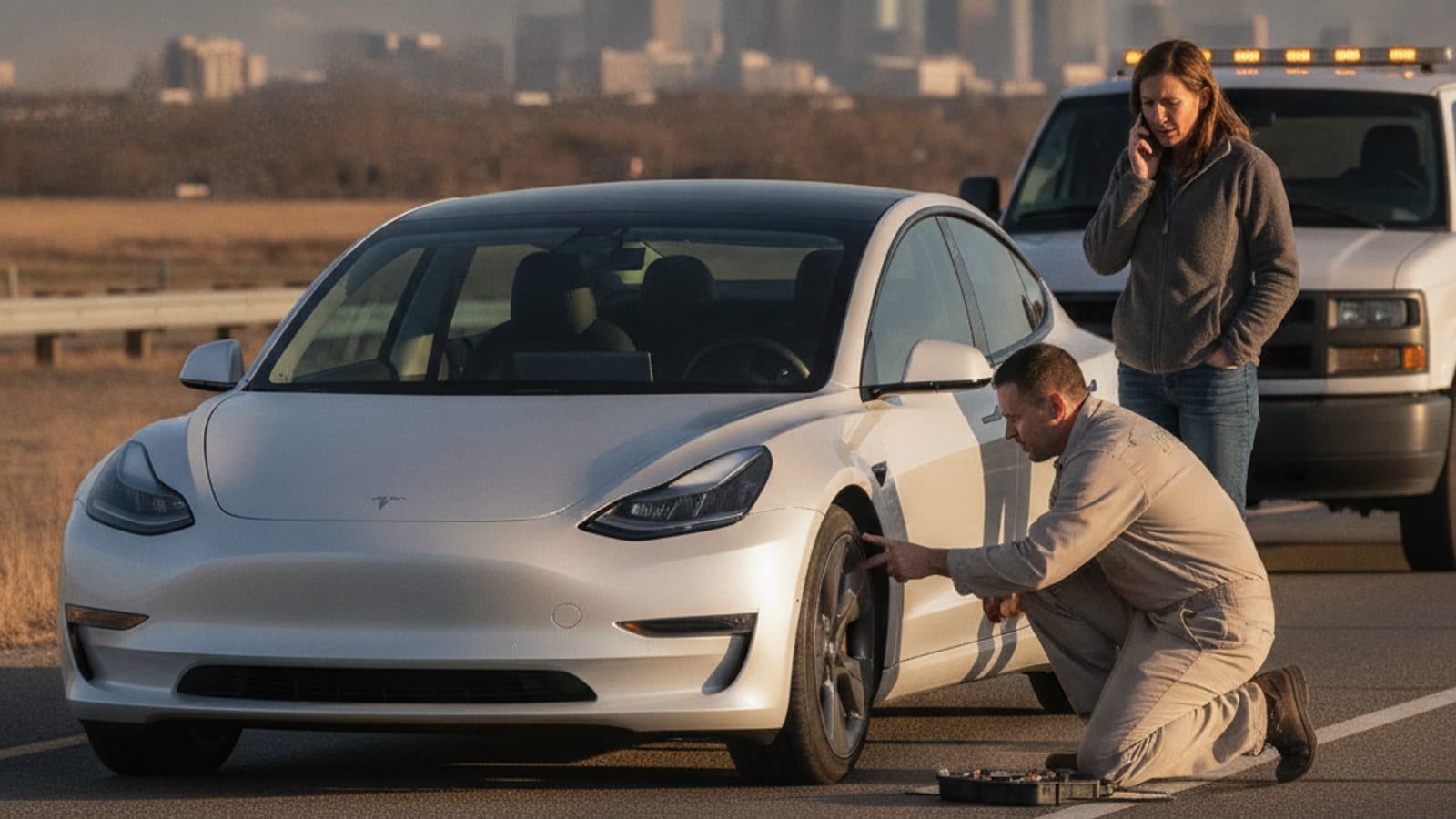
Tesla roadside tire repair isn’t a charge. Tesla’s roadside program covers flat-tire service on most Tesla models, but it won’t refill your traction pack at the shoulder. And the free state patrol that helps stranded drivers on listed metro freeways won’t be there on a side street, an off-ramp, or a stretch of US-285. A flat tire and an empty pack are two different jobs, and the path for each one is different. If you’re on a Denver metro shoulder with a Tesla, read this before you call anyone. If you want a referral for a charge, call (720) 738-6950 and we’ll match you with an independent local operator.
Tesla roadside handles the tire, not the pack
Tesla roadside assistance is requested through the Tesla app. The published menu for most current Teslas includes flat-tire service, a jump-start for the 12-volt, lockout help, and tow coordination for a vehicle that can’t drive. A flat tire on a Tesla typically ends with the spare being installed on the shoulder, a tow to a tire shop, or both. The dispatch goes through Tesla, and a contracted roadside operator usually rolls. Out-of-range assistance may be available in some cases, but Tesla’s own terms don’t treat it as a financial guarantee.
Tire repair is mechanical work. Charging the traction pack is electrical work. Tesla’s roadside network is built around the first kind. A flat on the side of US-36 or on a stretch of I-70 won’t bring a Level 2 charger to your bumper through the Tesla app. Tesla will arrange a tow to a Supercharger if the car can’t move under its own power. That isn’t the same as adding range where you sit. If your traction pack is the problem, the Tesla app is one option and a local mobile operator is another.
If you want to know what Tesla includes now, Tesla roadside: what is included and what is not goes step by step through the menu. For the mobile-charge path on a flat-out pack, mobile EV charging near me in the Denver metro: how a referral works explains the referral side.
CDOT Safety Patrol only helps on listed roads
The state’s free roadside program is CDOT Safety Patrol. It runs on covered metro segments: parts of I-25 South from 120th Ave to Arapahoe Rd, I-70 East from Wadsworth to Airport Blvd, and portions of US-6, C-470, and I-225. The I-70 Mountain Corridor is covered from Morrison to Vail. CDOT’s own page and its “my car broke down” page don’t mention electric vehicles, and they don’t list tire repair as a separate line item. The published menu is flat tires, jump-starts, fuel, debris, minor mechanical help, and incident support.
If your Tesla is flat on a covered segment during a posted window, the patrol can change the tire or get you to a shoulder. If you’re on a side street, on a stretch of Wadsworth that isn’t on the list, on C-470 outside the covered sections, or in a parking lot, the patrol won’t be dispatched. The free program is geographically narrow on purpose.
Front Range metro hours for CDOT Safety Patrol run 6:00 to 9:30 a.m. and 2:30 to 7:00 p.m. weekdays, with a weekend window of 10:00 a.m. to 7:00 p.m. The Mountain Corridor hours run 6:00 a.m. to 7:00 p.m. Friday through Sunday and during significant weather along that corridor. Outside those windows, the patrol is off shift and a different phone number matters. Confirm the active window with COtrip.org or 511 if you’re going to wait for it.
A flat on a side street at 11 p.m. doesn’t get a CDOT truck. A flat on I-70 westbound at 6 a.m. on a Saturday might. Read the geography before you bet your evening on the free truck.
E-470 has its own roadside line
Stall on E-470 and you have a separate call to make. E-470 is a cashless toll loop. Pull to the shoulder, stay out of travel lanes, and dial *470 for E-470’s own roadside assistance. The published list is flat tires, fluid top-offs, jump-starts, phone help, and debris removal. The program is free for stranded drivers on E-470 mainline and ramps. It doesn’t include EV charging.
Dial *CSP, which is *277, for Colorado State Patrol. State Patrol handles crashes, enforcement, and dispatch. It can call for a tow. It doesn’t bring a Level 2 brick to a dead EV either.
E-470 and the CDOT Safety Patrol are two different programs with two different geographies. Confusing them is how drivers wait two hours on a side street for a truck that was never going to come.
What “tire repair” actually means on the shoulder
A road service that says “tire repair” usually means one of three things on the shoulder: a swap to the spare, a plug-and-patch done in place, or a tow to a tire shop. The first two depend on whether your Tesla has a spare, where the damage sits on the tire, and whether the rim is bent. Teslas don’t all carry a spare. Many Model 3 and Model Y cars run without one, with a tire inflator kit in the trunk instead. An inflator kit can reseat a bead and refill a slow leak. It cannot fix a sidewall blowout or a tire that’s been driven flat for any distance.
Plug-and-patch from a mobile tire service is rare on a highway shoulder. It’s slow, and it’s hard to do safely next to fast traffic. Most roadside tire work on the metro side is a swap to a spare or a tow. If your Tesla has no spare and the tire won’t hold air, the path is tow.
A mobile operator from CDOT, E-470, or Tesla roadside can install your spare if you have one. If you don’t have one, they will tow you. None of those programs will repair a tire on the shoulder that needs more than a swap. If you need a real plug or a new tire, plan on a shop visit.
A flat and an empty pack look different
A flat tire usually announces itself. You hear a flapping sound, see a warning on the dash, or feel the car pull. The traction pack may still hold plenty of energy. The car may not move because the tire is shredded, not because the pack is dead.
An empty pack is different. The dash showed low range before the car stopped. The car rolled to a stop or slowed into a limp mode. No tire is flat. The car just won’t move under its own power.
CDOT Safety Patrol will help with a flat on a covered segment. It will not bring a charge to your bumper. Tesla roadside will arrange a tow if your Tesla can’t move, including to a Supercharger. Tesla roadside is not the same as a mobile Level 2 visit to your shoulder.
Operators we refer handle the charge side. They bring a 240-volt Level 2 source to the car. They quote you before any cable goes in. They bill you directly. We don’t own trucks, and we don’t set the price. For the tire side, your path runs through Tesla, your own spare, or a tow to a shop.
What Tesla app coverage looks like for tires
Tesla’s app coverage for flat tires depends on the model and year. The app confirms it for your VIN. The published menu covers flat-tire service for most models. Out-of-range assistance may exist, but the cost to the driver varies. The dispatch often goes through a contracted local operator, not a Tesla employee in a Tesla truck. Wait time and what gets done depend on who answers.
If the spare installs cleanly, the tire service is done in a few minutes. If the rim is bent or the tire won’t hold air, the dispatch turns into a tow. The driver pays the contracted operator directly for the tire work, and Tesla’s own policy decides whether anything is reimbursed.
What Tesla app coverage is NOT is a guarantee of a charge truck on a metro shoulder. Tesla’s program is built around tires, locks, jumps, and tows. A traction-pack refill isn’t a routine Tesla roadside visit. Treat it as a different job.
When a flat still needs a tow
A Tesla with a shredded sidewall won’t roll safely on a flat. Even a slow leak can damage a rim if you drive on it. A roadside operator can swap a spare. They cannot fix a sidewall blowout on the shoulder. They cannot straighten a bent rim in a parking lot. They cannot replace a tire that won’t hold air. In those cases, the work moves to a tire shop, and the car goes there on a flatbed.
CRS 42-4-1202 covers a disabled vehicle on a highway. Outside a business or residential district you may not stop on the paved main-traveled part of a highway, except a vehicle so disabled it is impossible to move it off. Hazard lights must be on under CRS 42-4-230. A flat counts as a disabled vehicle. The law lets you wait on the shoulder for help.
CRS 42-4-1803 sets no fixed hour count for abandonment. No Colorado statute treats a disabled EV as a special class. The Colorado Public Utilities Commission regulates towing carriers. Confirm with the operator what the tow fee is before the hook goes on. Exact tow fee figures weren’t verified for this page.
If you’re in a safe place off the highway, you can wait for a mobile tire service or a friend. If you’re on a highway shoulder, get the car off the travel lane first and call from there.
Charge Pro DEN’s role on a Tesla tire call
Charge Pro DEN is a referral line for stranded EV drivers. We don’t patch tires, mount spares, or send a tow truck. We match you with an independent local operator when the car needs a charge or a 12-volt jump. The operators we refer quote you before they start. They bill you directly. We don’t set prices, and we don’t promise an arrival time.
If your Tesla has a flat tire and a full pack, your path runs through Tesla, your own spare, a tow, or a mobile tire service. We can point you at the right Tesla flow but we don’t dispatch a tire truck. If your Tesla has an empty pack and an inflated tire, we can match you with a local operator who brings a Level 2 source. If both things are wrong at once, fix the tire first. The car needs to be safe and stationary before any cable goes in.
For a longer coverage comparison, Tesla, Rivian, and Lucid roadside compared walks through what each OEM program covers. For the empty-pack path specifically, Tesla hit zero on the road: charge, jump, or tow covers that script.
How to choose from a metro shoulder
Turn your hazards on. Get the car off the travel lane if you can. Stay visible to traffic and stay in the car if that’s the safer choice. Check your tire before you call anyone. If the tire is shredded or won’t hold air, that’s a tow. If the spare is intact and the swap is safe, that may be a Tesla or a CDOT job.
If the tire is fine and the pack is empty, the path is a charge. Operators we refer handle that. We serve the Denver metro from the plains to the foothills. The operator quotes you before they start work. Call (720) 738-6950 when you want that match. Treat it as a referral number, not a rolling promise.
If you’re on E-470, dial *470 for the same jump-and-tire list. If you’re on a covered CDOT segment during a posted window, the patrol can change a tire. Outside those cases, your call is Tesla roadside for the OEM path or your own tow for the tire shop.
Frequently asked questions
Does Tesla roadside fix tires on the shoulder?
Tesla roadside covers flat-tire service for most current Teslas. The work is typically a swap to a spare or a tow to a tire shop. Tesla roadside is not a Level 2 charge at your bumper.
Does CDOT Safety Patrol change Tesla tires?
CDOT Safety Patrol covers flat tires as part of its published menu on covered metro freeway segments. The patrol doesn’t publish an EV charging service, and its coverage is limited to the listed segments and posted hours.
What if my Tesla has no spare?
Many Model 3 and Model Y cars run without a spare. They carry a tire inflator kit. An inflator kit can handle a slow leak. It cannot fix a sidewall blowout. The road service in that case is a tow to a tire shop, not an in-place repair.
Can I wait on the shoulder for a Tesla truck?
CRS 42-4-1202 covers a disabled vehicle on a highway. With hazards on, you may wait on the shoulder for help. Confirm the dispatch through the Tesla app before you wait. Independent mobile charge operators don’t fix tires. Tesla’s program is the right channel for tire work.
What if my pack is also empty?
Fix the tire first. The car has to be safe and stationary before any cable goes in. Once the tire is sorted and the car is parked safely, call (720) 738-6950 and we’ll match you with an independent local operator who can bring a Level 2 source. They’ll quote you before any work starts.