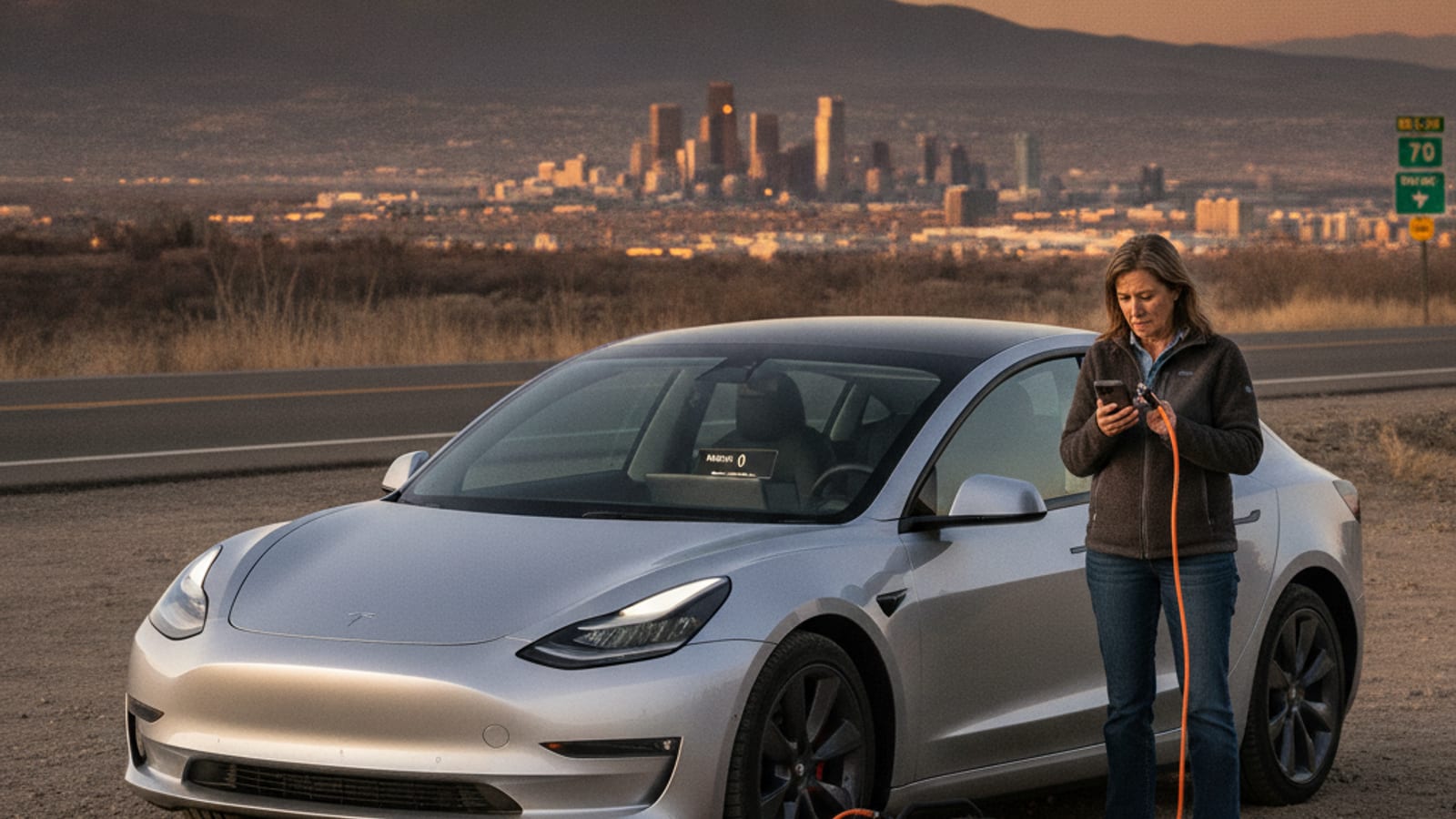
A Tesla at zero on the road comes down to three choices: a charge, a 12-volt jump, or a flatbed. The right one depends on where you are, what the dashboard showed before the car stopped, and whether you can stay safe on the shoulder. Call (720) 738-6950 to reach Charge Pro DEN. We are a referral line. An independent operator brings the truck. The operator quotes you before any cable goes in. You pay them for the work they do.
Get off the travel lane first
The first call is safety, not charging. If the car stopped in a travel lane, stay belted and call 911. State Patrol handles dispatch and crash response on Colorado highways. Do not try to push a dead Tesla across live traffic. If the car stopped on the shoulder, put the hazards on under CRS 42-4-230, and stay as far off the paved main-traveled part of the highway as you can. CRS 42-4-1202 says it is lawful to be stopped on the shoulder when the vehicle is so disabled it could not be moved further. That statute covers a Tesla at zero the same as any other car.
Stay in the car if that is the safer choice. Step out on the passenger side. Set out flares or triangles if you have them and can do it safely. Keep your phone charged. Watch for the posted speed and the closing distance of semis. A driver who can climb up an embankment, get behind a guardrail, and stay visible is in better shape than one who walks along the shoulder.
COtrip.org and the 511 line post closures and chain-law status. If you are stuck in a chain-law or traction-law zone, the road will be slow and full of trucks. Stay tight to the shoulder and stay visible.
What the dash was showing matters
If the dash dropped the range estimate to zero before the car stopped, the traction pack is empty. That is a mobile EV charging call, not a jump. An empty pack takes a 240-volt Level 2 source to refill. Operators we refer bring a Level 2 brick and the right plug. Tesla drivers get a native NACS lead on the truck. Typical charging time adds about 10 to 20 miles of range in 15 to 30 minutes. That is enough to limp to a Supercharger or back home.
If the dash showed plenty of range and the car would not wake, that is the 12-volt. The 12-volt is a small lithium-ion battery that runs the computers, the contactors, and the door locks. When it dies, the whole car looks finished. CDOT Safety Patrol will jump a 12-volt on listed Front Range freeway segments. They will not charge the traction pack at all. The operators we refer can jump a 12-volt on site, or replace one when that is the job. Tesla 12-volt jump on the shoulder walks the steps.
If the car will not roll and the suspension looks bent, the answer is a tow. A Tesla in neutral with no power is a flatbed job, not a charge. Tesla still needs a flatbed. Operators we refer can flatbed a Tesla to a shop or a Supercharger when that is the job.
What a mobile charge can actually do
A mobile Level 2 charge is not a fill-up. It is a range top-up that lets you drive under your own power to the next stall. About 10 to 20 miles of range in 15 to 30 minutes of charging is the typical result. That is enough on the Denver metro to reach a Supercharger in Centennial, Lakewood, Thornton, Westminster, Broomfield, or Boulder. From Idaho Springs it is the difference between climbing toward the Eisenhower Tunnel or watching the gauge die on the grade.
The truck rolls a 240-volt Level 2 source. Tesla drivers get a native NACS plug. Other EVs use a CCS or J1772 adapter. The operator hooks up, the cable locks, and the pack takes energy. The clock starts when charging starts, not before. It is not an arrival time and we do not promise one. For the empty-pack case, use out-of-charge recovery. For the broader choice, read charge in place or tow.
Cold cuts the result. Recurrent Auto studied more than 30,000 U.S. EVs and found about 78 percent of max range retained at 32 degrees and about 70 percent at 20 degrees. AAA’s 2026 dynamometer study found about 39 percent range loss at 20 degrees. The number you get on a January shoulder is the cold number, not the summer number. Build that into your plan.
Where you are changes the answer
On a listed CDOT Safety Patrol segment, the clock matters. Front Range metro weekday windows are 6:00 to 9:30 a.m. and 2:30 to 7:00 p.m. Weekend hours run 10:00 a.m. to 7:00 p.m. Mountain Corridor hours run 6:00 a.m. to 7:00 p.m. on Friday through Sunday, plus during significant weather. The free patrol jumps a 12-volt on those listed segments. It will not bring a charge. Skip the call if the pack was already at zero.
On E-470, dial *470 for the loop’s own roadside assistance. E-470 publishes a list that includes flat tires, jump-starts, fluid top-offs, phone help, and debris removal. E-470 does not publish an EV charging service. The same goes for I-25 North and US-36, where the express lanes were built with a minimum 8-foot outside shoulder for breakdowns. Move right, get out of the lane, then call.
If you are in town on a city street, the rules of the road are the same but the traffic is different. Stay visible, hazards on, and pull as far from the intersection as you can. An apartment-lot stall in Capitol Hill or a Park Meadows deck in Lone Tree reads the same way to the operator: a Tesla at zero that needs a Level 2 boost.
What Tesla roadside will and will not do
Tesla has its own roadside path in the Tesla app. Confirm what it covers for your VIN and year. Tesla often sends a contractor, not a Tesla crew. The contractor’s job is often a flatbed tow to a Supercharger or a service center. Out-of-range help exists, but it is not financially covered in every case.
CDOT Safety Patrol can jump a 12-volt. Operators we refer can jump a 12-volt and replace one on site. None of those paths replaces a real Level 2 charge to the pack when the gauge was already at zero. Tesla roadside, CDOT patrol, or a local boost covers the call order. Tesla roadside sends a contractor, not Tesla covers the contractor piece.
When the answer is still a tow
A roadside charge will not straighten bent suspension. It will not fix a flat. It will not free a car stuck on ice. If the car cannot roll, the answer is a flatbed. CRS 42-4-1803 lets an officer remove a vehicle on reasonable grounds to believe it is abandoned. A car with hazards on that cannot move is not abandoned. A car that has sat for days is a different conversation.
Colorado’s Towing Bill of Rights (HB22-1314) requires 24-hour written notice before most private-property tows and limits drop fees for tows halted on residential property. The Colorado Public Utilities Commission regulates towing carriers. The brand refers; the operators we refer quote and bill you for the tow if that is the right tool.
Make the call from the shoulder
Turn the hazards on. Get off the travel lane. Stay in the car if that is the safer choice. If the dash showed plenty of range before the car stopped, you probably need a 12-volt jump. If the gauge was already at zero, you need a Level 2 charge. If the car will not roll, you need a flatbed. Pick the one that matches what happened, then call.
Charge Pro DEN is a referral line. We do not own trucks, employ technicians, or set prices. An independent local operator brings the kit. They quote you before work starts. They bill you for the work they do. Call (720) 738-6950 from any Denver-metro shoulder when you want the match. Treat it as a referral number, not a rolling promise.
Frequently asked questions
What do I do first if my Tesla runs out of battery on the road?
Get off the travel lane. Put your hazards on. If you are in a live lane, stay belted and call 911. If you are on the shoulder, stay in the car or step out on the passenger side and get behind a guardrail if you can. Then call (720) 738-6950 for a mobile Level 2 charge referral.
Will Tesla roadside bring a charge?
Tesla roadside often sends a contractor for a flatbed tow to a Supercharger or service center. Out-of-range help exists in the Tesla program, but coverage varies by VIN and year. Confirm in the Tesla app before you wait on a truck.
Will CDOT Safety Patrol charge my Tesla?
No. CDOT Safety Patrol publishes a list of services that includes flat tires, jump-starts, emergency fuel, minor mechanical help, debris removal, and incident support. CDOT’s Safety Patrol page and the my-car-broke-down page do not mention electric vehicles or a charging service. The free patrol will jump a 12-volt on listed segments during published hours.
How long does a mobile charge take?
Typical charging time adds about 10 to 20 miles of range in 15 to 30 minutes of charging once the cable is in. The clock starts when charging starts, not before. It is a range top-up so you can drive to the next stall, not a full fill.
Is a dead Tesla battery the same as a dead 12-volt?
No. The traction pack is the big high-voltage battery that moves the car. The 12-volt is a small battery that runs the computers and contactors. If the dash dropped to zero before the car stopped, the pack is empty and you need a Level 2 charge. If the dash showed plenty of range and the car would not wake, the 12-volt is the failure and a jump may finish the job.