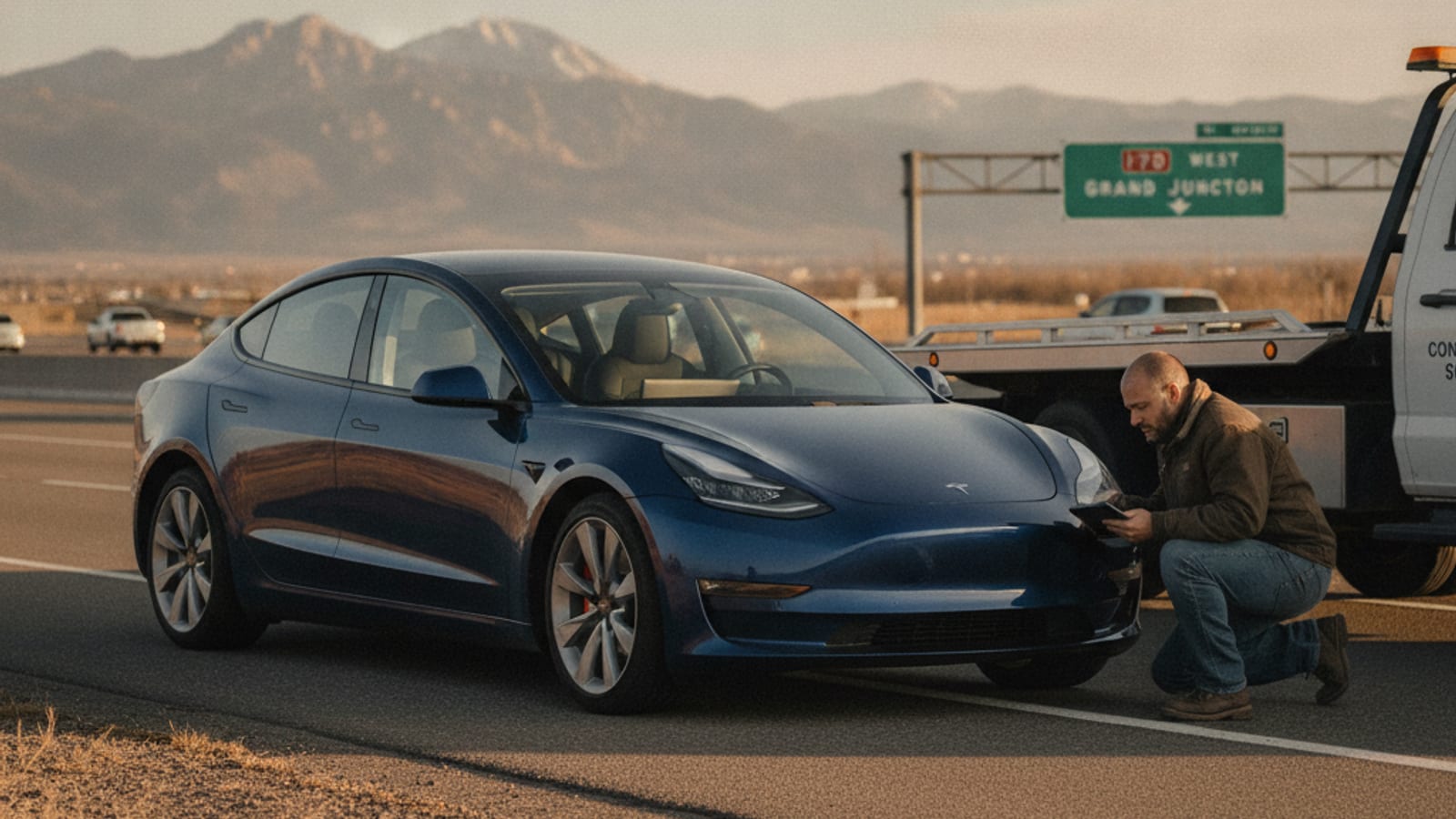
A tesla roadside contractor is not a Tesla employee. Tesla RSA dispatches a third party through its own network. The truck that shows up belongs to an outside company, and the driver pays that company for the work. If the truck is bringing a charge, it is most often a 240-volt Level 2 from a portable unit, and the operator quotes the price before the cable goes in. Charge Pro DEN is a referral line for the Denver metro. We do not own trucks. We do not employ technicians. We match you with an independent local operator who quotes first, then bills you directly for the work.
If the car is in a travel lane or another dangerous place, call 911 first. Hazards on, stay visible, and move to the outside shoulder where the ground allows it.
What Tesla’s own path covers and skips
Tesla roadside assistance is requested inside the Tesla app. The app is the right first call when you have signal, since it ties the request to your VIN and your year. Out-of-range assistance may be available through that path, but it is not financially covered. A driver who runs the pack to zero generally pays for the recovery out of pocket, through whatever contractor Tesla dispatches.
What Tesla does and does not send is the part most drivers miss. Tesla does not promise a charge truck to every call. The contractor that arrives usually carries jump-start gear and the ability to flatbed the car. Whether that contractor can also bring a portable Level 2 depends on the regional network. The Tesla app is the source for what your specific request will trigger. Read it before you wait, and read it again before you accept a tow you did not ask for.
For Tesla owners in the Denver metro, two realities shape the call:
- The Denver-metro cold eats pack range before you reach the shoulder. Recurrent’s winter study of more than 30,000 U.S. EVs found drivers retain about 78 percent of max range at 32 degrees and about 70 percent at 20 degrees on average. AAA’s 2026 dynamometer study put the loss closer to 39 percent at 20 degrees. Whichever figure you trust, cold means the trip meter lies, and the gauge runs lower than the predicted arrival.
- The state’s free roadside program does not bridge the gap. CDOT Safety Patrol is the metro’s free truck on covered Front Range segments and the I-70 Mountain Corridor. Its published menu is tires, jumps, fuel, debris, and minor mechanical help. Neither its safety patrol page nor its breakdown page mentions electric vehicles. That is silence in state guidance, not a guess. The free truck can wake a 12-volt battery. It will not add miles to the traction pack.
The combination means a Denver-metro Tesla driver with an empty pack has two paths: wait for whatever contractor Tesla dispatches, or call a local independent operator who brings Level 2 to the bumper. The local operator quotes before any cable goes in.
Tesla contractors and the 12-volt pattern
The most common Tesla call in a Denver winter is not an empty pack. It is a dead 12-volt. The traction pack may still show plenty of range, but the 12-volt runs the computers, contactors, and door locks. When it dies, the whole car looks finished. Newer Model 3 and Model Y cars carry a lithium-ion low-voltage battery, not the older lead-acid. Both fail after a long cold soak, just for slightly different reasons. The contractor that arrives will jump the 12-volt first and confirm the pack separately.
A jump is not a charge. A 12-volt jump gets the dash back and lets the contractor read what the pack actually has. If the pack is empty as well, the contractor decides between a flatbed to a charger and a portable Level 2 if the truck carries one. That choice depends on the network in this region. Tesla’s own pages do not publish which contractors in Colorado carry what gear, and we do not publish Tesla’s contractor roster either. The work the contractor can do on site is the work they have on the truck that day.
The first thing a Denver driver can do before any of that is check the simple signs. A car that drove fine yesterday and looks dead today after a freeze is most likely the 12-volt. A car that dropped to zero on the trip meter first, then would not move, is an empty pack. The two need different tools and different prices, and the operator quotes for the work they actually do.
The operator quotes before work
This is the part of a mobile rescue that the brand voice gets right when it stays disciplined. Charge Pro DEN refers. We do not set prices, promise arrival times, or publish hours. The operator who takes the call sets the price for the work they will do. They tell you what the visit costs before any cable goes in. You pay them, not us.
That structure is the same one Tesla uses when it dispatches a contractor, only Tesla is doing the dispatching through its own network. With us, the dispatch is independent. The operator decides what to bring, when to roll, and how to bill. We just make the introduction.
A few real implications for the driver:
- The operator may not roll at all if the price they would need to charge does not pencil out for the distance. That is part of why quotes happen first.
- The operator can refuse a job. We cannot force an independent company to take a call, and we would not try. The work is theirs.
- The operator chooses the connector. Tesla drivers get a native NACS plug on the lead. Other EVs use a CCS or J1772 adapter.
- A referral is not a membership. There is no club fee, no annual due, no roadside program bundled with the car. You pay for the visit you actually needed.
If a quoted visit turns out to be the wrong tool for the car, the operator can recommend a flatbed instead. We do not write a script for that. A dead-on-arrival 12-volt after a tow to a shop is still a tow, even if the operator could have jumped it. The contractor decides on site with the car in front of them.
Where Denver-metro Tesla calls actually happen
The call mix follows the metro’s geometry. A few patterns we see often, drawn from the Denver-metro research:
- I-25 through Denver, Thornton, and the north metro: the commute pattern, with traffic and heater load eating margin. The I-25 North express lanes were built with a minimum 8-foot outside shoulder for breakdowns, so move to the right and call from there. CDOT Safety Patrol covers I-25 South from 120th Ave to Arapahoe Rd on its published list.
- I-70 west into the foothills and the mountains: the flagship stranding. From Denver, the last confirmed fast charging before the Eisenhower-Johnson Memorial Tunnel at 11,158 feet is the Tesla site in Idaho Springs (8 stalls per the current inventory, at 7,526 feet). Georgetown sits in between and shows no Supercharger in the current inventory. A driver who did not top up in Idaho Springs and is climbing past Georgetown in a storm has no confirmed fast charging until over the tunnel. CDOT Safety Patrol covers the I-70 Mountain Corridor from Morrison to Vail during its posted hours.
- C-470 and the west metro: the staging region, the last flat, well-charged ground before climbs. Golden is the mouth of Clear Creek Canyon and the gateway to the mountain corridor. Many drivers top up there before committing to the canyon.
- US-285 up to the foothills: Evergreen and Aspen Park drivers commute down SH-74 or US-285 to the metro and climb home in the dark and the cold. Cold plus the climb plus a running heater eats a margin that looked fine on the plain.
- The south metro and DTC corridor: Centennial, Lone Tree, and the Park Meadows area. Long dwell at Park Meadows plus a cold night drains a marginal 12-volt, especially in the kind of older EV that already had a weak 12-volt.
- Denver International and Peña Boulevard: a week in a cold DEN parking lot can kill a 12-volt. The traction pack may still hold plenty of energy; the 12-volt may not. The airport-adjacent calls are a jump or on-site 12-volt replacement more often than they are an empty pack.
Each of those patterns is the same call in the end. The driver is on a shoulder or in a lot, hazards on, watching the gauge. What changes is who shows up and what they bring. Aurora, Bennett, and Watkins drivers face the eastern-plains version of the same call, where services thin fast past the airport.
CDOT, E-470, and the state’s published options
A Tesla driver in the metro has more than one phone to dial before reaching for our referral line. The state’s own options are worth knowing.
CDOT Safety Patrol runs on covered Front Range segments and the I-70 Mountain Corridor. Published hours for the Front Range metro are 6:00 to 9:30 a.m. weekdays, 2:30 to 7:00 p.m. weekdays, and 10:00 a.m. to 7:00 p.m. weekends. The I-70 Mountain Corridor hours run 6:00 a.m. to 7:00 p.m. Friday through Sunday and during significant weather along that corridor. The published menu is tires, jumps, fuel, debris, and minor mechanical help. It does not include a charge for the traction pack. It can jump a 12-volt. It cannot add range to the pack.
E-470 is the eastern-metro cashless toll loop. A driver who stalls on E-470 pulls to the shoulder and dials *470 for the authority’s own roadside assistance. The list is flat tires, fluid top-offs, jump-starts, phone help, and debris removal. It does not include an EV charge. *CSP, which is *277, reaches Colorado State Patrol.
CRS 42-4-1202 governs being on the shoulder. Outside a business or residential district, you may not stop or leave a vehicle on the paved main-traveled part of a highway, except a vehicle so disabled it is impossible to avoid stopping and to move it off. The hazard lights must be on. A violation is a class B traffic infraction. The statute does not treat an EV as a special class. The Colorado Towing Bill of Rights (HB22-1314, effective Aug 10, 2022) regulates nonconsensual tows and gives drivers the right to written notice 24 hours before most private-property tows, among other protections. We do not publish specific fee figures because the page could not verify them on the primary source.
A driver who reaches this part of the post without a referral line can call (720) 738-6950. The operator who takes the call quotes before the work.
What the operator brings and what they do
A mobile EV charge is a 240-volt Level 2 source rolled to the bumper. For a Tesla, that is a native NACS plug. For other EVs, it is a CCS or J1772 adapter. Typical charging time adds about 10 to 20 miles of range once the cable is in. The clock starts when charging starts, not before. Those miles let a driver leave under their own power and reach a public stall on their own schedule, instead of waiting for a flatbed to a charger.
A 12-volt jump is a separate job. The contractor connects to the 12-volt terminals, confirms the dash wakes, and reads what the pack actually has. On a Tesla, the hood opens with the right sequence and exposes the low-voltage battery. Lithium-ion on newer Model 3 and Model Y cars sits in the same general area after the hood is open. Hood terminals unlatch only. The contractor does not pry open sealed enclosures, and neither should a driver.
For out-of-charge recovery and the broader mobile EV charging option, the operator rolls with whatever your car needs. For Tesla roadside rescue the same applies, plus the option of a 12-volt jump when that is the real problem. Operators we refer handle Tesla and every major EV brand. A stuck charge port is a latch problem, not a tow problem. Ask the operator about the port before anyone hooks a winch.
If the car cannot roll, no amount of charge will fix that. A tow is still the right tool for bent suspension, body damage, or a car stuck in a position that prevents safe on-site work. We do not promise a charge where a charge is not the answer.
How to choose from a Denver metro shoulder
Turn the hazards on and stay visible to traffic. Stay in the car if that is the safer choice. If the car is on a covered CDOT Safety Patrol segment during published hours, that free truck can jump a 12-volt. Skip the wait when the pack was already at zero before the freeze, because the free truck will not bring a charge.
If you hold a Tesla roadside policy in the app, open the app and confirm what it covers for your VIN and your year. Ask whether the dispatched contractor carries Level 2 gear. Ask whether they will flatbed you. Write the answers down before you hang up. The app does not publish which contractors in Colorado carry what gear, so the answers come from the dispatch call itself.
If the car is otherwise fine and the pack is empty, call for range. A mobile EV charging referral adds that range in place. We serve the Denver metro from the plains to the foothills. The operator quotes you before they start work. Call (720) 738-6950 when you want that match. Treat it as a referral number, not a rolling promise.
If the car is broken in a way that charge will not fix, a flatbed is the right tool. Confirm the tow first, and read the rights under HB22-1314 before signing anything at a lot. We do not publish fee figures because the page could not verify them on the primary source, and a wrong dollar number is worse than no number.
Frequently asked questions
Does Tesla roadside send a Tesla employee?
No. Tesla RSA dispatches a third-party contractor through its own network. The truck that arrives belongs to an outside company, and the driver pays that company for the work done.
Will Tesla’s contractor bring a charge?
It depends on the regional network and on the truck dispatched for your call. Some contractors carry portable Level 2, others do not. The Tesla app and the dispatch call are the source for what your specific request will trigger. A portable Level 2 from us is a separate option, quoted by the operator before any cable goes in.
Is Tesla’s out-of-range assistance free?
Out-of-range assistance may be available through Tesla’s path, but it is generally not financially covered. The driver pays for the recovery through the dispatched contractor. Confirm the policy in the Tesla app for your VIN and your year before you wait.
What if my 12-volt is dead but the pack has range?
That is a jump, not a charge. CDOT Safety Patrol will jump a 12-volt on its covered segments during posted hours. An independent operator can jump a 12-volt on site as well, and can replace a 12-volt on site when that is the job. The operator quotes before any work.
Can I call (720) 738-6950 and skip Tesla’s app?
Yes. (720) 738-6950 is a referral line for the Denver metro. We match you with an independent operator who quotes before they start work. The Tesla app remains the right first call when you want to use your OEM coverage.