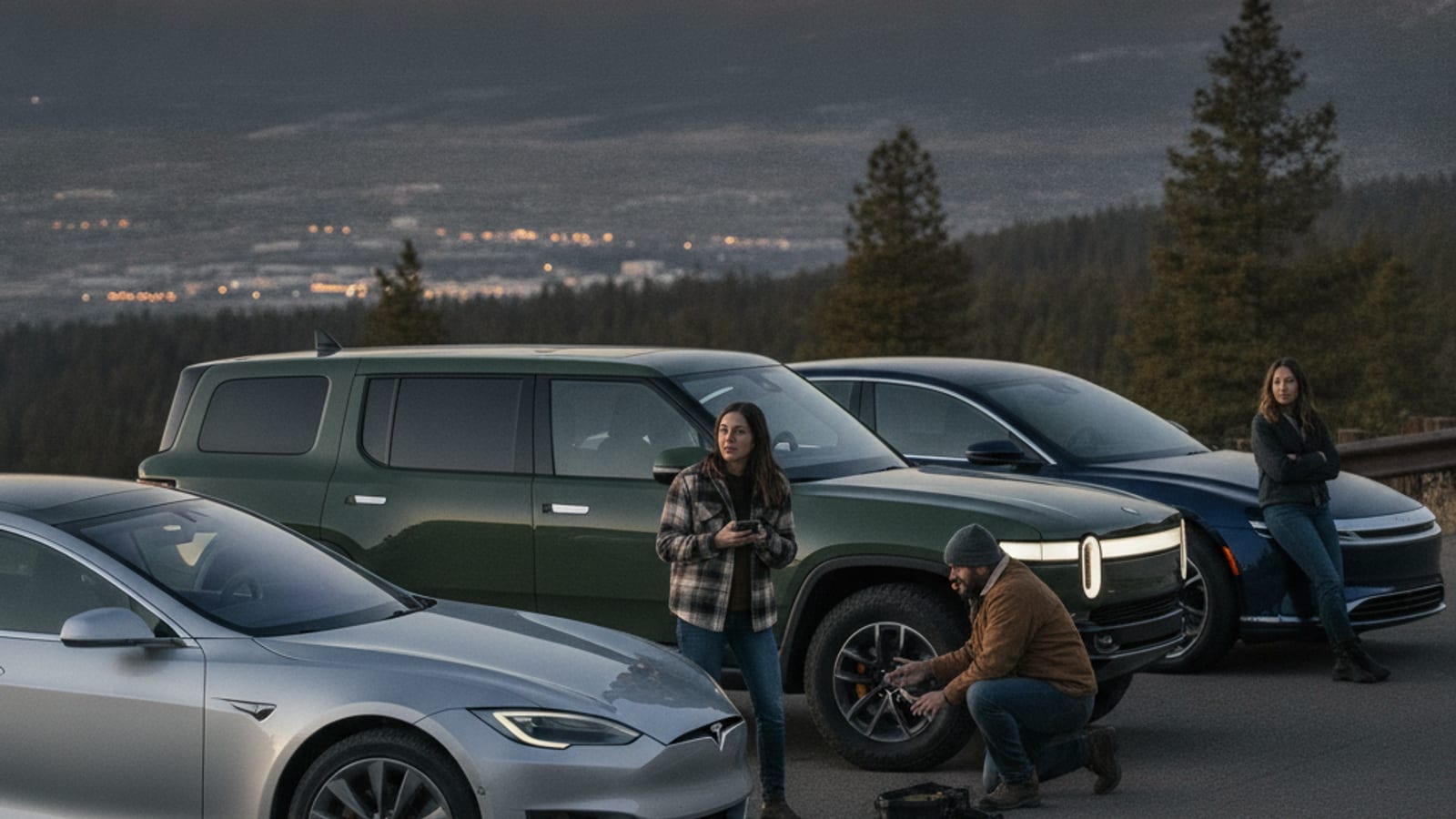
Tesla, Rivian, and Lucid each run their own roadside program. None of them bring a 240-volt charge to a stranded car in the Denver metro. Each program handles its own brand differently, and the gaps show up in the same places: a cold morning in a Cherry Creek garage, an empty pack on US-36, a dead battery in a Red Rocks lot. When the OEM program cannot help, an independent operator with a Level 2 source can. Call (720) 738-6950 for a referral when you want a match. Treat that number as a referral line, not a rolling promise.
Tesla roadside is requested in the app
Tesla roadside lives inside the Tesla app. You open the app on the car or on your phone, request Roadside Assistance, and follow the prompts. The program is included with most Tesla vehicles for a defined period after delivery. After that window the policy terms change, and you pay per use.
What Tesla covers reads as a list: lockouts, a flat tire change, a 12-volt jump, a tow to a Tesla service center or a nearby charger, and limited out-of-range assistance for a confirmed pack fault. The 12-volt jump overlaps with what CDOT Safety Patrol does on listed metro freeway segments. The tow part sends a third party contractor, and the contractor quotes separately when one is needed.
What Tesla does not always cover is a Level 2 charge on the shoulder. A Tesla that ran the traction pack to zero on a metro shoulder may be moved to a Supercharger as a tow, not charged in place. Out-of-range assistance may apply but is not financially covered for every scenario. Confirm in the app what your VIN and year actually include before you wait on a truck. For a longer Tesla-only path, read Tesla roadside, CDOT patrol, or a local boost.
The hood picture for current Model Y reads differently from older cars. Tesla uses a lithium-ion low-voltage battery on Model Y, and the procedure to reach the 12-volt terminals is the hood open with terminals unlatch only. A Model 3, Model S, or Model X in Denver cold still dies on a marginal 12-volt, and the app path is the same first call. Read Tesla low voltage warning, and what to do next for the dash signal.
Rivian roadside lives in the app and on the center display
Rivian roadside is included for the duration of the New Vehicle Limited Warranty on the R1T and R1S. You reach the program through the Rivian app or the center display. Rivian publishes access around the clock through the app on a logged-in vehicle. The program names Highway Assist Lane and Driver Assistance features separately from roadside.
What Rivian covers matches the usual roadside list: a tow, a 12-volt jump, a flat tire change, lockout help, and trip interruption support in defined cases. Rivian also includes flatbed transport for the R1T and R1S, and Highway Assist Lane availability is a separate feature on eligible trim.
The gap shows up in the same place as Tesla. Rivian’s program can dispatch a tow. It does not bring a 240-volt Level 2 source to a stranded R1T or R1S on a Front Range shoulder. A cold-soaked R1S in a Denver parking structure is more often a 12-volt problem than an empty pack. For that split, read Rivian R1T or R1S won’t start in the cold. For the broader program-versus-rescue framing, read Rivian Highway Assist versus roadside help on Colorado highways.
If the Rivian app does not connect (no signal in a canyon, frozen display, dead 12-volt), the program lists a backup number. The backup is the Rivian Adventure Center line. Use the app first when you have signal, then the backup line when you do not. For the broader program-versus-rescue framing, read Rivian Highway Assist versus roadside help on Colorado highways.
Lucid roadside is its own line
Lucid lists roadside at +1 (888) 995-8243 as published in the Lucid limited-warranty knowledge page. The Lucid Roadside Assistance Program is named as a separate program from the New Vehicle Limited Warranty. Lucid directs owners to the Owner’s Manual for the scope of what is covered.
The Lucid program uses a third-party roadside provider. Coverage is described as available for inoperable vehicles, including a tow, a 12-volt jump, fuel or charge assistance where appropriate, and trip interruption support. The Owner’s Manual is the source for scope, and Lucid adds a reminder that the program is separate from the warranty.
Lucid’s program does not bring a 240-volt Level 2 charge to a Lucid Air on a Colorado shoulder. A Lucid that ran the pack to zero on I-70 east of Idaho Springs faces the same gap as a Tesla or a Rivian: a tow to a stall, not a charge in place. The published regen number for a Lucid Air GT descent from Loveland Pass is real (a 77-mile descent on roughly 3% of pack), and that helps a Lucid driver coming down from the Eisenhower-Johnson Memorial Tunnel. It does not help a Lucid already on the shoulder.
For a Lucid that will not wake in a Front Range freeze, the 12-volt is the first thing to check. Read Lucid Air won’t start: what to do in Front Range cold.
None of them bring a Level 2 charge to a stranded car
All three programs send contractors. None of them promise a 240-volt source on a shoulder. The difference between Tesla, Rivian, and Lucid roadside is in the entry point (app versus app plus center display versus a phone line), the duration of the included coverage, and the tow destination rules. The Level 2 charge gap stays the same across all three.
A cold-soak failure on a Denver lot is the most common case. The 12-volt battery runs the contactors, the door locks, and the dash. When it dies the car looks finished, and the traction pack may still show range. CDOT Safety Patrol will jump a 12-volt on listed metro freeway segments during posted hours. The three OEM programs will dispatch a jump on most policies. Operators we refer can jump a 12-volt on site, and they can replace one on site when that is the job.
An empty traction pack is a different case. The pack sitting at zero on a shoulder is not what any of the three OEM programs covers with a charge. It is what a mobile Level 2 operator does. The operator rolls a 240-volt source with a NACS plug (Tesla native), a CCS adapter (most other EVs), or a J1772 adapter (older non-Tesla EVs). Typical charging time adds about 10 to 20 miles of range. That happens in 15 to 30 minutes of charging, once the cable is in. The clock starts when charging starts, not before. It is not an arrival time.
For the broader choose-your-call guide, read mobile charge or tow: which a stranded Denver EV actually needs.
The cold makes every gap wider
Denver sits on the high plains at 5,280 feet. January normal low sits around 18 degrees, and arctic drops have swung from 47 to minus 19 in about 48 hours. Cold eats range. Recurrent Auto’s study of more than 30,000 U.S. EVs found about 78 percent of max range retained at 32 degrees and about 70 percent at 20 degrees, with heat-pump vehicles holding about 10 points more at 32 degrees. AAA’s 2026 dynamometer study reported about a 39 percent loss at 20 degrees. Those numbers are why a comfortable morning margin on the plains can vanish on US-36 or on the climb into the foothills.
The foothills are a separate problem. The SH-74 climb from I-70 at El Rancho up to Evergreen gains well over 1,000 feet, and the cold plus the grade plus the heater pulls range faster than the trip meter predicts. A driver who reaches the foothills on a low pack and a cold morning may see the warning grow faster than expected. The descent returns a real share of that energy through regen, and drivers often dial regen down on icy descents for traction. Coming back down is the genuine useful counterpart to the climb.
The I-70 mountain corridor from Denver adds altitude. Idaho Springs sits at 7,526 feet, and Georgetown in between shows no Supercharger in the current inventory. From Idaho Springs the road climbs roughly 3,600 feet to the Eisenhower-Johnson Memorial Tunnel at 11,158 feet. A driver who left the metro with a comfortable margin can watch it vanish on the grade when the heater is running against sub-freezing air. Georgetown in between shows no Supercharger in the current inventory. The first confirmed charging past the tunnel sits at Silverthorne and Frisco.
How to choose from a metro shoulder
Turn the hazards on and stay visible to traffic. Stay in the car if that is the safer choice. Move to the outside shoulder if you are on an express lane. Hazards must be on under CRS 42-4-230, and a vehicle that genuinely cannot be moved off the paved main-traveled part of a highway is permitted on the shoulder under CRS 42-4-1202. That is a class B traffic infraction only if the vehicle was not so disabled it was impossible to avoid stopping.
Open the OEM app first when you have signal. For Tesla that is the Tesla app. For Rivian that is the Rivian app or the center display. For Lucid that is +1 (888) 995-8243. Confirm what is included for your VIN and year before you wait on a truck. Ask the dispatcher whether the truck carries EV charging equipment. Many empty-pack calls still move as flatbed tows to a stall.
On a listed CDOT Safety Patrol segment during posted hours, the free state patrol will jump a 12-volt. Front Range metro hours run 6:00 to 9:30 a.m. and 2:30 to 7:00 p.m. weekdays, and 10:00 a.m. to 7:00 p.m. weekends. The I-70 Mountain Corridor is covered Morrison to Vail, with Mountain Corridor hours 6:00 a.m. to 7:00 p.m. Friday through Sunday and during significant weather. The free state patrol does not charge the traction pack.
If the pack is empty and the car is otherwise fine, a mobile EV charging referral adds range in place. The operators we refer are independent and quote before any cable goes in. They bill you directly for the work they do. Call (720) 738-6950 when you want the match. The line serves the Denver metro from the plains to the foothills, including the I-70 corridor east and west of Idaho Springs.
A note on policy terms
Each OEM program changes its terms. Tesla has moved in and out of paid-only paths. Rivian includes roadside for the New Vehicle Limited Warranty period. Lucid lists the program as separate from the warranty. The Owner’s Manual for the specific vehicle is the source of truth for what is included. Open the relevant app or call the line before you wait on a truck in a cold lot.
Charging destination is the other gap. Tesla will often tow to a Supercharger. Rivian will tow to a Rivian Adventure Network site or to a service center. Lucid uses a third-party network that may tow to a Lucid Studio or to a service center. None of the three programs contract for a 240-volt charge in place on a shoulder. That is what the operators we refer do.
Frequently asked questions
Does Tesla roadside bring a Level 2 charge to a dead Tesla in the Denver metro?
Tesla does not publish on-site Level 2 charging as part of the roadside program. The typical resolution is a flatbed tow to a Supercharger. Open the Tesla app to confirm what is included for your VIN and year, and ask the dispatcher whether anyone on the truck carries EV charging equipment.
Is Rivian roadside available around the clock?
Rivian publishes access through the Rivian app and center display. The program is included for the duration of the New Vehicle Limited Warranty. Coverage terms change at the end of the warranty, and the app is the first place to confirm the current policy.
Where do Lucid owners call for roadside help?
Lucid lists +1 (888) 995-8243 as the published roadside number. The program is named separately from the New Vehicle Limited Warranty. The Owner’s Manual describes scope, and a third-party provider is dispatched.
What if the OEM program will not bring a charge?
Independent operators in the Denver metro bring a 240-volt Level 2 source with NACS, CCS, or J1772 adapters. They quote before they start, and they bill you directly. Call (720) 738-6950 for a referral when the OEM program will not bring a charge to the shoulder.