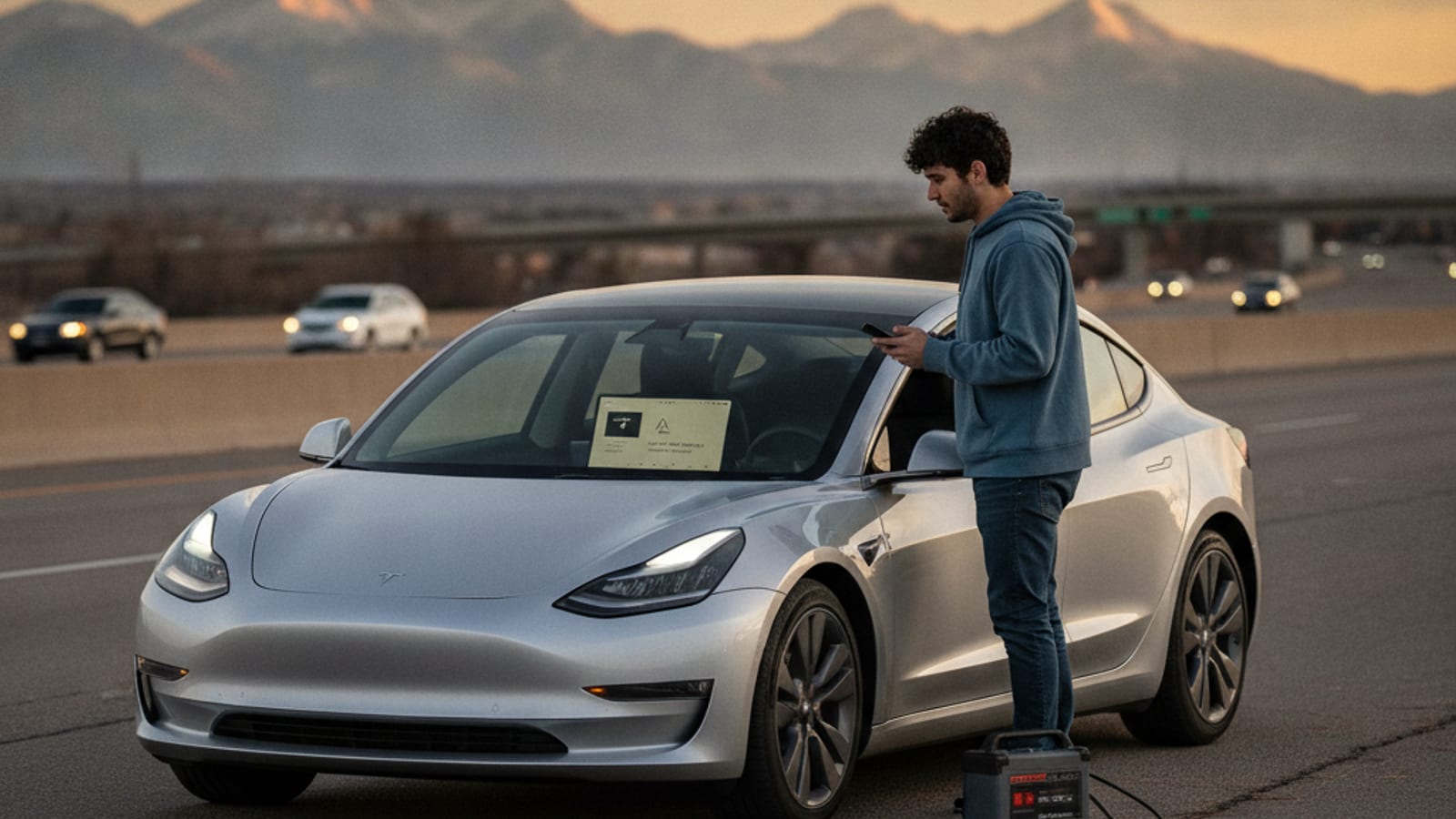
Tesla low voltage warning means the car’s 12-volt system is sagging, not that the traction pack is dead. Photograph the real Tesla message on the screen. Use that year’s owner’s manual for the specific battery location and jump procedure. Then call (720) 738-6950 if you want a local operator to handle the jump or a 12-volt replacement on site. You pay the operator directly. Charge Pro DEN is a referral line, and we don’t send a Charge Pro crew.
The 12-volt and the traction pack are two different batteries
Every modern Tesla runs two electrical systems. The big one is the high-voltage traction pack that drives the wheels. The small one is the 12-volt (or low-voltage) battery that powers computers, contactors, door handles, the infotainment screen, and the wake-up sequence. When the car looks completely dark, the traction pack can still hold hundreds of miles of range. The 12-volt is what failed.
A low voltage warning on the dash or in the Tesla app is the car’s way of telling you that small battery is sagging below its working range. The warning is not a verdict on the pack. It is a verdict on the 12-volt. Treating it as an empty pack leads to bad calls: flatbed to a Supercharger when a 12-volt jump would have woken the car on the spot.
The 12-volt still has to do real work in cold weather. It cycles the battery management system, runs the contactors that connect the high-voltage pack, and powers the heater for the pack itself when temperatures drop. A weak 12-volt gives up first in the cold, well before the pack is anywhere near empty.
Cold dwells are the usual trigger
Denver’s January normal low sits around 18 degrees, and the all-time record cold is minus 29 on January 9, 1875. The January 2024 arctic blast took Denver from 47 to minus 19 in about 48 hours. A car that sits outside through one of those stretches loses 12-volt capacity fast. A car that sits in an airport lot for a week loses 12-volt capacity even faster, because the car wakes periodically to check on the pack and to run thermal management.
Three patterns drive the low voltage warning here:
- A cold-soak in a Denver driveway or on the street. The 12-volt runs the BMS while you sleep, the heater cycles when it drops, and a marginal battery drains overnight. You come out to a dark car.
- A week in a DEN parking lot. Airport-adjacent lots are exposed, wind-scoured, and cold at 5,300 feet. A car left for a travel week often comes back with a dead 12-volt, sometimes with a pack that still shows plenty of range.
- A long dwell at work. Greenwood Village and the Denver Tech Center parking structures hold cars all day. A weak 12-volt plus a cold morning is enough to leave the car unable to wake.
In all three, the fix is the same: confirm the 12-volt is the problem, then jump or replace it on the spot.
Photograph the message before you do anything else
The Tesla screen shows a specific phrase for low voltage. It might say “Low voltage” or “12V battery needs service” or “Vehicle may not restart.” Whatever it says, take a photo with your phone. The exact wording matters because Tesla has changed the message text across model years and across software versions.
Three things the photo helps with:
- The Tesla app and the owner’s manual use specific language. The photo lets you match the message to the right section of the manual.
- Roadside help, if you call Tesla, will ask what the screen said. The photo saves a long back-and-forth.
- A local operator we refer can read the photo and bring the right 12-volt or the right jump pack for the model and year.
Do not clear the message until you have a photo. The Tesla screen rotates through warnings, and the next screen may be a different one.
Use that year’s owner’s manual
Tesla’s battery locations have changed. Newer Model 3 and Model Y cars use a lithium-ion low-voltage battery, and access is through the frunk under a plastic panel. Older Model S and Model X cars route the 12-volt through the front trunk area with different terminal access. The manual for your specific model and year shows the right sequence: where to lift, where the positive terminal sits, where the negative ground point is, and which order to connect and disconnect the cables.
Charge Pro DEN does not diagnose your car’s 12-volt as the cause. We refer operators who work on lots, driveways, and shoulders every week. The first job is the manual’s jump procedure; the second job is knowing which battery the manual calls out for that VIN. Don’t trust a generic how-to video for a different model year.
Tesla roadside is requested in the Tesla app
Tesla runs its own roadside program, requested through the Tesla app. Tesla’s program sends a third-party contractor. The contractor may bring a 12-volt jump pack, may bring a flatbed, or may bring nothing useful for a low-voltage warning at all. Out-of-range assistance may be available but is not financially covered.
Open the Tesla app while you still have phone battery. Request service. Note the confirmation number. Then decide whether to wait for Tesla’s contractor or to call (720) 738-6950 for a local operator.
What Tesla’s program does and does not include shifts by model year and by service tier. This page cannot confirm what your specific plan covers. Confirm in the app and in your account before you wait on a truck.
CDOT Safety Patrol will jump a 12-volt, not charge a pack
CDOT’s Safety Patrol covers listed Front Range segments, including I-25 South from 120th Ave to Arapahoe Rd, I-70 East from Wadsworth to Airport Blvd, and portions of US-6, C-470, and I-225. The I-70 Mountain Corridor is covered from Morrison to Vail. CDOT’s published menu is flat tires, jump-starts, emergency fuel, minor mechanical help, and debris removal. The Safety Patrol page and CDOT’s my-car-broke-down page mention nothing about electric vehicles, EV charging, or a charging-specific service.
A low voltage warning is the kind of call CDOT handles. The 12-volt is a battery. The Safety Patrol brings a jump pack. Pull to the right shoulder, turn on your hazards under CRS 42-4-230, and call for the patrol during its published hours.
Front Range metro hours run 6:00 to 9:30 a.m. and 2:30 to 7:00 p.m. weekdays, and 10:00 a.m. to 7:00 p.m. weekends. Mountain Corridor hours run 6:00 a.m. to 7:00 p.m. Friday through Sunday and during significant weather. Off-shift, the patrol won’t come.
Two things the patrol cannot do:
- Charge a traction pack. If the dash showed low range first, this is not the right call.
- Diagnose the 12-volt. The jump may finish the car, or it may not. A weak 12-volt that takes a jump and dies again the next morning is a replacement, not another boost.
What a local operator we refer actually does
Charge Pro DEN is a referral line for stranded drivers. We don’t own trucks, employ technicians, set prices, or promise arrival times. We match you with an independent local operator. The operator quotes you before any cable goes in. They bill you directly for the work they do.
For a low voltage warning, the operator’s job is one of three:
- Jump the 12-volt with a portable lithium pack. Tesla’s manual calls out the procedure for your model. The operator follows it. You pay the operator.
- Replace the 12-volt on the spot when the battery is dead enough that a jump won’t hold. Many modern Tesla 12-volts are lithium-ion and can be swapped in a driveway.
- Tow to a shop if the 12-volt has taken out a contactor or a control module. That’s a shop job, not a roadside job.
Operators we refer work on Tesla and every major EV brand. They bring NACS for Teslas, plus CCS and J1772 adapters for other cars. The cables and connectors are not the issue. The 12-volt is.
For the broader range of jump work on other EVs, see Tesla 12-volt battery jump. For a pack that is actually empty, the right call is out-of-charge recovery.
Why a low voltage warning is not the same as an empty pack
Drivers read any Tesla warning as “out of charge.” That conflates two systems. An empty pack shows up as miles-to-empty near zero. A low voltage warning shows up as the car refusing to wake, the screen flickering, or a low-voltage message.
Recurrent Auto studied more than 30,000 U.S. EVs in winter. At 32 degrees, EVs retained about 78 percent of max range on average. Cold alone rarely empties a pack that started the night with margin. Cold does kill a weak 12-volt. The pack is fine. The wake-up chain has no power.
A simple rule: if the gauge showed range before you parked and the car is now dark, suspect the 12-volt. If the gauge showed zero before you parked, suspect the pack. The fix is different for each.
What to do on a Denver shoulder when the warning appears
CRS 42-4-1202 makes it lawful to be stuck on the shoulder if the vehicle could not be moved further, with hazard lights on under CRS 42-4-230. A violation is a class B traffic infraction. Pull to the right shoulder, get out on the passenger side if you can, and stay visible.
Then:
- Photograph the dash message. Note the time and the outside temperature.
- Try a wake-up through the Tesla app. If the 12-volt has any life, the app’s climate or lock command can wake the car enough to drive.
- If the app won’t wake the car, call Tesla through the app. Note the confirmation.
- If you’re on a listed CDOT Safety Patrol segment and inside published hours, call for the patrol. They jump 12-volts. They do not charge packs.
- If you want a local operator to handle the jump or the 12-volt swap, dial (720) 738-6950. The operator we match quotes before work starts.
If the car is in a travel lane or another dangerous place, call 911 first.
What to do in a DEN parking lot when the warning appears
DEN is reached only by Peña Boulevard, which is city-maintained and exposed across the plains. The airport lots are large and the cars sit outside. A week in January can take a 12-volt from marginal to dead.
The lot is private property. The airport’s posted help number is the first call. After that, the same sequence as a shoulder: photograph the message, try the app, then call (720) 738-6950 for a local operator. The operator meets you at the car in the lot, jumps or replaces the 12-volt, and you drive away.
What the 12-volt replacement looks like
Current Tesla Model 3 and Model Y cars use a lithium-ion 12-volt. Access is through the frunk under a plastic panel. Older Model S and Model X cars route the 12-volt through the front trunk area with a different terminal layout. The manual for your specific year shows the path.
A lithium 12-volt behaves differently from a lead-acid one. It holds voltage until it suddenly doesn’t, then drops fast. A jump works the same way; a recharge rarely does. The replacement battery is a Tesla-spec part. A local operator we refer carries the right battery for the year and the model and quotes before the swap.
A Model S or Model X that has been parked for weeks on a Front Range driveway is a classic 12-volt stranding. The pack is full. The 12-volt is dead. The operator jumps or replaces, and you drive away.
How to prevent the next low voltage warning
Three habits that reduce the chance of the warning coming back:
- Drive the car at least every few days in the cold. A 12-volt recharges from the traction pack while you drive. A car that sits for a week loses 12-volt margin and pack margin at once.
- Keep the Tesla app active on your phone. The app issues commands that wake the car through the cellular modem.
- Replace a 12-volt that has had to be jumped once. A 12-volt that took a jump and held is at the end of its life. A 12-volt that took a jump and died again is past it.
For more on the underlying 12-volt split, see Tesla won’t start: seven checks before you call. For the broader cold-weather stranding picture, see Tesla low battery warning before you hit zero.
When a low voltage warning still means a tow
A 12-volt that takes out a contactor leaves the car unable to connect the high-voltage pack, even after a jump. That’s a tow to a shop, not a roadside fix. The tow itself is not our service. AAA, USAA, Geico, Uber roadside, and Tesla’s own contractor all handle flatbed tows. Confirm with whichever you hold.
CRS 42-4-1803 governs abandoned vehicles on officer discretion. There is no fixed clock. Don’t try to time a tow by an invented hour count. It doesn’t work that way in Colorado.
How to choose from a cold lot or a cold shoulder
If the warning came up after a cold-soak and the pack still shows range, start with the 12-volt. The fix is a jump or a swap, and a local operator we refer handles both on site.
If you’re on a listed CDOT Safety Patrol segment during published hours, that patrol will jump for free. Off-shift, the same jump costs whatever the operator quotes.
If the car is in a DEN lot, call the airport’s posted number first, then (720) 738-6950 for a local operator. For the broader metro-wide picture, read Tesla roadside app or phone: which should you use. For the cost side of those calls, read Tesla roadside: what is included and what is not.
Frequently asked questions
Is the Tesla low voltage warning the same as being out of charge?
No. The low voltage warning is the 12-volt system, not the traction pack. An out-of-charge pack shows up as miles-to-empty near zero. A low voltage warning shows up as the car refusing to wake, the screen flickering, or a low-voltage message. The fix is different.
Can a cold soak cause the warning even with range on the pack?
Yes. Cold draws down a marginal 12-volt faster than it draws down a healthy pack. A car that sat through a cold spell can show plenty of pack range and a dead 12-volt.
Will Tesla roadside send someone for a low voltage warning?
Tesla’s program is requested through the Tesla app and dispatches a contractor. This page cannot confirm what your specific plan covers. Confirm in the app before you wait.
Will CDOT Safety Patrol handle this call?
On a listed segment during published hours, yes. The Safety Patrol jumps 12-volts. It does not charge traction packs.
What does Charge Pro DEN actually do for this call?
Charge Pro DEN is a referral line. We match you with an independent local operator. The operator quotes before any work starts. You pay the operator directly. We don’t own trucks, employ technicians, set prices, or promise arrival times.