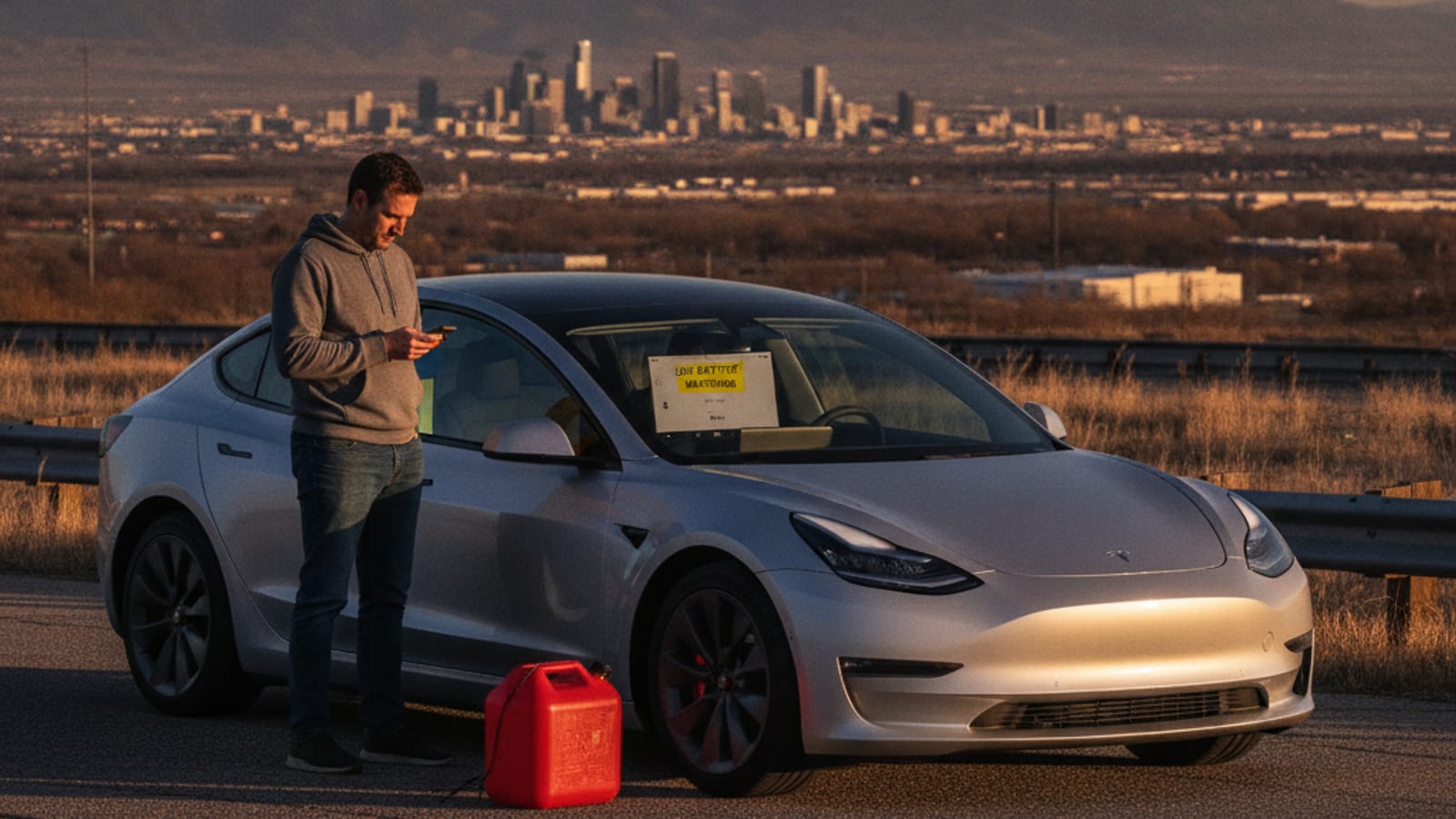
A Tesla low traction-battery warning is the car telling you to charge now, not when you get around to it. In the Denver metro, cold and grade eat range faster than the trip meter predicts, so treat the warning as the last comfortable stop. If you cannot reach a plug under your own power, the operators we refer can. Call (720) 738-6950 and we will match you with an independent local operator who quotes you before any cable goes in.
What the warning actually means
Tesla’s low traction-battery warning shows up at different state-of-charge numbers depending on the year and software, but the message is the same. The pack is low enough that the car wants you to stop and charge. If you see a turtle icon, range is reduced and power is limited. If you see “Battery very low” or a 0-mile estimate, you are at the edge of what the pack can do.
A low traction-battery warning is not the same as a 12-volt problem. The traction pack drives the wheels. The 12-volt runs the computers, contactors, lights, and locks. If the dash is dark and the car will not wake, that is usually the 12-volt. If the dash is up and the battery gauge is at the bottom, that is the traction pack.
Tesla asks drivers to request roadside in the Tesla app for a traction-pack emergency. Out-of-range assistance is a real policy but it is not a free, blanket benefit. Read your Tesla app for what is covered for your VIN and year. Charge Pro DEN is a separate path. We match you with an independent operator who brings a 240-volt Level 2 source to the bumper. You pay the operator directly for the work.
Cold eats range first
Cold cuts range before anything else does. Recurrent Auto studied more than 30,000 U.S. EVs across multiple winters. At 32 degrees, the average EV kept about 78 percent of its max range. At 20 degrees, about 70 percent. Best models held 88 percent at 32. Worst held 69. AAA’s 2026 dynamometer study showed about 39 percent range loss at 20 degrees with about a 35 percent efficiency loss.
Heat pumps help. A heat-pump Tesla holds about 10 points more range at 32 than a resistive-heater car. None of them hold 100 percent. Below about 15 degrees the battery management system wakes the car to run its own thermal management. That phantom drain is real and it is why a morning buffer can vanish on I-70 west of Golden before you have turned a wheel.
Denver’s January normal low sits near 18 degrees. The all-time record cold in Denver is minus 29, set January 9, 1875. In January 2024 the city swung from 47 to minus 19 in about 48 hours. None of that is a Tesla problem. It is a physics-of-lithium problem. Treat every cold morning as if 20 percent of your indicated range is going to disappear by the time you have driven 30 miles.
Then grade eats what cold left
Denver is at 5,280 feet. The foothills start west of Lakewood and Arvada. The climb up to the I-70 Mountain Corridor is real and sustained. Idaho Springs sits at 7,526 feet. The Eisenhower-Johnson Memorial Tunnel west portal is at 11,158 feet, the highest point on the entire U.S. Interstate system. Georgetown, between Idaho Springs and the tunnel, has no Supercharger in the current inventory. That makes Idaho Springs the last confirmed fast charge before the climb.
Cold plus grade plus heater is the worst combination for a Tesla. A heater running against sub-freezing air while the car climbs 3,600 feet in 30 miles will drain a margin that looked fine at the bottom. The car’s range estimate is honest about the recent past, but it is not a forecast. If you started cold-soaked and the car had been sitting on a frozen pack, the estimate is already optimistic.
The honest move at the warning: stop at the next working stall, even if it adds miles. A ten-minute plug is cheaper than a flatbed.
The descent gives it back
The good news is the other side of the mountain. Regenerative braking on a long descent returns a large share of the energy spent climbing. A widely cited InsideEVs analysis put regen return at roughly two-thirds. Corridor-specific tests back that up. A Lucid Air GT used about 3 percent of its pack over a 77-mile descent from Loveland Pass. A Hyundai Ioniq 5 used about 10 percent over 75 miles. Both tests credit regenerative braking.
If you top up in Idaho Springs, climb the tunnel, and run down toward Silverthorne, you arrive with more range than the trip meter mid-climb suggested. Drivers dial regen down on icy descents for traction, which trades some regen return for safety. A clean, dry descent in summer is the best case.
Foothills homes are the other range question
A second pattern lives in the foothills. Evergreen drivers commute down SH-74 to I-70 and the metro, then climb home in the dark and the cold. The climb from El Rancho up to Evergreen is well over 1,000 feet. The Aspen Park and Conifer run up US-285 is the same story at higher elevation. Aspen Park sits around 8,000 feet. The grade up Crow Hill plus a running heater eats a margin that looked fine on the plain.
If your evening commute starts with a low-traction-battery warning at the bottom of the hill, do not commit to the climb. Turn around, find a stall in the metro, and top up. A twenty-minute plug in Denver or Lakewood resets the night.
What to do when the warning hits
Turn the heater down. Heat is the largest cabin draw. Turn the seat heater on instead, which uses less pack energy and warms you faster. Slow down. Aerodynamic drag grows with the square of speed, so 65 instead of 75 is real range. Avoid aggressive acceleration. Lift off the accelerator early to let regen work on descents.
If you can reach a Supercharger or a Level 2 stall, stop there. Superchargers are dense across the metro. Confirmed stalls per the public inventory include Denver, Boulder, Lakewood, Thornton, Northglenn, Westminster, Arvada, Brighton, Longmont, Castle Rock, Centennial, Highlands Ranch, Lone Tree, and Idaho Springs. Use the in-car navigation to confirm availability before you roll.
If you cannot reach a plug under your own power, treat the warning as a tow-versus-charge decision. An empty pack often needs a Level 2 boost at the bumper, not a flatbed to a stall. A boost adds about 10 to 20 miles in 15 to 30 minutes of charging. That is enough range to reach a working stall under your own power. The operators we refer handle Tesla with a native NACS plug on the lead.
For the broader choice between charge in place and tow, read mobile charge or tow. For Tesla’s own coverage, confirm what your Tesla app actually provides before you request service.
The 12-volt still matters
A low traction-battery warning and a dead 12-volt can look similar from outside the car. If the traction gauge was already at the bottom and the car rolls to a stop, treat it as a pack problem. If the car sat through a cold night, was dark when you walked up, and the pack still shows range, treat it as a 12-volt problem.
Out-of-charge recovery is the service when the pack is the issue. A Tesla 12V jump is the service when the 12-volt is the issue. The operators we refer can do both at the bumper. They will quote you before they start work.
Stay safe on the shoulder
If the Tesla stops in a travel lane, put the hazards on and stay belted if traffic is moving past at speed. CRS 42-4-1202 is Colorado’s disabled-vehicle statute. Outside a business or residential district you may not stop on the paved main-traveled part of a highway, except a vehicle so disabled it cannot be moved off. Hazard lights must be on under CRS 42-4-230. Once you are off the travel lane and on the shoulder, exit from the passenger side if that is the safer choice.
CDOT Safety Patrol is free on listed metro segments. It covers I-25 South from 120th Avenue to Arapahoe Road, I-70 East from Wadsworth to Airport Boulevard, and portions of US-6, C-470, and I-225, with the I-70 Mountain Corridor covered from Morrison to Vail. The published menu is tires, jump-starts, fuel, debris, and minor mechanical help. The Safety Patrol page does not mention electric vehicles or charging. The free state truck will jump a 12-volt on a listed segment. It will not bring a charge to a dead traction pack. Skip the call when the pack was already at zero.
CDOT Safety Patrol hours are limited. Front Range metro weekday windows run 6:00 to 9:30 a.m. and 2:30 to 7:00 p.m. Weekend hours run 10:00 a.m. to 7:00 p.m. Mountain Corridor hours run 6:00 a.m. to 7:00 p.m. Friday through Sunday and during significant weather. Do not wait on a patrol that is off shift.
When to call for a Level 2 boost
Call when the car is otherwise fine, on a safe surface, and the pack is the reason it stopped. An operator brings a 240-volt Level 2 source. Tesla drivers get a native NACS plug on the lead. The clock starts when charging starts. Add about 10 to 20 miles in 15 to 30 minutes, then drive under your own power to a working stall.
Call when the car sits at the bottom of a climb with no shoulder ahead, the gauge is dropping, and there is no stall within the range you trust. The operators we refer can meet you at a safe pull-out, parking lot, or street and add enough to get you home.
Do not call when the car is in a travel lane with active traffic. Move to the shoulder first. If the car cannot roll, request a flatbed through Tesla roadside or a club, and ask for a Tesla-experienced operator.
How Charge Pro DEN works
Charge Pro DEN is a referral line for stranded EV drivers in the Denver metro. We do not own trucks. We do not employ technicians. We do not set prices. We do not promise arrival times. We do not publish hours. We match you with an independent local operator who quotes you before any cable goes in. You pay the operator directly for the work they do.
That operator brings a 240-volt Level 2 source, jumps a 12-volt when that is the job, and replaces a 12-volt on site when that is the job. They handle Tesla and every major EV brand. If your situation is a stuck charge port rather than a dead pack, ask the operator about the port before anyone hooks a winch. A stuck latch is a release job, not a tow.
For a broader look at who covers what, read Tesla roadside, CDOT patrol, or a local boost. That post stays on the call order. This post stays on the warning itself.
Frequently asked questions
Does a Tesla low battery warning mean I am stranded?
No. The warning is the car asking you to charge soon. If you can reach a working stall, drive there. If you cannot reach a stall under your own power, that is when you call for a boost. The operators we refer can add enough range at the bumper to get you to a stall.
How much range does cold actually cost?
Recurrent Auto found about 78 percent retention at 32 degrees and about 70 percent at 20 degrees across 30,000-plus U.S. EVs. AAA’s 2026 dynamometer study found about 39 percent range loss at 20 degrees. Heat-pump vehicles do about 10 points better at 32 than resistive-heater cars. Treat 20 percent as the planning haircut on a typical cold morning.
Can I make it from Denver to Idaho Springs on a low warning in winter?
It depends on starting pack, traffic, temperature, and whether you run the heater. Idaho Springs is the last confirmed Supercharger before the Eisenhower Tunnel, and it sits at 7,526 feet. A cold pack plus a running heater plus a crawl on ski weekends is the worst case. If you are at the warning before Golden, top up in the metro. If you arrive at Idaho Springs with margin, charge there. Georgetown has no Supercharger, so a low warning past Idaho Springs is a real problem.
Will regen save me on the descent?
A long descent returns a large share of the energy spent climbing. InsideEVs analysis put regen return at roughly two-thirds. A Lucid Air GT used about 3 percent of its pack over 77 miles descending Loveland Pass. Drivers dial regen down on icy descents for traction, which trades some return for safety. Plan for a partial return on a winter descent.
Does Tesla roadside bring a charge?
Tesla’s out-of-range assistance is a real policy. Confirm what is covered for your VIN and year in the Tesla app. Charge Pro DEN is a separate path. The operators we refer bring a 240-volt Level 2 source to the bumper. We quote you through the operator before any work starts.