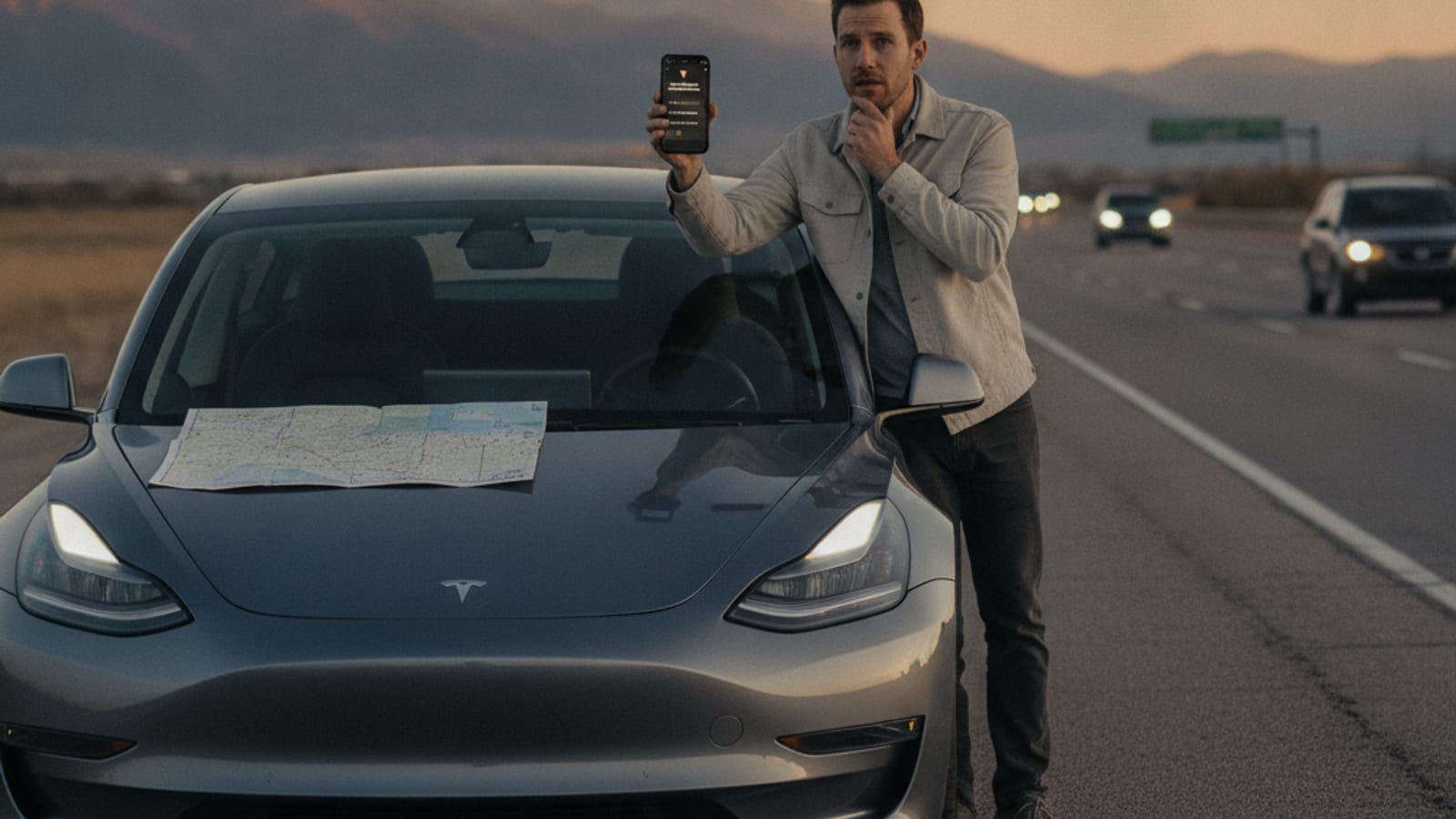
The Tesla app is the official place to start a Tesla roadside request. Use it when you have signal and the car can wake. When the car is dark in a parking lot, or you are between Idaho Springs and the Eisenhower Tunnel on a stretch with no bars, a phone call is the backup that still gets through. Colorado is a one-party consent state, so a recorded call with an operator is allowed without a heads-up. That is a small thing, but it matters when the call goes long. If neither path solves an empty pack, call (720) 738-6950 to reach Charge Pro DEN. The operators we refer roll a 240-volt Level 2 source to your bumper.
Where the Tesla app actually starts the request
Tesla roadside lives inside the Tesla app under Service, then Roadside. The app pulls the VIN, the car’s last reported location, and battery state. It walks through a short menu: out of charge, flat tire, lockout, tow. After you submit, Tesla routes the ticket to a contracted roadside provider. The provider calls the phone number on the Tesla account.
The app needs three things to work. It needs a live cell or Wi-Fi signal on your phone. It needs the car to have reported a recent location. It needs the Tesla account password to be fresh. A second device on the home Wi-Fi will not reach the car once the car is parked in a remote lot. A cold-soak can leave the car silent in Tesla’s eyes for days, and the location Tesla sees can be where it last woke, not where you are stranded.
Where a phone call still wins
A phone call to Tesla’s roadside line works in three situations where the app is the wrong tool.
The car is dark. If the 12-volt is dead, the Tesla cannot report its location, and the app may not load the right screen. A phone call lets you describe the car by VIN and last known address. Tesla will still dispatch, but they will dispatch to the address on file unless you give them a better one.
You are out of cell range. I-70 west of Idaho Springs, US-285 north of Aspen Park, US-40 up to Berthoud Pass, SH-103 up Mount Blue Sky, and the canyon roads around Evergreen and Kittredge all drop signal in patches. The Tesla app cannot submit a ticket with no bars. A phone call from a higher spot on the road, or from a friend in coverage, is the move.
You want a record on your phone. A live call gives you a human to ask follow-up questions of, and a callback number. The app sends the ticket into a queue with no read receipt. If your time matters, a call gives you a name and a hold time.
Colorado is one-party consent
Colorado recording law is CRS 18-9-303. One person on the call can record the conversation without telling the other party. That means a Tesla dispatcher, an insurance hotline, or a roadside operator can record a call with you, and you can record one with them. It also means Tesla may record a routine roadside call as part of its own service process. You do not need to ask, and they do not need to ask you. That is different from California’s two-party consent rule, which is why this matters if you moved here from the coast.
This rule is useful in one practical way. If you describe your car, your VIN, your last seen mile marker, and your credit card on the phone, that call can stand as your record. Take notes. Repeat the address back. Ask for a callback number if the line drops.
Cell signal in the canyon is the real limit
The Tesla app needs data. Phone calls need minutes but use far less signal. On a Front Range freeway shoulder that is the only difference between a ticket that submits and one that sits in the outbox.
I-70 from Idaho Springs west to the Eisenhower Tunnel climbs roughly 3,600 feet. The pull at the tunnel entrance, near the Georgetown exit, and along the Floyd Hill stretch between Idaho Springs and the US-6 interchange drops signal in patches. The Idaho Springs Supercharger is the last confirmed fast charge before the tunnel from this side. Georgetown in between shows no Supercharger in the current inventory. A driver who runs low between those two points is in the loneliest stretch on the metro corridor.
US-285 north of Aspen Park has long no-bar sections. SH-74 up Bear Creek Canyon from Morrison to Evergreen, and SH-103 up toward Mount Blue Sky, are the same. Berthoud Pass out of Empire is the worst of all in winter, with deep coverage gaps.
If you stall in one of those patches, two habits help. First, drive back downhill a quarter mile toward the last bar you had. The car will still roll. Second, text a friend with your location and have them call on your behalf.
What Tesla roadside covers, and what it does not
Tesla Roadside Assistance is a separate program from a warranty. It covers tows, flat tires, lockouts, and out-of-charge service for the model year covered by the policy. The published coverage is the same on the phone as in the app. Tesla sends a contracted provider. That provider may carry a small portable charger, or a flatbed, depending on the truck.
What Tesla does not promise on a Front Range shoulder is a Level 2 charge that adds 10 to 20 miles. Out-of-charge service may be a flatbed to the nearest Supercharger. That can leave you waiting on a public stall to add range, then driving your own car out.
A roadside jump for a dead 12-volt is covered when Tesla can confirm the failure. A 12-volt that has died after a week in a cold airport lot is a real call. The contracted provider may carry a jump pack. They may also swap the 12-volt on site, depending on the truck.
When the app and the phone both fall short
A few Denver-metro situations break both the app and the phone path.
The car is at zero with no signal. Between Idaho Springs and Georgetown on I-70 west, a Tesla that hits zero has no fast charge for miles. The Tesla app submits a ticket only when your phone has bars. A phone call placed from a higher spot on the road is the workaround. If neither gets through, the mobile EV charging referral brings a 240-volt Level 2 source to your bumper. The operators we refer quote you before any cable goes in. They bill you directly for the work they do.
The 12-volt is dead and the doors will not open. A frozen 12-volt on a Model 3 or Y can leave the car locked with no way to pop the hood. Tesla roadside handles this with a contracted provider that carries a 12-volt jump pack. The provider may also unlock the car with a 12-volt hot wire to the posts under the nosecone. This is a road call, not an app call.
The car is on the shoulder of a listed CDOT Safety Patrol segment. CDOT Safety Patrol runs on I-25 South from 120th Ave to Arapahoe Rd, I-70 East from Wadsworth to Airport Blvd, portions of US-6, C-470, and I-225, and I-70 Mountain Corridor from Morrison to Vail. Their published menu is tires, jumps, fuel, debris, and minor mechanical help. The Safety Patrol page and CDOT’s my-car-broke-down page both stay silent on EV charging. Front Range weekday hours are 6:00 to 9:30 a.m. and 2:30 to 7:00 p.m., with weekend hours from 10:00 a.m. to 7:00 p.m. Mountain Corridor hours run 6:00 a.m. to 7:00 p.m., Friday through Sunday and during significant weather. If you are on a listed segment during a published window, the free jump is for a dark 12-volt. Skip this call when the traction pack was already at zero.
The choice from a Denver-metro shoulder
Try the Tesla app first. It is the official path and Tesla’s records line up with it. If the app will not submit because of signal, walk back to the last bar and try again. If the car is dark and the app cannot find the VIN, switch to a phone call.
Use the Tesla roadside phone number backup if the line drops, you cannot reach the dispatcher, or you want a callback you can write down.
When neither the app nor the phone resolves an empty pack, call Charge Pro DEN at (720) 738-6950. We match you with an independent local operator who brings a 240-volt Level 2 source. Tesla drivers get a native NACS plug on the lead. Other EVs use a CCS or J1772 adapter. Typical charging time adds about 10 to 20 miles of range. The clock starts when charging starts, not before. We do not promise an arrival time and we do not set the price. The operator quotes you before any work begins.
A short checklist before you submit
Three things make either path cleaner. First, your VIN. It is on the dash and on the registration. Second, the last mile marker or cross street you saw with bars, not where you think you are. Third, your battery state as a percentage, not as a range number, because cold weather shrinks the range number without warning. CRS 42-4-1202 covers a disabled vehicle on a highway and lets you sit on the shoulder with hazards on while you sort the call. Hazards must be on under CRS 42-4-230.
Pull to the outside shoulder on an interstate. The I-25 North and US-36 Express Lanes were built with a minimum 8-foot outside shoulder for breakdowns. Stay in the car if the speed and sight distance make that the safer choice. Put on the flashers. Then submit, call, or both.
The one consent note worth knowing
Colorado is one-party consent for recording. If a Tesla dispatcher or a contracted provider records a call with you, that is legal without a heads-up. If you record a call with them, that is legal too. If you give the dispatcher your credit card on the phone and you want a paper trail, ask for the ticket number and the dispatcher name before you hang up. That is the only record the system will give you.
What to do next
If you can drive, drive to the nearest Supercharger. Confirm the stall count in your Tesla app or in the NREL inventory before you commit. Idaho Springs has 8 stalls. Castle Rock has 16. Highlands Ranch has 16. Centennial has 12. Lone Tree Park Meadows has 10.
If you cannot drive, pick the path that fits the moment. App with signal. Phone without. Free CDOT Safety Patrol jump on a listed segment during a published window. Local mobile Level 2 charge when neither Tesla nor CDOT can deliver one.
For the broader comparison between Tesla, AAA, and a local mobile charge, read AAA vs mobile EV charging when the pack is dead. That post stays on who covers which script. This one stays on the choice between the Tesla app and a phone call.
Charge Pro DEN is a referral line. We do not own trucks, and we do not employ technicians. We do not set prices for the visit. We match you with an independent local operator. The operator quotes you before any cable goes in. They bill you directly for the work they do. Treat (720) 738-6950 as a referral number, not a rolling promise.
Frequently asked questions
Should I use the Tesla app or call Tesla roadside?
Use the Tesla app first when you have signal and the car can wake. Use the Tesla roadside phone number when the car is dark, when you have no signal, or when you want a human on the line. Both paths route through Tesla’s contracted providers.
Does Tesla record my call?
Colorado is a one-party consent state under CRS 18-9-303. Tesla may record a routine roadside call without telling you. You may record one too. That is a different rule than California’s two-party consent.
What if I have no signal on I-70 between Idaho Springs and the tunnel?
Drive back downhill toward the last bar. Use a phone call from there, or text a friend with your location and have them submit on your behalf. If neither gets through, call Charge Pro DEN at (720) 738-6950 and the operators we refer will roll a 240-volt Level 2 source to your bumper.